
Origins: Florence, 1860
In 1860, Giovanni Panerai opened a workshop and watchmaking school on Ponte alle Grazie in Florence—the city’s first—offering both repairs and precise instruments. His grandson, Guido Panerai, expanded the business in the early 1900s, supplying the Italian Royal Navy (Regia Marina) with scientific tools. In 1916 Guido invented Radiomir, a radium-based luminous paste enclosed in sealed tubes, originally used to illuminate gun sights and depth gauges.

Radiomir: The Military-Watch Revolution
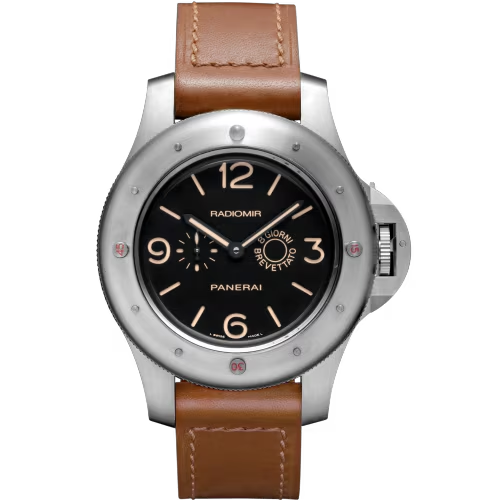
In 1936, Panerai developed the Radiomir wristwatch (Ref. 3646) for Italian Navy frogmen. Built on large stainless-steel cushion cases with wire lugs and Rolex/Cortébert-made hand-wound movements, it featured luminous matte dials that shone in low light—critical for underwater missions.
The oversized crown ensured gloved operation, while the water-resistant construction allowed stealth in harsh, saltwater environments. Production remained classified until after WWII, with only about 1,600 units made between 1935 and 1970, each assembled to meet strict naval specifications and never offered to the civilian market.
Crown Protection & Luminor Innovation
By the 1950s, awareness of radium’s dangers led Panerai to introduce Luminor, a safer tritium-based luminous compound, alongside its now-iconic crown-protecting bridge. The Luminor design, featuring a thicker, block-cut case and “sandwich” dial, cemented the brand’s bold aesthetic and functional DNA.
Egyptian Model & Ceiling of Secrecy
In 1956, Panerai released the oversized GPF-2/56 “Egyptian”, featuring a mammoth 60 mm case, rotating bezel, and 8-day Angelus movement—built specifically for the Egyptian Navy’s combat divers. It was an unapologetically utilitarian instrument, engineered for visibility and endurance under extreme conditions. However, by 1970,
Panerai ceased military production entirely, retreating into obscurity and remaining virtually unknown to the civilian market until its quiet reemergence in 1993.
Civilian Launch & Pop Culture Breakthrough
In September 1993, Post-military Panerai debuted its first commercial models: Luminor, Luminor Marina, and a smaller Mare Nostrum Chronograph—all faithful to the original tool-watch ethos. In 1996, Sylvester Stallone purchased a Luminor in Rome during filming of Daylight, sparking Hollywood buzz with custom “Slytech” editions. Stallone’s influence and Arnold Schwarzenegger’s endorsement propelled Panerai’s fame, especially in the U.S. .
Richemont Acquisition & Luxury Reinvention
In 1997, the Richemont (Vendôme) Group acquired Panerai. The brand introduced itself at SIHH 1998 with top-tier 44 mm Luminor and Luminor Marina models, as well as the reissued Mare Nostrum. ichemont understood the potential of Panerai’s oversized cases, bold typography, and naval backstory in an era hungry for distinctive mechanical watches.
What began as a niche curiosity for Italian watch enthusiasts was systematically shaped into a fully fledged luxury marque, capable of sitting alongside Richemont’s most established maisons while retaining the rugged DNA that made it cult in the first place. From then on, Panerai expanded globally, opening boutiques in Florence, Hong Kong, Bal Harbour, and beyond.
In-House Movements & Technical Prowess
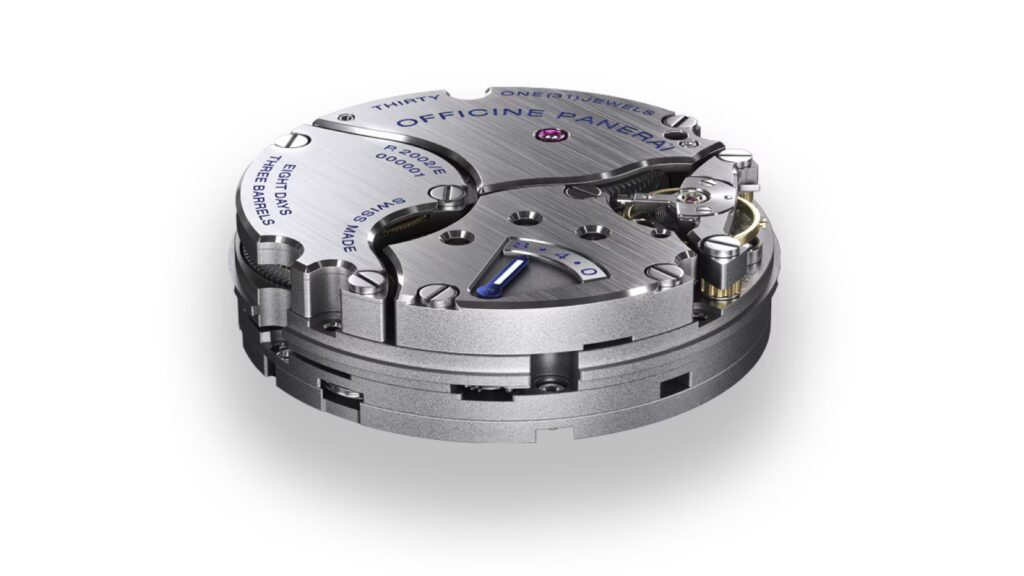
- 2005: Launch of first in-house P.2002 manual GMT calibre (8-day power reserve).
- 2007–2014: Introduction of calibres P.2003, P.2004, P.2005 (tourbillon), P.9000 series, P.4000 micro‑rotor, and high-tech materials like Bronzo, Carbotech™, and BMG‑TECH™.
- Complex creations: minute repeaters and 3D-printed titanium cases emerged between 2010–2018.
Modern Milestones & Brand Revival
- 2010: Release of L’Astronomo, Lo Scienziato and Jupiterium – high complications inspired by Galileo’s 400th anniversary.
- 2011–2012: Iconic Bronzo watch and historical Radiomir 47 mm remakes.
- 2017: Panther of materials—the Carbotech and BMG‑TECH Submersible models; official America’s Cup partnerships.
- 2018–2019: CEO transition, tourbillon GMT, L’Astronomo moon-phase; bold experiences in military and sailing environments.
- 2020–2022: Celebratory Luminor Marina 70th anniversary PAM01117, the Submersible QuarantaQuattro reintroducing.
- 2025: Modern refresh of Luminor Marina—thinner case (down ~12%), cleaner finish, lightened steel, Tritium X2 lume, and the introduction of Titano models.
Why Panerai Matters
Panerai matters because it bridges two worlds rarely joined so convincingly — uncompromising military tool-watch authenticity and unapologetic luxury presence. Before the marketing gloss, these were instruments designed for Italian Navy divers, built for absolute legibility, water resistance, and mechanical endurance.
That DNA remains visible today in the stark sandwich dials, oversized crown guards, and cavernous cases. In a landscape crowded with iterative design, Panerai carved a silhouette so unmistakable it can be recognized from across a room, a street, or even a dimly lit bar.
Its story — decades of military secrecy, sudden emergence in the ‘90s, and transformation under Richemont — offers one of modern horology’s most compelling arcs. Collectors value its purity of form, the tactile satisfaction of winding its long-reserve movements, and the quiet knowledge that, under the polish, Panerai’s roots are still in the dark, cold depths where a watch was a lifeline, not an accessory.
- Heritage rooted in function: Panerai began as a military-grade instrument maker, maintaining its bold, utilitarian aesthetic even in luxury form.
- Iconic design: Oversized cushion-shaped cases, crown guards, and sandwich dials remain instantly recognizable.
- Material innovation: From radium/gilded lume to high-tech Carbotech™ and metallic-glass, Panerai continuously pushes watchmaking boundaries.
- Cultural impact: Hollywood ambassadors like Stallone and Schwarzenegger helped cement its reputation as an “action‑hero” watch.
- Horological credibility: The development of in-house calibres and complex complications underscores its technical legitimacy in haute horlogerie.
Panerai Today
- Headquarters: Geneva, Switzerland; Manufacture: Neuchâtel, Switzerland.
- Market segments: Historic, Contemporary, Manifattura, and limited Special Editions (500–4,000 units) .
- Global outreach: More than 30 boutiques worldwide, with immersive factory tours to connect consumers to its craft.

The Panerai Identity: Where Design Embraces the Sea
Italian-designed, Swiss-engineered—Panerai has crafted a remarkable identity: rooted in Florence, honed by tactical needs, and refined with luxury ambition. Despite expanding complications and materials, Panerai still centers on legibility, durability, and the powerful narrative of exploration and adventure.
Whether you’re drawn to a vintage Radiomir echoing WWII frogmen, a modern Submersible in Carbotech™ built to brave the depths, or a sleek 2025 Luminor Marina embodying contemporary style—Panerai remains a compelling fusion of history, innovation, and Italian soul.
In summary, Panerai’s journey—from a Florentine workshop to Richemont prestige—is a masterclass in balancing heritage with horological progress. Its watches, both bold and technically capable, resonate with enthusiasts and professionals alike.
