
Panerai Luminor – The Lever, the Legend, the Long Shadow
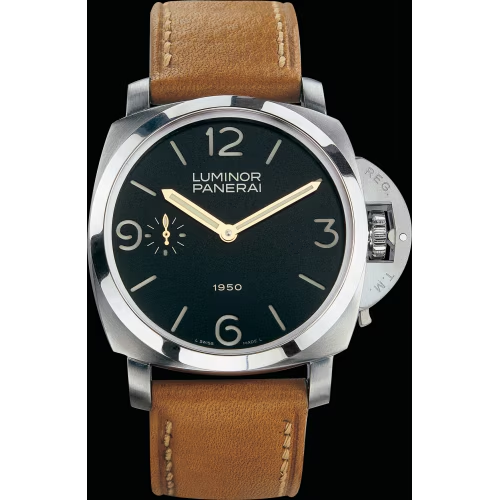
Panerai Luminor – Some watches inherit a legacy. Others rewrite it. The Panerai Luminor sits in between — a direct descendant of the Radiomir, yet distinct enough to build its own mythology. If the Radiomir is the purest form of Panerai’s wartime design language, the Luminor is the evolution that made the brand recognisable from across a room. That lever crown guard? It’s not a design flourish — it was born from necessity.
The 1949 Spark – From Radiomir to Luminor
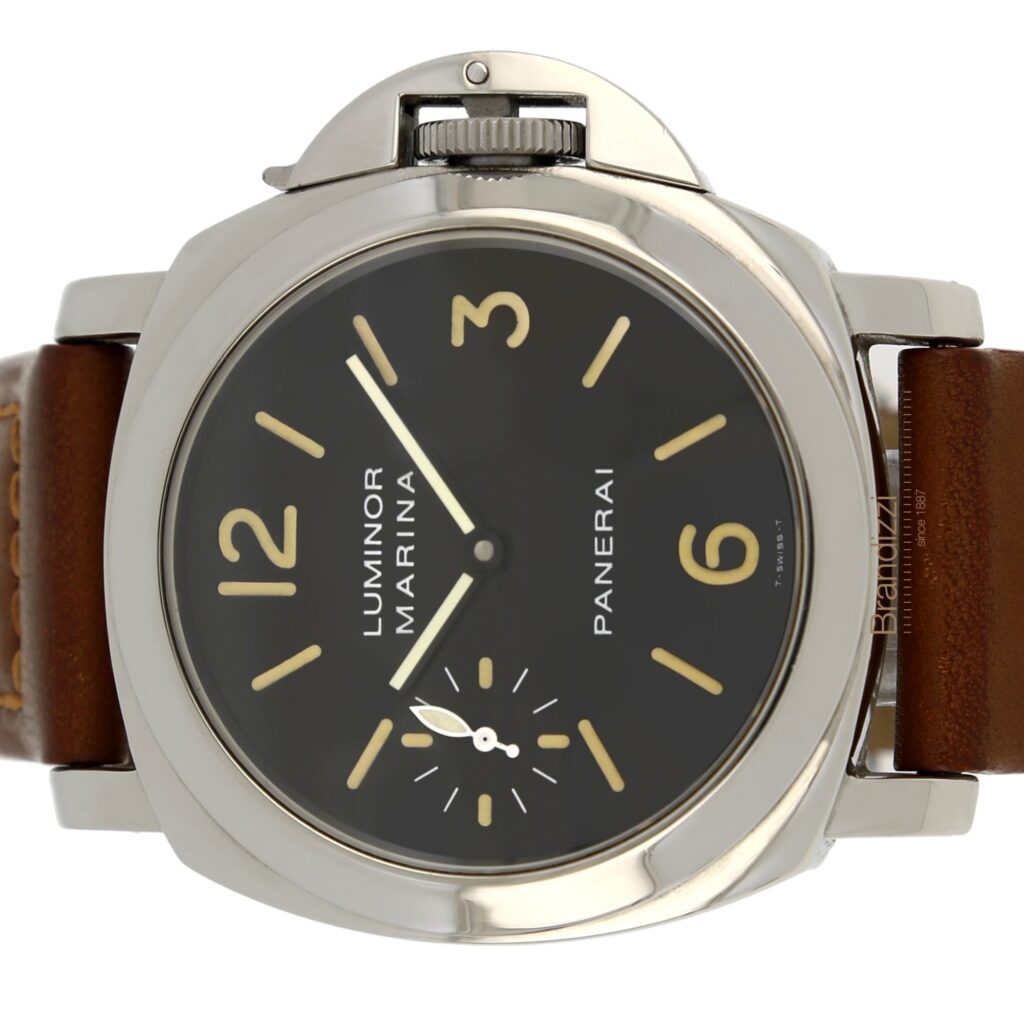
By the late 1940s, the Italian Navy was still issuing Radiomirs, but the world had changed. Radium lume — the radioactive miracle paint that gave the Radiomir its name — was a known health hazard. Panerai’s answer was a new luminescent material: Luminor, based on tritium. Still radioactive, yes, but far safer and easier to handle. It also gave the dial a slightly different hue — less fiery green, more a steady, chalky glow.
The switch to Luminor lume happened quietly in 1949, but the case design overhaul that followed made noise. The wire lugs of the Radiomir were replaced with robust, integrated lugs machined from the same block of steel as the case. Most importantly, Panerai patented a crown-protecting locking bridge in 1955 — the lever mechanism that remains the Panerai Luminor’s calling card.
This wasn’t about branding. The lever compressed a gasket inside the crown, dramatically improving water resistance and preventing accidental winding stem movement during dives. For military divers operating at unpredictable depths, it was insurance.
Military Service – 1950s to 1970s
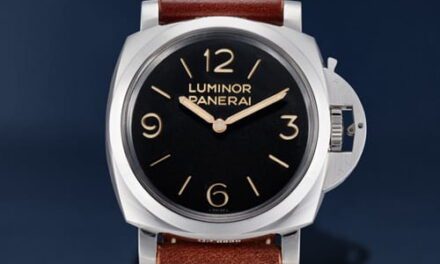
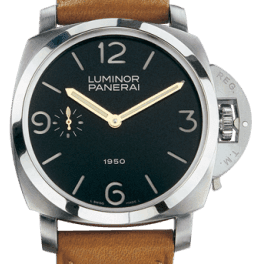
The early Panerai Luminor cases — now known as the “Luminor 1950” shape — were massive, 47 mm wide, with cushion profiles and wide-set lugs. These were not subtle. They were tool watches in the truest sense.
Movements of the era
- Rolex-supplied Cal. 618 carried over briefly from late Radiomirs.
- Angelus SF240 8-day hand-wound movement soon became the standard. Its twin barrels offered a practical advantage: fewer windings during extended missions. The gear train was straightforward — large brass wheels, a center wheel driving off the barrel, and a robust Swiss lever escapement. Finishing? Purely functional. Anglage and Geneva stripes weren’t in the vocabulary.
During these decades, Panerai watches were still issued exclusively to military divers — not just Italian Decima MAS, but also Egyptian, Israeli, and other special units. Dials often remained sterile, without branding, for operational secrecy.
The Quiet Fade – 1980s
By the 1980s, the world’s navies had moved on to more modern dive timers and, increasingly, electronic instruments. Panerai’s Luminor production dwindled to small, custom orders. The brand’s identity as a watchmaker was fading outside military circles.
Civilian Debut – 1993
The civilian world first met the Panerai Luminor in 1993 when Panerai released a small collection inspired by its military heritage. These early Luminor models (PAM00001, PAM00002) retained the crown guard, sandwich dials, and imposing cases, but were powered by modified Unitas 6497/6498 movements. These calibers, though humble, had gear trains strong enough to handle oversized hands and the torque demands of such a large dial.
The watches sold modestly — until a certain Hollywood star wore one in a blockbuster film. Sylvester Stallone’s connection to Panerai in the mid-1990s (and the resulting “Slytech” editions) turned the Luminor into a cult object.
Vendôme Era – 1997 to 2005
When the Richemont Group (then Vendôme) acquired Panerai in 1997, they understood the marketing power of the Luminor silhouette. The Luminor became the face of Panerai’s rebirth.
Key developments
- Case evolution – Still 44–47 mm, but improved machining, higher-grade steel, and better gaskets.
- Movements – ETA/Unitas-based calibers were decorated with Côtes de Genève, blued screws, and polished screw heads. Gear trains remained basic but now finished to luxury standards.
- Dial execution – Sandwich construction preserved, lume switched to modern non-radioactive pigments.
By the early 2000s, the Panerai Luminor 1950 case was reintroduced — thicker mid-case, domed crystal, historically accurate proportions.
In-House Era – 2005 to 2015
Panerai began rolling out its P-series in-house movements:
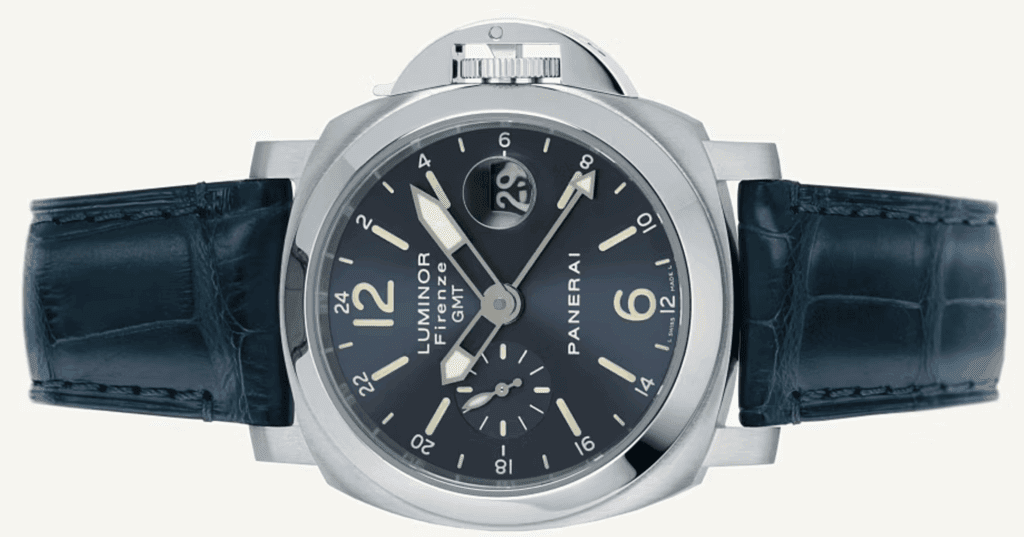
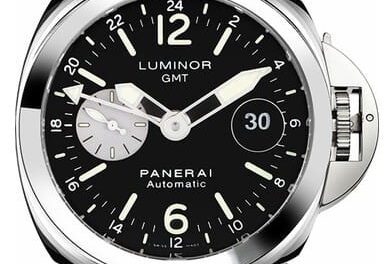
- P.2002 – 8-day, manual wind, GMT, linear power reserve indicator. The gear train used three series-coupled barrels, delivering steady torque. Free-sprung balance for improved regulation.
- P.9000 – Automatic, 3-day reserve, bidirectional rotor, double barrel. Compact and designed for the 44 mm Luminor cases.
- P.3000 – Manual, 3-day reserve, oversized bridges covering most of the gear train, large diameter balance for stability.
- P.5000 – Manual, 8-day reserve, twin barrel, long thin click spring for smoother winding feel.
Finishing stepped up: polished bevels, perlage on mainplates, sunray brushing on wheels, engraved text on bridges. Still industrial at heart — no hand-polished interior angles — but robust and clean.
Modern Complications – 2015 to 2025
The Luminor, firmly established as Panerai’s icon, became a platform for technical experimentation:
- Luminor Due – Slimmed-down cases (as little as 38 mm), sacrificing water resistance for dress-watch wearability.
- Luminor Marina Carbotech – Carbon-fiber composite cases, lighter and scratch-resistant.
- Luminor Submersible – Originally part of the Luminor line, now spun off as its own family. True dive-watch specs, rotating bezels.
- High complications – Equation of time, tourbillon GMTs, minute repeaters. Movements like the P.9100 (flyback chronograph) featured vertical clutch and column wheel systems, with gear trains optimized for minimal backlash.
By 2025, the Panerai Luminor line spans everything from faithful 1950-style 47 mm hand-winds to ultra-modern titanium automatic GMT chronographs. Super-LumiNova is standard — bright, crisp, and available in faux-patina shades for vintage effect.
Collector’s Takeaway
The Panerai Luminor is not just a Radiomir with a crown guard. It’s the moment Panerai moved from borrowed Rolex cases to a design entirely their own. From a collector’s standpoint:
- Military-issued Luminors (1950s–70s) are grail pieces — extremely rare, historically significant, and heavily faked.
- Pre-Vendôme civilian models (1993–1997) are rising fast in value, representing the bridge between military tool and luxury status symbol.
- Early Vendôme era (late 1990s–early 2000s) offers accessible entry points with solid Unitas calibers and faithful proportions.
- Modern in-house Luminors are technically impressive, but their appeal is split — some collectors find them over-engineered for a design born of simplicity.
If the Radiomir was made to disappear into the dark waters of La Spezia, the Luminor was made to survive the mission and be recognised when you got back. That crown guard is a statement, whether you’re diving in the Tyrrhenian Sea or ordering espresso in Florence.
And that’s the truth: once you’ve worn a Panerai Luminor, you understand that the lever isn’t just a gimmick. It’s a handshake with history — firm, unapologetic, and built to last.
| Era / Year | Radiomir (Visual Cues) | Luminor (Visual Cues) | Submersible (Visual Cues) |
|---|---|---|---|
| 1935–1938 | Tall wire lugs soldered to case, flat bezel, “sandwich” dial with cut numerals, long pencil hands, sub-seconds at 9, no branding. | — | — |
| 1938–1945 | Thicker wire lugs, some California dials (Roman + Arabic mix), warmer radium lume patina, deeper cushion case profile. | — | — |
| 1949–1955 | First tritium dials — lume less orange with age, integrated lugs start to appear. | Integrated lugs; crown-protecting lever absent pre-1955, appears after patent; lever is chunky, flat-tipped; sterile dials for military issue. | — |
| 1960s–1970s | Cases sometimes slightly smaller than wartime 47 mm; Angelus 8-day movements require flatter caseback profile. | Lever crown guard now fully squared-off at ends; Angelus 8-day gives no sub-seconds; long stick hands; matte black dials. | — |
| 1980s | Rare sightings; mostly aged tritium with heavy dial discoloration. | Very few exist; lever guards sometimes hand-finished with visible file marks. | — |
| 1993 | Vendôme-free reissues: wire lugs with screw ends, sapphire crystal, Unitas movement visible through back in some; bright white Luminova replacing tritium. | PAM00001, 00002 — flat dials, sausage lume (painted, not sandwich); no OP logo on early runs. | — |
| 1997–1999 | Vendôme-era: sharper lug cuts, thicker polished bezels, etched casebacks with OP logo. | Lever guard edges now more precise; dials deeper black, improved lume application. | PAM00024: Luminor case with rotating bezel, shallow knurling, smaller lume plots than later models; ETA/7750-P1 auto, no chronograph pushers. |
| 2000–2005 | Titanium Radiomirs appear (matte grey case), thicker sapphire domes; exhibition backs standard. | Luminor 1950 reissues — domed crystals, “Fiddy” cases; improved OP engraving on crown guard. | PAM00025 in titanium: darker case tone, brushed bezel; La Bomba PAM00087: extra-thick bezel teeth, helium escape valve on case side. |
| 2005–2010 | In-house calibers bring recessed power reserve on some; bridge engraving deeper, more refined. | P.2002 linear power reserve visible; P.3000 bridges fill case; balance bridge shapes become distinctive. | Still ETA/7750-P1: rotor with OP logo engraving; bezels get deeper engraving, more pronounced teeth. |
| 2010–2015 | P.5000 and P.3000 bridges cover nearly full movement; 3-screw balance bridge; blued screws appear. | Automatic P.9000 visible with twin-barrel layout; crown guard pin polished flush; lume plots larger on sandwich dials. | P.9000/P.9010 auto: thinner case, crown guard sits closer to mid-case; bezels now 60-click with firm action. |
| 2016–2018 | Aged “Brunito” finishes — irregular dark patches; faux-patina lume with cream tone. | Luminor Due — thinner mid-case, flat crystal, less water resistance; blue sunburst dials on some. | Carbotech: layered carbon grain visible, each unique; BMG-Tech: uniform metallic grey-blue sheen; dial text in high-contrast white. |
| 2019 | Otto Giorni distressed finish: heavy brushing plus artificial denting. | Luminor Marina 70th — green lume, blue dials, “70 Years” engraving. | Line breakaway: “SUBMERSIBLE” text prominent under 12; more aggressive bezel teeth; some models delete OP logo entirely. |
| 2020–2025 | Radiomir Quaranta — smaller, elegant proportions, short wire lugs, thinner bezel. | QuarantaQuattro — new case size with balanced proportions; Luminor Perpetuals with skeletonised calendar plates. | Brabus editions: skeleton bridges, off-centre micro-rotor visible; Bronzo patinates unevenly; Tourbillon GMT has deep-cut case flanks, sapphire both sides. |



Trackbacks/Pingbacks