
Quick Takeaways
- Panerai registered the name Luminor on 11 January 1949 for a luminescent material. The name started as a paint before it became a watch.
- The crown-protecting bridge was patented in 1956 and first appeared on the GPF 2/56, a 60mm watch with the Angelus SF 240 and an 8-day reserve.
- The tritium-based lume called Luminor replaced radium in the 1960s, which is when the material and the model name finally met.
- Panerai launched its first civilian collection on 10 September 1993 at La Spezia: the 44mm Luminor, the Luminor Marina and the 42mm Mare Nostrum chronograph.
- Richemont (previously Vendôme) bought Panerai on 18 March 1997, and in-house movements followed from 2005 with the P.2002.
Jump directly to the timeline.
Most people see the lever and think design. It is the first thing the eye lands on, that small bridge locked over the crown, and it is the reason a Luminor is recognised from across a room. Yet the Panerai Luminor history begins somewhere less glamorous: a trademark filed for a luminous compound, in January 1949.
The Radiomir came first, named for the radium paste on its dial. The Luminor took its name from the material that replaced it, then grew a case feature that became the face of the brand.
Between that trademark and the 44mm civilian watches of 1993 sit a patent, an Egyptian Navy deal, an 8-day Angelus movement and a 60mm case. This is the story of how the Luminor was born, and why the lever deserves most of the credit. We follow it from the first trademark through the military years to the 1993 launch at La Spezia. Where does the Luminor really begin?
What Is the Panerai Luminor?
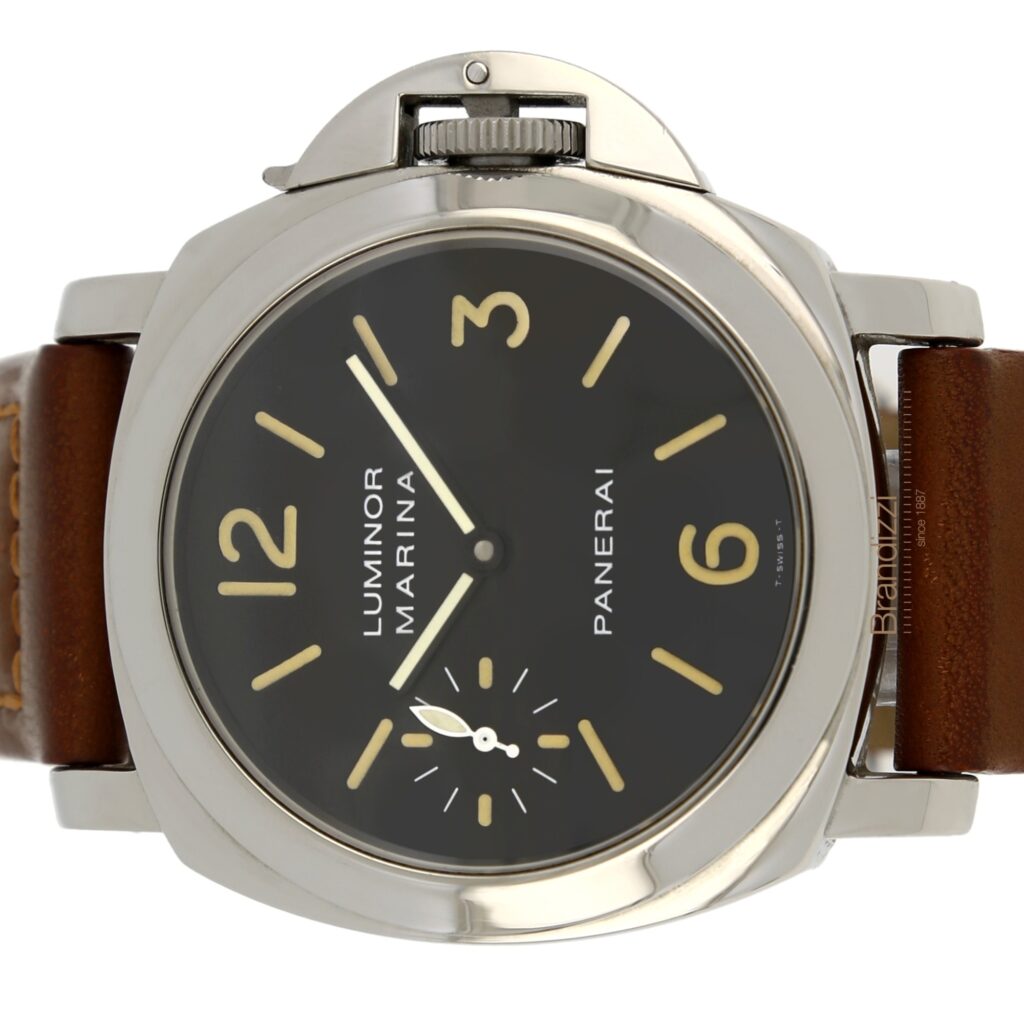
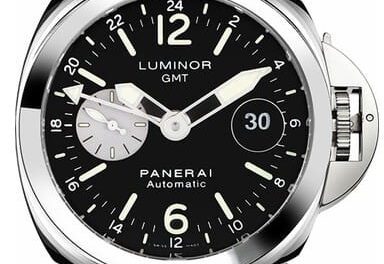
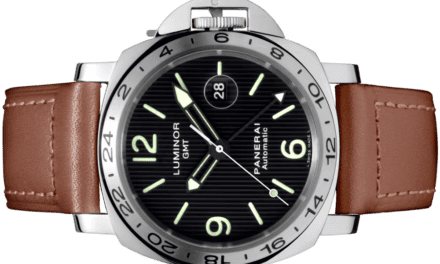
The Luminor is Panerai’s second great case family after the Radiomir. Where the Radiomir has a cushion case with wire lugs, the Luminor has lugs cut from the same block as the case and a crown protected by a bridge that closes over it.
The simplest way to separate them is the crown. A Radiomir has an exposed crown. A Luminor has the lever. Everything else, from the sandwich dial to the oversized proportions, is shared DNA.
The name needs a note of its own, because it has three meanings. It was a trademark in 1949, a luminous compound in the 1960s and a watch family afterwards. Collectors tend to merge the three, and the timeline gets confusing fast.
Panerai Luminor History: How Did It Begin in 1949?
On 11 January 1949, Panerai registered the name Luminor as a trademark for luminescent materials. That is the earliest date attached to the name, and it describes a product, not a watch.
The reason is practical. Radium paste, the original Radiomir lume, was radioactive. Panerai wanted something safer, and the replacement was a low-radiation, tritium-based compound. By the 1960s that compound had taken over from radium and carried the name Luminor.
So the first Luminor was a glow, not a case. The case came out of a different problem entirely.
Panerai Luminor History: Why Does It Have a Crown Guard?
This is the section that carries the whole story, so it runs long.
The crown is the weakest point of any dive watch. It is a hole in the case, with a stem running through it, and anything that bumps it can loosen it or wind the movement when you don’t want that. For a military diver working in the dark with gloves on, that was a real worry.
Panerai’s answer is the crown-protecting bridge, patented internationally by Guido Panerai & Figlio in 1956. Panerai itself describes it as:
“the element that most identifies a Panerai watch” Panerai, on the crown-protecting bridge
I’d go further and say it is the whole point of the model. Take the lever away and what remains is a Radiomir in a different case. Put it back and you have a watch that looks like nothing else on a dive boat.
What does the lever do?
It sits over the crown and locks it against the case, shielding it from knocks and accidental turning. In practice you flip it open to wind or set the watch, then close it again.
Where did it first appear?
The first watch with the bridge was the GPF 2/56, built in 1956. It was a 60mm watch powered by the Swiss-made Angelus SF 240, with an 8-day power reserve. It went to the Egyptian Navy with the consent of the Italian Navy, which is how it picked up the nickname Egiziano.
Sixty millimetres. Read that again. The watch that introduced the most recognisable feature of the brand was enormous even by Panerai standards, and its eight-day movement meant long stretches between windings.
What happened before the GPF 2/56?
In 1954, Panerai tested the references 6152 and 6154. After the tests, it produced the definitive 6152/1, with reinforced lugs cut from the same block as the case. This is the other half of the Luminor identity: lugs that are part of the case instead of wire soldered on. Together with the lever, it explains why the Luminor looks heavier and more compact than the Radiomir.
Why does the sandwich dial matter?
The Luminor inherited the sandwich dial construction that defines Panerai: a top layer with cut-out numerals and markers, with luminous material behind it. The lume was the point of the whole system. Once the radium paste gave way to the tritium compound of the 1960s, the Luminor name described both the case family and the glow inside it.
I find that overlap oddly satisfying. The material and the model share a name because they were developed for the same job: being read in the dark, underwater, by someone who could not afford to misread it.
What Happened to the Luminor in the 1970s?
In 1972 Giuseppe Panerai died, Dino Zei became CEO and the company was renamed Officine Panerai Srl. The Luminor’s next big chapter would not come until the 1990s, when it moved from specialist tool to product.
Panerai Luminor History: When Did It Go Civilian in 1993?
On 10 September 1993, Panerai presented its first civilian collection at the military harbour of La Spezia. It offered three models from ten references, in numbered and limited editions:
- the 44mm Luminor
- the 44mm Luminor Marina
- the 42mm Mare Nostrum chronograph
The 44mm size is worth noticing next to the 60mm GPF 2/56. The lever, the integral lugs and the sandwich dial all carried over.
The launch started slowly. What changed it was Hollywood: Sylvester Stallone wore a Luminor, the 5218-201/A, in the 1996 film Daylight, and the brand began to reach people who had never heard of the Italian Navy. A writeup of Panerai’s modern story tells that part well.
If you want to see how a watch from this period looks today, the Pre-Vendôme 5218-202a is a good place to start.
How Did Vendôme and Richemont Change the Luminor?
On 18 March 1997, the Richemont Group, previously the Vendôme Group, acquired Officine Panerai S.p.A. That date splits Panerai collecting in two: pre-Vendôme and post-Vendôme, and Paneristi use the label every day.
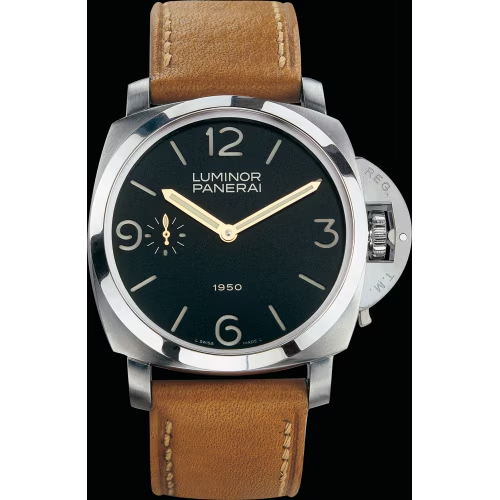
From here the Luminor stops being a cult object and becomes the core of a collection. Its descendants run from the 47mm hand-wound Luminor 1950 line, such as the Luminor 1950 3 Days PAM00372, to the modern ranges.
The Submersible also grew out of the Luminor family before becoming a dive-watch line of its own.
When Did the Luminor Get In-House Movements?
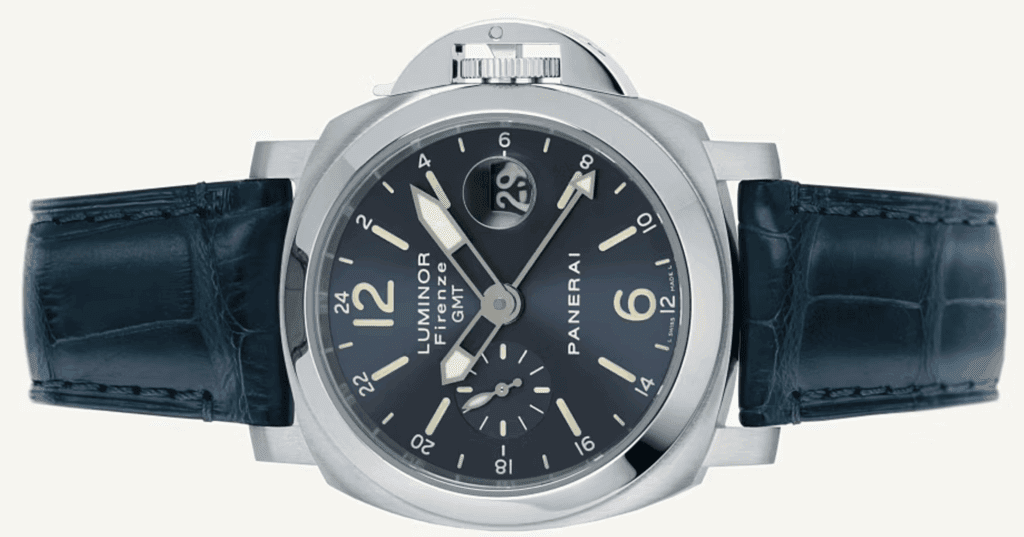
Before 2005, Panerai’s movements came from third parties such as Rolex and Angelus. From 2005 it built its own, starting with the P.2002: hand-wound, GMT and 8-day.
The timeline from there is short:
- 2008: the P.9000, a 3-day automatic used in Luminor and Radiomir
- 2011: the P.3000, a 3-day hand-wound
- 2013: the P.5000, an 8-day hand-wound, and the P.9100 chronograph
The P.9100 is a good example of how far the Luminor has travelled. It is a flyback chronograph with a column wheel and a vertical clutch, 3 days of reserve from two barrels, 37 jewels and 302 components. The family of 8-day and GMT movements around the P.2003 tells the rest of that story. The P.9100 is a long way from an Angelus SF 240.
Where Is the Luminor Today?
The Luminor Marina continues today in 44mm cases made from materials the 1949 trademark could not have imagined. In 2020, for the 70th anniversary of the international patent filing, Panerai released the Luminor Marina in DMLS titanium, Carbotech and Fibratech (PAM01117, PAM01118 and PAM01119).
The shape has not changed. The lever is still there, and so are the integral lugs that arrived with the 6152/1. Seventy years after the first trademark, the two ideas that define the Luminor remain the two things you see first.
Who Is It For?
- The collector who wants to understand where the Luminor came from before buying one
- Someone comparing Radiomir and Luminor and wanting the real difference
- A Paneristi who cares about dates, patents and references more than marketing
- Readers who love heritage that is documented, not romanticised
Not for: buyers looking for a specific reference review; anyone who wants current prices or market values.
Conclusion
The Luminor began as a trademark, became a lume, and then became the watch that the lever defined. The 1956 patent turned a case family into an identity, and the 1993 launch carried that identity out of the navy and into the world.
Is the story still relevant? I’d say yes, because every Luminor you see today, from a 44mm Marina to a Fibratech limited edition, still carries the lever that was designed for a diver in the dark. The shape has outlived the mission.
Which chapter of the Luminor story do you find most compelling: the 1956 lever, the 1993 launch or the in-house movements? Tell me in the comments.
Extended Summary
- The name Luminor was registered on 11 January 1949 as a trademark for luminescent materials, and became a tritium-based lume in the 1960s.
- The crown-protecting bridge was patented in 1956 and first appeared on the 60mm GPF 2/56, powered by the 8-day Angelus SF 240.
- The 6152/1 gave the Luminor its integral lugs, cut from the same block as the case.
- The first civilian collection arrived on 10 September 1993 with the 44mm Luminor, the Luminor Marina and the 42mm Mare Nostrum, and Stallone’s Daylight watch brought it wider attention in 1996.
- Richemont acquired Panerai in 1997, and in-house movements started in 2005 with the P.2002.
At a Glance
| Year | Milestone |
|---|---|
| 1949 | “Luminor” registered as a trademark for luminescent materials (11 January) |
| 1954 | References 6152 and 6154 tested; definitive 6152/1 follows with lugs cut from the case block |
| 1956 | GPF 2/56: 60mm, Angelus SF 240 (8-day), crown-protecting bridge patented |
| 1960s | Radium paste replaced by a low-radiation tritium compound named Luminor |
| 1972 | Giuseppe Panerai dies; Dino Zei becomes CEO; company becomes Officine Panerai Srl |
| 1993 | First civilian collection at La Spezia (10 September): 44mm Luminor, Luminor Marina, 42mm Mare Nostrum |
| 1996 | Stallone wears the 5218-201/A in Daylight |
| 1997 | Richemont (previously Vendôme) acquires Panerai (18 March) |
| 2005 | P.2002, Panerai’s first in-house movement |
| 2008 to 2013 | P.9000 (2008), P.3000 (2011), P.5000 and P.9100 (2013) |
| 2020 | Luminor Marina 44mm in titanium, Carbotech and Fibratech (PAM01117, PAM01118, PAM01119) |




Trackbacks/Pingbacks