
Panerai Submersible – From Luminor’s Depths to Its Own Waters
Panerai Submersible – Some Panerais were born in the dark. The Submersible was born in the deep. It didn’t arrive with the wartime pedigree of the Radiomir or the Luminor — instead, it emerged decades later, not from necessity but from the realisation that the modern diver’s watch was a battlefield in its own right. By the time the Panerai Submersible appeared, the market already had its Seamasters, its Submariners, its Sea-Dwellers. Panerai’s move into this territory was less about survival and more about identity: if they were going to build a “true” diver, it would look like no one else’s.
Genesis – The Luminor Submersible, 1998
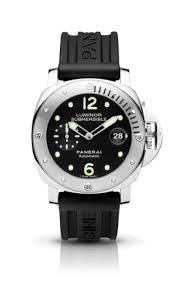
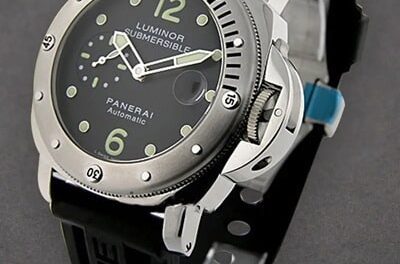
Before the Panerai Submersible had its own name, it was a variant of the Luminor. The first civilian version appeared in 1998 as the Luminor Submersible PAM00024 — a 44 mm cushion-case Luminor with a unidirectional rotating bezel, 300 m water resistance, and a robust ETA 7750-P1 automatic movement (minus the chronograph module).
The bezel was the defining feature. Inspired loosely by the one-off Panerai reference 6152/1 supplied to the Egyptian Navy in the 1950s, it had chunky five-minute markers and a pronounced coin-edge grip. This was Panerai signalling that they could play by ISO 6425’s rules — elapsed-time bezels, legible lume, over-engineered seals — without abandoning their design DNA.
The crown-guard lever stayed, tying it visually to the Luminor family. Movements in the earliest Submersibles were utilitarian — gear trains built for torque, large reverser wheels for winding efficiency, 28,800 vph beat rates for stable timing under shock. Decoration was minimal.
From Variant to Identity – Early 2000s
The Panerai Submersible line expanded quickly in the early 2000s:
- PAM00025 – Titanium case, black dial, lighter on the wrist but still 44 mm.
- PAM00087 – The now-legendary “La Bomba” — 1000 m water resistance, helium escape valve, thick sapphire crystal like an aquarium wall.
These early heavy-depth models introduced more serious engineering. Cases were thicker, casebacks reinforced, and gaskets doubled. The crown-guard lever’s compression was critical to meeting depth ratings — in fact, Panerai testing showed the lever kept seal integrity beyond the ISO minimums.
Inside, the ETA/Valjoux 7750-P1 remained the workhorse — the same tough gear train, cam-operated winding system, and large balance wheel designed to shrug off shock and pressure.
The In-House Shift – 2010 to 2015
The in-house era reshaped the Panerai Submersible. Starting around 2010, the ETA base movements gave way to proprietary calibers:
- P.9000 – Automatic, twin-barrel, 3-day reserve, free-sprung balance. Gear train laid out under broad bridges, with bidirectional winding for efficiency.
- P.9010 – Slimmed-down evolution of the P.9000, same reserve, more compact height to allow thinner cases without sacrificing depth rating.
- P.9100 – Flyback chronograph version, vertical clutch for smooth engagement, column wheel control. Gear train adjusted to handle chronograph torque without amplitude drop.
This was also when the Panerai Submersible began to visually differentiate itself from the Luminor beyond just the bezel. Cases became chunkier, bezels more pronounced, and the dial layouts leaned more into professional-tool cues — oversized applied markers, seconds at 9, date at 3, bolder handset.
Breaking Away – Submersible as Its Own Line, 2019
For two decades, the Submersible sat in the Luminor catalog. In 2019, Panerai formally broke it out into its own family. This was more than marketing — it allowed the Submersible to stretch its design legs without being tied to the Luminor Marina’s proportions.
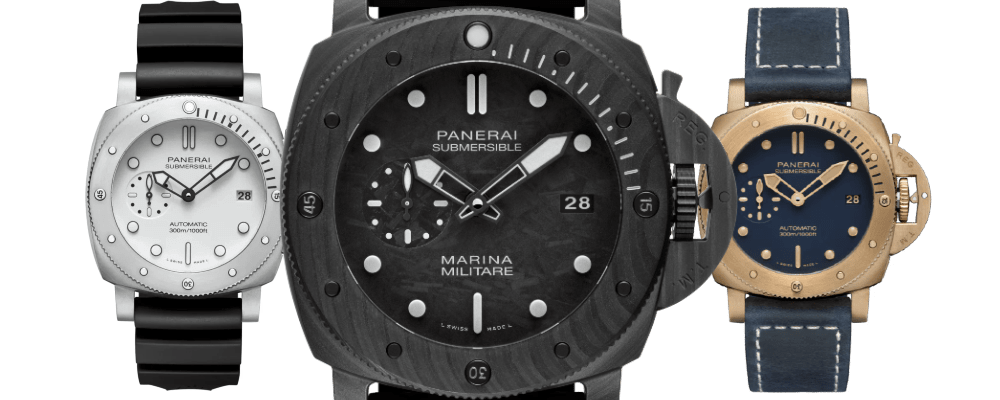
This period also saw the introduction of BMG-Tech (bulk metallic glass) cases — harder than titanium, corrosion-proof, and with a subtle grey-blue sheen. Carbotech carbon-fiber composite returned for ultra-light models. Dials explored gradients, textured surfaces (the “shark skin” pattern on some editions), and high-contrast lume.
Modern Engineering – 2020 to 2025
By the 2025 catalog, the Submersible has become Panerai’s most technically diverse line. Highlights include:
- Submersible QuarantaQuattro – 44 mm steel or eSteel cases (recycled steel alloy), P.900 automatic, 300 m rating.
- Submersible 47 mm Bronzo – Bronze case that patinates with use, P.9010 movement.
- Submersible S Brabus Editions – Skeletonized P.4001/S micro-rotor automatic GMT, 3-day reserve, tungsten rotor, off-center winding mass for thinner profile. Gear train visible through skeletonized bridges, finished with brushed surfaces and polished bevels.
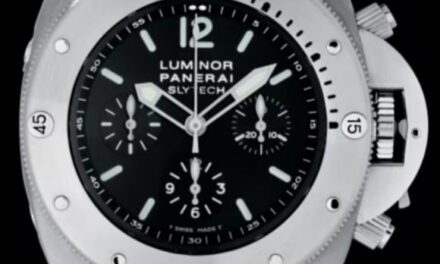
- Submersible Chrono Flyback – P.9100, vertical clutch, twin barrels, rugged column wheel.
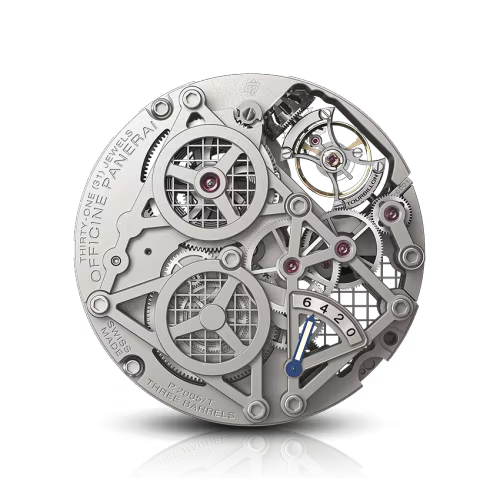
- Submersible EcoPangaea Tourbillon GMT – P.2005/T, titanium tourbillon cage rotating every 30 seconds, triple-barrel 6-day reserve, gear train architecture optimised for shock resistance even with the tourbillon’s complexity.
Water resistance remains between 300 m and 1000 m depending on model, with ISO-compliant testing. Bezel actions are firm, precise 60-click unidirectional mechanisms with minimal back-play — a notable upgrade over early 2000s examples.
Movement Architecture Across Eras
- ETA/Valjoux Era (1998–2010) – Gear trains were built for resilience, not aesthetics: large pivots, minimal jewel count where unnecessary, rhodium-plated bridges.
- In-House P.9000 Family (2010–Present) – Twin-barrel series-coupled layout ensures torque stability over full reserve. Free-sprung Glucydur balance, full balance bridge for shock resistance. Rotor bearings upgraded to ball-bearing units for longevity.
- High Complication P.2005/T – Horizontal gear train feeding the tourbillon carriage, lightweight titanium cage to minimize energy loss, constant-force delivery aided by triple barrels.
Collector’s Takeaway
The Panerai Submersible will never have the wartime mythology of the Radiomir or the Luminor — and that’s fine. It doesn’t need it. It’s the watch that proves Panerai can make a contemporary ISO-rated diver without looking like anyone else.
From a collector’s perspective:
- Early Luminor Submersibles (PAM00024, PAM00025) are increasingly desirable — they bridge the gap between heritage Panerai and modern pro-diver.
- La Bomba PAM00087 is already a cult classic, its 1000 m rating making it one of the most overbuilt Panerais ever.
- In-house era models offer better long-term serviceability within Panerai’s network and technical refinements across the board.
- Limited-edition materials (Bronzo, BMG-Tech, Carbotech) bring collectability but also polarize tastes — patina lovers vs. those who prefer their watch frozen in time.
If the Radiomir whispers its history and the Luminor wears its lever like a badge, the Panerai Submersible simply gets on with the job — silently, at depth, with a bezel click that’s as crisp at 30 bar as it is on your desk. And for a modern tool watch, that’s all the heritage it needs.
| Era / Year | Radiomir (Visual Cues) | Luminor (Visual Cues) | Submersible (Visual Cues) |
|---|---|---|---|
| 1935–1938 | Tall wire lugs soldered to case, flat bezel, “sandwich” dial with cut numerals, long pencil hands, sub-seconds at 9, no branding. | — | — |
| 1938–1945 | Thicker wire lugs, some California dials (Roman + Arabic mix), warmer radium lume patina, deeper cushion case profile. | — | — |
| 1949–1955 | First tritium dials — lume less orange with age, integrated lugs start to appear. | Integrated lugs; crown-protecting lever absent pre-1955, appears after patent; lever is chunky, flat-tipped; sterile dials for military issue. | — |
| 1960s–1970s | Cases sometimes slightly smaller than wartime 47 mm; Angelus 8-day movements require flatter caseback profile. | Lever crown guard now fully squared-off at ends; Angelus 8-day gives no sub-seconds; long stick hands; matte black dials. | — |
| 1980s | Rare sightings; mostly aged tritium with heavy dial discoloration. | Very few exist; lever guards sometimes hand-finished with visible file marks. | — |
| 1993 | Vendôme-free reissues: wire lugs with screw ends, sapphire crystal, Unitas movement visible through back in some; bright white Luminova replacing tritium. | PAM00001, 00002 — flat dials, sausage lume (painted, not sandwich); no OP logo on early runs. | — |
| 1997–1999 | Vendôme-era: sharper lug cuts, thicker polished bezels, etched casebacks with OP logo. | Lever guard edges now more precise; dials deeper black, improved lume application. | PAM00024: Luminor case with rotating bezel, shallow knurling, smaller lume plots than later models; ETA/7750-P1 auto, no chronograph pushers. |
| 2000–2005 | Titanium Radiomirs appear (matte grey case), thicker sapphire domes; exhibition backs standard. | Luminor 1950 reissues — domed crystals, “Fiddy” cases; improved OP engraving on crown guard. | PAM00025 in titanium: darker case tone, brushed bezel; La Bomba PAM00087: extra-thick bezel teeth, helium escape valve on case side. |
| 2005–2010 | In-house calibers bring recessed power reserve on some; bridge engraving deeper, more refined. | P.2002 linear power reserve visible; P.3000 bridges fill case; balance bridge shapes become distinctive. | Still ETA/7750-P1: rotor with OP logo engraving; bezels get deeper engraving, more pronounced teeth. |
| 2010–2015 | P.5000 and P.3000 bridges cover nearly full movement; 3-screw balance bridge; blued screws appear. | Automatic P.9000 visible with twin-barrel layout; crown guard pin polished flush; lume plots larger on sandwich dials. | P.9000/P.9010 auto: thinner case, crown guard sits closer to mid-case; bezels now 60-click with firm action. |
| 2016–2018 | Aged “Brunito” finishes — irregular dark patches; faux-patina lume with cream tone. | Luminor Due — thinner mid-case, flat crystal, less water resistance; blue sunburst dials on some. | Carbotech: layered carbon grain visible, each unique; BMG-Tech: uniform metallic grey-blue sheen; dial text in high-contrast white. |
| 2019 | Otto Giorni distressed finish: heavy brushing plus artificial denting. | Luminor Marina 70th — green lume, blue dials, “70 Years” engraving. | Line breakaway: “SUBMERSIBLE” text prominent under 12; more aggressive bezel teeth; some models delete OP logo entirely. |
| 2020–2025 | Radiomir Quaranta — smaller, elegant proportions, short wire lugs, thinner bezel. | QuarantaQuattro — new case size with balanced proportions; Luminor Perpetuals with skeletonised calendar plates. | Brabus editions: skeleton bridges, off-centre micro-rotor visible; Bronzo patinates unevenly; Tourbillon GMT has deep-cut case flanks, sapphire both sides. |




Trackbacks/Pingbacks