Quick Takeaways
- The Radiomir PAM00323 is a 47mm Radiomir in polished stainless steel housing the P.2003/6 calibre, Panerai’s first fully automatic in-house movement, with a 10-day power reserve, GMT function, circular power reserve indicator, date, and day/night display
- Only 400 pieces were made, introduced in 2010, making this one of the most mechanically ambitious and numerically scarce Radiomir references of the in-house era
- The P.2003/6 is exclusive to this reference, no other Panerai ever carried it. If you want this movement, you buy this watch.
- The three spring barrels in series are not a marketing stunt. They deliver a genuinely flat torque curve across the full 10-day cycle, meaning the watch keeps rate on day nine almost as well as day one
- Secondary market pricing currently sits around $10,000–$14,500 on Chrono24. Steep but defensible for an exclusive calibre, a 400-piece run, and a complication stack you won’t find in any other Radiomir case
Jump directly to the spec sheet.
Introduction
There’s a version of Panerai that most people know: big case, lever crown guard, sandwich dial, hand-wound Unitas or ETA under the hood. That version is honest and often beautiful, but it’s not a watch that asks anything technical from the brand. For years, critics were right to note that Panerai’s visual identity was doing more work than its movements.
The P.2000 series changed that. When Panerai unveiled their first fully in-house automatic calibre, the P.2003, at the Neuchâtel manufacture in 2005, it was the brand’s loudest possible answer to anyone who had ever called them an oversized case with a bought movement. Three spring barrels. Ten days of reserve. GMT. Seconds reset. And it was automatic, which the hand-wound P.2002 that preceded it wasn’t.
The PAM00323, the Panerai Radiomir 10 Days GMT, is the reference that put the P.2003/6 variant specifically into a Radiomir cushion case, wire lugs and all, and limited production to 400 pieces worldwide. Introduced in 2010, it has since become exactly what Panerey’s own deep-dive on the calibre describes it as: “a quiet grail for those who see Panerai’s in-house era as the brand’s true test.” I’d agree with that. This is the Radiomir for the collector who cares what’s inside.
The P.2003 Family: Why This Movement Matters
Before the dial, before the case, before the complications: the movement is the story here. Everything else on the PAM00323 is context.
Panerai’s First Automatic In-House Calibre
The P.2003 was the first automatic movement entirely designed and produced at the Officine Panerai manufacture in Neuchâtel. That isn’t a small distinction. Prior to the P.2000 series launch in 2005, virtually every Panerai carried a movement sourced from ETA, Unitas, Zenith, or La Joux-Perret, modified and finished to Panerai’s specification, but not designed there. The P.2003 changed the brand’s fundamental credibility argument. It took everything the hand-wound P.2002 had built, three barrels, 8-day reserve, GMT, and added automatic winding via a bidirectional oscillating weight on a ball bearing, extending the reserve to a full 10 days.
The P.2003/6 variant specifically, as detailed in Panerey’s own calibre deep-dive, consists of 292 components, runs at 28,800 beats per hour, carries 25 jewels, and measures 13¾ lignes in diameter at 8mm thick. It has a Glucydur® balance for thermal stability, a KIF Parechoc® anti-shock system, and, critically, the seconds reset device that Panerai would make a hallmark of the P.2000 series: pull the crown to the time-setting position and the seconds hand snaps to zero, allowing for precise synchronisation before release.
Why Three Barrels Matter, and Why Series Matters More
The three spring barrels in series are what make the 10-day reserve technically credible rather than merely impressive on a spec sheet. Most movements with extended reserves use two barrels in parallel, which doubles energy storage but also doubles the torque variation across the wind cycle. Series-connected barrels solve this differently: each barrel operates at a lower, more consistent tension, and the three-barrel system delivers what Panerai’s own technical documentation calls a force which remains almost constant for the whole duration of the power reserve.
The practical result is a movement that holds rate consistently on day eight or nine, not just on days one through three. That’s the engineering argument for a 10-day reserve, not that you’ll forget to wind your watch for a week and a half, but that you’ll get better timekeeping throughout the full cycle because the mainspring is never asked to deliver explosive torque at full wind or scrape along at depleted tension at the end. As Caliber Corner’s movement guide notes, the P.2003’s three-barrel patent belongs to Panerai. It’s not a shared solution. They built it themselves, and it is part of the reason the P.2000 family earned the brand genuine horological credibility.
The /6 Variant: Exclusive to the PAM00323
The P.2003/6 is a specific variant of the base P.2003 calibre, configured with a circular power reserve indicator at 6 o’clock rather than the linear sliding indicator used on most P.2003 applications. This matters for two reasons. First, it affects how the dial reads, a circular indicator integrates more naturally into the Radiomir’s symmetric layout than a linear slider would. Second, and more importantly: the P.2003/6 was used exclusively in the PAM00323. No other reference. No Luminor variant. No special edition rerun.
“…the P.2003/6 was only ever used in the Radiomir 10 Days GMT PAM00323.” Panerey, P.2003/6 Movement Deep-Dive
That exclusivity is not accidental. Panerai made a deliberate choice to hold this calibre variant to a single reference, and that decision shapes how the PAM00323 sits in the collection, as a specific, contained statement rather than a platform that gets recycled across production runs.
The Dial: A Complication Stack, Legibly Executed
The PAM00323’s dial is the most functionally loaded face in the Radiomir line, and it doesn’t feel crowded. That’s the achievement worth noting: Panerai managed to fit five distinct functions into a Radiomir layout without turning it into a cluttered instrument panel.
Layout and Sub-Dials
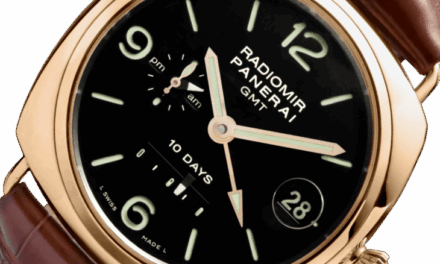
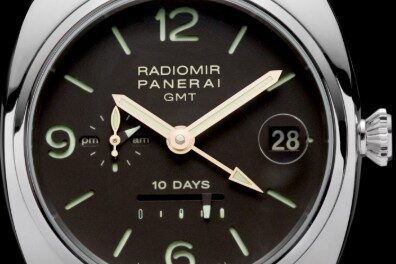
The black sandwich dial carries the standard Radiomir architecture: luminous Arabic numerals at 3, 6, 9, and 12, baton markers between them, luminous sword hands for hours and minutes. The sandwich construction, two-plate with lume glowing through the cutouts, gives the markers the same recessed depth that Paneristi have valued since the original military pieces. This part of the dial is completely faithful to the Radiomir’s heritage.
What sits around the base architecture is where the PAM00323 departs. At 9 o’clock: a sub-dial combining the small seconds counter with the day/night indicator, a subtle half-moon disc showing AM or PM within the running seconds register. At 3 o’clock: the date aperture. At 6 o’clock: the circular power reserve indicator, a ring track with a sweeping hand that traces ten days of remaining energy. At 12 o’clock: the GMT reference time hand, a central arrow pointing to the 12-hour scale for the second time zone. hand that traces ten days of remaining energy. At 12 o’clock: the GMT reference time hand, a central arrow pointing to the 12-hour scale for the second time zone.
Reading the GMT
The GMT implementation on the PAM00323 is not the most intuitive on the market, and The Watch Observer’s WatchUSeek-published review was direct about this: the reference time arrow at 12 o’clock reads against the main hour chapter ring rather than against a dedicated 24-hour bezel. You get home time at a glance, but translating it into an actual second time zone reading requires a moment’s thought rather than a glance. For many collectors, that’s fine, the GMT is a traveller’s tool, not a cockpit instrument. For collectors who switch time zones constantly and want instantaneous dual-time reading, the PAM00323’s implementation will feel demanding.
What it does do well is keep the case clean. No engraved bezel, no extra pushers, no chapter ring crowding. The Radiomir’s signature blank bezel stays blank, and the GMT information lives entirely within the dial. For a watch this technically ambitious, the external restraint is commendable.
The Circular Power Reserve
The circular power reserve at 6 o’clock is the detail that makes the PAM00323’s dial feel considered rather than assembled. A linear indicator, as used on most P.2003 applications, would have cut horizontally across the lower dial, creating a visual break in the sandwich construction. The circular indicator fits within the existing sub-dial architecture, reading as a natural companion to the seconds counter at 9 rather than an intrusion. When the indicator hand sweeps to the left edge of the track, you wind the watch. The simplicity of that interaction, on a movement this complex, is worth appreciating.
The Case: Radiomir Geometry, Complicated Content
47mm With Wire Lugs
At 47mm in diameter and 16.5mm thick, the PAM00323 sits firmly in Panerai’s large-case territory. But the Radiomir’s wire lugs do their characteristic work here: the case follows the wrist rather than projecting from it, and the absence of a Luminor crown guard removes the most visually imposing element of case bulk. Multiple owners with standard wrists report the 47mm Radiomir as more wearable than comparable 44mm Luminors, the geometry is that different.
The case is polished stainless steel throughout, no brushed sections, no alternating finishes. Polished steel picks up scratches faster than brushed, and at 47mm of surface area the PAM00323 will show wear more visibly than a matte-finished case would. Keep a microfibre cloth at hand if this matters to you. The wire lugs are removable, which is one of the small practical details Panerai gets right on the Radiomir line: strap changes require no tools and take thirty seconds.
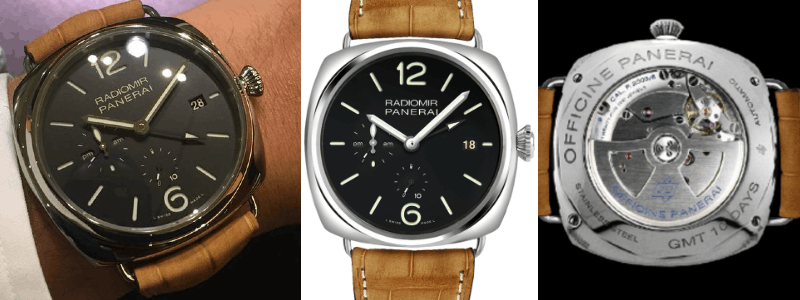
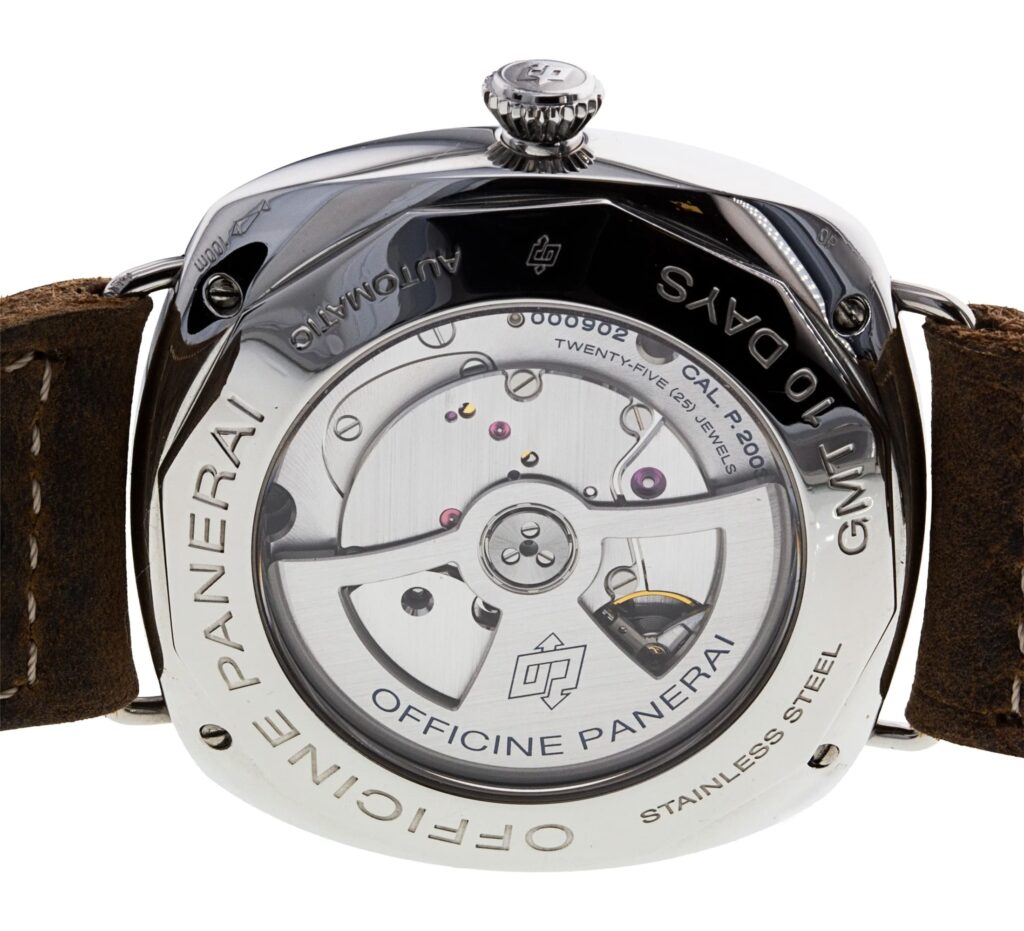
Water resistance is 100 metres, consistent with the Radiomir family. The exhibition sapphire caseback gives you a view of the P.2003/6 in motion, the oscillating weight sweeping over brushed and chamfered bridges, the three barrels stacked in their characteristic arrangement. The Watch Observer’s review notes a limitation worth acknowledging: the rotor architecture means most of the gear train is obscured from the caseback view. You see the oscillating weight and the balance, but not much of the three-barrel system. It’s a partial view of a complete movement. That’s a design consequence of how the P.2003/6 is constructed, not a finishing shortcut.
Is the PAM00323 Worth Buying Today?
The 400-Piece Argument
Four hundred pieces worldwide. That figure matters when you’re deciding whether the PAM00323’s premium over comparable Radiomir references is justified. This is not a case where “limited edition” is a marketing label attached to a production run of several thousand, 400 pieces is genuinely scarce. As a result, clean examples with box and papers are not plentiful on the secondary market, and when they appear they sell. The exclusivity of the P.2003/6 calibre, which lives in no other reference, compounds this: there is no alternative route to owning this movement. If you want the P.2003/6, you buy the PAM00323.
For the collector who has tracked the P.2003 family’s broader history on Panerey, the 400-piece run combined with calibre exclusivity creates a straightforward collector’s argument: this watch cannot be replicated, rerun, or substituted. That’s rarer than it sounds in a catalogue as broad as Panerai’s.
Service Reality
Ask collectors about the P.2003 family and the responses are honest: reliable in normal operation, but the complexity of 292 components, three barrels, and a full GMT system makes this a movement that should go back to Panerai’s network for service rather than an independent watchmaker. As our P.2003/6 deep-dive notes, “it’s not a movement every watchmaker wants to wrestle with outside of Panerai’s official network.” Official Panerai servicing on a complicated reference starts above $1,000 and can reach significantly higher, factor that into your ownership calculation. The movement’s longevity is not in question; the service cost is a real number.
Secondary Market Pricing
Active listings on Chrono24 place PAM00323 examples between approximately $10,000 and $14,500, with clean full-set examples, original box, papers, alligator strap, toward the upper end. One store display model is currently listed at $14,520, reflecting the premium that comes with documentation and condition. Unpapered examples in good condition start around $10,000. Given the 400-piece production, the movement exclusivity, and the full complication stack, that pricing is defensible, if steep.
Compared to the PAM00246 Radiomir 1/8 Second, another mechanically ambitious Radiomir reference, the PAM00323 trades at a similar level with a more practical complication set. The PAM00246’s foudroyante is spectacular and rarer; the PAM00323’s 10-day GMT is genuinely usable. Which matters more depends on why you collect.
Who Is It For?
- The collector who has grown past the surface of the Radiomir collection. The PAM00323 is for someone who wants to understand what Panerai was capable of building once they committed fully to in-house manufacture
- Someone who winds it, travels with it, and finds satisfaction in the mechanics. Winding once on Sunday and not thinking about it again until the following Wednesday is not a trivial experience, and neither is glancing at 6 o’clock and seeing the reserve indicator still comfortably in the upper third of its arc on day six
- A collector who values calibre exclusivity above catalogue breadth. No other reference offers a path to the P.2003/6; owning this movement means owning this specific watch
- Someone drawn to restraint over spectacle. The dial is busy but not flashy, the case is polished but not dramatic; unless you know what the circular indicator at 6 o’clock signifies, the watch reads simply as a well-equipped Radiomir. That restraint is part of the point.
Not for: Collectors who want instantaneous dual-time reading, the GMT implementation reads against the main chapter ring rather than a dedicated 24-hour bezel, which takes a moment’s thought rather than a glance. Anyone who wants full visibility of the movement through the caseback, the rotor obscures most of the three-barrel system from view. And not for buyers unwilling to budget for official Panerai servicing, independent watchmakers are generally not the right choice for this calibre.
Conclusion
The PAM00323 answers the question that defined Panerai’s in-house era: could the brand build a movement that matched the scale and ambition of its cases? The P.2003/6, exclusively housed in this reference, in 400 examples, is a clear yes. Three barrels in series, a genuine 10-day reserve, a proper automatic GMT with seconds reset, and a calibre exclusive enough that no other reference offers a path to it.
I’d push back gently on one framing you’ll find in some collector discussions: that the PAM00323 is underrated. It isn’t, exactly, the market prices it appropriately for what it is. What it is, though, is under-discussed, particularly outside dedicated Paneristi communities. More collectors know the California dial PAM00424 than know the P.2003/6. More know the PAM00246’s foudroyante than know the three-barrel architecture behind the Radiomir 10 Days GMT. That imbalance is the PAM00323’s opportunity.
If you’re researching the Panerai in-house movement story and want a single reference that illustrates both the ambition and the restraint of that era, the movement doing extraordinary things inside a case that gives nothing away, the PAM00323 is it.
Would you buy the PAM00323 for the P.2003/6 alone, or does the movement exclusivity feel like a collector’s trap? Let me know in the comments.
Extended Summary
- The PAM00323 is a 400-piece Radiomir from 2010 housing the P.2003/6 calibre, Panerai’s first fully automatic in-house movement, with a 10-day power reserve, GMT, circular power reserve indicator, date, and day/night display. The P.2003/6 was never used in any other reference.
- The three spring barrels in series deliver a genuinely flat torque curve across the full 10-day cycle. This is a real engineering achievement, not a spec sheet figure; the watch holds rate on day nine in ways that single- or dual-barrel movements can’t match.
- The dial is the most complication-dense in the Radiomir line: five functions across four sub-dial positions, and manages to read as legible rather than cluttered. The circular power reserve at 6 o’clock is the detail that makes the layout work.
- The GMT implementation reads reference time against the main chapter ring rather than a dedicated 24-hour bezel: functional, restrained, and slightly demanding for fast time-zone transitions. Know this before you buy.
- Secondary market pricing of $10,000–$14,500 reflects the 400-piece production, calibre exclusivity, and full complication stack; service costs for the complex P.2003/6 architecture (292 components, three barrels, full GMT system) are real and should be factored into the ownership calculation.
<a id=”jump”></a>
At a Glance
| Reference | PAM00323 |
| Collection | Radiomir |
| Name | Radiomir 10 Days GMT |
| Introduced | 2010 |
| Limited to | 400 pieces |
| Case material | Polished stainless steel |
| Case diameter | 47mm |
| Case thickness | 16.5mm |
| Lugs | Wire loop, removable |
| Water resistance | 100 metres |
| Crystal | Sapphire |
| Caseback | Exhibition sapphire |
| Movement | Panerai P.2003/6 (in-house, automatic) |
| Movement diameter | 13¾ lignes |
| Movement thickness | 8mm |
| Power reserve | 10 days (240 hours), three barrels in series |
| Beat rate | 28,800 vph |
| Jewels | 25 |
| Components | 292 |
| Complications | GMT, date, day/night indicator, circular power reserve, seconds reset |
| Dial | Black sandwich; luminous Arabic numerals and markers |
| Availability | Discontinued; pre-owned only |
| Secondary market | ~$10,000–$14,500 |