Introduction — Panerai Beyond the Dial
Say “Panerai” to a casual Panerai collector and the response is predictable: cushion case, sandwich dial, oversized crown guard, wrist presence for days. Fair enough — that’s the iconography. But for those who’ve followed the brand beyond the surface, Panerai’s credibility rests not only on its visual DNA, but on what it dared to build under the hood once the Richemont years began in earnest.
The P.2000 family marked a turning point. It was Panerai’s loud answer to critics who claimed the brand was all case and no caliber — just another shell over an ETA. Introduced in 2005, the P.2000s were the first fully in-house movements designed and produced in Neuchâtel. They weren’t small, they weren’t shy, and they weren’t apologetic. Among them, the P.2003/6 sits as one of the most ambitious — a movement that powered a single, deeply technical reference, the Radiomir 10 Days GMT PAM00323.
And here’s the thing: it deserves a closer look. Because while Panerai has since scattered its catalog with countless complications and “special editions,” the P.2003/6 represents a moment of clarity. A ten-day moment, in fact.
The P.2000 Family — A Short History
Panerai’s in-house journey began mid-2000s. The P.2002 set the tone: an 8-day hand-wound caliber with linear power reserve, a nod to Panerai’s Angelus-equipped watches of the 1940s. It was heritage anchored in mechanics.
The P.2003 followed, answering a different question: what if the practicality of automatic winding could live alongside the romance of a massive power reserve? The base P.2003 featured a full 10-day reserve, three barrels, and complications that took Panerai firmly out of the “oversized diver” box and into watchmaking credibility.
Over the years, the family splintered into variants — some with linear indicators, some circular, some skeletonized, some not. But the P.2003/6, introduced in 2010, had a very specific identity: it sat exclusively in a Radiomir case, with its circular power reserve on the dial and a full suite of complications laid out with purposeful restraint.
Anatomy of the P.2003/6
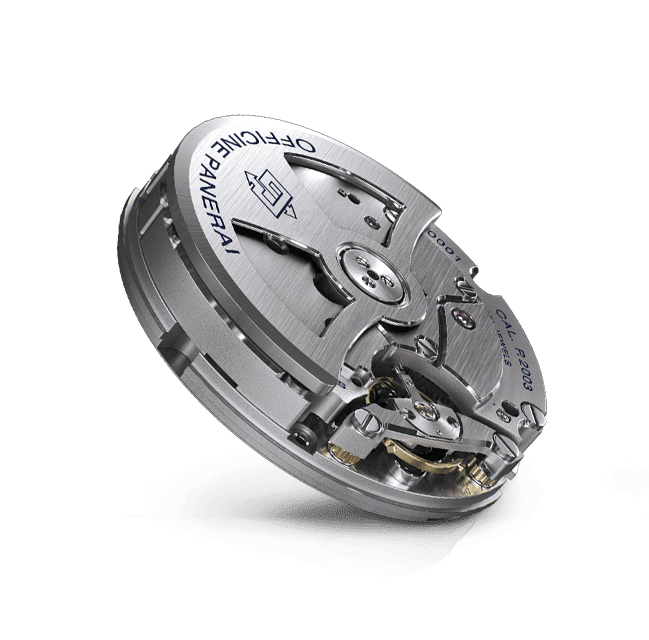
Let’s get technical. The P.2003/6 is an automatic mechanical movement, entirely executed in-house by Panerai. It measures 37.8 mm across and 8 mm thick, coming in at 13¾ lignes. Not petite by any stretch, but neither is the Radiomir 45 mm case it was designed to inhabit.
Inside, it runs at a frequency of 28,800 vibrations per hour (4 Hz) — modern, stable, and in line with Panerai’s preference for reliability over esoterica. It’s fitted with a Glucydur® balance for thermal stability, paired with a KIF Parechoc® anti-shock system to handle the bumps and jolts that a 45 mm tool watch inevitably sees.
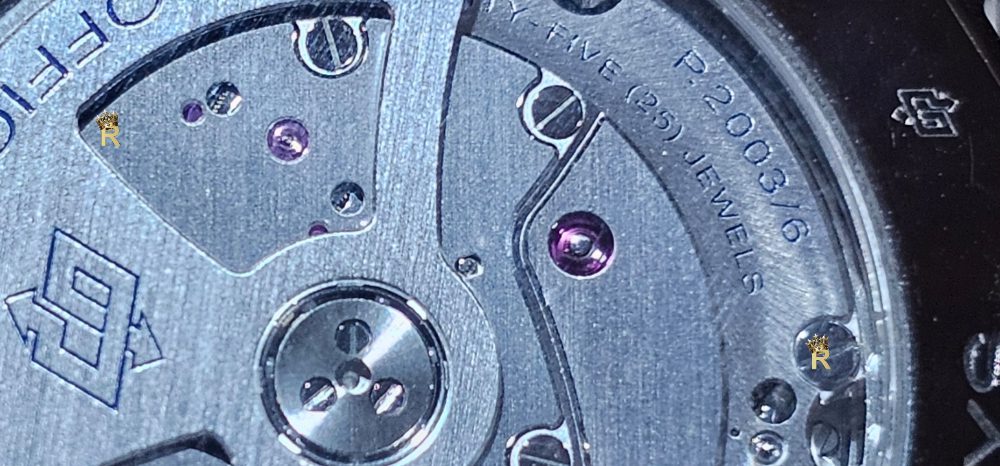
The jewel count is 25, spread across a movement that totals 292 components. That’s not Haute Horlogerie excess; that’s engineering density. The automatic winding is bidirectional, feeding energy into three spring barrels arranged in series, delivering a formidable 10-day power reserve.
On paper, it’s impressive. On the wrist, it’s even more so — because every one of those functions translates into usable practicality.
Complications and Functions
The P.2003/6 doesn’t just keep time; it manages time zones, dates, and reserves in ways that feel intuitive, not forced.
- Hours and minutes, central, clean.
- Small seconds at 9 o’clock, a Panerai staple, grounding the dial.
- Date window at 3 o’clock, crisp, functional.
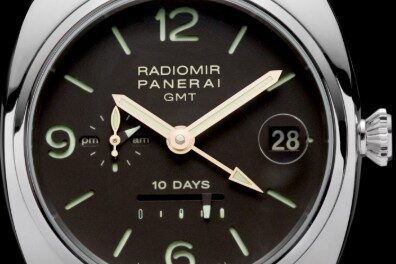
- GMT function: a second 12-hour hand, independently adjustable in one-hour jumps, paired with a fixed 24-hour hand. It’s not a token GMT; it’s a traveler’s companion.
- Circular power reserve indicator at 6 o’clock, a full circle that shows off the 10-day autonomy without breaking the dial symmetry.
- Zero-reset seconds: pull the crown, seconds hand snaps to zero for precise synchronization.
- Independent hour adjustment: local hour can be set without disturbing the minutes or seconds — again, travel-focused.
This is Panerai at its most pragmatic. The watch looks bold, yes — it’s a Radiomir — but underneath, the movement is quietly obsessed with legibility and utility.
Comparison Within the P.2003 Family
To understand the /6, you have to see it against its siblings.
The base P.2003 was typically paired with a linear power reserve indicator, often in Luminor 1950 cases. It was technical, but visually busy. Variants like the P.2003/B stripped away certain features or changed display formats, often chasing aesthetics.
The P.2003/6 took a different path: the circular indicator instead of linear. That seemingly small choice makes the difference. It reads more naturally, integrates into the Radiomir dial with balance, and arguably ages better in design terms. Functionally it’s the same engine — same barrels, same 10 days, same complications — but the presentation and exclusivity set it apart.
This isn’t a mass-production caliber shuffled across dozens of references. It’s a tailored movement for a single watch.
References Using the P.2003/6
Here’s where the story narrows: the P.2003/6 was only ever used in the Radiomir 10 Days GMT PAM00323.
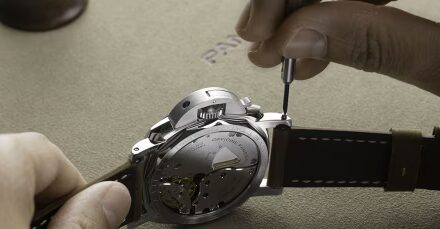
Unveiled in 2010, the PAM323 fused Panerai’s cushion-case elegance with the technical heft of the P.2003/6. At 47 mm in polished steel, with wire lugs and an exhibition caseback, it gave collectors an unfiltered look at the caliber.
No other reference carried it. Not a Luminor, not a special edition, nothing. For once, Panerai resisted the temptation to recycle — and the result is that the P.2003/6 is as much a part of the PAM323’s identity as the sandwich dial or Radiomir case shape. They’re inseparable.
Finishing and Aesthetics
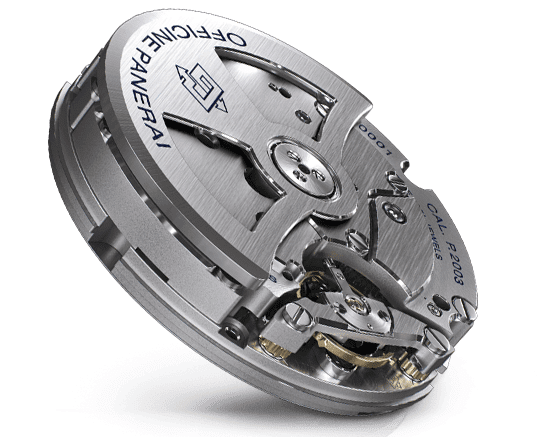
Panerai has never chased Geneva stripes and mirror anglage. That’s not its game. The P.2003/6 is finished in the brand’s functional, industrial style: large brushed bridges, clean edges, engraved text, and a solid rotor that gets the job done without theatrics.
If you’re looking for black polishing and hand-finished bevels, look elsewhere. But if you’re looking for a movement that looks the part in a 45 mm military-derived tool watch, this is it. There’s a certain honesty here: no pretense, no borrowed haute decoration — just mechanical muscle, neatly presented.
Serviceability and Collector Reputation
Ask collectors about the P.2003 family and the responses are consistent: reliable, robust, but a bit complex when it comes to servicing. With 292 components, three barrels, and a GMT system, it’s not a movement every watchmaker wants to wrestle with outside of Panerai’s official network.
That said, Panerai’s Neuchâtel manufacture built these with longevity in mind. The 10-day reserve isn’t fragile; it’s stable. Reports from owners suggest the movement holds rate well over the full power curve, not just in the first few days. That matters, because what good is a 10-day reserve if the last three days drift?
Service costs are not negligible, but neither are they horror stories. The real-world consensus: the P.2003/6 does what it says on the tin — it keeps going, and going, and going.
Why 10 Days Still Matters
Panerai could have stopped at 3 days. Or 8, to echo the Angelus 240 from its wartime history. But 10 days? That’s a statement.
It’s not just about convenience (though winding your watch once every week and a half is satisfying). It’s about symbolism. The Angelus 8-day defined Panerai’s vintage credibility. The P.2003/6’s 10-day power reserve was a way of saying: we’ve not only honored that past, we’ve surpassed it.
Collectors know it, too. There’s a sense of pride in flipping the PAM323 over, seeing the movement, and knowing those three barrels are silently unwinding, holding rhythm for a week and a half without complaint. It’s overengineering in the best way.
Collector Positioning
Who buys into the P.2003/6? Not the casual Panerai fan chasing the latest limited-edition dial color. This caliber appeals to the collector who values mechanics, who wants more than a Unitas in a cushion case.
The PAM323 has become a quiet grail for those who see Panerai’s in-house era as the brand’s true test. It’s not flashy — no tourbillon cages, no minute repeaters — but it embodies everything that Panerai needed to prove in 2010.
On the secondary market, the PAM323 holds its own precisely because it isn’t diluted. It’s one watch, one movement, one story. And in a catalog that often blurs, that clarity is rare.
Conclusion — Ten Days of Truth
The P.2003/6 may not be the most famous Panerai caliber. It may not sit in a hundred references or anchor the brand’s current catalog. But in the Radiomir 10 Days GMT PAM323, it tells the truth about what Panerai set out to achieve in its in-house era: long reserves, practical complications, robust construction, and a refusal to play at borrowed aesthetics.
Ten days of power. One reference. One movement. That’s the legacy. And for collectors who want to understand Panerai not just as a design house, but as a true watchmaker — the P.2003/6 is as honest as it gets.