The All-Black Luminor Power Reserve That Still Turns Heads
Quick Takeaways
- The PAM00028 is a 44mm Luminor Power Reserve in fully PVD-coated black steel — limited to 1,000 pieces, originally produced in 1998–99 and re-run in 2009
- The hobnail dial is the watch’s most divisive feature — not everyone loves it, and that’s exactly why it’s interesting
- It runs on a SOPROD 9040 — an ETA-based movement, not in-house — and I’d argue that’s part of what makes this piece historically significant, not a mark against it
- Secondary market prices run from $4,500 to well over $10,000 depending on which version you’re holding and what condition it’s in
- This is not a watch for someone still finding their Panerai feet. It rewards collectors who already know why they want it
Introduction
I keep coming back to the PAM00028. Not because it’s the flashiest thing Panerai ever made — it isn’t. Not because the movement is a technical marvel — it won’t win that argument either. I keep coming back to it because it exists at a specific moment in this brand’s history that nobody seems to talk about properly anymore.
1998. Panerai had been selling to civilians for barely a decade. The Luminor line was young by collector standards. The cult was forming but hadn’t fully calcified. And in that window, Panerai produced a limited run of 1,000 watches with a fully blacked-out PVD case, a Paris hobnail dial unlike anything else in the collection, and a movement sourced from the best Swiss suppliers available to them at the time.
No in-house calibre. No manufacture fanfare. Just a deeply specific, visually unusual tool watch for people who were paying attention.
That watch is the PAM00028. And if you think the SOPROD movement disqualifies it — we need to talk.
The Case: Black on Black on Black
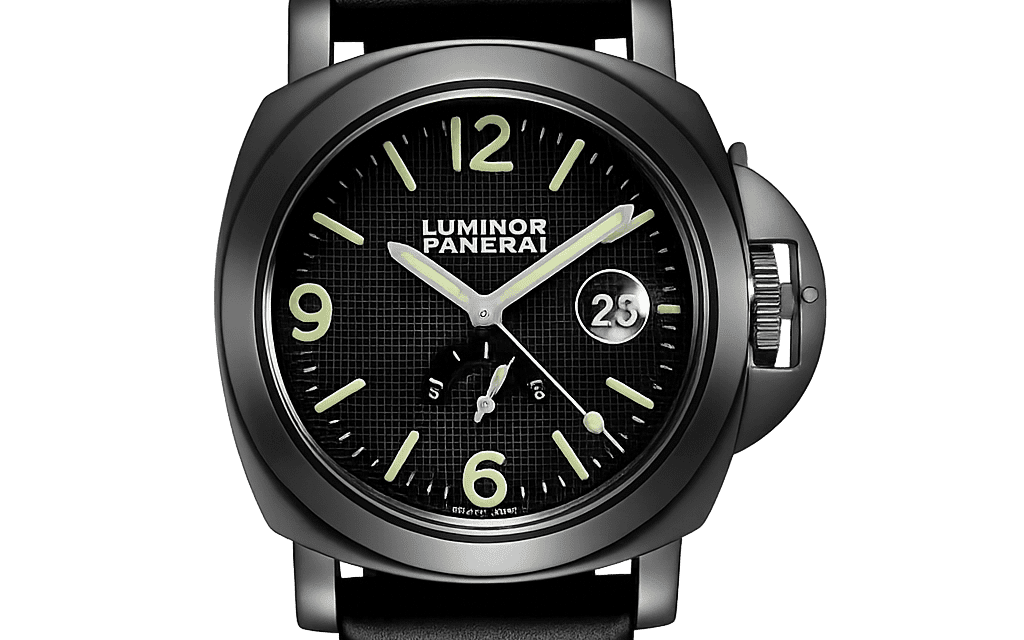
At 44mm, this sits exactly where a Luminor should. Not enormous, not apologetic. The PVD coating covers everything — case, bezel, crown guard lever, tang buckle — and it does so with a coherence that a lot of modern blacked-out watches still can’t match. This doesn’t look like an afterthought. The darkness is load-bearing.
On the wrist it reads as quietly aggressive. That’s the only phrase that fits. It doesn’t announce itself like a 47mm Submersible. It just sits there, all matte and dense, and lets other people wonder what it is.
The crown guard lever clicks with that familiar Luminor authority. Open it, wind it, close it. Every time. That mechanism — patented in 1955, still essentially unchanged — is one of the best pieces of functional watch design ever produced. Panerai’s military history demanded something that wouldn’t fail forty metres underwater, and it shows. You feel it every time you interact with the watch.
The PVD Question — Let’s Be Honest
Here’s where I won’t sugarcoat it. PVD wears. On a 1999 original, the lugs, crown guard edges, and caseback will almost certainly show steel through the coating by now. I’ve seen WatchUSeek listings from long-term owners describing exactly this — a patina forming, the black thinning at contact points.
Some collectors find that beautiful. Proof the watch was worn, not stored.
Others find it unacceptable on a watch at this price. And that’s a legitimate position.
My take: if you’re buying an original B-series, the PVD story is part of the deal. You’re not buying a pristine display piece — you’re buying a twenty-five-year-old tool watch that was made in an era before DLC hardening existed. Accept it or buy the 2009 re-run. But don’t pretend it’s a flaw unique to this reference — it’s a property of the technology, and the technology was honest for its time.
The Hobnail Dial — Busier Than It Needs to Be, and I’m Mostly Fine With That
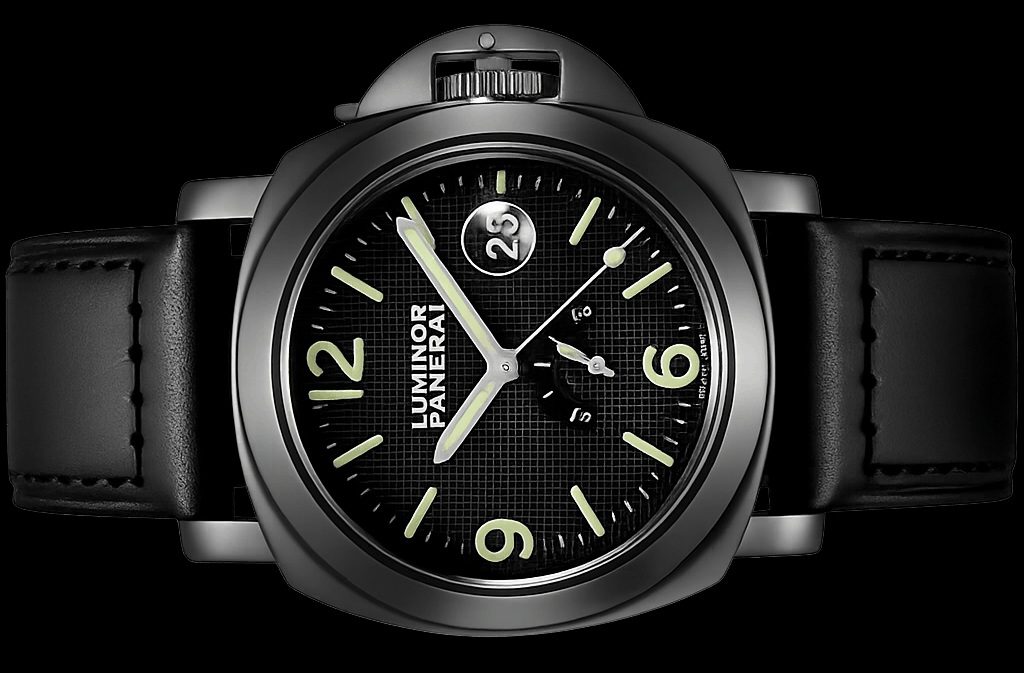
The Paris hobnail — Clous de Paris — is a guilloche-style texture normally found on dress watch dials from Geneva ateliers. Panerai dropped it into a 44mm black tool watch case, rendered it entirely in black-on-black, and then added a date window and a power reserve indicator on top of it.
It is, objectively, a lot.
As we go into in our hobnail dial deep dive, this texture has shown up across several Panerai references over the years. But nowhere does it feel quite as committed — or as strange — as it does here. The pyramidal points only reveal themselves under raking light. In a dim room, the dial looks flat. Step outside, angle it toward the sun, and suddenly there’s this almost architectural depth to it. It’s a dial you keep discovering.
Do I love it? Mostly. The date window at 3 sits slightly awkwardly — it breaks the dial’s internal geometry in a way that bugs me more every time I look at it. The power reserve arc at 6, on the other hand, earns its place. Knowing you’re running low before the watch dies on you is genuinely useful, and the execution is restrained enough that it doesn’t crowd the space.
The lume is standard Luminor — Arabic numerals, baton markers, sword hands. Does its job. The all-black environment means daytime contrast is lower than a standard Luminor, and you’ll notice that in certain lighting. It’s not a dealbreaker. It’s a trade-off you make knowingly when you choose this watch.
The SOPROD 9040: This Is the Section Most Reviews Get Wrong
Let me say this plainly: the SOPROD 9040 is not a weakness of the PAM00028. It’s a timestamp.
I’m tired of reading collector threads where someone dismisses an early Panerai because it doesn’t have a P.9000 or a P.3000 inside. That criticism makes no historical sense whatsoever. The in-house movement era at Panerai didn’t properly begin until the mid-2000s. Before that — and this is documented thoroughly in Panerai’s own brand history — the brand was using the best available Swiss ébauches, finishing and certifying them properly, and building watches that were about the case, the design, and the identity first.
The SOPROD 9040 is an ETA 2892 base with a Soprod power reserve module — beating at 28,800 vph, 42 hours of reserve, COSC Chronometer certified. As Bob’s Watches explains, COSC certification covers less than 3% of all Swiss watch production. This movement was independently tested across fifteen days, multiple positions, multiple temperatures, and passed. It is not a cheap movement. It was never a cheap movement.
What it is, honestly, is a movement that reflects where Panerai actually was in 1998. The brand had recently gone from supplying the Italian Navy to selling watches to civilians in Florence and eventually worldwide. The in-house development was coming, but it wasn’t here yet. Using the SOPROD wasn’t a compromise — it was the correct decision for a brand at that stage of its evolution.
Owning a PAM00028 original means owning a watch from before Panerai became the manufacture-movement company it is today. That is not a lesser thing. For certain collectors — and I count myself among them — it’s actually more interesting. You’re holding the brand at a pivot point. Pre-manufacture, pre-global expansion, pre-Sylvester Stallone making it a celebrity accessory. Just Panerai, a Swiss movement, and 1,000 watches.
If that framing doesn’t move you, fine — the PAM00537 will give you a hobnail dial with an in-house calibre underneath it. But you’ll be buying a different kind of watch entirely.
B-Series or Re-Run — Pick One, Know Why
The original B-series came out of 1998–99. WatchBase’s production records confirm the timeline — these are genuine early-era pieces, pre-dating much of what collectors now think of as “classic” Panerai. The 2009 re-run (same reference number, same 1,000 pieces) was made as a tribute to the original. Same basic architecture, same movement family, same dial.
But they are not the same watch to a serious collector, and I’d push back hard on any seller who tells you otherwise.
The B-series commands more. It should. It’s older, rarer in genuinely good condition, and it’s the real thing. The re-run is fine — mechanically sound, easier to find clean — but it’s a tribute act, not the headliner.
My position: if provenance matters to you, save up for a proper original. If you want the look and the feel without the premium, the re-run is entirely defensible. Just be clear with yourself which one you’re buying.
What You’ll Pay
Chrono24’s PAM00028 listings currently show a range of roughly $4,450 at the low end — worn, stripped of papers, bought from Japan — to $10,000+ for NOS examples or the rare “Silver Arrow” variant with its distinctive power reserve hand. Full-set originals with the pearwood box, limited edition scroll, COSC papers, and guarantee booklet tend to cluster around $7,000–$8,000.
The spread tells you everything. PVD watches are unforgiving — condition variance is enormous, and a beat-up example really is a fundamentally different object to a preserved one. Look at the case before anything else. Specifically the lugs and the crown guard edges. That’s where the coating goes first.
Who Actually Needs This Watch
Not beginners. Genuinely. If you’re still figuring out whether you like Panerai, start with a standard Luminor. The brand’s own archive page for the PAM00028 makes the watch look deceptively simple — it’s only once you start understanding early Panerai collecting that this reference reveals its depth.
This is for the collector who already has a few Panerais under their belt and wants something that connects them to how it started. The person who finds modern Panerai — with its in-house movements, Carbotech cases, and brand ambassador campaigns — slightly disconnected from the original spirit. The person who wants to hold a watch from 1999 and feel the brand when it was still figuring out what it was going to be.
That collector exists. And for that collector, the PAM00028 is one of the most honest watches Panerai has ever made. As aBlogtoWatch notes in their broader Panerai overview, the brand’s DNA has always been rooted in Italian design meeting Swiss functionality — and nowhere is that more visible than in these early limited editions, before the positioning became polished.
Conclusion
The PAM00028 isn’t trying to be the best Panerai. It never was. It’s trying to be a specific Panerai from a specific moment — all black, hobnail dial, SOPROD movement, 1,000 pieces, end of story.
People who dismiss it for the movement are missing the point. People who overpay for a worn example without checking the PVD are making a different kind of mistake. But the collectors who find a clean B-series at a fair price, who understand what the SOPROD represents, who appreciate the hobnail for what it is rather than what it isn’t — those people are going to keep this watch for a long time.
It’s a piece of early Panerai history. Full stop.
Have you owned one? I’d genuinely like to know what your experience was — drop it in the comments.
Extended Summary
- The PAM00028 is a 1,000-piece Luminor Power Reserve in all-black PVD steel from 1998–99 (re-run 2009) — historically significant as an early civilian-era Panerai, not despite its movement but partly because of it
- The SOPROD 9040 is ETA-based, COSC-certified, and entirely correct for its era — dismissing it as a weakness misreads what Panerai was in 1999
- PVD wear on originals is real and should be inspected carefully before buying; condition drives the price spread from $4,500 to $10,000+
- The original B-series and 2009 re-run are not the same watch — provenance matters, and so does knowing which one you’re actually holding
- This watch is for collectors who want to own early Panerai history — before the manufacture era, before the global campaigns, when the brand was still finding its shape