Quick Takeaways
- PAM00201 is one of 50 platinum Radiomirs produced in 2005, the H-serial year — one of only two references to debut Panerai’s first in-house movement, the P.2002, making this watch a primary document of the brand’s transition from ETA-era manufacturer to genuine manufacture
- The P.2002 calibre was the pivot point in Panerai’s history: hand-wound, 8-day power reserve from three spring barrels, GMT differential, seconds reset device, linear power reserve indicator — 247 components developed over three years at Panerai’s Neuchâtel facility, launched in 2005 after the project began in 2002
- The brown dial separates the PAM00201 from its sibling PAM00200 (white gold, 200 pieces, black dial) — the chocolate-brown sandwich face against polished platinum is a pairing specific to this reference and unrepeated in the broader Radiomir line
- The platinum case weighs 186.9g at 45mm: lighter than steel at the same size due to platinum’s efficient case architecture, but with a density and colour that reads differently from any other precious metal Panerai — gold-toned hands against brown dial against platinum case: a deliberate palette that rewards scrutiny
- Secondary market pricing reflects rarity and historical weight: documented pre-owned examples at approximately $26,000–$30,000 — with only 50 pieces worldwide, this is not a watch you find; it’s one you wait for
Jump directly to the spec sheet.
The Watch That Carried Panerai’s First Movement
There are two ways to read the Panerai PAM00201.
The first: a 45mm platinum Radiomir with a brown sandwich dial, wire lugs, an 8-day power reserve, and a GMT function. Fifty pieces worldwide. Extraordinary by any standard.
The second: one of the two watches that introduced the P.2002 calibre to the world in 2005 — Panerai’s first in-house movement, the calibre that answered an eight-year question about whether the brand would remain an assembler of borrowed movements or become a genuine manufacture. The watch that proved the answer was manufacture.
Both readings are correct. The Panerai PAM00201 is simultaneously a rare precious-metal Radiomir and a primary document of one of the most significant transitions in the brand’s modern history. Most discussions of the P.2002 reference the PAM00200, the 200-piece white gold sibling with the black dial. The PAM00201 is the rarer, more concentrated expression: fifty examples in platinum, a brown dial that no other Radiomir in this era matched, and a movement whose implications for the brand outlasted the watch by decades.

2005 — The Year Panerai Became a Manufacture
I’d argue this is the most important date in Panerai’s post-Vendôme history.
From 1997, when the Richemont Group (then Vendôme) acquired Panerai, through 2004, every movement in every Panerai ran on a borrowed base: Unitas 6497, Valjoux 7750, platforms from Soprod, movements from LaJoux-Perret. The “OP” prefix on these calibres — OP III, OP XI, OP XVI — was the house signal that this was externally sourced material, dressed for Panerai but not designed by Panerai. The watches were excellent. The DNA of the case and dial was Panerai through and through. But the engine came from someone else.
Panerai opened its Neuchâtel manufacture in 2002. The calibre project that would become the P.2002 was launched that same year — hence the name, a tribute to the year the plant opened, as official Panerai documentation confirms. Three years of development followed. In 2005, the P.2002 debuted in exactly two references: the PAM00200 (200 pieces, 18ct white gold) and the PAM00201 (50 pieces, platinum).
Let me be direct about something that deserves honest treatment. A documented article on Perezcope argued that the P.2002 was designed and produced at ValFleurier, a Richemont manufacturing subsidiary, rather than being “in-house” in the purest sense. The Panerai position — that the movement was designed and developed at Neuchâtel under Panerai’s direction, using Richemont’s manufacturing capabilities — is also documented. Where you land on this depends on how strictly you define “in-house.” What is not in dispute: the P.2002 was exclusive to Panerai, carried the “P.” prefix that distinguishes Panerai’s own calibres from the “OP” designators of the ETA era, and represented a genuine step-change in the brand’s technical ambition. For collectors, it remains the inflection point.
The P.2003 calibre family that followed — and the decade of development documented in the P.2003/6 — built directly on the P.2002 architecture. Whatever the manufacturing nuance, the P.2002 opened a door that has never closed.
The P.2002 — Eight Days, Three Barrels, and a GMT That Thinks Differently
Here is where the PAM00201 earns the deepest treatment, because the P.2002 is not merely a long-reserve movement. It’s a mechanical argument.
Three Barrels in Series
Most watches with extended power reserves achieve them with two barrels — spring-loaded chambers whose coiled mainsprings unwind to drive the gear train. Two barrels in series simply doubles the spring length, doubling the theoretical reserve. Simple enough. The problem is torque inconsistency: a fully wound mainspring delivers more force than a depleted one, and over a 72-hour cycle that variation is modest. Stretch it to eight days and the torque variation becomes significant enough to affect rate.
The P.2002 uses three spring barrels arranged in series. This is the architectural choice that makes eight days credible rather than theoretical. Three barrels distribute the torque delivery curve across a longer span, flattening the power delivery and maintaining more consistent drive force across all 192 hours of reserve. The movement beats at 28,800 vph — a higher frequency than most long-reserve movements dare to run, because sustained high-frequency oscillation amplifies any torque inconsistency. The P.2002’s three-barrel design makes that frequency sustainable over the full reserve. Through the exhibition sapphire caseback, those three barrels are visible as a row of chambers on the main plate — a visual architecture unlike anything in the ETA-era Panereai.
The Linear Power Reserve Indicator
Most power reserve displays are sector indicators — an arc that sweeps between “full” and “empty” markings, read at a glance. The P.2002 uses a linear indicator: a straight horizontal bar that creeps along a scale at 6 o’clock, from the fully wound position toward zero. On the PAM00201, that bar sits at the base of the brown dial, tracking the reserve across 8 days in a format that reads more like a fuel gauge than a traditional watch complication.
It’s an unconventional choice. I find it compelling precisely because it doesn’t aestheticise the function — it quantifies it. You know at any given wind how many days remain. Not approximately. Precisely.
The GMT Differential
Standard GMT displays add a second time zone via a 24-hour hand reading from a fixed or adjustable 24-hour scale. The P.2002 does something more considered: a GMT differential mechanism that displays a second time zone through a dedicated complication rather than a simple additional hand. The result is visible at 9 o’clock on the PAM00201 — small seconds combined with a 24-hour AM/PM indicator that clarifies whether the second time zone is in daylight or darkness. For frequent long-haul travellers in 2005, before the smartphone era had made time zones trivially manageable, this was a genuine piece of utility.
The Seconds Reset Device
Pull the crown on the PAM00201 and the small seconds hand stops and resets to zero. This is the seconde foudroyante principle applied to precision setting: when you push the crown back in, the movement restarts from a known zero point, allowing you to synchronise the watch to an accurate time signal to the exact second. In an 8-day movement that might not be wound again for a week, that initial precision matters.
The KIF Parechoc Anti-Shock System
Standard Panerai movements of this era used Incabloc anti-shock protection for the balance staff. The P.2002 uses KIF Parechoc, a different approach to protecting the balance pivot from shock damage. Neither is superior in absolute terms, but the KIF system has different geometric characteristics that Panerai clearly preferred for this calibre. It’s a small detail that confirms the P.2002 was specified from the ground up, not assembled from standard components.
247 Components, 6.6mm Thick
At 13¾ lignes in diameter and just 6.6mm thick, the P.2002 is a remarkably flat movement for what it achieves. It fits the Radiomir cushion case without requiring the case to bulk up beyond its natural dimensions. The 247 components — confirmed across official Panerai and WatchBase documentation — include all of the above: the three-barrel train, the GMT differential, the linear display mechanism, the seconds reset, the date. Every component was designed around this movement. None was borrowed.
The Platinum Case — 50 Pieces and the Rarest Expression
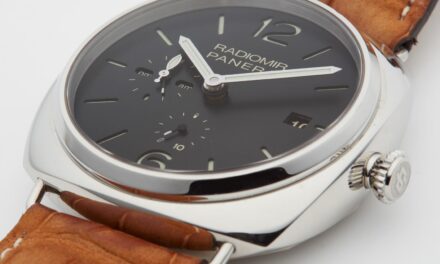
The PAM00201 case is polished platinum in the classic Radiomir cushion form: 45mm, wire loop lugs (patented, removable), polished platinum bezel, no crown-protecting device. The Radiomir has never had a crown guard — it predates that architecture, and this watch honours that lineage faithfully.
Platinum at 45mm produces a case with an official weight of 186.9g. For reference, that’s lighter than the 415g of the PAM00194 Submersible 2500m we discussed elsewhere — platinum is not the heaviest case material Panerai uses. But it has a specific quality on the wrist: a cool, dense presence that gold doesn’t replicate. Polished platinum reads silver-white in direct light, deeper and greyer in shadow. Against the brown dial and gold-toned hands, the case acts as a neutral that lets the dial lead.
The polished white gold buckle is the only white gold component in an otherwise platinum watch — a small inconsistency that perhaps reflects production economics or availability at the time, and one that most owners will never think about again once the watch is on the wrist.
The exhibition sapphire caseback sits directly against the P.2002 movement. Through it, the three-barrel architecture and Côtes de Genève bridge finishing are visible. For a Radiomir — a line that typically carries a plain or screw caseback in its base form — this is an invitation: look at what’s inside.
Pairing the PAM00201 with the Radiomir 1940 line’s evolution demonstrates how much the Radiomir cushion shape has persisted across materials. Steel, titanium, tantalum, bronze, white gold, platinum — the case form doesn’t change; the material carries the message.
The Dial — Brown, Sandwich, and a Colour That Earns Its Place
The PAM00201’s brown dial is not a default choice. It’s the distinction.
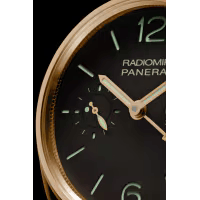
The sibling PAM00200 — 200 pieces, white gold, same movement — carries a black dial. The PAM00201 gets brown. In a brand whose core dial language is almost entirely black, that is a deliberate decision. Against polished platinum, the chocolate-brown face reads warmer and more complex than black would. Luminous Arabic numerals sit at 3, 6, 9 and 12 o’clock (the traditional Radiomir configuration, not the Luminor’s 6-and-12 asymmetry). Between them, baton hour markers. The whole face is a sandwich construction — two-layer architecture with the luminous substrate glowing through cut-out apertures — which gives the markers a recessed depth that flat-applied lume doesn’t produce.
At 9 o’clock: small seconds sub-dial combined with the 24-hour AM/PM indicator, reading the GMT second time zone. At 3: the date aperture. At 6: the linear power reserve indicator, tracking the remaining days of the 8-day reserve across a horizontal scale.
The gold-toned hands — confirmed in dealer listings from the original sale period — pick up the warmth of the brown dial and create a three-layer colour relationship: platinum case, brown dial, gold hands. None of these are accidental. The Radiomir annual calendar line demonstrates how subsequent Radiomir complications have continued to use the sub-dial-heavy layout that the PAM00201 established in 2005.
PAM00201 Pre-Owned — Fifty Pieces, Two Decades On
With 50 examples produced, the PAM00201’s secondary market is a different proposition from any watch we’ve discussed in this series. You’re not browsing; you’re waiting.
A documented listing on EveryWatch showed a very good condition example without original box or papers at approximately DKK 179,000, equivalent to roughly $26,604. eBay has seen asking prices in the $29,000–$30,000 range for more complete-appearing examples. At original retail in 2005, the PAM00201 carried a price around $54,600 (confirmed by Prestige Time’s archived listing) — the pre-owned market now sits at roughly half that figure, which reflects the general softening in Panerai secondary market values that has characterised the post-2014 period.
“The P.2002 calibre takes its name from the year Officine Panerai inaugurated its production plant — a tribute to the watchmaking art of the Florentine brand.” — Official Panerai history documentation
That naming convention matters. The calibre isn’t named after the year it launched (2005) or after a technical specification. It’s named after the moment the manufacture opened. The PAM00201 is, among other things, a declaration: we have a plant, we have a calibre, and this is what we built first.

Buying a PAM00201 pre-owned means verifying several specific things:
Provenance. Fifty pieces means every example that surfaces can theoretically be traced. The H-serial production code (2005) is on the caseback alongside the individual piece number from 50. If a seller cannot confirm or show that caseback engraving, proceed with great caution.
Dial condition. The brown sandwich dial is particular and fragile — exposure to moisture or poor storage can cause the two-layer construction to separate or discolour. Under direct light, the brown should read consistent and the lume apertures should glow cleanly. Any unevenness in colour or dry patches in the sandwich face layers is cause for concern.
Movement service. The P.2002 is a complex movement and service is not trivial. The three-barrel architecture requires a watchmaker who knows what they’re handling. A watch that is running consistently and has documented Panerai service history commands a legitimate premium here — more than on any simpler reference.
Completeness. The full set includes the original brown crocodile strap, polished white gold buckle, and the original presentation case. The perpetual calendar article on Panerey demonstrates how documentation and provenance affect perceptions of Panerai’s own complicated pieces; for 50-piece platinum editions, completeness is not optional — it’s the difference between a collector’s piece and a question mark.
Who Is It For?
- The collector who wants the first chapter of Panerai’s manufacture story — the PAM00201 is not simply a rare platinum Radiomir; it is, alongside the PAM00200, the physical introduction of Panerai’s in-house era, and owning one means owning that moment
- A Paneristi with deep knowledge of the brand’s calibre evolution — the P.2002’s three-barrel architecture and GMT differential are entry points into the P.2002 family of movements that shaped everything Panerai built after 2005
- Someone who appreciates the Radiomir form in its most concentrated precious-metal expression — platinum, 50 pieces, wire lugs, no complications beyond what the case needs: the PAM00201 makes no aesthetic compromises
- A collector of historically significant mechanical objects — quite independently of the Panerai brand, a 50-piece platinum watch carrying the inaugural calibre of a watchmaking inflection point is the kind of object that belongs in a considered collection rather than a rotating display
Not for: Anyone buying casually or looking for accessible daily-wear Panerai. The PAM00201 is not a tool watch; it’s a statement about horological history made in 50 examples of platinum. Its 100m water resistance and polished case finishing make clear this was never intended as anything other than a collector’s object. And with secondary market supply this thin, it demands patience, diligence, and — if you find one — certainty.
Conclusion
The Panerai PAM00201 carries more history than almost any other reference in the modern catalogue. Not because of its case material, though polished platinum in 50 examples is extraordinary in itself. Not because of its dial, though the brown-on-platinum pairing is specific and unrepeated. But because the movement inside it — the P.2002 calibre — was the answer to a question Panerai had been building toward since opening its Neuchâtel manufacture in 2002: can we build our own?
The answer was yes. And this watch, 50 times over in platinum, was the proof.
For a collector who wants to hold the moment Panerai became a manufacture — not read about it, but hold it on the wrist — there is no more direct object than this. If you’ve tracked one down or ever held a PAM00201 in your hands, I’d genuinely like to know: does the historical weight change the way it feels?
Extended Summary
- PAM00201 is a 50-piece platinum Radiomir from 2005, H-serial, produced alongside the PAM00200 (200 pieces, white gold) as the inaugural vehicles for Panerai’s first in-house movement, the P.2002 — these two references represent the most historically significant modern production moment in Panerai’s catalogue
- The P.2002 calibre was a genuine architectural departure: three spring barrels in series for consistent torque across 8 days, 28,800 vph, GMT differential, seconds reset device, and a linear power reserve indicator at 6 o’clock — 247 components, 6.6mm thick, all designed for this movement; the “in-house” designation carries some nuance regarding ValFleurier involvement, but the P.2002 remains the pivot point in Panerai’s transition from ETA-era manufacturer to manufacture
- The brown sandwich dial is the defining visual difference from the PAM00200: two-layer luminous construction, gold-toned hands, sub-dials at 3 and 9, linear power reserve at 6 — no other Radiomir of this era pairs a brown face with a platinum case and gold hands; the palette is specific to this reference
- Pre-owned pricing of approximately $26,000–$30,000 reflects both the genuine rarity of 50 pieces and the broad softening of Panerai secondary market values since the mid-2010s — provenance verification, caseback serial, dial condition and movement service history are the four non-negotiable checks for any pre-owned example
- The PAM00201 rewards the collector who reads history alongside specification: it is a platinum watch, a 50-piece limited edition, and the physical record of the year Panerai answered the manufacture question — for those who care about the story as much as the object, this reference sits alone
At a Glance
| Reference | PAM00201 |
| Collection | Radiomir / Special Editions 2005 |
| Name | Radiomir 8 Days GMT Platinum |
| Introduced | 2005 |
| Edition size | 50 pieces (H-serial) |
| Companion | PAM00200 (200 pieces, 18ct white gold, black dial) |
| Case material | Polished platinum |
| Case diameter | 45mm |
| Lug style | Wire loops, removable (patented) |
| Water resistance | 100 metres |
| Weight | 186.9g |
| Movement | Panerai P.2002 (in-house, Neuchâtel Manufacture) |
| Movement type | Hand-wound mechanical |
| Power reserve | 8 days (linear indicator) |
| Beat rate | 28,800 vph |
| Jewels | 21 |
| Components | 247 |
| Anti-shock | KIF Parechoc |
| Functions | Hours, minutes, small seconds, GMT differential, date, power reserve indicator |
| Dial | Brown sandwich; luminous Arabic numerals and hour markers; date at 3; small seconds + 24h indicator at 9; linear power reserve at 6 |
| Bezel | Polished platinum |
| Caseback | Exhibition sapphire |
| Strap | Brown crocodile |
| Buckle | Polished white gold |
| Availability | Pre-owned only |
| Secondary market | ~$26,000–$30,000 |