A Study in Purity and Restraint
Quick Takeaways
- The PAM373, the Radiomir 3 Days Platino, is a 300-piece Special Edition from 2011: a 47mm platinum case built on the classic wire-lug Radiomir architecture, not the later 1940 case. A near-academic exercise in distillation rather than another material variation.
- 950 platinum, polished, at 47mm, with wire lugs soldered directly to the case and an onion-shaped crown, the visual and structural signatures of the original Radiomir references supplied to the Regia Marina starting in 1938
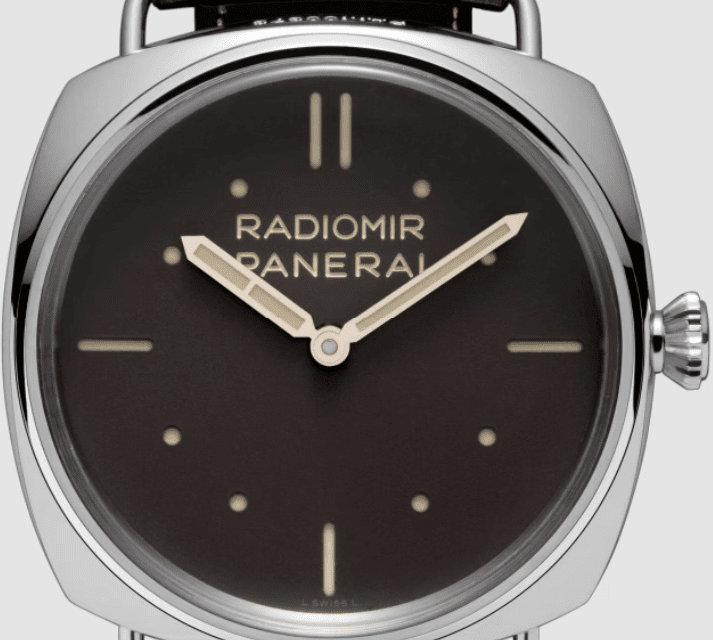
- The brown sandwich dial carries no numerals, no date, no seconds, just baton hour markers and a single gilt line reading “Radiomir Panerai.” Nothing performative, nothing to interrupt the symmetry.
- The movement is the in-house P.3000, hand-wound, 21,600 vph, twin barrels, 72-hour reserve, 161 components, visible through a sapphire display caseback, a modern engine inside a deliberately old-fashioned shell
- On the secondary market, documented full-set examples commonly trade from the high-$20,000s to the low-$30,000s, reflecting genuine scarcity and the reference’s quiet standing among Radiomir purists
Jump directly to the spec sheet.
When Panerai released the Radiomir 3 Days Platino, PAM00373, in 2011, it wasn’t chasing novelty or trend. This was not another variation on a theme, nor a marketing exercise in material upgrades. It was, instead, a near-academic exercise in distillation, a modern platinum homage to the very first Panerai tool watches from the late 1930s, rendered with deliberate restraint and almost ascetic simplicity.
Produced in a limited run of 300 pieces, confirmed by WatchBase’s reference documentation, the PAM00373 was part of the brand’s early Neuchâtel-era push to reassert in-house manufacturing and heritage coherence. It quietly embodies that intent: all the DNA of the original Radiomir, rebuilt around the P.3000 caliber, and finished with the kind of understatement only platinum allows.

Case and Construction: The Original Form, Perfected
The PAM373 uses the classic Radiomir case, not the Radiomir 1940. That distinction is crucial. Here we have wire lugs, a polished cushion case, and an onion-shaped crown, all visual and structural signatures of the original Radiomir references supplied to the Regia Marina beginning in 1938.
- Case material: 950 platinum
- Diameter: 47mm
- Thickness: approximately 16mm
- Water resistance: 100 metres
- Crystal: Plexiglas (not sapphire)
- Caseback: Sapphire display
- Lug width: 26mm
Specifications confirmed directly against Panerai’s own archive listing for this reference.
Panerai chose platinum not as a status gesture but as a design thesis, to elevate the humble form through weight, tactility, and light. The mirror polish softens its edges; under certain lighting, the watch appears warmer than steel, subtly grey rather than bright. This is the traditional, dense 950 platinum alloy rather than the harder proprietary Platinumtech blend Panerai developed years later for references like the PAM01364, an important distinction for anyone comparing this watch against more recent platinum Radiomirs.
The wire lugs remain faithful to early Radiomir construction, fixed and soldered directly to the case. It’s an inherently old-fashioned approach that sacrifices convenience for authenticity. Likewise, the domed Plexiglas crystal is a deliberate anachronism, distorting reflections slightly and lending the dial that unmistakable vintage character.
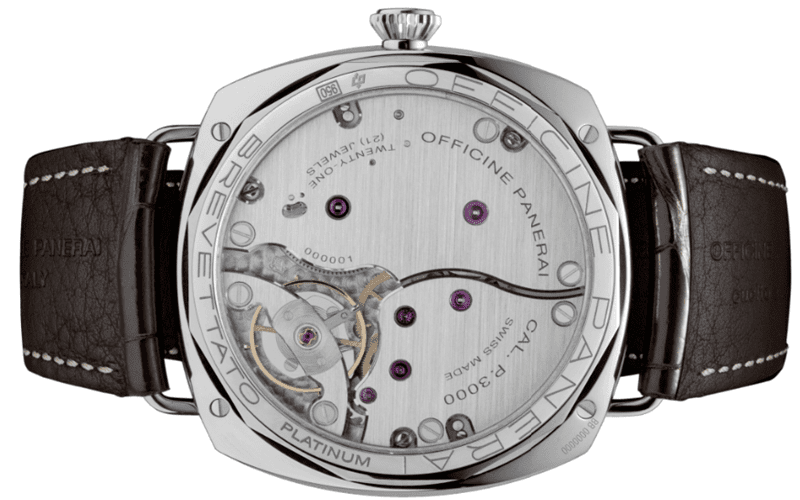
Flip it over, and the sapphire caseback reveals a starkly modern contrast: the fully in-house P.3000 movement, filling the case with quiet purpose.
The Dial: Simplicity Made Honest
The dial of the PAM373 is brown, matte, and index-only, no numerals, no logo overload, no date, no seconds. Just baton hour markers cut through the top dial plate, revealing the glowing layer beneath.
It’s a two-layer sandwich construction, exactly as Panerai pioneered in the late 1930s to improve underwater visibility. The luminous material sits beneath the top plate, glowing through clean, rectangular apertures.
Text is limited to a single gilt line at 12 o’clock: “Radiomir Panerai.” That’s it. No “Automatic,” no “Swiss Made,” nothing to interrupt the symmetry. The hands are gold-toned, pencil-shaped, and polished, harmonising with the warmth of the dial. The lume colour leans slightly creamy, reminiscent of tritium ageing but not exaggerated. It’s Panerai at its most disciplined: nothing unnecessary, nothing performative.
The dial’s design isn’t an invented aesthetic. A specialist vintage dealer’s listing for the reference notes the design is directly modelled on an original wartime prototype:
“…based on a 1930’s prototype Radiomir, of which only two examples are known…” Watch Club, London, on the PAM00373’s dial design lineage
That’s a genuinely rare piece of design provenance for a modern production watch, however small the run.
Movement — Caliber P.3000 in the PAM373
Behind the simplicity lies one of the cornerstones of Panerai’s modern manufacture: the P.3000 hand-wound calibre, introduced in 2010.
Key specifications:
- Diameter: 16½ lignes (37.2mm)
- Height: 5.3mm
- Frequency: 21,600 vibrations/hour (3Hz)
- Power reserve: 72 hours (3 days) via twin barrels
- Jewels: 21
- Components: 161
- Functions: hours, minutes, independent hour hand adjustment
Architecture. The P.3000 was designed specifically for Panerai’s large cases, it fills the 47mm footprint perfectly. The twin mainspring barrels deliver a consistent torque curve, and the full-bridge layout enhances durability and shock resistance.
Operation. The winding feel is deliberate, solid, and smooth, with a satisfying mechanical resistance through the onion crown. The movement features an independent hour-hand adjustment system, allowing local time changes in one-hour increments without hacking or affecting the balance.
Finishing. Functional, not decorative. The bridges are brushed horizontally, edges cleanly bevelled but not mirror-polished. Screws are polished, jewel sinks neat and consistent. Panerai avoided Geneva stripes and excessive ornamentation, fitting for a watch born of naval utility, even when executed in platinum.
Performance. In collector accounts, the P.3000 typically runs within a few seconds per day with good amplitude stability. It’s robust, easily serviced, and has become one of the brand’s most reliable manual calibres of the modern era.
Wrist Experience: Density and Discretion
At 47mm, the PAM373 sounds imposing, but its wire-lug geometry and curved caseback make it far more wearable than the raw dimensions imply. The absence of a crown guard, never used on a Radiomir, helps too, preserving symmetry and comfort on the wrist.
What defines the wearing experience is weight. Platinum has a gravitas unlike any other metal. The watch sits low but firm, not oppressive, just authoritative. It’s not a daily wearer; it’s a deliberate one.
The dark brown alligator strap, ecru-stitched, 27/22mm, pairs with a trapezoidal polished white gold buckle, not platinum, as some casual descriptions of this reference suggest. The pairing is mature, muted, timeless, far from the tactical black straps often associated with Panerai.
Historical Context: A Modern Tribute with Academic Precision
The PAM00373 is rooted in the 1938 Radiomir Ref. 3646, one of the earliest Panerai dive watches produced for the Regia Marina, the Italian Royal Navy, including the frogman commando units that made the brand’s reputation. Those watches featured wire lugs, sandwich dials, and large manually wound movements supplied by Rolex.
Panerai’s 2011 reinterpretation retained the essential architecture but reimagined it through modern manufacture. By using platinum and an in-house movement, the brand symbolically reclaimed its past from the era of supplied parts. Anyone interested in how Panerai’s other platinum tributes handle this same tension between heritage and manufacture ambition should also look at the PAM00201, the 2005 platinum Radiomir that debuted the brand’s very first in-house movement, the P.2002. The PAM373 wasn’t meant to recreate history, it was meant to reconcile it with contemporary horology.
Is the PAM00373 Worth Buying Pre-Owned?
Because of its limited production, 300 pieces worldwide, the PAM373 was never a mainstream reference. It didn’t appeal to the casual buyer, too minimal, too austere, too expensive for a time-only Radiomir. But within collector circles, it commands quiet respect.
It’s the ultimate Radiomir for purists: no numerals, no logos beyond necessity, no sapphire crystal glare, and no gimmicks. It represents Panerai at its most introspective, the distilled essence of the brand before the marketing era. For collectors weighing this reference against other precious-metal chronograph-adjacent pieces in the line, the Radiomir 1940 Chronograph Monopulsante PAM502 shows how differently Panerai approached precious metal when complication, rather than restraint, was the brief.
On the secondary market, the PAM00373 surfaces rarely. When it does, documented listings show prices commonly spanning the high-$20,000s to low-$30,000s depending on completeness and condition, well above the roughly €30,000 original launch price once currency movement and scarcity are accounted for. Full sets with original box, papers, and the correct white gold buckle command the top of that range.
Who Is It For?
- The Radiomir purist who wants the least commercial expression of the case. No crown guard, no numerals, no date, this is the reference that strips the design back to its 1938 essentials
- A collector already invested in Panerai’s platinum lineage. Owning the PAM373 alongside the earlier PAM00201 traces the brand’s platinum Radiomir story across its first in-house hand-wound and automatic movements
- Someone drawn to genuine design provenance. The dial’s basis in a documented 1930s prototype, of which only two originals are known, gives this reference a specific historical anchor most modern tributes lack
- A buyer comfortable with a deliberate, occasional-wear watch rather than a daily driver. Platinum’s weight and the Plexiglas crystal’s vintage fragility both argue for considered rather than constant wear
Not for: Collectors who want a crown guard or any Luminor-derived case language, this is Radiomir in its purest form. Anyone who finds a numeral-free, date-free dial too austere to read comfortably at a glance. And not for buyers expecting sapphire-crystal durability, the Plexiglas front is authentic to the brief but will mark more easily than modern alternatives.
Conclusion
The Panerai Radiomir PAM373 is not about spectacle. It’s a watch that rewards those who understand context: a 1930s design reborn through modern engineering, elevated by material choice, and stripped of anything superfluous.
Every decision is rooted in discipline, from the Plexiglas crystal to the lack of numerals, from the brushed bridges to the hand-wound simplicity. Even the use of platinum feels intellectual, not indulgent, a material statement that purity, not practicality, can be luxurious.
This is the rare modern Panerai that feels both scholarly and soulful, a watch that doesn’t demand attention but commands it quietly, through proportion, heritage, and integrity. If the PAM00372 was Panerai’s revival anthem, the PAM373 is its sonata, softer, rarer, and in many ways truer.
Does a watch this restrained earn more of your respect than one that leans on complication, or does the absence of a seconds hand and date test your patience? I’d like to know where you land.
Extended Summary
- The PAM00373, the Radiomir 3 Days Platino, is a 300-piece Special Edition from 2011, a 47mm 950 platinum case built on the classic wire-lug Radiomir architecture in direct homage to the 1938 Ref. 3646 supplied to the Regia Marina
- The brown sandwich dial carries no numerals, date, or seconds hand, just baton markers and a single gilt “Radiomir Panerai” inscription; the design is modelled on a documented 1930s prototype of which only two originals are known
- The in-house P.3000 movement is hand-wound, 21,600 vph, twin barrels, 72-hour reserve, 161 components, and visible through a sapphire display caseback, functional finishing throughout rather than decorative flourish
- The strap and buckle are correctly white gold, not platinum as sometimes described; a dark brown alligator strap on a trapezoidal polished white gold buckle completes the specification
- Secondary market pricing commonly runs from the high-$20,000s to low-$30,000s for documented, complete examples; genuine scarcity at 300 pieces keeps this one of the quieter but more respected platinum Radiomirs in circulation
At a Glance
| Reference | PAM00373 |
| Collection | Radiomir, Special Editions |
| Name | Radiomir 3 Days Platino |
| Introduced | 2011 |
| Limited to | 300 pieces |
| Case material | 950 platinum, polished |
| Case diameter | 47mm |
| Case thickness | ~16mm |
| Lugs | Wire loop, fixed (patented) |
| Lug width | 26mm |
| Water resistance | 100 metres |
| Crystal | Plexiglas |
| Caseback | Sapphire display |
| Movement | Panerai P.3000 (in-house, hand-wound) |
| Movement diameter | 16½ lignes (37.2mm) |
| Movement thickness | 5.3mm |
| Power reserve | 72 hours (3 days), twin barrels |
| Beat rate | 21,600 vph |
| Jewels | 21 |
| Components | 161 |
| Functions | Hours, minutes |
| Dial | Brown sandwich, no numerals, gilt “Radiomir Panerai” text |
| Strap | Dark brown alligator, ecru stitching, 27/22mm |
| Buckle | Trapezoidal polished 18k white gold, 22mm |
| Availability | Discontinued; pre-owned only |
| Secondary market | ~$27,000–$32,000 depending on completeness and condition |