The Radiomir That Went Too Far (And Why That’s the Point)
Quick Takeaways
- The PAM00246 is a 45mm Radiomir in stainless steel housing one of Panerai’s most technically ambitious complications: a rattrapante chronograph with a foudroyante 1/8-second display — two separate functions, both in a single movement
- Only 300 pieces were made, introduced in 2006 — this is one of the rarest and most mechanically complex Panerai references most collectors have never seriously considered
- The movement is the OP XXI calibre, a heavily modified ETA 7750 built by La Joux-Perret with a column wheel and rattrapante layer added — it sounds unglamorous until you understand what was actually done to that base movement
- The blue chronograph hands against a matte black dial are not a styling choice — they are a legibility solution for a dial carrying three separate timing functions simultaneously
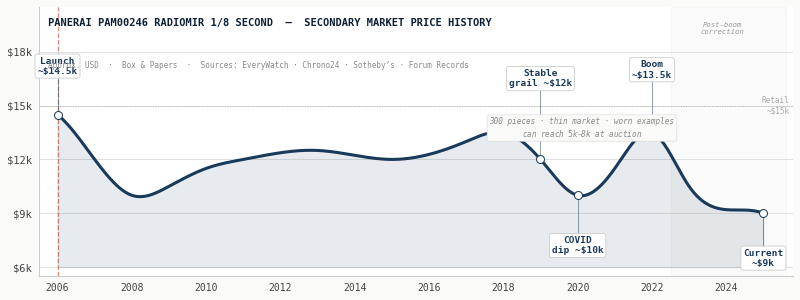
- On the secondary market, clean examples with box and papers currently trade around $8,000–$10,000 — undervalued for what the watch is, particularly given the 300-piece run and the mechanical complexity on offer
Introduction of the Panerai PAM00246
Most Panerai references make sense immediately. Big case, legible dial, lever crown guard, tool-watch DNA — the language is consistent whether you’re looking at a base Luminor or a Submersible. The PAM00246 does not make sense immediately. It takes a few seconds. Then the foudroyante hand begins to flicker across its subdial at nine — eight beats per second, one tick per 1/8th of a second — and suddenly you understand exactly what kind of watch this is.
The Panerai PAM00246 is a Radiomir rattrapante chronograph with a 1/8-second foudroyante display, limited to 300 pieces and introduced in 2006. It’s the watch Panerai built when they wanted to demonstrate what a 45mm cushion case could contain when pushed to the edge of mechanical ambition. Whether it belongs in the Radiomir lineage is a fair question — and one I’ll give you a direct answer on by the end. What it undeniably belongs to is the narrow category of Panerai watches that are genuinely difficult to replicate, and that rarity deserves a closer look.
RWhat the PAM00246 Actually Is — Complications Explained
Before anything else, let’s untangle the terminology. This watch combines three distinct timing mechanisms, and most coverage muddles them together.
Chronograph: The Foundation
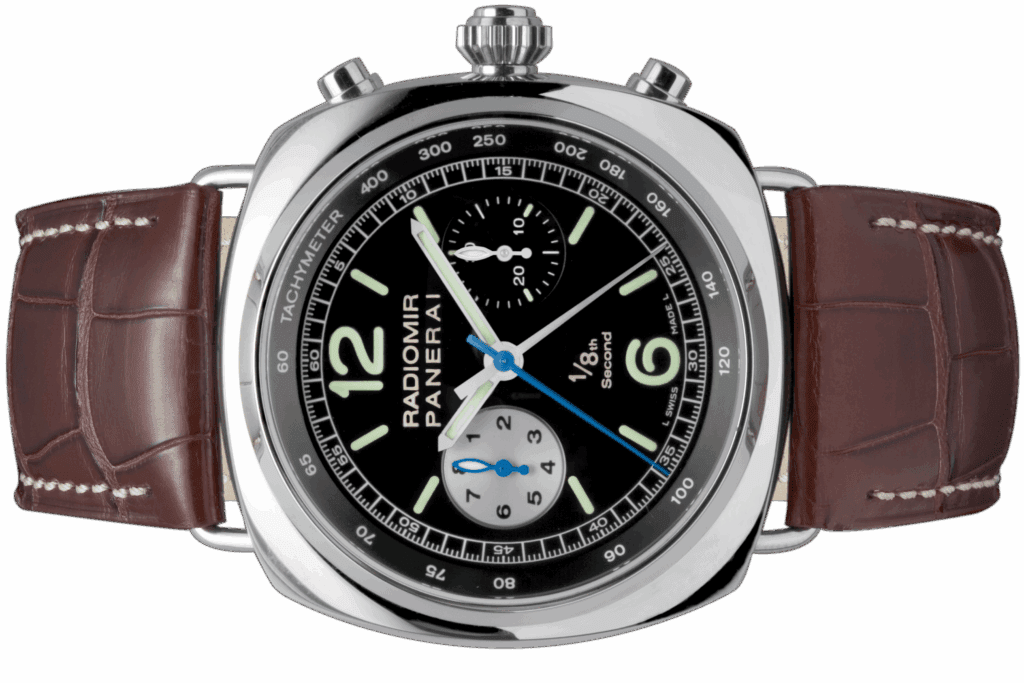
A standard chronograph is a stopwatch integrated into a wristwatch — start, stop, reset via pushers. The PAM00246 has a conventional chronograph function: the large blue central sweep hand is the running chronograph seconds, the sub-register at 3 o’clock counts elapsed minutes up to 30, and the whole thing is operated by the two round pushers flanking the case. Standard enough. But it’s the platform for what comes next.
Rattrapante: Split Seconds
The rattrapante — French for “catch up” — adds a second chronograph hand stacked beneath the first. When you activate the chrono, both hands run together. Press the split-seconds pusher (integrated into the crown on the PAM00246, which is the correct and historically coherent way to do it on a Panerai) and the lower hand stops, freezing an intermediate time while the main chrono hand continues. Press again and the stopped hand catches up instantly, rejoining the main sweep. It’s the mechanism you need to time two events that start together but don’t end at the same moment — two runners crossing a finish line seconds apart, two laps of an engine test.
As Chrono24’s complication guide notes, the rattrapante’s roots go back to 1831, but it remains one of the most mechanically demanding complications to execute reliably. On most watches that carry it, it commands a significant price premium. On the PAM00246, it’s included alongside something even rarer.
Foudroyante: 1/8-Second Display
The foudroyante — literally “lightning” in French — is the sub-dial at 9 o’clock. It shows elapsed time in 1/8-second increments: the hand sweeps through eight positions per second, stopping briefly at each graduation before jumping to the next. At 28,800 beats per hour, the movement runs at exactly 8Hz — one beat per 1/8th of a second — which means the foudroyante hand is advancing with every single beat of the balance wheel. Watch it through the display caseback and you are, in the most literal sense, watching the movement breathe.
This is not a complication that makes the watch more useful for most wearers. Timing events to 1/8 of a second is a niche requirement. What the foudroyante actually does is make the movement’s internal rhythm visible — it turns the calibre’s frequency into a display. I find that genuinely compelling. You can argue about whether you need it; you cannot argue about whether it’s interesting.
The OP XXI Calibre — La Joux-Perret’s Masterwork on a 7750 Base
What Was Built, and How
The Calibre OP XXI is Panerai’s designation for a movement constructed by specialist firm La Joux-Perret on an expanded ETA 7750 base. To be precise: the base is the ETA Valgranges architecture, a scaled-up 7750 variant measuring 36.6mm in diameter (versus the standard 7750’s 30mm) to better fill the 45mm case. La Joux-Perret then applied what Grail Watch’s column wheel analysis describes as their LJP8721 rattrapante variant — two column wheels to manage both the standard chronograph and the split-seconds mechanism. That’s architecturally different from the cam-based rattrapante that Richard Habring developed for IWC; this approach gives more precise, reliable split-seconds engagement and is more expensive to produce.
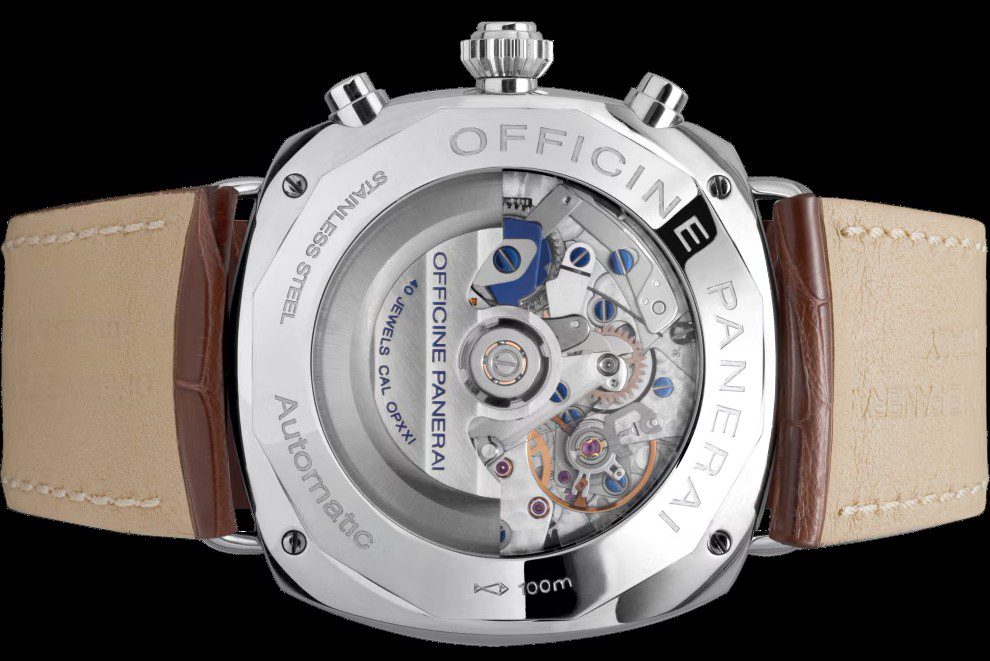
The foudroyante layer sits on top of all this, driving the indicator hand at 9 o’clock in 1/8-second steps. Total jewel count: 40. Côtes de Genève decoration on the bridges, rhodium-plated finishing, Glucydur monometallic balance, Incabloc shock protection. Power reserve: 42 hours at full wind — adequate, and it rewinds automatically via the rotor.
The ETA Base: a Feature, Not a Flaw
Here’s where I’ll push back on a narrative I’ve seen in forum threads. The OP XXI is built on a modified ETA 7750 base, and some collectors treat that as a deduction. I’d argue it’s the opposite. The 7750 is, per Quill & Pad’s authoritative history of the calibre, the most widely used chronograph movement in history — a platform so mechanically sound that IWC, Panerai, Hublot, and Chronoswiss all used it as the foundation for genuinely complicated, high-spec modifications. La Joux-Perret’s work on this calibre added two column wheels and a rattrapante layer to a movement that did not natively support either. That’s not a shortcut. That’s applied engineering on a proven base.
For collectors who value in-house movements as a matter of principle: fair enough. But the OP XXI does things Panerai’s own P-series movements have never been asked to do. The complexity here lives in what was added to the base, not in what the base replaced.
“While 7750 is considered a common movement, it is strong, reliable and easy to service — which stays true to Panerai’s roots as a military diver.” — WatchUSeek Panerai forum thread
That collector’s take is blunter than I’d put it, but it’s not wrong. And on a 300-piece limited edition from 2006, the practical consideration of serviceability matters. Any qualified watchmaker familiar with the 7750 family can work on the base; only the rattrapante layer requires specialist knowledge.
The Dial — Too Much Information, Executed Correctly
The Layout
The PAM00246’s dial is the most complicated face Panerai had put on a Radiomir at the time of its introduction, and it shows. The main chapter ring carries a railroad-style 60-minute scale with 1/8-second graduations in luminous white, readable at running speed. A tachymeter to 400 UPH runs on the sloped bezel flange, which is a functional nod to the watch’s motorsport-adjacent timing capabilities. The two sub-dials — foudroyante at 9, 30-minute counter at 3 — are recessed and visually distinct: silver for the foudroyante, black for the minute counter, both with their own sets of luminous markers.
The Blue Hands
The blue central chronograph hand is the right call. With three separate timing mechanisms operating simultaneously, colour differentiation isn’t an aesthetic gesture — it’s necessary information separation. The main time-reading hands are luminous baton; the chrono sweep is blue; the foudroyante indicator is blue with a luminous insert. In operation, you can track all three at a glance without mentally sorting through hand positions. Whether it looks like a Panerai is a separate question. It doesn’t, entirely — and that’s part of what makes the PAM00246 interesting.
Does This Dial Belong on a Radiomir?
I’ll be direct: no, if your definition of “Radiomir” is the austere cushion case with clean dial and military minimalism. The Radiomir was built for legibility under water, not for simultaneous split-second lap timing. A tachymeter and a foudroyante have nothing to do with diving. The Radiomir’s heritage is about reduction, not accumulation.
But yes, if your definition is broader — if the Radiomir is a platform defined by its case shape and its willingness to host complications that the Luminor’s crown guard doesn’t accommodate as elegantly. The cushion case, wire lugs, and smooth bezel of the PAM00246 give the complications room to breathe. The dial is busy, but the case is quiet. That tension is either deeply wrong or exactly right depending on your Panerai philosophy. I find myself in the second camp. The Radiomir’s simplicity at the case level makes the dial’s density a statement rather than a mess.
Case, Crown, and the Display Caseback
45mm in Practice
At 45mm and 13.1mm thick, the PAM00246 is large without being absurd — particularly on the brown alligator leather strap it shipped with. The cushion case’s downturned wire lugs mean the watch sits lower on the wrist than a comparable 45mm round case would, and the polished finish catches light well without reading as flashy. Water resistance is rated to 100 metres — less than the Luminor’s 300m, but consistent with the Radiomir’s architecture and entirely practical.
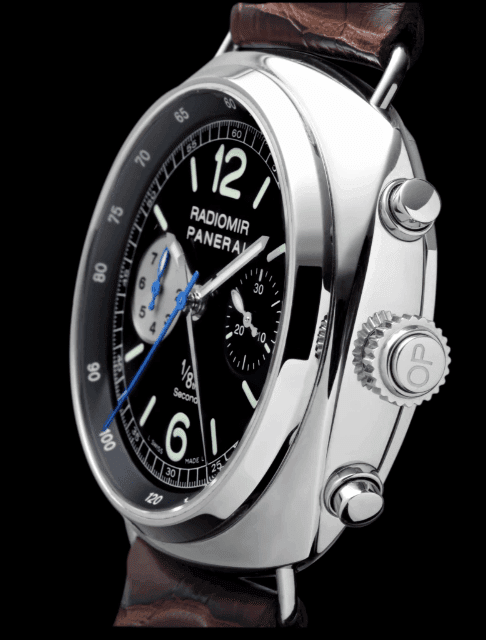
The onion crown is screw-down, and the split-seconds pusher is integrated into its crown unit. That placement is unusual — most rattrapante watches use a dedicated case pusher for the split function — but it keeps the case profile clean and is historically coherent with Panerai’s lever-and-crown-guard design language. In practice, operating it requires unlocking the crown, which adds a half-second of friction to split-second timing. Make of that what you will.
The Sapphire Caseback
The exhibition caseback is one of the few times Panerai’s display back actually earns its keep. With the OP XXI running, the foudroyante mechanism is visible through the caseback — that rapid, stuttering progression of the rattrapante gearing, the column wheels engaging and releasing, the rotor oscillating over Côtes de Genève bridgework. It’s the kind of view that makes the movement’s mechanical statement tangible rather than theoretical. The case perimeter engraving — OFFICINE PANERAI · 100M · AUTOMATIC · STAINLESS STEEL — is clean and restrained.
Is the PAM00246 Worth Buying Today?
Who Actually Owns One
This is a collector’s watch. It always was. At 300 pieces, the PAM00246 was never aimed at the Paneristi who wanted a reliable daily wear or a straightforward entry into the brand. It was aimed at the collector who wanted to know what Panerai could do when the brief was “build the most technically ambitious Radiomir we have ever attempted.” Some owners wear it; most treat it as a display piece. That’s not a criticism — it’s a reflection of what the watch is.
If you’re buying one to wear daily, consider the service implications carefully. The rattrapante layer requires specialist attention when it eventually needs service, and as WatchUSeek threads note, Richemont-controlled service for complicated references can be both slow and expensive. The 7750 base is serviceable by any competent watchmaker; the La Joux-Perret rattrapante module is not.
Secondary Market Pricing
Active listings currently place PAM00246 examples between approximately $8,000 and $10,000 on Chrono24, with the cleaner full-set examples — box, papers, limited edition certificate — toward the upper end. Auction records via EveryWatch show earlier estimates of $5,000–$8,000, which means the market has firmed on this reference as its rarity becomes better understood. For a 300-piece run with a foudroyante, rattrapante, and column-wheel movement, that pricing is, I’d argue, still undervalued relative to what comparable complications cost elsewhere. An IWC Portugieser Rattrapante trades at significantly higher multiples. A comparable Breitling rattrapante reference is in the same territory. The Panerai carries both functions plus the foudroyante display at a fraction of the price.
The PAM00502 Radiomir 1940 Chronograph Monopulsante offers a useful comparison — another Radiomir complication piece in precious metal. The PAM00246, in steel, with arguably greater mechanical complexity, holds its value without the gold surcharge.
The Honest Verdict
The PAM00246 is not a watch for everyone. The dial requires patience. The complications demand that you understand what you’re looking at before they give you anything. The service story is real and should factor into your decision.
But for the collector who wants a Panerai that exists at the absolute edge of what the brand attempted before its full in-house movement transition — a watch where the mechanical ambition is visible, measurable, and genuinely rare — the PAM00246 makes a compelling argument. 300 pieces with a foudroyante and a rattrapante. That’s not a watch; that’s a position statement from a brand in the middle of deciding what it was capable of.
Conclusion
The PAM00246 is not where most collectors start with Panerai, and it’s not where most will end up. It’s a detour — a specific, technically obsessive detour into what a 45mm Radiomir case can contain when the movement specification has no interest in restraint. The foudroyante hand at 9 o’clock ticks eight times per second and tells you almost nothing useful about your day. What it tells you about the watch is everything.
At current market prices, with only 300 examples ever produced, the PAM00246 remains one of the better-value entries into serious Panerai chronograph collecting. The Radiomir’s history is rooted in military utility — but the PAM00246 is proof that the platform could carry something far stranger. Whether that’s a betrayal of the DNA or an expression of it is the question I’d put to any Panerist who handles one. What does it tell you when the foudroyante starts running?
Extended Summary
- The PAM00246 is a 300-piece Radiomir from 2006 combining a rattrapante chronograph and foudroyante 1/8-second display — two separate timing functions in one movement, making it one of the most mechanically complex references Panerai has produced in the Radiomir line
- The OP XXI calibre is a heavily modified ETA 7750 by La Joux-Perret, with two column wheels and a rattrapante layer added — the 7750 base is a feature, not a compromise, given its serviceability and the sophistication of what was built on top of it
- The blue chronograph hands are a deliberate legibility decision, not a styling affectation — with three timing functions running simultaneously, colour separation is functional
- The dial’s density sits in tension with the Radiomir case’s characteristic quietness — the case is clean, the dial is anything but — and whether that tension resolves as coherent or contradictory depends on your Panerai philosophy
- Current secondary market pricing of $8,000–$10,000 for a full-set example is arguably undervalued for a 300-piece rattrapante foudroyante; best suited to serious collectors who understand what they’re buying and have a service plan for the rattrapante module