Quick Takeaways
- The P.2003/6 is an in-house automatic with 10 days of reserve, GMT, date, small seconds, seconds reset and a circular power reserve at 6.
- It is built on the P.2003, Panerai’s first automatic in-house calibre (2006), and it arrived in 2012 with the AM/PM version of the PAM00323. It replaced the P.2003/5 of the 2010 original.
- 292 components, 25 jewels, 28,800 vph, 13¾ lignes and 8mm thick, with three barrels in series. Even torque is the design goal.
- The /6 appears in one reference only, the PAM00323. If you want this movement, you buy that watch.
- Official servicing starts at around €1,500. Keep it inside Panerai’s network.
Jump directly to the spec sheet.
Introduction — Ten Days of Truth: Inside Panerai’s P.2003/6
Say “Panerai” to a casual collector and the response is predictable: cushion case, sandwich dial, oversized crown guard, wrist presence for days. Fair enough, that’s the look. But for those who follow the brand beyond the surface, Panerai’s credibility rests on what it built under the hood once the Richemont years began in earnest.
The P.2000 family marked the turning point. It was Panerai’s loud answer to critics who claimed the brand was all case and no calibre, just another shell over a bought movement. Among its members, the Panerai P.2003/6 movement sits as one of the most ambitious: a 10-day automatic with a GMT, carried by a single reference, the Radiomir 10 Days GMT PAM00323.
Panerai has since scattered its catalogue with countless complications and special editions. The P.2003/6 is the opposite: a movement and a watch that belong to each other. This guide covers where it came from, how it is built and why it matters. Where does the story start?
What Is the Panerai P.2003/6 Movement?
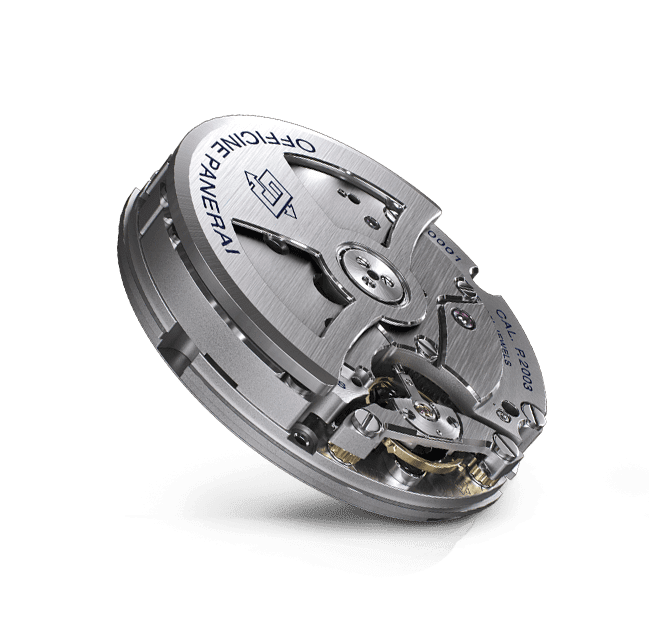
The P.2003/6 is a variant of the P.2003, an automatic mechanical movement designed and made by Panerai in Neuchâtel. It runs three spring barrels in series for a 10-day reserve, and it carries a GMT function, a date and a circular power reserve indicator at 6 o’clock.
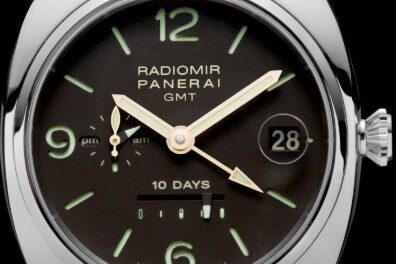
The variant matters because of what it is not. Most P.2003 watches use a linear reserve indicator. The /6 uses a circle, and that one change shapes the whole look of the PAM00323 dial.
The P.2000 Family: A Short History
Panerai’s in-house journey began in the mid-2000s. Before it, the brand’s movements were modified outside calibres, and that was the criticism the P.2000 series set out to end.
The P.2002 came first, in 2005: an 8-day hand-wound movement with a linear power reserve, a nod to the Angelus SF 240 that powered the 1956 GPF 2/56, the watch known as the Egiziano. It was heritage anchored in mechanics. The brand’s own history page lays out the same sequence, and my history of Panerai puts it in the wider story.
The P.2003 followed in 2006 and answered a different question: what if automatic winding could live alongside a big reserve? It added a bidirectional rotor on a ball bearing and stretched the reserve to 10 days, with GMT and a date. For the first time, Panerai had an automatic movement it designed itself. My P.2003 calibre family article follows the line in more detail.
How Does the P.2003/6 Differ From Other P.2003 Calibres?
The family has several branches. The base P.2003 uses a linear reserve indicator and powers the Radiomir 10 Days GMT in white gold (PAM00235) and pink gold (PAM00273), and more recently the 44mm Luminor Dieci Giorni GMT, PAM01482. The P.2003/10 adds higher finishing, with perlage and skeletonized bridges and rotor.
The two versions of the PAM00323 are the interesting pair:
- The 2010 dot version runs the P.2003/5.
- The 2012 AM/PM version runs the P.2003/6.
Functionally it is the same engine: the same barrels, the same 10 days and the same complications. What changes is the presentation. The circular indicator reads more naturally on a Radiomir dial, and it arguably ages better in design terms.
Anatomy of the Panerai P.2003/6 Movement
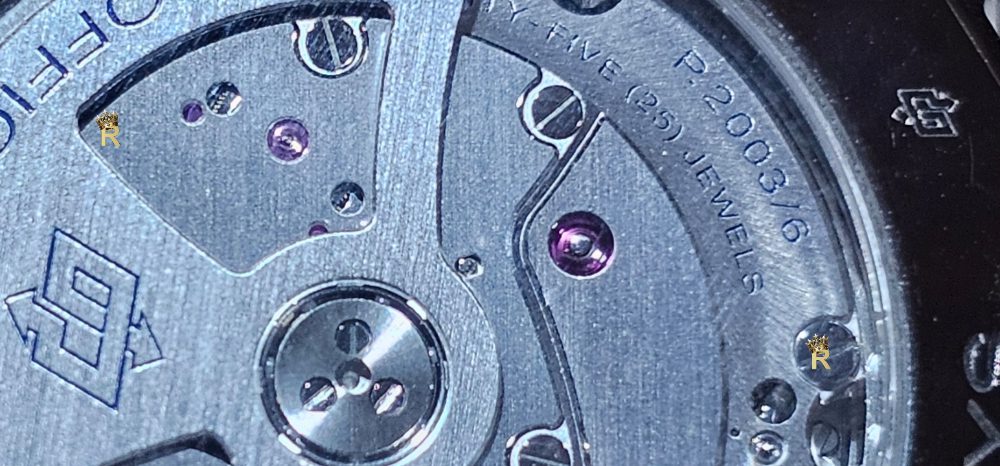
Let’s get technical. The P.2003/6 measures 13¾ lignes in diameter, about 31mm, and 8mm thick. Not petite, but neither is the 47mm Radiomir it lives in.
It beats at 28,800 vibrations per hour (4 Hz), which is modern, stable and in line with Panerai’s preference for reliability over esoterica. A Glucydur balance handles thermal stability, and a KIF Parechoc anti-shock system takes care of the bumps a tool watch sees.
There are 25 jewels and 292 components. That isn’t haute horlogerie excess, it’s engineering density. The winding is bidirectional, feeding energy into three barrels arranged in series.
Why do three barrels in series matter?
The three barrels in series are what make the 10-day reserve technically credible rather than merely impressive on a spec sheet. Each barrel works at a more moderate tension, and the aim is a force that stays almost constant over the whole reserve.
My own experience backs it up. On my PAM00323, the watch holds rate on day nine almost as well as on day one. That’s the engineering argument for 10 days. It isn’t that you can forget to wind for a week and a half, it’s that the mainspring is never asked for explosive torque at full wind or left scraping along at the end.
“much less need for winding” Europa Star, on what a long reserve meant for Panerai’s military divers
What does the P.2003/6 do?
- Hours and minutes, central
- Small seconds at 9 o’clock, with the day and night indicator
- Date window at 3 o’clock
- GMT: a 12-hour hand that sets independently in one-hour steps, paired with a fixed 24-hour hand
- Circular power reserve indicator at 6 o’clock
- Zero-reset seconds: pull the crown and the seconds hand snaps to zero for precise synchronisation
The GMT is not the most intuitive on the market. One detailed owner review makes the point that reading a second time zone takes a moment’s thought rather than a glance. For a traveller’s tool, that’s acceptable. This is Panerai at its most pragmatic: bold on the outside, quietly obsessed with usefulness on the inside.
Which Watch Uses the Panerai P.2003/6?
Here’s where the story narrows: the P.2003/6 appears in one reference, the Radiomir 10 Days GMT PAM00323, from the 2012 AM/PM version onward. Not a Luminor, not a special edition, nothing else.
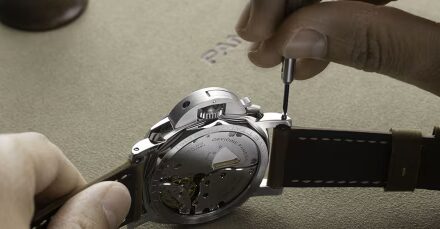
At 47mm in polished steel, with the wire lugs that define the Radiomir and an exhibition caseback, the PAM00323 gives you an unfiltered look at the movement. The black sandwich dial keeps the standard Radiomir layout, and the circular reserve at 6 o’clock sits in it without breaking the symmetry. The 2010 dot version carries the P.2003/5 instead, so check which version you are looking at before you buy for the movement alone. For once Panerai resisted the temptation to recycle. The P.2003/6 is as much a part of the watch’s identity as the sandwich dial or the Radiomir case shape.
Other 10-day watches exist, but not with this variant, and none of them gives you the circular indicator. If you want the P.2003 family in other forms, look at the PAM00235, PAM00273, the 2012 platinum, white gold and red gold PAM00495 to PAM00497, or the Luminor PAM01482.
Finishing and Servicing
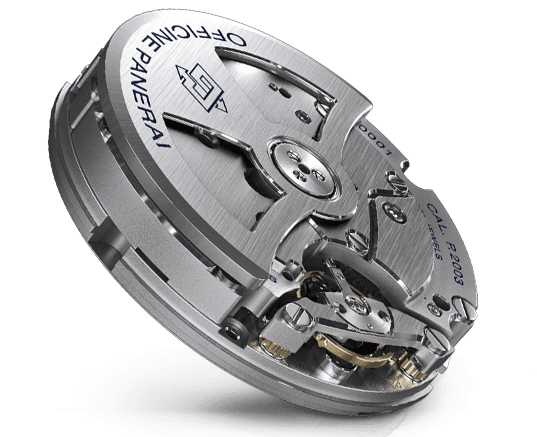
Panerai has never chased Geneva stripes and mirror anglage. The P.2003/6 is finished in the brand’s functional, industrial style: brushed bridges, clean edges, engraved text and a solid rotor that gets the job done without theatre.
If you want black polishing and hand-bevelled angles, look elsewhere. If you want a movement that suits a military-derived tool watch, this is it. The rotor hides most of the gear train, so through the caseback you see the rotor and the balance more than the barrels. That’s the design, not a shortcut.
The P.2003 family is reliable in normal operation, but 292 components, three barrels and a GMT system mean it belongs in Panerai’s official network, not with every independent watchmaker. Official servicing starts at around €1,500 and goes up from there. The movement is built for longevity. The service cost is the real number to plan around.
Why Ten Days Still Matters
Panerai could have stopped at 3 days. Or 8, to echo the Angelus SF 240 of the 1950s. But 10 days is a statement.
It isn’t only convenience, though winding once on Sunday and glancing at 6 o’clock to find the reserve still in the upper third on day six is a real pleasure. In my opinion it is about symbolism. The Angelus 8-day defined Panerai’s vintage credibility, and the 10-day reserve was a way of saying the brand had honoured that past and gone further.
The PAM00323 has become a quiet grail for those who see Panerai’s in-house era as the brand’s true test. It isn’t flashy, with no tourbillon cage and no minute repeater, but it embodies what Panerai needed to prove. It’s overengineering in the best way.
Who Is It For?
- The collector who values mechanics and wants more than a bought movement in a cushion case
- Someone who likes the idea of winding once a week and a half
- A Paneristi tracing the in-house era from the P.2002 onward
- Buyers who prefer a single-reference calibre to one recycled across a catalogue
Not for: collectors who want haute-horlogerie finishing; anyone who wants a full view of the barrels through the caseback; buyers unwilling to budget for official servicing.
Conclusion
The P.2003/6 may not be the most famous Panerai calibre. It doesn’t sit in a hundred references or anchor the current catalogue. But in the PAM00323 it tells the truth about what Panerai set out to achieve in its in-house era: long reserves, practical complications and sturdy construction, with no borrowed aesthetics.
Ten days of power, one reference, one movement. For collectors who want to understand Panerai as a watchmaker and not only a design house, that’s about as honest as it gets, and the P.9010/AC shows where the brand went next.
Is the P.2003/6 the finest of Panerai’s in-house calibres, or does a later movement take the title for you? Tell me in the comments.
Extended Summary
- The P.2003/6 is a 10-day automatic GMT with three barrels in series, 292 components, 25 jewels and 28,800 vph.
- It follows the 2005 P.2002 and the 2006 P.2003, Panerai’s first automatic in-house calibre, and arrived in 2012.
- The /6 replaced the P.2003/5 of the 2010 dot version and swapped the linear reserve indicator for a circular one at 6 o’clock.
- It is used in the PAM00323 only, a 47mm polished steel Radiomir.
- Servicing starts at about €1,500, and the movement belongs in Panerai’s network.
At a Glance
| Spec | Detail |
|---|---|
| Calibre | P.2003/6 |
| Type | Automatic, mechanical |
| Introduced | P.2003 in 2006; the /6 in 2012 |
| Diameter | 13¾ lignes (about 31mm) |
| Thickness | 8mm |
| Components | 292 |
| Jewels | 25 |
| Frequency | 28,800 vph (4Hz) |
| Power reserve | 10 days (240 hours), three barrels in series |
| Winding | Bidirectional rotor on a ball bearing |
| Balance | Glucydur |
| Shock protection | KIF Parechoc |
| Functions | Hours, minutes, small seconds, date, GMT, day/night indicator, circular power reserve, seconds reset |
| Watch | PAM00323 only (AM/PM version) |