The Moment Panerai Decided to Grow Up
By 2006, Panerai had something to prove. The brand’s modern resurgence — fuelled through the late ’90s by the Radiomir and Luminor revivals — had established its identity, but not yet its independence. Earlier in-house efforts like the P.2002 showed intent, but a self-winding calibre with a serious power reserve was still missing.
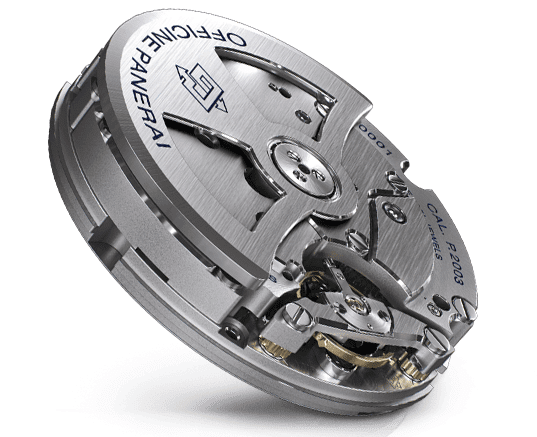
The P.2003 changed that. It arrived as the first automatic movement fully designed and produced by Panerai at its Neuchâtel manufacture. And it wasn’t shy about it. Three barrels. Ten days of reserve. GMT. Date. Power-reserve indicator. All wrapped in the kind of physical presence that matched the brand’s heavy-cased DNA.
It wasn’t delicate or ornate. It was the mechanical equivalent of a Luminor crown guard — a statement of function and force.
From that moment on, Panerai could legitimately claim to build not just its cases and dials, but its own engines. The P.2003 marked the brand’s graduation from bold design house to serious manufacture.
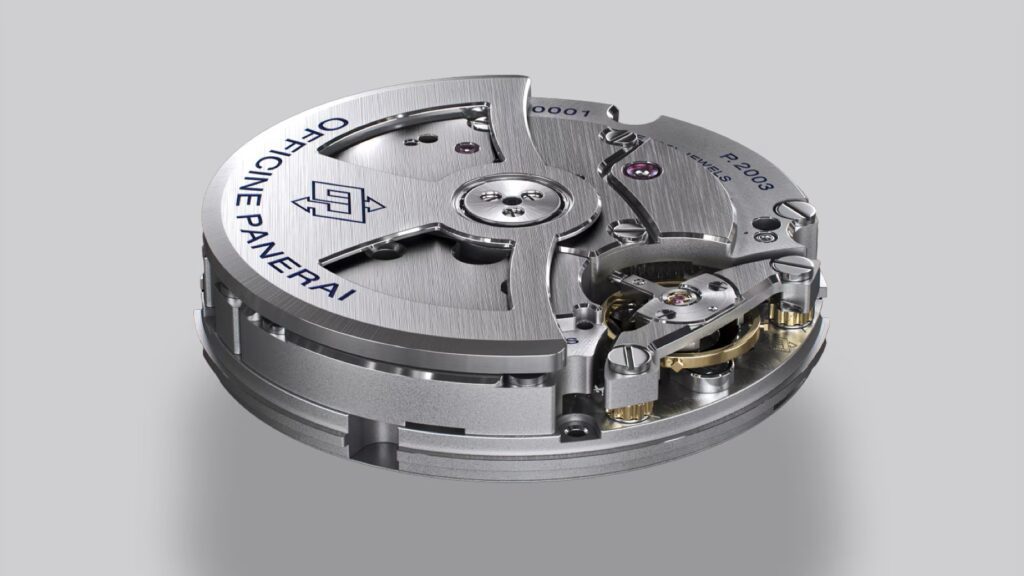
Architecture — Form Follows Force
Measured at 13¾ lignes (about 31 mm) and roughly 8 mm thick, the P.2003 is substantial. Inside that mass lives a design built around endurance.
- Frequency: 28,800 vibrations per hour (4 Hz)
- Jewels: 25
- Winding system: Bi-directional automatic rotor on ball bearings
- Power reserve: 10 days via three barrels in series
- Functions: Hours, minutes, small seconds, date, GMT with independently adjustable local hour, and power-reserve indicator (style dependent on variant)
Most long-reserve movements achieve duration by sacrificing amplitude. Panerai’s engineers avoided that compromise by using three barrels that discharge gradually, maintaining torque stability from full wind to depletion.
The result: consistent timekeeping throughout the ten-day cycle — a design more about reliability than bragging rights.
The free-sprung balance, fitted with inertia screws, improves stability under shock and temperature variation. It’s a detail shared with Panerai’s higher-grade movements and underscores the P.2003’s dual purpose: durability with precision.
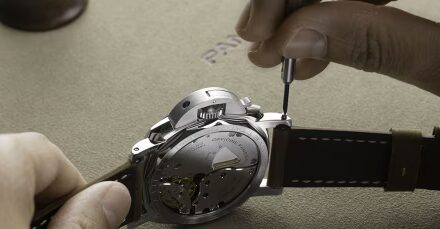
Viewed through a sapphire back, it feels almost architectural — thick bridges, clean geometry, and the quiet impression of something built to last longer than its owner.
The Variants — Four Interpretations of a Core Idea
P.2003 — The Original Blueprint
The debut P.2003 paired automatic winding with the brand’s signature linear power-reserve indicator, visible across the dial like a fuel gauge. It made its first major appearance in the Luminor 1950 10 Days GMT, where the complication mirrored the tool-watch ethos: clarity, strength, and immediacy.
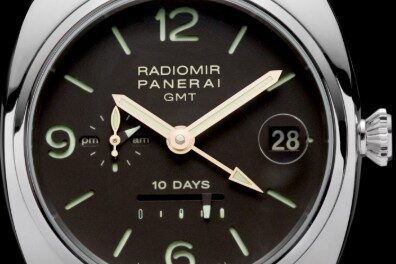
Every hallmark of the family was already in place — the GMT hand adjustable by the hour, the instant date correction, the small seconds at nine o’clock, and the zero-reset feature that allows precise synchronisation.
It was Panerai’s first self-sufficient calibre designed without compromise — not for delicacy, but for daily wear by people who actually use their watches.
P.2003/5 — The Refined Evolution
The P.2003/5 introduced a key visual change: the circular power-reserve display. It replaced the utilitarian line with a more balanced indicator, often placed at six o’clock. Mechanically, it remained identical — ten days, three barrels, the same automatic system — but the aesthetic softening opened the movement to dressier references like the Radiomir 10 Days GMT PAM 323.
This variation signalled a maturing design language within Panerai’s manufacture era. The function stayed identical; the form grew more versatile.

P.2003/6 — The Traveller’s Edition
Next came the P.2003/6, adding a 24-hour AM/PM display — a refinement aimed at frequent travellers who wanted to visualise home time more clearly while adjusting local time independently.
It’s a small change in mechanical terms, but a meaningful one in usability. The extra indicator doesn’t clutter the dial; it enriches it. The P.2003/6 remains relatively rare and is often recognised by collectors as the most functionally complete interpretation of the calibre.
P.2003/10 — The Skeletonised Statement
The P.2003/10 keeps the same architecture but renders it visible. Skeletonised bridges, open-worked rotor, and an overall emphasis on transparency. Nothing mechanical changes — it’s still the ten-day, triple-barrel engine — but the presentation shifts from functional to sculptural.
Used in limited or boutique editions, the /10 brought a level of visual sophistication uncommon for Panerai. It allowed enthusiasts to see the very mechanisms that had defined the brand’s reputation for reliability.
If the base P.2003 was built to endure, the /10 was built to celebrate that endurance.
Finishing — Honest Workmanship
Panerai’s finishing philosophy has always favoured utility over flourish. The P.2003 family continues that approach: cleanly brushed bridges, light perlage on the mainplate, straightforward screws, and clear structural layout.
There’s no Geneva-striping competition here — just deliberate, precise finishing that prioritises durability. The P.2003/10 version, with its skeletonised architecture, introduces finer brushing and visible bevels, but even there, restraint is key.
The finishing isn’t austere; it’s practical. It looks engineered, not embellished — the kind of craftsmanship that rewards close inspection without demanding it.
Real-World Performance
A long reserve can be a double-edged sword — endurance often comes at the cost of consistency. But the P.2003 handles its power elegantly.
When fully wound, amplitude remains stable for most of the ten-day span. The final 24 hours show minor decline, but not enough to affect daily accuracy. The GMT system is intuitive — the local hour jumps in one-hour increments with date linkage, making time-zone adjustments seamless.
The zero-reset seconds mechanism is particularly satisfying: pulling the crown to set the time instantly stops and resets the seconds hand to zero. It’s a small but distinctly modern feature that elevates the movement from rugged to refined.
Panerai owners report practical accuracy within +2 to +5 seconds per day — entirely respectable for a calibre not submitted for chronometer testing. The focus was always autonomy over certification.
A Place Within the Manufacture Lineage
The P.2003 sits within Panerai’s broader P.2000-series — a lineage representing the brand’s mechanical maturity:
- P.2002: Hand-wound, 8-day reserve, linear indicator — the foundation.
- P.2003: Automatic, 10-day reserve, GMT — the evolution.
- P.2004: Flyback chronograph built on the same architecture.
- P.2005: Tourbillon with unique rotating cage, derived from the same design philosophy.
Viewed as a family, the P.2003 is the most balanced — complex enough to impress, practical enough to live with. It carried the torch from the early experimental years into Panerai’s modern manufacture identity.
Practical Considerations
The P.2003’s robustness comes with a few realities.
- Servicing: Three barrels mean more components and longer service times.
- Thickness: At 8 mm, it’s not suited to ultra-slim cases; it lives best inside the 1950-style housings designed for it.
- Rotor bearings: Reliable, though minor play can develop after heavy use — standard for automatic systems of this scale.
- Power-reserve indicator: Requires careful handling during service to maintain calibration.
These are traits to be aware of, not faults. They reflect the calibre’s industrial heritage — designed for endurance, not exhibition.
Collector Perspective
Collectors view the P.2003 as one of Panerai’s pivotal movements. It bridges the gap between early outsourced calibres and the fully integrated manufacture era.
Among enthusiasts, the distinctions between variants have become a quiet taxonomy:
- P.2003: For purists who prefer the original, linear “instrument panel” aesthetic.
- P.2003/5: For those drawn to symmetry and subtlety.
- P.2003/6: The functionalist’s choice — complete and purposeful.
- P.2003/10: For collectors who value open-worked mechanics and boutique exclusivity.
The movement’s market perception has remained steady rather than speculative. It’s respected more for its reliability and engineering honesty than for hype — which, in Panerai’s universe, might be the truest compliment.
Why It Still Matters
Nearly two decades after its debut, the P.2003 continues to represent Panerai’s clearest expression of independence. It’s large, reliable, and defiantly practical — qualities often overlooked in an industry chasing thinness and spectacle.
While subsequent movements like the P.9010 refined packaging and efficiency, they didn’t replace the P.2003’s sense of presence. This was Panerai’s first true statement of engineering self-reliance — and it still feels modern.
Every variant shares a common heartbeat: a design built not to impress a loupe, but to serve a wrist.
Reflection — Endurance as a Philosophy
The beauty of the P.2003 lies not in complexity, but in conviction.
It doesn’t rely on decorative excess or mechanical novelty. It stands for something simpler and rarer: mechanical patience.
Ten days of uninterrupted power isn’t a boast; it’s an attitude. It’s a watchmaker saying, “We’ve made this once — and made it to last.”
In a landscape of rapid iteration, the P.2003 remains a reminder that endurance — physical, technical, and conceptual — is still the most elegant complication of all.h of these variants (PAM numbers, case materials, production years) and we can map them side-by-side. Would that be useful?