Quick Takeaways
- The Panerai PAM00274 — the Radiomir 10 Days GMT Platinum — is a 2007 special edition of just 50 pieces, the rarest and most elevated member of the three-watch precious-metal trilogy that included the white gold PAM00235 and rose gold PAM00273 (each 250 pieces).
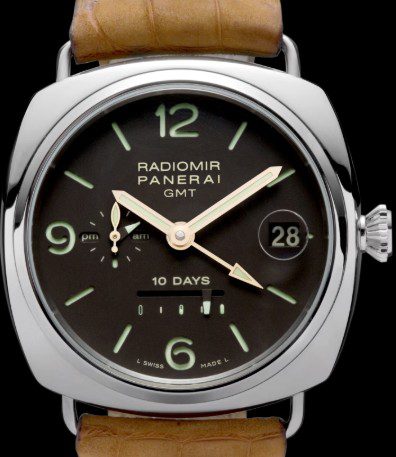
- It is the only watch in the trilogy with a brown dial — while its two siblings wear black, the PAM00274’s warm brown sandwich dial creates a deliberate warm-on-cold contrast with the cool platinum case that no other member of the set achieves.
- The movement is the P.2003, Panerai’s first automatic calibre designed entirely at the Neuchâtel Manufacture — three spring barrels in series, 10-day (240-hour) power reserve, GMT differential, seconds-reset, and a linear power reserve indicator at 6 o’clock.
- The community has consistently identified this watch as among the dressiest Panerai ever made — the combination of wire lugs, no crown guard, platinum, and a warm dial creates a watch that sits at the absolute intersection of the brand’s military DNA and fine watchmaking traditions.
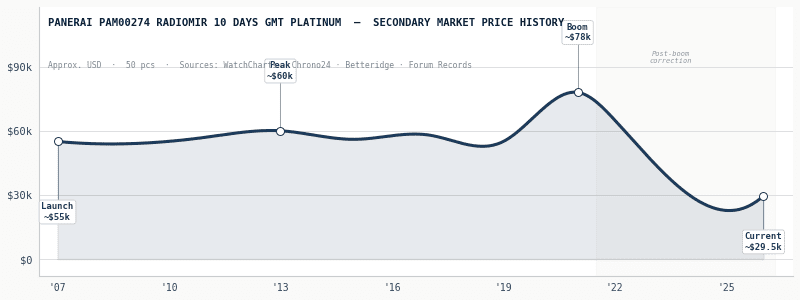
- Secondary market pricing runs approximately $27,700–$33,300 USD for documented examples — reflecting the production ceiling of 50 pieces, the platinum material, and the brown dial that no other automatic Panerai of this era carried in this configuration.
Jump directly to the spec sheet.
Panerai PAM00274 Review — The Rarest Watch in the 2007 Ten-Day Trilogy
There is a moment in the WatchProSite forum archives from 2009 — in a thread asking which Panerai is the dressiest — where a member posts an image of the PAM00274 and adds a note for sale. The description is eight words: “the most beautiful Panerai I have seen.”
Eight words. No model history, no movement explainer, no case specification. Just that.
The PAM00274 earns it. Released in 2007 as the apex of a three-watch precious-metal series alongside the white gold PAM00235 and rose gold PAM00273, it is the only member of the group that sits outside the standard luxury bracket and enters the category of quietly extraordinary. Fifty pieces made. Polished platinum. A brown dial that no other watch in the trilogy carries. An 18k white gold deployant buckle that matches neither the platinum of the case nor the gold of its siblings — chosen specifically for this reference.
The movement is the P.2003 — Panerai’s first automatic manufacture calibre — running for ten days on three spring barrels and reading the remaining reserve on a sliding linear indicator at 6 o’clock. GMT differential at 9. Date at 3. Seconds-reset when you pull the crown.
There is nothing excessive about this watch. Everything about it is deliberate.
One Trilogy, Three Arguments — Why PAM274 Is Different
Fifty vs Two-Fifty — What the Production Number Actually Signals
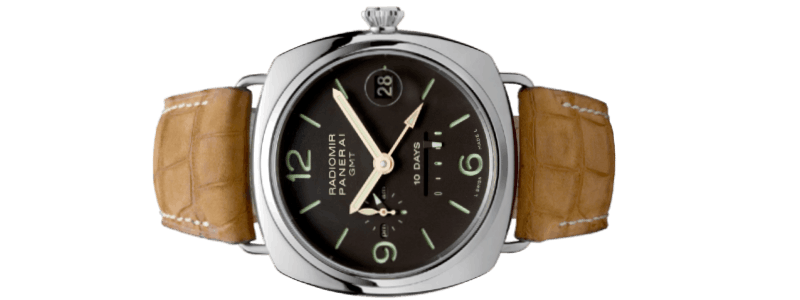
Understanding the PAM00274 starts with understanding what it sits within. Panerai released three platinum, white gold, and rose gold Radiomirs simultaneously in 2007, all powered by the same P.2003 calibre in the same 45mm wire-lug case. They are, mechanically and architecturally, nearly identical. The differentiation is in materials, production numbers, and one critical dial decision.
The PAM00235 in white gold and the PAM00273 in rose gold were each produced in 250 pieces — meaningful rarity within the broader Panerai catalogue, but achievable at most of the brand’s authorised boutiques in any major market. The PAM00274 was produced in 50 pieces. That is not five times rarer in a mathematical sense; it is five times rarer in every practical sense — fewer auction appearances, fewer secondary market opportunities, fewer collectors who have handled one in person.
WatchBase records the relationship plainly: the PAM274 is “the platinum equivalent of the 273 (pink gold) and 235 (white gold) that were both introduced in the same year” and notes that “in contrast with the other two, the 274 features a brown dial.” Two sentences that contain everything structurally essential about this reference.
The 50-piece number was distributed through Panerai boutiques in a way that positioned this watch as a boutique-only acquisition — not a piece you could walk into any authorised dealer and request. A WatchProSite seller note confirms it directly: “Only 50 units made and distributed by the Boutiques.” This is not incidental. Fifty pieces through select boutiques, in the most precious case material, with the only warm dial in the trilogy — the PAM00274 was engineered to be the version collectors would pursue specifically, not stumble into.
The Only Brown Dial in the Set
The dial decision is the most important editorial choice Panerai made with this reference, and it deserves direct treatment.
Both the white gold PAM00235 and the rose gold PAM00273 carry black sandwich dials. The black dial reads as classic, confident, Panerai — it has maximum contrast with any case material, creates the clearest legibility platform for the luminous Arabic numerals, and makes no concession toward any particular emotional register.
The platinum PAM00274 gets brown. Warm, coffee-toned, quiet brown — described variously in auction catalogues and dealer listings as “brown,” “chocolate brown,” and “tobacco,” the last term used specifically by WatchProSite member Anthony in his 2009 forum post identifying the PAM274 as one of the dressiest Panerais.
This is not a coincidence. The warmest possible dial was paired with the coolest possible case material. Platinum is grey-white, cold, formal. A black dial on platinum risks reading as severe — think of a black-dialled chronograph in platinum, clinical and precise. A brown dial on platinum does something entirely different: the warmth of the dial field creates a conversation with the coolness of the case that generates a specific, irreducible visual depth. It is the same logic Panerai applied to the PAM00262’s chocolate California dial against its platinum case, and it works for the same reason — contrast that resolves into warmth rather than tension.
Nicolas on WatchProSite captured this in the kind of direct collector-to-collector language that no press release ever manages:
“The perfect companion for a Fiddy… A reliable movement, a heavy platinum case, and a gorgeous clean, sober brown dial.” — WatchProSite, Officine Panerai forum, on the PAM00274 within the “dressiest Panerai” discussion, 2009
Clean and sober are the operative words. The brown dial on the PAM00274 does not shout warmth — it holds it, quietly, against the formal weight of platinum.
Platinum and Brown — The Visual Logic
Why the PAM274 Got a Warm Dial Where Its Siblings Did Not
The logic extends beyond aesthetics into the collector psychology of precious-metal Panerai. When a Panerai wears a black dial and a steel case, it reads as a tool. When it wears a black dial and a gold case, it reads as a luxury tool. When it wears a black dial and a platinum case, it risks reading as the most expensive version of the same thing — premium but not transformed.
The brown dial on the PAM00274 transforms it. It pulls the watch out of the comparative luxury tier — where the PAM00273 in rose gold competes on material grade — and places it in a different register entirely: the collector register, where the combination of choices that went into the watch creates something that cannot be compared linearly with its siblings.
Monochrome Watches documented another detail that only the production-era specifications reveal: the applied hour markers on the PAM00235 and PAM00273 are in a metal that matches the case — white gold numerals on white gold, rose gold numerals on rose gold. On the PAM00274, the applied numerals do not match platinum. The warmth of the applied markers against the cool platinum case is part of the same visual argument the brown dial makes — deliberate, intentional contrast. A fully platinum-matched dial on a platinum case would be monochromatic and cold. Panerai rejected that option specifically for this reference.
Panerai’s approach to the perpetual calendar has often been described as a study in contradiction — military heritage carrying haute horlogerie complications. The PAM00274 is an earlier expression of the same productive contradiction: a combat-diver’s wire-lug case in the most formal precious metal, with a dial colour that references nothing military and everything Italian in the warmth of leather, coffee, and aged materials.
White Gold Hands and the White Gold Buckle
Two finishing details on the PAM00274 confirm that Panerai thought carefully about every touchpoint on this reference.
The hands are rose gold — not white gold, not platinum-toned silver. The choice of rose gold hands against a brown dial on a platinum case introduces a third warm element into the equation. Brown field, rose gold hands, cool platinum case: the dial face has warmth built in at every level that carries the eye without the case ever losing its formal register.
The deployant buckle is 18k white gold — confirmed across the official Panerai archive, the Betteridge listing, and auction documentation. White gold buckle on brown/ecru alligator strap with platinum case and rose gold hands: this is a specification that required specific decisions at every step. None of these choices are incidental, and none of them are accidental on a watch made in 50 pieces.
The strap itself is “Nubuck Gold, Ecrue” per the official Panerai archive — the same warm, lightly textured ecru tone used on the PAM00262 platinum California, a colour that reads as warm ivory against the cool platinum. It is the strap choice that completes the warm/cool visual logic that the watch constructs from case to buckle.
The P.2003 Inside — Architecture Worth Understanding
Three Barrels, Ten Days, Automatic Winding
The P.2003 was, at the time of the PAM00274’s release, Panerai’s newest and most capable in-house movement. It is the direct automatic descendant of the hand-wound P.2002 that debuted in 2005 — inheriting its GMT differential, its seconds reset, and its linear power reserve architecture, but adding automatic winding via an oscillating weight mounted on ball bearings that winds in both directions.
The ten-day reserve is delivered by three spring barrels in series. Two are stacked vertically; the third links through a gear train that simultaneously drives the linear power reserve indicator. This architecture keeps each barrel running at lower individual tension across the full cycle, which is why the P.2003 can sustain 28,800 vph across ten days — a beat rate that most long-reserve movements sacrifice in the interests of energy conservation. The flat torque curve across the ten-day cycle is the calibre’s central engineering achievement.
The P.9010/AC architecture demonstrates where the P.2000 calibre family eventually evolved — towards complication and annual calendar capability. The P.2003 in the PAM00274 is an earlier, purer expression of that family’s DNA: ten days of power, GMT, date, and the seconds reset that makes precise synchronisation genuinely practical rather than theoretical.
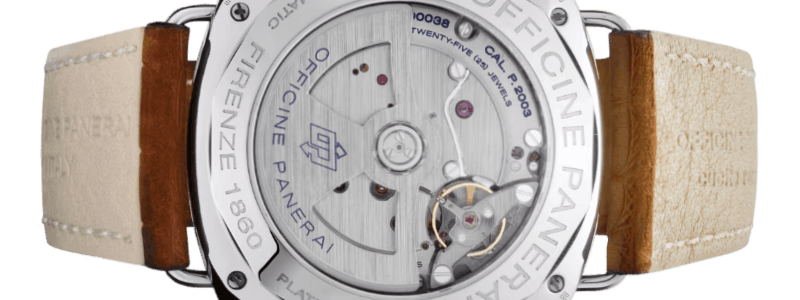
Through the exhibition sapphire caseback, the three barrels are visible in a row alongside the oscillating weight. The view is architecturally coherent — three drums of stored energy, a rotor that restores them passively, and the bridges of a manufacture movement finished to a standard appropriate for platinum surroundings.
The Justin Hast and Tim Green discussion on Panerai touches on exactly this: how the brand’s identity is built on the convergence of Italian aesthetic conviction and genuine Swiss horological capability. The PAM00274 is one of the clearest expressions of that convergence the brand has ever produced — a watch that holds no compromises at any level from the dial down to the calibre.
The zero-reset seconds device is worth understanding practically: pull the crown to the second position and the seconds hand snaps to zero and stops. Push it back in when your reference time clicks over and the seconds restart clean. No seconds offset, no timing error. In a watch that costs $58,900 retail and runs for ten days automatically, the ability to set the time to the second is not an amenity — it is evidence that every complication on the dial earns its place. The BMG-Tech material context frames Panerai’s materials philosophy more broadly — but the PAM00274’s choice of traditional platinum over any proprietary alloy is itself a statement: for a 50-piece special edition in 2007, only the real thing was appropriate.
Fifty Pieces and the Secondary Market
Fifty pieces is a production number that operates differently from 99, 250, or 500. At 99 pieces, a watch is rare but surface with some regularity in secondary markets — enough examples exist for collectors to build a view of typical condition, documentation completeness, and fair price. At 50 pieces, a watch is effectively encountered — each appearance is an event rather than an option.
On Chrono24’s current PAM00274 listings, two examples were recently available at $27,736 and $33,301 USD. These represent the realistic secondary market range for documented examples in strong condition, and the spread reflects variability in completeness — full original set documentation commands the premium. The original retail price of $58,900 means secondary market pricing sits at roughly 47–56% of retail, which is consistent with the broader Panerai correction but should be read against a platinum spot price that has risen significantly since 2007.
The Betteridge documentation of a full-set PAM00274 — “platinum case on a black alligator strap with an 18k white gold buckle… original Panerai watch box and papers, dated 2008” — confirms what constitutes a complete example. The case number, the white gold buckle, the specific alligator strap colour, and the 2008-dated papers (meaning first sale in 2008 for J-series 2007 production) are all markers that a serious buyer should verify.
The thin market creates liquidity risk that cannot be ignored honestly. Fifty pieces globally means no broad buyer pool waiting. Transactions happen between specialists and require patience on both sides. The WatchBase trilogy summary provides the contextual frame: this is the platinum counterpart to two 250-piece references, occupying a deliberate apex position by every measure — production number, case material, dial distinction, and original retail price.
Comparing the PAM00274 directly with its siblings is illuminating: the PAM00273 rose gold trades at $15,000–$22,500 for full-set examples. The PAM00274 commands a premium of approximately 40–50% over that range — reflecting the 5x rarity differential and the brown dial specificity, not merely the platinum material alone.
Who Is It For?
- The collector who owns the PAM00273 or PAM00235 and wants the trilogy’s completion — the PAM00274 is the logical apex of the 2007 set. Owning the platinum alongside either precious-metal sibling creates one of the more compelling comparative pairs in the modern Panerai catalogue.
- A collector specifically drawn to brown-dialled Panerai references — the PAM00274’s brown dial is one of the most distinctive warm-toned dials in the automatic Radiomir line. It carries the same visual philosophy as the PAM00262 California but in a completely different architectural context.
- A Paneristi who defines “dressiest Panerai” as platinum wire lugs with a warm dial — the community record on this is documented and consistent. Nicolas on WatchProSite called it the perfect companion to a Fiddy; the WPS seller called it the most beautiful Panerai they had seen. These are specific collector voices making a specific case that holds across time.
- A patient buyer comfortable with illiquid precious-metal positions — fifty pieces means thin market, long holding periods, and transactions that require specialist knowledge. This is not a watch for the impatient.
Not for: Collectors who prioritise immediacy of acquisition — 50 pieces in global circulation makes finding an example a matter of patient monitoring rather than active searching. Not for buyers expecting liquidity comparable to the PAM00273 or PAM00235 — the production differential is real and market depth reflects it. Not for those who find warm dials on platinum cases philosophically incoherent — the combination is a strong editorial position, not a universally shared preference. And not for collectors whose primary satisfaction comes from the movement alone — the P.2003 is genuinely capable, but it is the totality of case, dial, and movement that justifies this reference.
Conclusion
The PAM00274 is the kind of watch that reveals itself slowly. The first time you look at a photograph, you see platinum and brown and a Radiomir case. The second time you understand what 50 pieces actually means. The third time you read the WatchProSite thread and hear Nicolas describe it in eleven words and realise he got it exactly right.
The brown dial was reserved for platinum. The production number was set at 50. The buckle is white gold. Nothing about this reference was accidental, and everything about it rewards the attention it takes to understand it.
This is the top of the 2007 trilogy. It knows exactly what it is.
Is the PAM00274 the dressiest Panerai ever made, or does another reference take that title in your view? Let us know below.
Extended Summary
- PAM00274 is the Radiomir 10 Days GMT Platinum — 50 pieces from 2007, the platinum apex of a three-watch set alongside the white gold PAM00235 and rose gold PAM00273 (each 250 pieces), all sharing the P.2003 in-house automatic calibre in a 45mm wire-lug case.
- The brown dial is the PAM00274’s defining distinction from its siblings — while the white gold and rose gold versions carry black dials, the platinum version received a warm brown field that creates a deliberate warm/cool contrast with the cool platinum case; applied hour markers on the PAM00274 also differ from the case metal, unlike the matched metals of the other two.
- The P.2003 calibre delivers 10 days of power reserve via three spring barrels in series at 28,800 vph, with GMT differential, zero-reset seconds, and a linear power reserve indicator — representing Panerai’s first automatic movement designed entirely at the Neuchâtel Manufacture.
- The 18k white gold deployant buckle on a brown/ecru alligator strap completes a coherent luxury finishing specification; original retail was approximately $58,900 USD, with secondary market examples trading at $27,700–$33,300 USD for documented full-set pieces.
- The collector community has consistently described the PAM00274 as among the dressiest Panerai ever produced — the combination of wire lugs, no crown guard, platinum case, brown dial, and rose gold hands places it at the precise intersection of the brand’s military heritage and fine watchmaking traditions.
At a Glance
| Spec | Detail |
|---|---|
| Reference | PAM00274 |
| Collection | Special Editions |
| Released | 2007 |
| Limited to | 50 pieces |
| Case material | Polished platinum, 45mm |
| Lugs | Removable wire lugs (patented) |
| Water resistance | 100 metres |
| Crystal | Domed sapphire with anti-reflective coating; cyclops at 3 |
| Caseback | Exhibition sapphire |
| Movement | Panerai P.2003 (in-house automatic) |
| Power reserve | 10 days (240 hours) — triple barrel series |
| Beat rate | 28,800 vph |
| Jewels | 25 |
| Components | 296 |
| Complications | GMT/24h indicator, date, small seconds, linear power reserve, zero-reset seconds |
| Dial | Brown sandwich; Arabic numerals; date @ 3; seconds/24h @ 9; linear PR @ 6 |
| Hands | Rose gold; luminous centres |
| Strap | Brown/ecru alligator with 18k white gold deployant buckle |
| Lug width | 27mm |
| Availability | Discontinued; 50 pieces only |
| Original retail | ~$58,900 USD |