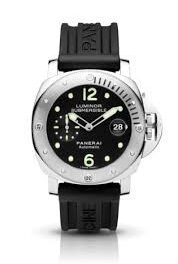
The Submersible That Thinks
Quick takeaways
- The PAM00307, better known as the Luminor 1950 Pangaea Depth Gauge, is a 47mm titanium hybrid diver introduced in 2008 as a 500-piece limited edition, built for explorer Mike Horn’s Pangaea Expedition. A genuine instrument watch, not a themed collaboration.
- The depth gauge is mechanical-electronic, not digital. A sealed piezo-resistive pressure sensor drives a dedicated analogue pointer around the dial’s outer scale, reading real depth in real time, calibrated to 120 metres. No LCD screen, despite what casual summaries sometimes claim.
- The movement is the OP XV, which is literally the OP III calibre (itself built on a modified Valjoux 7750-P1 architecture) with the depth-gauge electronic module integrated, not a separate movement family. Chronometer certified (COSC), with the depth module carrying its own individual METAS certificate
- Deep matte blue dial, not black, a deliberate nod to the sea itself, with small seconds at 9 and the depth scale running the dial’s periphery
- At 47mm and roughly 23mm thick, this is one of the largest Panerais made, and titanium is the only material that makes the electronics-plus-mechanics package wearable at all
Jump directly to the spec sheet.
The PAM307 sits in that rare Panerai twilight zone between serious instrument and fever dream. Introduced in 2008 as a limited edition of 500 pieces, it was the brand’s boldest attempt to merge the heart of a mechanical watch with the mind of an electronic instrument, and to do it without compromising what makes a Panerai feel like a Panerai.
Panerai has always belonged to the sea, born from luminous paste and secrecy for the Italian Navy, but the PAM00307 took that lineage and gave it circuitry. This was no marketing plaything or “inspired by the ocean” affectation. It was built to read the sea itself, in real time, through an onboard pressure sensor hidden under that hulking titanium shell.
The result is a 47mm Luminor 1950 that fused mechanical muscle with technical intellect. Not a dive computer, not a pure watch, something right in between.

Case and Construction: The Titanium Colossus
Hardware first. The PAM307 uses the Luminor 1950 case, that muscular cushion shape bridging the wire-lug Radiomir past and the Submersible present.
Case material: brushed titanium, with a brushed steel bezel Diameter: 47mm Thickness: approximately 23mm Weight: 188.5g Water resistance: 12 bar / 120 metres Crystal: Sapphire Caseback: Titanium, screw-down Crown protection: Patented Panerai lever system
Titanium was the only logical choice. At this scale, steel would have made it punishing on the wrist, and that’s before factoring in the electronic module sealed within. Titanium gave Panerai the strength, corrosion resistance, and weight savings needed for a legitimate professional instrument.
Visually it’s archetypal Panerai: cushion case, integrated crown guard, broad lugs that dip just enough to hug the wrist. The finishing is all business, satin across the body, a brushed steel bezel catching just a whisper of light.
The caseback bears limited-edition inscriptions referencing Mike Horn’s Pangaea Expedition, the scientific exploration project that inspired the watch. Beneath it sits the sealed pressure-sensing system, developed in collaboration with a specialist manufacturer and integrated by Panerai’s engineers in Neuchâtel.
The Dial: Analogue Time, Electronic Depth
Here’s where it gets interesting. The PAM307’s dial is a deep matte blue, not black, a subtle nod to the sea itself. It manages to host both a mechanical time display and an electronic depth gauge without descending into chaos.
Layout highlights:
- Blue background with luminous markers
- Large Arabic numerals at 12 and 6, batons elsewhere
- Small seconds at 9 o’clock
- Peripheral depth-scale indicator
The depth indicator is not a typical LCD screen, despite what some lazy summaries claim. Instead, the watch uses a dedicated mechanical pointer driven by an electronic pressure sensor, its position showing real-time depth readings in metres. When submerged, the module activates automatically; when idle, it sleeps to conserve battery power.
A manual test function lets divers verify the system and battery function before a dive, a genuinely practical safety feature rather than a novelty.
The system is rated to 120 metres. The pressure transducer sits invisibly within the case, keeping the watch’s lines clean and unmistakably Panerai. Legibility, as ever, is near-sacred: large hands, generous Super-LumiNova, instant readout whether under sunlight or saltwater.
The Movement: OP XV, the Hybrid Heart
Forget the P.9000, it came later, and it’s not inside this watch. The PAM00307 runs on the Panerai calibre OP XV, which is not a distinct calibre family in its own right. It is the OP III, itself built on a modified Valjoux 7750-P1 architecture, fitted with the depth-gauge electronic module. Panerai renamed the combined package OP XV to reflect the addition, but the base mechanical architecture is identical to the OP III used elsewhere in the catalogue at the time.
Caliber: OP XV (OP III base, plus depth-gauge module) Frequency: 28,800 vph (4Hz) Jewels: 21 Power reserve: approximately 42 hours Certification: COSC chronometer certified; depth-gauge module carries its own individual METAS certificate Functions: hours, minutes, small seconds; integrated depth-gauge module
The OP XV handles the timekeeping purely mechanically. The depth-gauge module operates separately, a sealed electronic system powered by a micro-battery that drives the indicator hand and sensors. One system runs on gears and barrels, the other on voltage and pressure differentials, and yet they coexist in a single case.
The movement itself is rugged, not decorative. Brushed bridges, straightforward layout, minimal ornament. It’s built for dependability, not display, fitting, given the mission brief.
Depth Gauge Technology: How the PAM307 Reads the Sea
The “Pangaea” name comes from explorer Mike Horn’s Pangaea Expedition, a years-long scientific voyage beginning in 2008, dedicated to oceanic and environmental exploration. Panerai partnered with Horn for the project, producing the PAM307 as a functional companion and commemorative edition.
The watch’s depth gauge relies on a piezo-resistive pressure sensor, which converts ambient water pressure into an electrical signal that drives the indicator hand. It’s precise, durable, and entirely sealed from external exposure.nt water pressure into an electrical signal that drives the indicator hand. It’s precise, durable, and entirely sealed from external exposure.

The system automatically activates underwater and powers down after use, preserving battery life. In 2008, this was cutting-edge. Panerai had effectively built a mechanical-electronic hybrid that still looked like a classic Luminor. Not a computer strapped to your wrist, a tool watch that happened to think.
Mike Horn’s own relationship with the watch went well beyond ambassador duty. In an interview conducted aboard his expedition yacht, he described using the watch in genuinely extreme circumstances:
“…use his watch as an anchor in the side of a cliff…” Mike Horn, describing field use of the PAM307, WatchProSite interview
He looped a rope through the watch’s fastened strap hole to support his own weight while climbing. Whatever the marketing brief called for, that’s a strength test few watches, Panerai or otherwise, are ever actually subjected to.
On the Wrist: Commanding, Surprisingly Civilized
At 47mm, it’s a statement piece, no question. But the titanium case and downward-curved lugs make it more wearable than you’d expect. The rubber strap, embossed “OFFICINE PANERAI,” attaches via 26mm lugs and a broad steel buckle. It’s designed for genuine submersion use: salt-resistant, UV-resistant, unapologetically utilitarian.
Underwater, it’s superb. The analogue time and electronic depth gauge remain readable at all times, crisp, luminous, and intuitive. It doesn’t blink, beep, or scroll data. It just shows you where you are, in metres, the way a Panerai should.
Out of the water, it’s no dress companion, too tall, too purposeful, but on a deck, in sunlight, it looks right at home. A reminder that Panerai, when it wants to, can still make a tool watch that feels genuinely alive.
Not every collector agrees the concept fully lands. A 2010 WatchProSite discussion on the reference captured the split directly, with one participant describing pieces like this as “romantic watches, not intended as a serious dive instrument,” regardless of the manufacturer’s technical claims. It’s a fair, honestly-argued position, and one worth weighing before buying a reference built as much around narrative as around function.
Historical Context: The Instrument Returns
By 2008, Panerai was deep into its Richemont era, the days of naval contracts long gone, replaced by boutique showcases and polished bezels. The PAM307 was a sharp turn back toward the brand’s original purpose: building instruments for people who relied on them.
It echoes the spirit of early depth-testing watches and prototypes like the Ref. 6152/1, created for the Italian Navy’s diving divisions. Those were pure tools, never meant for civilians. Ten years before the PAM307, the modern Submersible line itself began with the Luminor Submersible PAM00024 in 1998, a far simpler watch, but the same instinct: build the tool first, let the aesthetics follow. The PAM307, for once, brought that DNA back into collectors’ hands, uncompromised, technical, functional. For context on how far the brand’s water-resistance ambitions eventually went, the site’s PAM00194 review covers a much later reference rated to 2,500 metres of saturation-diving depth, a useful comparison point for how differently Panerai approached “extreme” across different eras.
Is the PAM00307 Worth Buying Pre-Owned?
Among Paneristi, the PAM307 holds an odd reputation. Revered for its innovation, often ignored in conversation. Maybe because it doesn’t fit the romantic narrative, part mechanical, part electronic, not “pure” enough for the traditionalists.
But that duality is precisely what makes it special. This was Panerai innovating for purpose, not for catalog variation. Limited to 500 pieces, it remains one of the few Panerai models that genuinely earns the title of instrument watch.
They don’t surface often, and when they do, seasoned collectors know exactly what they’re looking at: a moment when Panerai still had the nerve to experiment. Buyers should verify the depth-gauge module is functioning correctly before purchase; the electronic component is the one part of this watch a generalist watchmaker cannot service the way they’d handle the mechanical side.
Documented sales are thin but informative. An Antiquorum auction result shows a PAM00307 selling at HKD 55,000, roughly $7,000 USD, for an example needing a movement overhaul. Dealer asking prices for complete, well-documented sets have run considerably higher, into the mid-teens in USD terms. That spread, low-$7,000s for a project watch up to the mid-$10,000s or beyond for a pristine full set, reflects both the reference’s obscurity and the real cost of servicing the electronic module correctly when it does need attention.
Who Is It For?
- The collector who wants Panerai’s history of genuine instrument-making, not just its aesthetic. The PAM307 was built to do a specific job, and it does it, rather than simulating tool-watch credibility
- Someone drawn to hybrid mechanical-electronic engineering. Watching a sealed pressure sensor drive a mechanical pointer in real time is a genuinely different experience from any purely mechanical complication
- A Paneristi who already owns conventional Submersible references and wants the outlier that most collectors overlook, distinctive by virtue of being genuinely functional rather than merely rare
- Anyone who values documented provenance and a real narrative. The Mike Horn Pangaea Expedition connection isn’t marketing dressing; it’s a watch that was actually used in the field it was built for
Not for: Collectors who want a slim, easy daily wearer, 23mm of thickness with an electronic module inside is a genuinely large watch. Anyone uncomfortable owning a watch with a component (the depth-gauge battery and sensor) that a standard watchmaker can’t service. And not for those who agree with the “romantic watch, not a serious instrument” school of thought, that’s a legitimate, documented collector position on this exact reference.
Conclusion
The Luminor 1950 Pangaea Depth Gauge PAM307 is proof that evolution doesn’t have to dilute identity. It’s a bridge between eras, Florence’s naval origins meeting Neuchâtel’s engineering in 2008. Titanium for practicality, analogue for soul, electronics for precision.
Not beautiful in a conventional sense, but compelling, purposeful, and defiantly singular. A watch that doesn’t perform for applause, only for understanding. It’s the rare Panerai that speaks in both frequencies, mechanical heartbeat and electronic pulse, a tool watch that doesn’t pretend to be anything else.
Would you want a genuine functional instrument in your collection even if it means living with something this thick and this specialized? Or does the electronic module cross a line a mechanical purist shouldn’t cross?
Extended Summary
- The PAM00307, the Luminor 1950 Pangaea Depth Gauge, is a 500-piece limited edition from 2008: a 47mm titanium hybrid diver built for explorer Mike Horn’s Pangaea Expedition, combining mechanical timekeeping with a genuine electronic depth-reading instrument
- The depth gauge uses a sealed piezo-resistive pressure sensor driving a dedicated mechanical pointer around the dial’s periphery, rated to 120 metres, not a digital display as some casual coverage suggests
- The OP XV movement is the OP III calibre plus the depth-gauge module, not a separate movement family; COSC certified with the depth module separately METAS certified, 21 jewels, 42-hour reserve
- The deep matte blue dial is a deliberate departure from Panerai’s usual black, with small seconds at 9 and the depth scale running the outer edge; legibility remains a priority throughout
- Collector reception is genuinely divided, some treat it as one of Panerai’s most interesting instrument watches, others as a “romantic” novelty rather than a serious tool; both positions are documented and defensible, which is part of what makes this reference worth understanding properly before buying
At a Glance
| Reference | PAM00307 |
| Collection | Submersible, Special Editions |
| Name | Luminor 1950 Pangaea Depth Gauge |
| Introduced | 2008 |
| Limited to | 500 pieces |
| Case material | Brushed titanium, brushed steel bezel |
| Case diameter | 47mm |
| Case thickness | ~23mm |
| Weight | 188.5g |
| Water resistance | 12 bar (~120 metres) |
| Crystal | Sapphire |
| Caseback | Titanium, screw-down |
| Movement | Panerai OP XV (OP III base, plus depth-gauge module) |
| Beat rate | 28,800 vph |
| Jewels | 21 |
| Power reserve | ~42 hours |
| Certification | COSC (movement); METAS (depth-gauge module) |
| Complications | Small seconds, integrated analogue depth gauge |
| Dial | Deep matte blue; luminous Arabic numerals and markers |
| Strap | Black rubber, 26/22mm |
| Buckle | Trapezoidal brushed steel, 22mm |
| Availability | Discontinued; pre-owned only |
| Secondary market | ~$7,000 (project/incomplete) to mid-$10,000s+ (complete, documented sets) |