Quick Takeaways
- PAM00194 is a 1,000-piece Luminor Submersible in 47mm titanium, introduced 2004. Rated to 2,500 metres of water resistance, the most extreme dive specification Panerai has applied to a wristwatch in this format.
- 2,500 metres is saturation diving depth: where commercial divers live in pressurised habitat systems for weeks and breathe helium-oxygen mixtures. The helium escape valve on the PAM00194’s case is not decorative; it exists because small helium atoms infiltrate watch cases during saturation dives and must be vented during decompression.
- The official weight is 415.4g: heavier than almost any other Luminor Submersible. The mass comes from the case architecture required to withstand 250 bar of pressure, and it is the first thing you notice when you pick one up.
- The OP III is the Valjoux 7750-P1 base stripped of its chronograph, automatic, COSC certified, 42-hour power reserve. The same movement that powered the early civilian Submersible line; not in-house but properly made and widely serviceable.
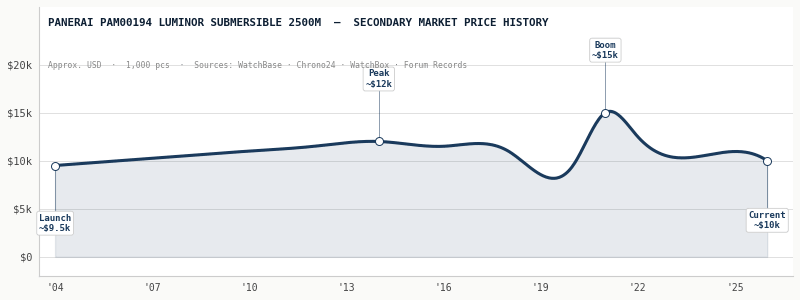
- Secondary market pricing ranges from around $7,000 for worn examples to over $15,000 for complete serviced sets. A 1,000-piece limited edition with a 2,500m rating and genuine saturation-diving credentials; the pre-owned market recognises what it is.
Jump directly to the spec sheet.
When the Number on the Dial Actually Means Something
When the Number on the Dial Actually Means Something
Most dive watches don’t get tested beyond 30 metres. Most collectors don’t dive at all. And most water resistance ratings above 300 metres exist to signal robustness rather than because anyone genuinely needs them.
The Panerai PAM00194 is the exception.
2,500 metres isn’t a round number chosen for marketing impact. It’s a saturation diving specification, the pressure regime in which commercial divers live in underwater habitat systems, breathing helium-oxygen gas mixtures, working at depths that recreational scuba equipment cannot reach. It’s a world where every component of a diver’s equipment, including the wristwatch, faces pressure equivalent to 250 atmospheres of water weight. The Panerai PAM00194 Luminor Submersible 2500m was engineered to survive there.
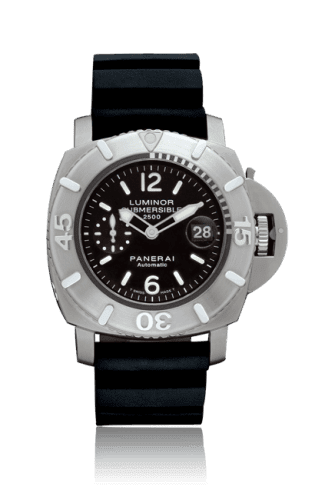
Released in 2004 as a 1,000-piece limited edition, the G-serial, as confirmed in WatchUSeek forum listings, this is a watch that announces itself physically before you’ve looked at the dial. Pick one up and the first thing you register is the weight. The official Panerai spec is 415.4 grams. That’s not the titanium case being heavy; titanium is light. That’s the case architecture being built to withstand pressures that would collapse a standard dive watch like a beer can.
Explore the Luminor collection and you’ll find many 47mm titanium examples. None of them feel like this.
What 2,500 Metres Actually Means — and Why the Helium Valve Is There
Let me spend some time on this, because it’s the entire reason the PAM00194 exists and because most coverage of this watch treats the spec as a trophy rather than an engineering requirement.
Recreational scuba diving operates to a maximum of roughly 40 metres for recreational certifications, and 130 metres for the deepest technical diving configurations. Below that, human physiology breaks down, nitrogen narcosis, oxygen toxicity, decompression obligations that take days to safely resolve. For commercial and scientific work at great depth, saturation diving was developed: divers live in pressurised chambers on the surface or underwater, breathing a helium-oxygen mixture called heliox. Their bodies remain at the same pressure as their working depth for the duration of their deployment, days or weeks, before a slow controlled decompression.
The problem for watches in this environment is helium. It’s a tiny atom, small enough to permeate through gaskets, seals, and any microscopic pathway in a watch case. During the pressurisation phase, helium infiltrates the watch. That’s manageable. During decompression, when the pressure of the habitat drops back toward surface atmospheric pressure, the helium trapped inside the watch tries to escape, building internal pressure that can blow the crystal off the case with considerable force.
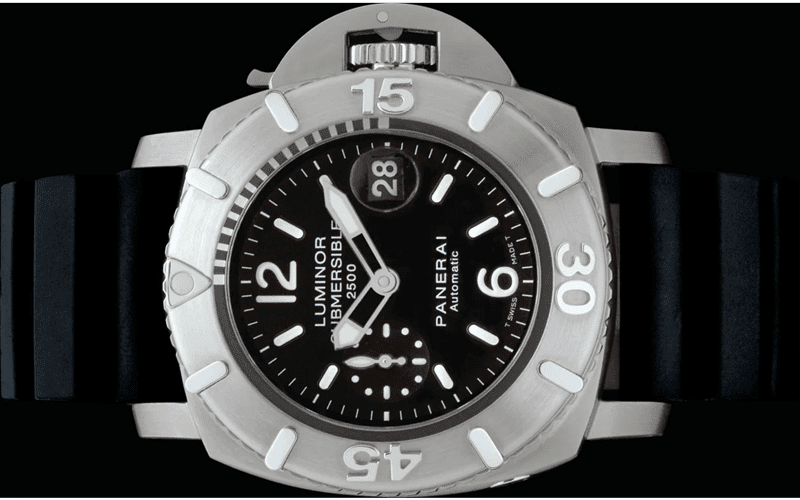
The helium escape valve (HEV) solves this. It’s a one-way valve, typically spring-loaded, that opens under internal pressure to vent accumulated helium during decompression, then reseals. On the PAM00194, that valve sits in the case at the 8 o’clock position, a small but purposeful addition to the standard Luminor Submersible silhouette.
Here’s the honest context: as noted in WatchUSeek’s forum discussion on helium escape valves, the HEV has “zero use for anyone that does not do saturation diving.” Recreational divers, technical divers, even most commercial divers will never encounter the conditions that trigger it. But the HEV’s presence on the PAM00194 is not cosmetic. It’s the physical sign that the engineering behind this case was built to an actual saturation diving specification, not a theoretical one.
The 2,500m rating also demands a solid screw caseback, the exhibition sapphire glass back of a standard display-back Panerai cannot be engineered to withstand 250 bar. The caseback on the PAM00194 is a machined titanium screw-back with no glass aperture. You’re not looking at the movement when this watch is on the wrist. That’s a deliberate sacrifice of aesthetics for structural integrity, and it’s the correct call.
The screw-down titanium crown-protecting device completes the picture. The same Luminor bridge-and-lever system that appears on dress Panereai performs an entirely different function here: it’s the primary seal against extreme depth pressure, engineering the crown to resist 250 bar of inward force. On the surface, it looks identical to every other Luminor crown guard. Under 2,500 metres of water, it’s doing a very different job.
The Case — 47mm, Two-Part Titanium, Steel Bezel, and 415 Grams
The PAM00194 case is the defining physical experience of this watch, so it deserves more than a bullet list.
Two-part cushion-shaped titanium body, 47mm across, with a brushed steel crown-protecting device and lever rather than titanium, the steel provides a visual contrast but more importantly brings additional strength and gasket compatibility to the most pressure-sensitive interface in the case. The bezel is also brushed steel, unidirectional anti-clockwise, with ratchet clicks at one-minute intervals and a graduated immersion time scale. Steel on titanium reads as a purposeful two-material execution that gives the case a density of detail missing from all-titanium finishes.
The 415.4 grams needs to be understood correctly. Standard titanium Submersibles are light relative to their steel equivalents; titanium’s density is roughly 57% that of stainless steel. The PAM00194 achieves its mass through case depth and wall thickness, not material weight. Everything about the case architecture is built to contain 250 bar of pressure. The sapphire crystal is substantially thicker than standard dive watches. The caseback threads are deeper. Every seal point is over-engineered relative to a 300m-rated counterpart.
On the wrist, that mass distributes across a 26mm lug width, notably wider than the 24mm of the standard Luminor, on a black caoutchouc (natural rubber) strap with a trapezoidal brushed steel buckle. Natural rubber, rather than the synthetic rubber of later Panerai straps, is appropriate for saturation diving conditions, where certain synthetic elastomers degrade under prolonged heliox exposure. The original black rubber strap on a well-preserved PAM00194 has a specific texture that later rubber straps don’t replicate. It’s a small detail, but it matters for completeness.
At rest in your hand, the PAM00194 communicates seriousness through pure physics. This is what the heritage behind the Panerai name, precision instruments for professional use, feels like when expressed in a wristwatch format.
The Dial — Black, Operational, No Architectural Frills
The dial of the PAM00194 is a sausage-style black face, a single-layer construction with luminous Arabic numerals and applied hour markers, not the two-layer sandwich architecture of the classic Radiomir and Luminor Marina references. This is intentional and correct.
Luminous Arabic numerals, sword hands with luminous tips, small seconds sub-dial at 9 o’clock, date aperture at 3. Everything is calibrated for immediate legibility under pressure, in low ambient light, against a dark water background. The numerals don’t need to be beautiful; they need to be readable at arm’s length in conditions that make subtlety irrelevant.
The sword hands are thick enough to carry meaningful lume and visible against the dial at angle. The date window at 3 sits cleanly without disturbing the dial’s visual balance. There’s no depth scale on the dial, the immersion time calculation lives on the rotating bezel, where it belongs on a saturation tool.
I’d push back on any review that treats the PAM00194’s relatively plain dial as a disappointment. A watch built for 2,500 metres isn’t trying to compete with a Marina Militare tribute piece for visual complexity. It’s an instrument. The dial reads that way.
The OP III — Automatic, COSC Certified, and Correctly Specified for 2004
The movement powering the PAM00194 is the OP III: Panerai’s designation for a modified Valjoux 7750-P1, the chronograph base stripped of its chrono mechanism and reconfigured as a clean time-and-date automatic by SOPROD on Panerai’s behalf.
21 jewels, 28,800 vph, 42-hour power reserve, COSC chronometer certified. The Glucydur monometallic balance, Incabloc anti-shock device, Côtes de Genève bridge finishing, personalised oscillating weight. These are the same calibre specifications that powered the earliest civilian Luminor Submersibles from the late 1990s, the PAM00024, PAM00025, PAM00087, and the OP III was the undisputed automatic workhorse of Panerai’s pre-in-house era.
Panerai’s in-house programme began in earnest with the P.2002 in 2005 and the P.9000 arriving in 2006. The PAM00194 was produced in 2004, squarely in the OP III period. There’s no apology needed for this. The OP III is robust, well-understood, widely serviceable by independent watchmakers familiar with the Valjoux 7750 family, and COSC-certified. For a watch built to endure 250 bar of pressure, the movement is the least likely component to give you trouble.
The solid caseback means you won’t see the OP III without removing the back during service. That’s the right trade-off. What matters at depth is timekeeping accuracy and mechanical reliability, not the view through the caseback. Compare this to the PAM00372 hand-wound approach and you understand the different design philosophies at play: manual wind for the purist daily wearer; automatic for the professional tool watch that needs to keep running through a saturation dive deployment without someone remembering to wind it.
The COSC certification on the OP III means the movement runs within -4/+6 seconds per day across positions and temperatures. At saturation depth, where precision timing can be operationally critical, that standard matters.
Is the PAM00194 Pre-Owned Worth Buying?
On Chrono24, the PAM00194 ranges from around $6,292 for worn examples without papers through to $15,510 for complete recently-serviced sets with box and documentation. Multiple listings cluster in the $9,000–$12,000 range for good-condition examples with partial documentation. The WatchBox listed one on an orange rubber strap, an aftermarket alternative that confirms most owners swap the original black caoutchouc.
“…the granddaddy of Panerai submersibles… an uber tool watch.” WatchUSeek seller listing, PAM00194 forum thread
That’s exactly right. And the pre-owned calculation for a watch this specific needs some honest framing.
Verify the G-serial production year. The PAM00194 was produced as a G-serial in 2004. Check the caseback serial prefix against known production data; G-series numbers are well-documented in the Paneristi community.
Check the helium valve. Press it gently, it should depress a couple of millimetres and spring back cleanly. A sticky or inoperative HEV doesn’t affect normal function, but a compromised valve suggests the case hasn’t been properly maintained. This is relevant if you intend to actually dive with the watch.
Inspect the caseback threads. A caseback that has been removed clumsily can have damaged threads, a significant structural issue on a 250-bar-rated case. Any reputable seller should be able to confirm it’s been serviced correctly.ctly.
The weight test. The WatchBase listing confirms 47mm titanium case; the official Panerai spec confirms 415.4g. Handle the watch before buying if possible. A PAM00194 that feels light relative to expectation, less substantial than you’d expect from a 47mm titanium case, may have had components replaced.
Original strap. The black caoutchouc (natural rubber) strap with trapezoidal brushed steel buckle is the original configuration. It’s increasingly rare in original condition on 20-year-old examples. Present with original strap and the proper Panerai box with papers adds genuine completeness premium.
At $9,000–$10,000 for a good-condition G-serial with box and papers, the PAM00194 is not cheap. But it’s a 1,000-piece limited edition with the most extreme water resistance specification in the Luminor Submersible line, a COSC-certified movement, a helium escape valve, and the physical presence of something genuinely engineered for extreme professional use. For the collector who wants the deepest expression of what Panerai’s saturation-diving heritage actually means in a modern wristwatch, the price is proportionate to what you’re getting.
Who Is It For?
- The collector who wants the most purposefully engineered Luminor Submersible of its era. The PAM00194 is not a derivative of the standard Submersible with an upgraded water resistance sticker; it was designed from the case outward to withstand 250 bar
- A Paneristi who appreciates extreme specifications backed by genuine engineering. The helium valve, solid caseback, steel crown guard, and 415g mass are all consequences of the 2,500m specification, not design choices bolted on for marketing
- Someone drawn to the pre-in-house era of serious Panerai tool watches. The G-serial 2004 production sits in the sweet spot between the earliest civilian Submersibles and the in-house movement era; it’s a historically coherent object
- A serious diver who wants a wristwatch that is actually rated for saturation conditions. There are very few wristwatches in existence with this specification; the PAM00194 is one of them, and it’s priced below most comparable professional dive instrument watches
- A collector who respects the Panerai Submersible lineage and wants the reference that pushed that lineage to its operational extreme in the early 2000s
Not for: Anyone who wants a light daily wearer, 415g is a deliberate choice, not incidental, and it demands a certain kind of wrist commitment. Also not appropriate for collectors who need an exhibition caseback to feel the movement is worthwhile; that back is solid titanium and it’s not opening for aesthetics. And not a first Panerai, the PAM00194 rewards context.
Conclusion
The Panerai PAM00194 makes a single, sustained argument from the moment you pick it up to the moment you read the dial: 2,500 metres is a real specification, earned through engineering, not marketing.
The case architecture, the helium escape valve, the solid screw titanium back, the 415-gram weight distribution, these aren’t features layered onto a standard Luminor Submersible. They’re the consequences of building a wristwatch rated to the pressure of 2.5 kilometres of water. That’s the depth where commercial saturation divers work. The PAM00194 was built for that world, even if most of its 1,000 owners will never go anywhere near it.
For most Paneristi, the appeal of the PAM00194 isn’t the diving credential, it’s the certainty that this watch was built without compromise. Every detail serves the specification. Very few watches of any era can say that honestly.
If you’ve owned or dived with a PAM00194, I’d genuinely like to know: does the weight eventually become the feature you love most about it?
Extended Summary
- PAM00194 is a 1,000-piece Luminor Submersible in 47mm titanium, introduced 2004 as a G-serial Special Edition. Rated to 2,500 metres / 250 bar, making it the most extreme water-resistance specification Panerai has applied to a Luminor Submersible format watch.
- The 2,500m specification is a saturation diving standard: it demands a helium escape valve (at 8 o’clock), solid screw titanium caseback, steel crown-protecting device, and the case architecture that produces the watch’s 415.4g official weight. Every heavy gram is a consequence of the engineering requirement, not incidental.
- The OP III movement is the Valjoux 7750-P1 base, stripped of its chronograph by SOPROD, automatic, COSC certified, 42h reserve. The same calibre family that powered Panerai’s earliest civilian Submersibles; robust, widely serviceable, and correctly specified for a 2004 professional dive tool.
- Pre-owned pricing ranges from ~$7,000 for worn examples to over $15,000 for complete recently-serviced sets. Helium valve condition, caseback thread integrity, G-serial verification, and original caoutchouc strap are the key pre-purchase checks.
- The PAM00194 is the Luminor Submersible in its most operationally serious form: not a derivative dive watch with an extreme water resistance specification bolted on, but a case designed from the outset around a saturation diving requirement. For the collector who wants the deepest expression of Panerai’s precision instrument heritage in a wristwatch, this is the reference.
At a Glance
| Reference | PAM00194 |
| Collection | Luminor Submersible / Special Editions |
| Name | Luminor Submersible 2500m |
| Introduced | 2004 |
| Edition size | 1,000 pieces (G-serial) |
| Case material | Brushed titanium (crown guard and lever: brushed steel) |
| Case diameter | 47mm |
| Lug width | 26mm |
| Water resistance | 2,500 metres / 250 bar |
| Helium escape valve | Yes |
| Movement | Panerai OP III (Valjoux 7750-P1 base) |
| Movement type | Automatic |
| Power reserve | 42 hours |
| Beat rate | 28,800 vph |
| Jewels | 21 |
| COSC certified | Yes |
| Functions | Hours, minutes, small seconds (9 o’clock), date (3 o’clock), immersion time calculation |
| Dial | Black; luminous Arabic numerals and hour markers; sword hands |
| Bezel | Brushed steel, unidirectional anti-clockwise, one-minute ratchet clicks |
| Caseback | Solid screw titanium |
| Strap | Black caoutchouc (natural rubber), 26/22mm; trapezoidal brushed steel buckle |
| Weight | 415.4g |
| Availability | Pre-owned only |
| Secondary market | ~$7,000–$15,500 (condition and completeness dependent) |