
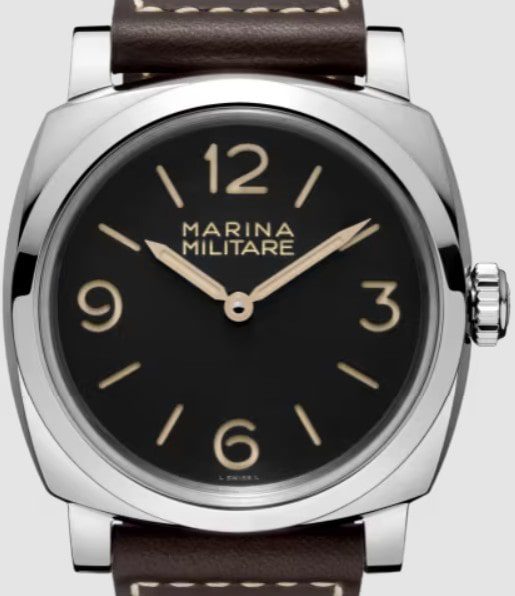
The Marina Militare Revisited
The PAM587 is one of those rare modern Panerai references that doesn’t just quote history—it inhabits it. Released in 2014 as a 1,000-piece Special Edition, the Radiomir 1940 3 Days “Marina Militare” distills the stripped-down tool-watch spirit of Panerai’s post-war divers into a modern, dependable package.
Positioned between the fan-favorite PAM372 of 2011 and the refined PAM673 of 2017, the PAM587 takes the clearest line to the mid-century naval watches that made Panerai matter in the first place. It’s the one with the austere dial, the vintage-style crystal, and the least tolerance for ornament.
Where It Sits in the Modern Heritage Arc
Panerai’s early-Richemont decade (roughly 2002–2010) was about scale—more models, broader distribution, and the birth of in-house calibres. By SIHH 2011, the brand needed a course correction that spoke to the hardcore. The answer was the PAM372: a 47 mm Luminor 1950 with no date, no small seconds, and the then-new P.3000 inside. It was the modern “archetype” that brought the crown-lock lever back to center stage.
The PAM00587 shares that movement and size but chooses a different path: Radiomir 1940 case, no crown guard, and “Marina Militare” on a sandwich dial—a far more literal bridge to the naval instruments of the early 1950s, particularly the 6152/1 lineage.
Case and Construction: The 1940 Shape, Uncompromised
The Radiomir 1940 case is its own animal—neither the wire-lug Radiomir of the 1930s nor the crown-lever Luminor of the 1950s, but a solid-lug cushion design with clean shoulders and a polished, monolithic presence. On the PAM587 it arrives at 47 mm in polished AISI 316L steel. The geometry emphasizes metal and volume: a thick mid-case, convex bezel, and straight, blocky lugs that make the silhouette read as a single piece of machined steel.
This case is also important for what it doesn’t include: no crown-protecting lever. A standard screw-down crown keeps faith with many historically adjacent pieces and, crucially, differentiates the 587 from the more common Luminor 1950-family tributes. Water-resistance is a practical 10 bar (≈100 m)—plenty for daily life, straps permitting.
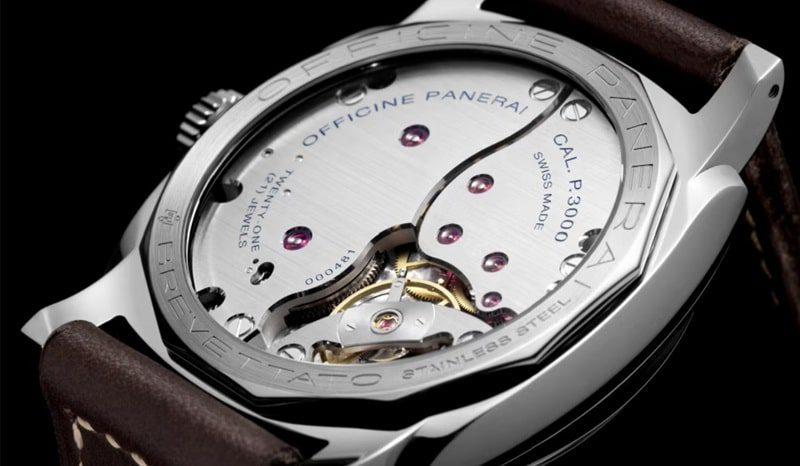
Flip the watch over and you get a see-through sapphire back. That’s a modern concession, yes, but it suits the P.3000’s broad-bridge architecture and clears up a persistent misunderstanding: the 587 does not have a solid engraved caseback. The exhibition back is part of the official spec for this reference.
Crystal: Vintage Cues Done Honestly
Look closely at the front and you’ll spot another piece of deliberate anachronism: the PAM587 uses a domed Plexiglas-type crystal rather than sapphire. Panerai leaned hard into period-correct optics here, and it changes the watch’s personality. The dome’s edge distortion—where numerals and markers warp at oblique angles—feels straight out of a 1950s diver and gives the dial a soft, organic depth that flat sapphire can’t replicate.
Several dealers and hands-on writeups note the plexi is thick (commonly listed around 3 mm) and some sets even shipped with a spare crystal, a nice nod to the realities of acrylic wear. Either way, the headline is the same: plexi up front, sapphire out back.
If you’re new to Panerai, a quick reality check: acrylic will pick up hairline scratches faster than sapphire. Most wipe away with PolyWatch; deeper marks are a service job. You trade scratch-resistance for warmth and period character. On a watch like this, that’s the right trade.
Dial and Hands: “Marina Militare,” Full Stop
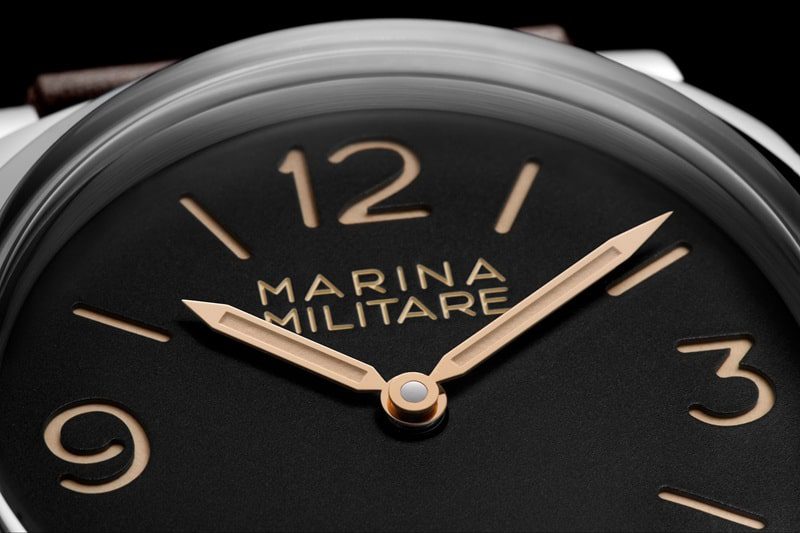
The dial is the PAM587’s statement. This is classic sandwich construction—a luminous lower plate topped by a matte black upper with cutouts for the hour markers—executed with Panerai’s usual confidence. Only four Arabic numerals remain (12/3/6/9), with baton indices everywhere else. And the text? Just “Marina Militare.”
No “Luminor,” no “Panerai” shouting at you, which is the point: it evokes an era when dials were printed for a military contract, not a window display. In daylight, the lume reads as a warm beige “old-radium” tone; in the dark it glows green, clean and even. Formally, it’s as close as Panerai dare get to mid-century utility without pretending this is a relic.
The handset sticks to the brief: simple baton hands with luminous fill, sized to the dial’s bold negative space. The absence of a running seconds sub-dial is intentional and keeps the watch visually calm.
Movement: P.3000, Built Like a Bridge
Under the hood is Panerai’s in-house calibre P.3000: a large manual-wind built for 47 mm canvases. The numbers tell the story. Diameter 16½ lignes (~37.2 mm); thickness 5.3 mm; two barrels for roughly three days of power reserve; a wide Glucydur® balance beating at 21,600 vph with a variable inertia design.
The architecture reads like a three-quarter plate movement: broad bridges covering most of the train for rigidity and shock resistance, secured by stout screws, with minimal decorative flourish. It’s purposeful rather than precious—exactly what a Panerai purist wants to see through that sapphire back. Official literature lists hours and minutes only for this execution.
One note collectors debate: some P.3000 executions allow an independent, jump-hour setting (handy for travel). Panerai’s current movement page doesn’t state this outright, so I won’t claim it as universal for the PAM587; consider it a feature you may encounter in the family rather than a guaranteed spec of this reference. What is guaranteed is the feel: large-diameter wheels and long, thin mainsprings deliver stable torque and amplitude across the reserve, and the winding action is satisfyingly mechanical.
On the Wrist: Size, Stance, and the Plexi Effect
At 47 mm, the Radiomir 1940 wears with intent. The secret to its surprising comfort is the case geometry: the lugs are short and straight but the caseband’s curved flank lets the watch sit lower than the raw number suggests. The domed acrylic visually adds height yet softens the watch’s edges; reflections pool toward the dial’s center and the numerals “breathe” as you roll your wrist. It’s theater, but quiet—the kind of optical character that hooks vintage-leaning Panerai collectors.
Strap choice matters on a 47. The PAM00587 shipped on a brown leather strap (26 mm lug width) with a polished trapezoidal buckle, and that’s the look most owners keep: unlined calf with minimal stitching that will darken and crease as it picks up life. Swap to a thicker, pull-up leather if you want the “tool” vibe dialed to 11, or to a slimmer strap to tamp down the bulk. (Panerai did not pair this reference with a steel bracelet.)
The Comparatives: PAM372 and PAM673
Putting the PAM587 next to the PAM372 clarifies Panerai’s modern heritage triangle. The 372 uses the Luminor 1950 case with the signature crown-locking lever, “Luminor Panerai” on the dial, and sapphire up front—same 47 mm outline, different personality. It’s arguably the friendliest daily wearer of the three, but it’s also the most “Panerai Greatest Hits” in aesthetic terms.
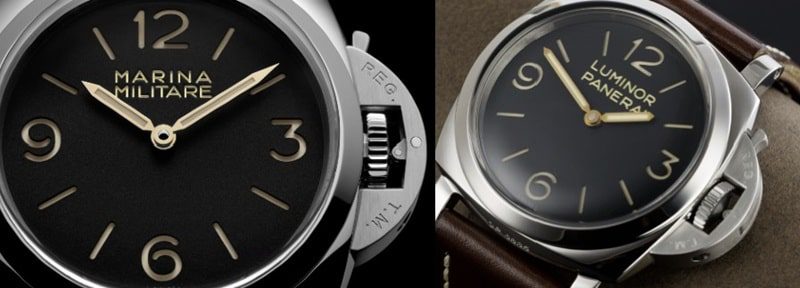
The PAM673 (2017) fine-tunes that 372 formula—again with the Luminor case and display back—easing the colors and typography into a gentler register. The 587 stands apart: no crown lever, “Marina Militare” dial, plexi crystal—and an attitude that’s more archival than commercial. That’s why the PAM587 resonates so loudly with the purist crowd.
History, Not Role-Play: The 6152/1 Thread
The reference 6152/1 (early 1950s) is the bridge between Radiomir and Luminor in Panerai lore. It’s the era that saw the evolution toward crown protection and beefier cases, with “Marina Militare” dials issued to Italian Navy divers. The PAM587 isn’t a 1:1 remake of any single 6152/1 variant, and Panerai doesn’t claim it is.
Instead, it’s a modern-spec Radiomir 1940 that borrows the typography, the spartan dial philosophy, and the visual stance of those instruments—adding a serviceable in-house calibre and a display back so the movement work isn’t hidden. In the spectrum of modern Panerai tributes, few pieces walk that line as carefully. (Panerai’s own archive page frames the 587 explicitly as a Radiomir 1940 “Marina Militare” Special Edition.)
What Collectors Look For
Because the 587 is a limited run of 1,000, the usual “box and papers” premium applies. Authenticity checks are straightforward:
- Crystal: Expect domed plexi, not sapphire; fine swirl marks are normal on used examples and polish out. Some deliveries included a spare plexi; that’s a nice bonus today.
- Caseback: Should be sapphire display, not solid. If you’re shown a solid back on a watch presented as PAM00587, press for proof—this reference is spec’d open.
- Dial: “Marina Militare” only in large type; sandwich construction; correct numeral shape at 12/3/6/9. Hands are simple batons with lume.
- Movement: P.3000 with broad bridges, two barrels, 3-day reserve; clean screw heads and consistent finishing visible through the back. panerai.com
- Strap/Buckle: 26 mm leather strap and trapezoidal steel buckle are period-correct; many owners swap straps, so originality adds value but isn’t mandatory.
On the secondary market, pricing fluctuates with condition and completeness, but the PAM587 typically enjoys steady demand due to the dial text, the plexi charm, and limited numbers—less hyped than the 372, more collectible than many open-series references. (For ballpark purposes only: dealer platforms commonly show a spread from the mid-$6k to low-$10k range depending on set and condition, but always verify current comps.)
Critique: The Honest Trade-Offs
Three realities to accept:
- Size: 47 mm isn’t for everyone. The case wears better than the numbers imply, but if your wrist prefers 40–42 mm, this won’t be the watch that changes your mind.
- Plexi Practicality: Acrylic is more scratch-prone than sapphire. If you’re fussy about hairlines, this will test you. If you love vintage optics, it will spoil you.
- Finishing Philosophy: The P.3000 is engineered, not embellished. If you expect Côtes de Genève fireworks, look elsewhere. If you prize solidity and proportion, you’ll appreciate the architecture.
One detail often asked about—the jump-hour function some P.3000s exhibit—remains ambiguously documented on official pages for this exact reference. I treat it as a “sometimes present in the family” capability rather than a guaranteed spec of the PAM587. The essentials (hours/minutes only, twin barrels, 3 days) are not in doubt.
Verdict: A Purist’s North Star
Between the PAM372’s “rebirth” energy and the PAM673’s refinement, the PAM00587 is the one that feels least commercial and most single-minded. The “Marina Militare” dial plants its flag; the Radiomir 1940 case and plexi crystal give it the right physical grammar; the P.3000 provides modern autonomy with old-school presence.
It’s not pretending to be a vintage 6152/1. It is, however, one of the most convincing modern channels for that watch’s function-first logic.If your collecting lens prioritizes historical texture over maximal complication—if you want a Panerai that reads like a field instrument that wandered into 2024 with better metallurgy—this is the one that still feels like a secret handshake.
Specifications (fully verified)
- Reference: PAM587 (Radiomir 1940 3 Days “Marina Militare”) — Special Edition of 1,000 (2014).
- Case: Polished stainless steel (AISI 316L), 47 mm diameter; Radiomir 1940 geometry (no crown-lock lever). Water resistance 10 bar / 100 m.
- Crystal (front): Domed Plexiglas (vintage-style acrylic); some deliveries included a spare plexi.
- Caseback: See-through sapphire display back.
- Dial: Matte black sandwich; Arabic numerals at 12/3/6/9; baton markers; large “Marina Militare” text; beige-tone lume that glows green.
- Movement: Panerai P.3000, hand-wound; 16½ lignes (~37.2 mm); 5.3 mm thick; 21,600 vph; two barrels; ~3-day power reserve; broad-bridge architecture. Functions: hours, minutes.
- Strap/Buckle: Brown leather, 26 mm lug width; polished trapezoidal steel buckle.


