Quick Takeaways
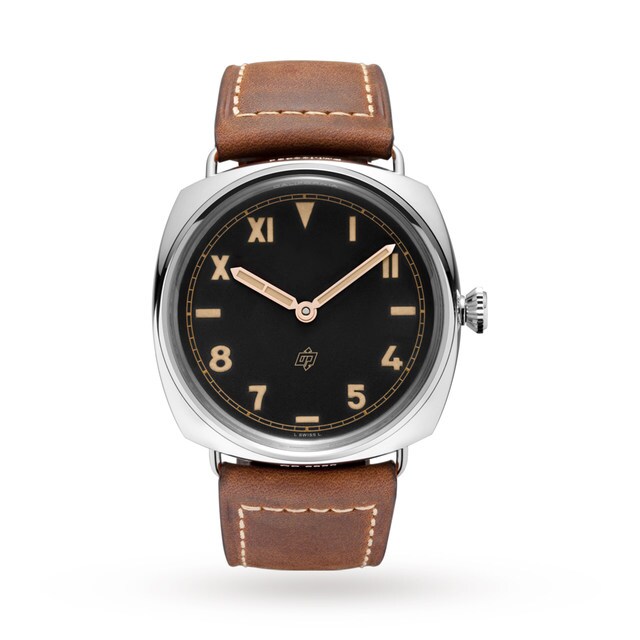
- The PAM00424 is a 47mm Radiomir in stainless steel with the California dial, half Roman numerals top, half Arabic bottom, powered by the in-house P.3000 hand-wound calibre with a 72-hour power reserve
- Two versions exist under the same reference number: the pre-2014 edition with a date aperture and the post-2014 no-date version. The no-date is the cleaner watch; the market prices them nearly identically, making it a matter of taste rather than collectability
- The California dial is not a styling exercise. It traces directly to the Rolex-made ref. 3646 of 1944, the final wartime batch that was diverted from its intended Italian recipients and supplied instead to German Kampfschwimmer divers. This is one of the few modern Panerai dials with a genuinely uncomfortable history behind it.
- The P.3000 is fully in-house, hand-wound, and deliberately old-school: 21,600 beats per hour, 13.2mm balance wheel, twin serially-connected barrels. It feels mechanical in a way that automatic movements don’t, and winding it is part of owning this watch
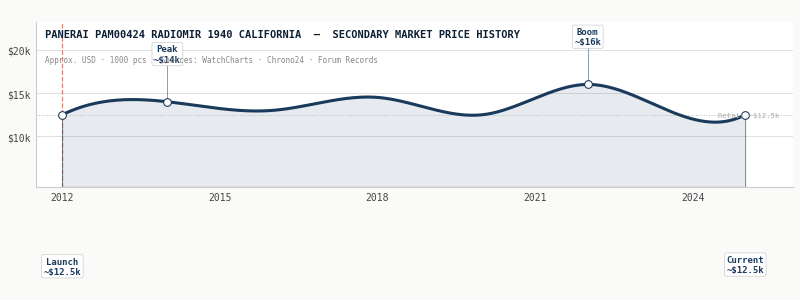
- Secondary market pricing currently sits around $4,700–$7,000 on Chrono24, with clean full-set examples toward the upper end and occasional outliers above $8,000. Honest value for an in-house movement and one of the most distinctive dials in the collection.
Jump directly to the spec sheet.
Introduction of the Radiomir with the California dial – PAM424
The California dial is the most argued-about detail in all of Panerai’s modern history. Half Roman, half Arabic, no brand name on the dial, it shouldn’t work, and yet it absolutely does. For decades, owning one meant hunting down a rare limited edition and paying serious collector premiums. Then, in 2012, Panerai did something that split the community straight down the middle: they put the California dial on a regular production Radiomir and called it the PAM00424.
The purists were not happy. Some called it a dilution of something sacred. Others, arguably the more pragmatic wing of the Paneristi, pointed out that now you could buy the most distinctive dial Panerai has ever made, paired with a brand-new in-house movement, without camping out on a waiting list or paying double retail for a numbered limited edition.
Both camps had a point. This is a review for the people still trying to figure out which camp they belong to.
The PAM00424 is a 47mm stainless steel Radiomir running the Calibre P.3000, Panerai’s own manufacture movement, debuted on this very reference. Here’s what you actually need to know about it.
The California Dial: Panerai’s Most Divisive, Most Beloved Detail
This is the section I need to give its proper due, because most reviews gloss over it with three sentences. I’m not going to do that.
What a California Dial Actually Is, and Where the Name Came From
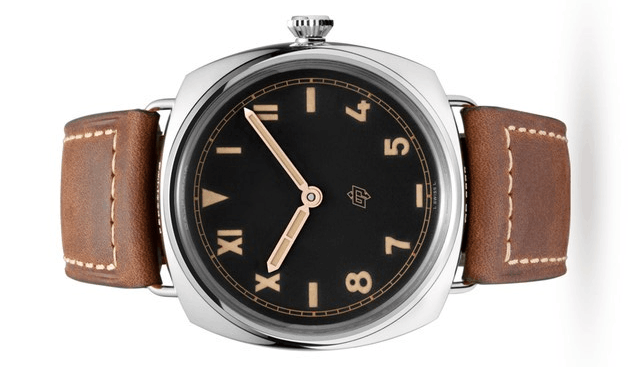
The California dial mixes Roman numerals (I through VI) on the upper half of the dial with Arabic numerals (7 through 12) on the lower half, separated by baton indices and anchored by a triangle at 12 o’clock. No running seconds. No brand name on the dial face itself, just the OP logo at six. It reads with unusual clarity. Your eye lands on the hour hand and knows exactly where it is without parsing a uniform numeral system.
The name is generally credited to Kirk Rich, a California-based dial restorer working in the 1970s, who used the term as shorthand for the mixed-numeral format when clients brought him vintage pieces to refinish. The origin of the dial design itself is considerably older. It appears on Panerai’s Reference 3646, the Rolex-cased instrument produced from 1940 to 1944.
Most of that production run served the Royal Italian Navy, but the final 1944 batch, the specific batch that carried the California-style dial, never reached its intended Italian recipients at all: Nazi forces raided Panerai’s Florence workshop that summer and diverted the entire shipment to German Kampfschwimmer combat divers instead. The full story of how that dial developed through Panerai’s military history is one of the more genuinely interesting, and uncomfortable, threads in the brand’s provenance.
Roman Up Top, Arabic Down Below: Why It Works
What looks like an anomaly at first glance has a functional logic. The Roman numeral section covers the early morning hours, the hours you check before you’re fully awake, when a clear, chunky numeral helps. The Arabic section covers the working hours. Whether or not that was ever the actual reasoning, it’s a convenient justification for a layout that sounds wrong until you wear it for a week. After that, reading any other dial feels slightly less interesting.
On the black matte dial of the PAM00424, the effect is especially strong. The gilt sword hands, warm yellow-gold in tone, pointed and deliberately old-fashioned, cut across that numeral mix with real authority. There’s no clutter. Hours and minutes only, no date aperture (on the corrected version), nothing competing with the dial’s inherent drama. The lume fill in the numerals isn’t generous, but in moderate darkness the visibility is entirely adequate for a dress-adjacent piece.
I’d push back on anyone who calls this dial “quirky.” It isn’t quirky. Quirky implies superficial eccentricity. This dial has eighty years of documented history on it. It was built for military operators, not for style points.
The Date Window Controversy and the 2014 Correction
Here’s where the PAM00424 stumbled at launch and where the community’s frustration was entirely justified.
The original PAM00424, launched at SIHH 2012, carried a date window at 3 o’clock. On most watches, a date is unremarkable. On a California dial, it is actively destructive. The asymmetry of the numeral layout is the point. That carefully balanced upper/lower divide, the deliberate simplicity, the absence of anything that doesn’t need to be there, a rectangular date aperture punched into the lower-right quadrant of the dial breaks every single one of those principles.
Collectors noticed immediately. The criticism wasn’t petty forum sniping; it was a substantive design objection. The date had no business on that dial.
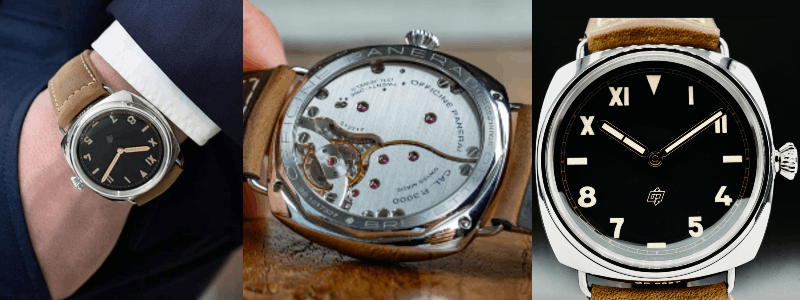
Panerai removed it in 2014, creating what is now catalogued as the PAM00424.2, same reference number, cleaner execution. Both variants still circulate on the secondary market, and the price difference between them has remained negligible. But the preference is clear: the no-date version is the right one. If you’re buying pre-owned and have the choice, always buy the PAM00424.2.
No-Date Version: The Dial Panerai Should Have Shipped From the Start
The reaction at SIHH 2012 was documented in the French watch press. TheWatchObserver’s original review, translated here, captured the sentiment directly:
“…their beloved icon finding itself, almost, accessible to the common…” TheWatchObserver.fr, translated from the original French, 2012 SIHH review of the PAM00424
The “sacrilege” the purists cried wasn’t really about the dial. It was about the accessibility. The PAM00249, a 1,936-piece limited edition from 2006 carrying the same California layout on a Radiomir case, had become exactly the kind of Holy Grail reference that defines a serious Panerai collection. Prices had roughly doubled within months of its release. For the collectors who’d tracked one down and paid for it, seeing the California dial go into open production two model numbers later felt like the brand had undercut their investment.
I understand the feeling. I don’t fully share it.
The no-date PAM00424.2 is a cleaner, more honest watch than its history suggests. The California dial on it is not a replica of the PAM00249, it’s built on the PAM00424’s own case dimensions, driven by the P.3000 rather than the older OP X, and it sits 0.79mm thicker as a result. Small difference in number, noticeable in hand. But the sapphire display caseback on the PAM00424 (versus the opaque back on the PAM00249) is a genuine advantage. It lets you see the P.3000 doing its work, and the movement is worth looking at.
For the collector who wants a California dial to wear rather than a California dial to own on paper, the PAM00424.2 is the better daily companion. Full stop.
The P.3000: Panerai’s First In-House Manufacture
What the P.3000 Delivered
The Calibre P.3000 was Panerai’s first fully in-house manufacture movement, and the PAM00424 was its introduction. That context matters when you consider what it meant for the brand. Before the P.3000, Radiomir California DNA existed only in watches powered by Rolex-derived or ETA-based movements. The PAM00249’s OP X calibre, itself based on ETA architecture, was serviceable and period-correct, but it wasn’t a manufacture statement.
The P.3000 changed that. Developed entirely at Panerai’s Neuchâtel manufacture, it’s built around the large-bridges architecture that the brand now uses across its in-house range: wide, visible bridges, a balance wheel of 13.2mm in diameter with variable-inertia regulation adjusted via external screws on the rim. It runs at 21,600 vph, deliberately unhurried, which suits the tool-watch philosophy, and winds via a crown with no crown-protecting device. Radiomir tradition: the winding crown is recessed and screws down, water-resistant to 10 atm.
72 Hours, Twin Barrels, Display Caseback
The shift to in-house manufacture in the 2010s was a meaningful repositioning for the brand, and the P.3000 was the engine that opened the chapter. Twin spring barrels in series give it the 72-hour reserve that the “3 Days” model name promises. In practice, three days is comfortable and genuinely usable: wind it Monday morning and it’ll run through the weekend without intervention.
The sapphire display caseback gives you a clean view of those large bridges. The movement looks deliberately uncrowded, there’s space between components, everything is accessible, nothing is miniaturised for its own sake. It feels like a movement designed to be maintained, not displayed and forgotten. I find that reassuring at this price point.
One recurring note in collector forums: the P.3000 lacks a power reserve indicator, which would be a natural fit given the “3 Days” naming. It’s a small frustration and a genuine one. At original retail, Panerai could have included it. They didn’t.
47mm Without the Anxiety
The case is 47mm in diameter and 16.06mm thick, with a lug-to-lug of approximately 50.7mm. On paper that reads as large. On the wrist it doesn’t wear that way. The cushion case’s downturned wire lugs follow the curve of the wrist rather than sitting perpendicular to it, distributing the case across a wider surface area than a conventional lug design would. The absence of the Luminor’s crown guard also helps, there’s nothing projecting from the case flank, so the perceived width is purely the case itself. Multiple reviewers with sub-7-inch wrists have worn this watch comfortably, which is not something you can say about many 47mm references.
Water resistance is rated to 100 metres, sufficient for swimming and casual water exposure, not for diving in any serious operational sense. The wire lugs are polished steel, which scratches faster than a brushed surface. Keep a polishing cloth nearby if you care about that sort of thing. The sapphire caseback is both front and rear on newer production runs, giving you the movement view without the Plexiglas crystal of the PAM00249 that some collectors prefer for its vintage authenticity.
Is the PAM00424 Worth It Over the PAM00249?
This is the question anyone considering the PAM00424 eventually asks, so let’s deal with it honestly.
What You Gain With the PAM00424
The Calibre P.3000 is the first and most important advantage. The PAM00249 runs an older OP X, solid, but not in-house. If you care about manufacture movements (and Paneristi generally do), the PAM00424 delivers something the PAM00249 cannot.
The open production status is the second advantage. You can buy a PAM00424 pre-owned today on Chrono24 for roughly $4,700 to $7,000 USD depending on condition and whether the date variant is involved, with occasional listings running higher for exceptional full sets. A PAM00249 in comparable condition regularly trades well above that. The PAM00424 gives you a California dial Radiomir with an in-house movement for a fraction of the cost. That is not nothing.
The display caseback is a small but real additional advantage. The PAM00249 had an opaque back. The PAM00424 lets you see the P.3000, which is worth seeing.
What You Lose
Provenance. The PAM00249 is a numbered limited edition of 1,936 pieces, deliberately echoing the year of the original Radiomir’s design, 1936. Every PAM00249 carries that story on its caseback. The PAM00424, as an open-production reference, doesn’t have that.
The plexiglass crystal on the PAM00424’s limited sibling, the PAM00448, the other limited-edition California introduced alongside the PAM00424 at SIHH 2012, is something collectors genuinely miss. Plexiglass scratches differently than sapphire, distorts light slightly, and carries a vintage authenticity that sapphire cannot replicate. The PAM00424’s sapphire is sharper and more durable. It’s also less romantic.ght slightly, and carries a vintage authenticity that sapphire cannot replicate. The 424’s sapphire is sharper and more durable. It’s also less romantic.
And then there’s the thickness. 16.06mm versus 15.27mm is a real difference, not a fatal one, but the PAM00249’s slimmer profile is more elegant. Other Radiomir references across the collection demonstrate how Panerai has balanced case depth differently across generations; the PAM00424 sits on the thicker end of the Radiomir spectrum.
My take: if you’re collecting for investment or provenance, the PAM00249 is the answer. If you’re collecting to wear, which I’d argue is the only reasonable reason to collect watches, the PAM00424.2 is a stronger daily proposition.
Who Is It For?
- The collector who wants a California dial Paneristi credential without the limited-edition premium or the secondary-market anxiety
- Someone building their first serious Panerai collection who wants an in-house movement, a Radiomir case, and a dial with genuine historical weight
- A Paneristi upgrading from a standard-dial Radiomir who wants the brand’s most distinctive dial on a familiar, comfortable platform
- The watch enthusiast who values wearability over trophy status. The PAM00424.2 is the California dial you can actually put on in the morning
Not for: hardcore Radiomir purists who measure authenticity by limited-edition provenance; collectors for whom the PAM00249 or PAM00448 are the only legitimate California references; anyone troubled by a watch that sits 16mm off the wrist.
Conclusion
The Panerai PAM00424 is a watch that got off to an awkward start, the date-window original deserved the criticism it received, and then quietly became one of the most sensible purchases in the Radiomir collection. The no-date PAM00424.2 is what it always should have been: a clean California dial, Panerai’s first in-house manufacture movement, and a cushion case that wears better than the spec sheet suggests.
Is it as collectable as the PAM00249? No. Does it carry the same limited-edition mythology? No. But it gives you the California dial in daily-wear form, backed by the P.3000, for a secondary market price that leaves money for the next one. For a collector who wants to wear their watches rather than count them, that’s a credible argument.
The question I keep coming back to: given that the PAM00424.2 is still in open production and regularly available pre-owned at fair prices, is there a stronger value entry point into the California dial world right now, or has this reference already earned its place as the sensible choice it always threatened to become?
Extended Summary
- PAM00424 is the open-production Radiomir California, introduced at SIHH 2012 with a 47mm polished steel cushion case and the California dial that mixes Roman and Arabic numerals. The no-date PAM00424.2 variant (updated 2014) is definitively the better buy.
- The California dial’s history runs back to Panerai’s Ref. 3646 military instruments of 1940–1944; the specific batch carrying the California dial was diverted from its intended Italian recipients to German Kampfschwimmer divers in the war’s final year. The PAM00424 makes that heritage wearable daily without limited-edition pricing, though purists still hold the PAM00249 and PAM00448 above it in the collector hierarchy.
- Calibre P.3000 was Panerai’s first in-house manufacture movement, debuted on this reference, hand-wound, twin barrels, 72-hour power reserve, display caseback. It trades some of the PAM00249’s slimmer elegance for genuine manufacture credibility.
- Secondary market reality: the PAM00424.2 trades at roughly $4,700–$7,000 USD versus significantly more for the PAM00249; for the wearability-focused collector, the case for the PAM00424 is straightforward.
- Best suited for: serious Paneristi who want the California dial daily, collectors entering the Radiomir line with a preference for in-house movements, and anyone unwilling to pay limited-edition premiums for a dial they intend to actually put on their wrist.
At a Glance
| Spec | Detail |
|---|---|
| Reference | PAM00424 / PAM00424.2 (no-date variant) |
| Collection | Radiomir |
| Introduced | SIHH 2012 |
| Case material | AISI 316L polished stainless steel |
| Case diameter | 47mm |
| Case thickness | 16.06mm |
| Lug-to-lug | ~50.7mm |
| Water resistance | 100 metres (10 atm) |
| Movement | Calibre P.3000 (in-house manufacture) |
| Winding | Hand-wound |
| Power reserve | 72 hours (3 days) |
| Beat rate | 21,600 vph (3 Hz) |
| Jewels | 21 |
| Complications | Date (original); none (no-date variant) |
| Dial | Black California dial, Roman numerals I–VI upper half, Arabic 7–12 lower half, gilt sword hands, no seconds |
| Crystal | Convex sapphire front, sapphire display caseback |
| Availability | Open production (regular collection) |
| Secondary market | ~$4,700–$7,000 USD, occasional listings higher for exceptional full sets |
| Spec | Detail |
|---|---|
| Reference | PAM00424 / PAM00424.2 (no-date variant) |
| Collection | Radiomir |
| Introduced | SIHH 2012 |
| Case material | AISI 316L polished stainless steel |
| Case diameter | 47mm |
| Case thickness | 16.06mm |
| Lug-to-lug | ~52mm |
| Water resistance | 100 metres (10 atm) |
| Movement | Calibre P.3000 (in-house manufacture) |
| Winding | Hand-wound |
| Power reserve | 72 hours (3 days) |
| Beat rate | 21,600 vph (3 Hz) |
| Jewels | 21 |
| Complications | Date (original); none (no-date variant) |
| Dial | Black California dial — Roman numerals I–VI upper half, Arabic 7–12 lower half, gilt sword hands, no seconds |
| Crystal | Convex sapphire front, sapphire display caseback |
| Availability | Open production (regular collection) |
| Retail price | ~$7,700 USD (at last retail listing); pre-owned $4,700–$6,500 USD |