
Clous de Paris as a Toolmaker’s Texture
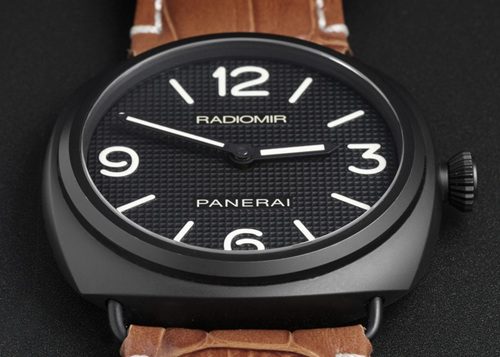
Hobnail dial – Clou de Paris, Panerai dials are most often defined by simplicity—broad numerals, legible plots, and a flat expanse designed for clarity under pressure. The brand’s occasional use of the hobnail, or Clous de Paris, texture represents a deliberate deviation from that flat-dial philosophy. Within Panerai, this surface pattern is not a decorative flourish borrowed from classic watchmaking but a functional choice: a method of controlling reflection and breaking up the visual field of larger dials.
The hobnail dial appears only on select Panerai references. Each instance serves a specific purpose within the brand’s design language, offering tactile dimension without compromising the clean utility that defines the Luminor, Submersible, and Radiomir families.

Definition and Purpose
In Panerai terminology, the French expression “décoration Clous de Paris” is used officially to describe this dial treatment. It consists of a geometric grid of small, pyramid-shaped studs—tiny “nails” rising from a matte base. The effect scatters light evenly across the dial, reducing glare from the large sapphire crystals fitted to Panerai’s oversized cases.
Unlike the brand’s sandwich dials, which rely on cut-outs and layered lume, hobnail dials are solid-surface constructions with applied luminous plots or numerals. The texture does not compromise legibility; instead, it reinforces it by providing a controlled play of light across the otherwise broad dial plane.
Historical Context Within Panerai
The earliest recorded use of the hobnail dial at Panerai dates to the late 1990s. The pattern first appeared on the Luminor Submersible PAM00025, a titanium-cased diver’s watch that required a visual break in its large, matte-black surface. This texture softened the stark utilitarianism of titanium while maintaining excellent legibility.
Shortly thereafter, the pattern migrated into the Luminor Power Reserve line, appearing on models such as the PAM00028 (notably the 2009 Special Edition) and later on the PAM00241, a 40 mm execution. These early uses established the hobnail dial as a recurring but carefully rationed feature within Panerai’s modern catalog.
The texture was subsequently employed on more complex pieces—chronographs, GMTs, and left-handed Submersibles—each time serving both functional and aesthetic goals.
Functional Role in Panerai Design
Panerai’s design ethos emphasizes clarity, symmetry, and durability. The Clous de Paris texture complements these priorities in several ways:
- Light Diffusion: The fine pyramid grid prevents glare from high-polish hands and broad crystals.
- Visual Depth: The pattern adds relief and shadow contrast, improving dial readability under bright light.
- Material Harmony: Titanium and DLC-coated cases benefit from the matte dynamism of the texture, preventing dial flatness.
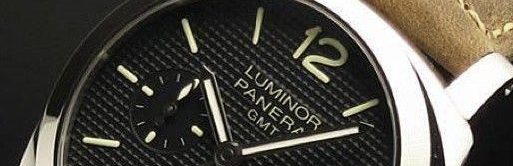
- Technical Emphasis: In watches carrying multiple complications—GMTs, power reserves, chronographs—the hobnail pattern keeps each register visually distinct without adding clutter.
Key References Employing the Hobnail Dial
Luminor Submersible PAM00025 (1998–2013)
- Case: 44 mm titanium
- Movement: OP III automatic
- Dial: Black with Clous de Paris texture
- Significance: The first known Panerai reference to use the hobnail pattern extensively. The dial’s texture breaks up the visual field of the Submersible’s large, tool-oriented design. Its long production run solidified the link between the hobnail dial and titanium cases.
Luminor Power Reserve PAM00028 (2009 Special Edition)
- Case: 44 mm stainless steel
- Movement: Soprod 9040, COSC-certified
- Dial: Black with “Paris hobnails” and power reserve at 6 o’clock
- Notes: Official Panerai Special Edition archives describe this model explicitly as having a “black dial with Paris hobnails decoration.” The texture adds refinement to an otherwise practical complication layout.
Luminor Power Reserve PAM00241
- Case: 40 mm stainless steel
- Movement: Automatic, power reserve at 5 o’clock
- Dial: Black hobnail dial
- Notes: A smaller-format application of the texture, proving the design’s adaptability beyond the 44 mm standard. The pattern moderates reflections and reinforces proportional balance on a reduced dial surface.
Luminor 1950 Regatta Rattrapante PAM00332 (2009)
- Case: 44 mm DLC-coated steel
- Movement: OP XVIII (Valjoux 7750-based rattrapante)
- Dial: Black with Clous de Paris, tachymeter scale on the rehaut
- Notes: Official archives describe “noir avec décoration Clous de Paris.” Here, the texture serves to calm the complexity of overlapping hands, subdials, and printed scales. The result is a professional chronograph that remains legible and distinctively Panerai.
Luminor 1950 3 Days GMT PAM00535 (2014)
- Case: 42 mm stainless steel
- Movement: P.9001 automatic
- Dial: Black hobnail with GMT hand and date at 3 o’clock
- Notes: Introduced as part of a smaller Luminor 1950 series, this reference demonstrates that the hobnail texture retains its utility even at 42 mm. The subtle relief complements the refined proportions of the downsized case.
Luminor 1950 3 Days GMT Power Reserve PAM00537 (2014)
- Case: 42 mm stainless steel
- Movement: P.9002 automatic
- Dial: Black hobnail with GMT and power reserve at 5 o’clock
- Notes: Paired complications benefit from the pattern’s diffused reflectivity, ensuring clarity across the dial’s multiple scales and indicators.

Luminor Submersible 1950 Left-Handed PAM00569 (2014)
- Case: 47 mm titanium
- Movement: P.9000 automatic
- Dial: Black with Clous de Paris; small seconds at 3 o’clock, date at 9 o’clock
- Notes: Official documentation confirms the decoration: “noir avec décoration Clous de Paris.” The pattern integrates harmoniously with the mirrored destro layout, balancing the asymmetry created by the left-hand crown guard.
Radiomir 8 Days PAM00197
- Case: 45 mm pink gold
- Movement: OP XIV (Jaeger-LeCoultre base, 8-day manual wind)
- Dial: Black hobnail
- Notes: One of the few Radiomir models to feature the texture. The hobnail surface tempers the warmth of gold with technical restraint, maintaining the Radiomir’s instrumental lineage while signaling subtle luxury.
Design and Construction Characteristics
Panerai’s execution of the Clous de Paris pattern follows several consistent principles:
- Scale: The pyramids are finely cut and uniform, maintaining readability at multiple angles.
- Finish: Generally matte or satin, never polished. This differentiates Panerai’s hobnail surfaces from those used decoratively in haute horlogerie.
- Lume Application: Most models use applied “sausage” plots filled with Super-LumiNova. The sandwich construction typical of many Panerai dials is rarely combined with a hobnail dial, as layered apertures disrupt the grid structure.
- Color Palette: Almost exclusively black dials with white or ecru lume. The contrast enhances visibility and supports the brand’s functional design intent.
Chronological Overview
| Reference | Family | Case (mm) | Material | Movement | Dial Description | Production |
|---|---|---|---|---|---|---|
| PAM00025 | Luminor Submersible | 44 | Titanium | OP III Auto | Black Clous de Paris | 1998–2013 |
| PAM00028 | Luminor Power Reserve | 44 | Steel | Soprod 9040 Auto | Black “Paris hobnails” | 2009 SE |
| PAM00241 | Luminor Power Reserve | 40 | Steel | Auto | Black Clous de Paris | ~2006–2012 |
| PAM00332 | Luminor 1950 Rattrapante | 44 | DLC Steel | OP XVIII | Black Clous de Paris | 2009 |
| PAM00535 | Luminor 1950 GMT | 42 | Steel | P.9001 | Black hobnail | 2014 |
| PAM00537 | Luminor 1950 GMT PR | 42 | Steel | P.9002 | Black hobnail | 2014 |
| PAM00569 | Luminor Submersible Destro | 47 | Titanium | P.9000 | Black Clous de Paris | 2014 |
| PAM00197 | Radiomir 8 Days | 45 | Pink Gold | OP XIV | Black hobnail | Mid-2000s |
Patterns of Use
Panerai applies the hobnail dial selectively. Analysis of its usage reveals four core motivations:
- Functional glare management on large titanium or DLC cases (PAM00025, PAM00569).
- Legibility enhancement on complication-heavy models (PAM00332, PAM00537).
- Refinement at reduced diameters where dial depth adds visual structure (PAM00535).
- Material contrast on precious-metal executions to temper brightness (PAM00197).
The result is a pattern of deployment that emphasizes clarity, purpose, and material honesty rather than ornamentation.
Collector Considerations
Enthusiasts value hobnail-dial Panerai models for their restrained distinctiveness. They remain visually unmistakable as Panerai instruments, yet stand apart through surface texture and light control.
When assessing authenticity and period correctness, attention should focus on:
- Official Dial Language: Panerai’s use of “Clous de Paris” or “Paris hobnails” in official documentation is definitive.
- Layout Orientation: Destro references such as PAM00569 must show the mirrored sub-seconds and date positions (seconds at 3, date at 9).
- Dial Integrity: Due to the fine texture, refinishing or over-cleaning can flatten the pattern—an aspect worth inspecting in vintage or long-run models like PAM00025.
- Movement Pairing: Each hobnail dial reference corresponds to specific calibers (OP III, P.9000 series, Soprod 9040, OP XVIII, etc.); misaligned pairings should be scrutinized carefully.
Rarity and Position in the Panerai Landscape
Hobnail dials remain the minority within Panerai’s design canon. They appear in no more than a dozen production references, spanning roughly from 1998 to 2015. Despite their infrequency, they occupy a crucial position in illustrating Panerai’s material experimentation phase: the period when the brand balanced traditional identity with modern finishes and in-house movement expansion.
Collectors of Panerai watches often categorize these pieces as textural Panerai—watches that explore how surface engineering can coexist with the tool-watch DNA that defines the marque.
Conclusion
The Clous de Paris dial, when used by Panerai, functions as a technical instrument rather than a decorative gesture. From the PAM00025 Submersible that introduced the texture to the PAM00569 destro diver that perfected its integration, the hobnail surface has served to manage light, improve readability, and add restrained dimensionality to some of the brand’s most purposeful designs.
Across Luminor, Submersible, and Radiomir models, its application has been measured and deliberate—appearing only where it reinforces clarity, balance, or material integrity. Within Panerai’s visual language, the hobnail dial remains a rare but telling statement: a demonstration that even a toolmaker’s watch can employ texture with precision and intent.


