
Quick Takeaways
- The Panerai Equation of Time shows the gap between sundial time and clock time on a linear indicator at 6 o’clock. The sun and your watch disagree by up to about 16 minutes during the year.
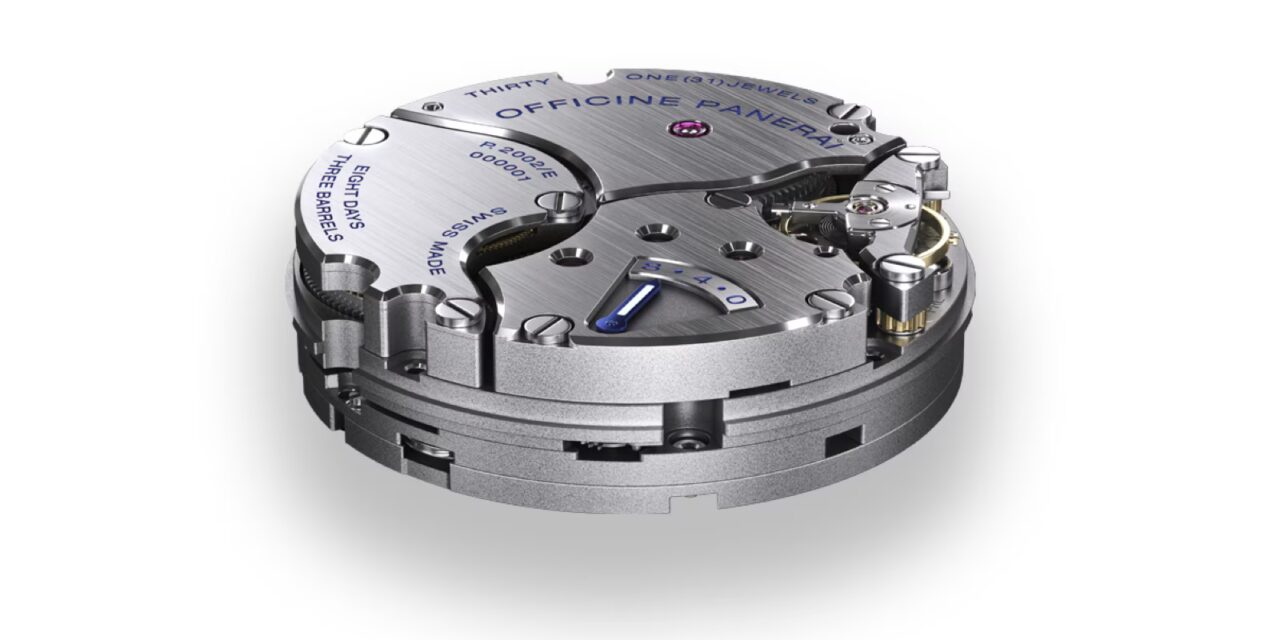
- The 8-day models run on the hand-wound P.2002/E, with 328 components, 31 jewels and 28,800 vph. Panerai’s first in-house calibre, the P.2002, is the base.
- The PAM00516 (48mm steel, 200 pieces) and the PAM00601 (47mm steel, 100 pieces) launched in 2015.
- The PAM00656 and PAM00670 put the complication in 47mm titanium, with brown and blue dials and a day/night GMT ring.
- The tourbillon versions came earlier: the 50mm PAM36500 (titanium), PAM36501 (pink gold) and PAM36502 (white gold), with sunrise and sunset on the outer edge of the PAM36500.
Jump directly to the spec sheet.
Most complications answer a practical question. A chronograph times things. A GMT tells you the hour somewhere else. The Panerai Equation of Time answers a question almost nobody asks: how far is your clock from the sun today?
It is a niche complication, and it fits Panerai better than you would expect, even if it will never be the brand’s best seller. A brand built on naval instruments, with cases the size of a small plate, suddenly makes a watch that tracks the Earth’s orbit. The linear indicator at 6 o’clock reads like a navigation gauge, which is exactly the language Panerai already speaks.
The line runs from a 2010 tourbillon through the 2015 steel pair to the 2016 titanium models. Which one is worth your attention? Let’s start with the idea behind them, then look at how Panerai puts it on the dial, and then go through the references one family at a time.
What Is the Equation of Time?
Your watch runs on mean solar time: every day is exactly 24 hours long. The real sun does not follow that rule. Because the Earth’s orbit is an ellipse and its axis is tilted, the sun reaches its highest point a little earlier or later than noon on your watch, depending on the date.
The difference between the two is the equation of time. It reaches roughly 16 minutes at its biggest, around early November, and it swings the other way in February, when a sundial runs slow. Four times a year it passes through zero.
For centuries this mattered to navigators and astronomers who needed to turn a sundial reading into clock time. Today it matters to nobody’s schedule, and that is the charm. An Equation of Time watch is a mechanical way of showing a fact about the sky.
How Does the Panerai Equation of Time Work on the Dial?
This is the section that carries the whole collection, so it runs long.
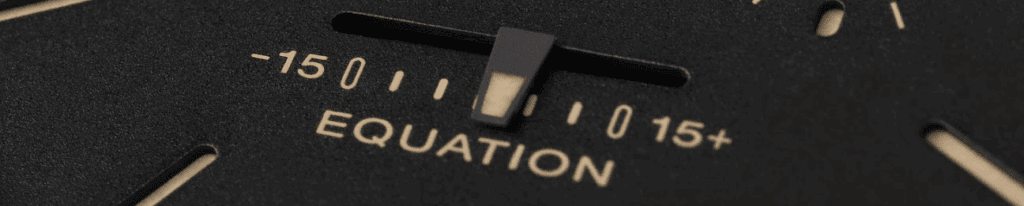
On every Equation of Time Panerai, a linear indicator at 6 o’clock shows the current value, the difference between true solar time and mean solar time. It is a straight scale, not a subdial, which suits the Panerai dial. The layout around it stays familiar: small seconds at 9 and date and month at 3.
What does the indicator tell you?
It tells you how far the sun is from your watch today. When the indicator sits at one end of its scale, a sundial would run ahead of your watch. At the other end, it would run behind. Somewhere in between, four times a year, the two agree.
I’d argue the linear layout is the right call. A circular subdial would compete with the small seconds, and a digital window would break the language of the dial. A straight scale at 6 o’clock keeps the dial open and readable.
What is the P.2002/E?
The 8-day models share the P.2002/E, a hand-wound calibre of 13¾ lignes and 8.30mm thick with 328 components, 31 jewels and a 28,800 vph beat. It is based on the P.2002, Panerai’s first in-house calibre, launched in 2005. A KIF Parechoc device protects the balance.
Eight days of reserve means you wind it once a week and stop thinking about it. The equation of time is a slow-moving value, so there is no urgency to set it. The complication fits a movement that runs for a week at a time.
How is the dial laid out?
The steel pair have black dials with luminous Arabic numerals and hour markers, and the Equation of Time indicator at 6, seconds at 9 and date and month at 3. A linear power reserve indicator is also on the dial of the PAM00516. Large numerals and a lot of black keep the dial in the spirit of the rest of the range.
Why does it suit Panerai?
Because the brand has always treated the watch as an instrument, and a watch that compares the sun with the clock is about as instrument-like as a complication gets.
Panerai Equation of Time PAM00516 and PAM00601: The Steel Pair
In 2015, Panerai released two references in stainless steel with the P.2002/E.
The PAM00516 is the Radiomir 1940 Equation of Time 8 Days Acciaio. The case is 48mm in polished 316L steel, and it weighs 173 grams with 100 metres of water resistance, a sapphire caseback and a black alligator strap. It is limited to 200 pieces, and it appears to be Panerai’s first Equation of Time watch without a tourbillon. The PAM00516 page lists the full specification.
The PAM00601 is the Luminor 1950 version, limited to 100 pieces. The case is 47mm in polished steel with the crown-protecting bridge, a weight of 177 grams and an antique brown alligator strap with ecru stitching. Panerai’s PAM00601 page has the details.
The choice between them is the old Panerai one. Take the PAM00516 for the wire-lug Radiomir shape and the larger 48mm presence. Take the PAM00601 for the Luminor lever, a slightly smaller case and a rarer edition.
Panerai Equation of Time in Titanium: PAM00656 and PAM00670
A year later, the 2016 models moved the complication into titanium. The PAM00656 has a brown dial and the PAM00670 a blue one, both in 47mm brushed titanium Luminor 1950 cases with sapphire on both sides and 100 metres of water resistance. They launched at around €21,000.
Two things change from the steel pair. The GMT function arrives as a day/night indicator in the small ring at 9, the same device used on other Panerai models. And the power reserve moves to the caseback, which makes room on the dial for the Equation of Time scale.
Titanium brings the complication to a lighter case, and the blue-versus-brown choice becomes the main decision. Warm brown for a vintage tone, blue for a cooler, more modern one.
“the new models are flawless“ Horobox, reviewing the 2016 releases
I’d call that generous, but the pair does show how comfortably the complication fits the Luminor. The dial stays readable, which is the test that matters.
Panerai Equation of Time Tourbillon Watches: PAM36500 and PAM00920
The tourbillon models came first. Panerai’s archive places the Luminor Tourbillon Equation of Time in 2010, five years before the steel pair, and they are a different class of watch.
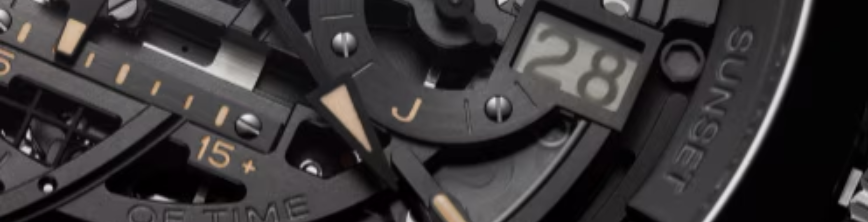
The PAM36500 is a 50mm brushed titanium Luminor with a brown dial. The hand-wound P.2005/G has 46 jewels, 375 components and a 28,800 vph beat, with four days of reserve from three barrels. The dial carries the Equation of Time indicator at 6, the tourbillon and seconds at 9 and date and month at 3, with sunrise at 8 and sunset at 4 on the outer edge. Panerai’s page lists the specification.
The PAM36501 is the pink gold version, in 18-carat gold with a black dial and a dark brown alligator strap. The PAM36502 is the white gold version, also black-dialled, on a dark blue alligator strap. All three are limited editions.
At the far end sits the PAM00920, the 2018 L’Astronomo. It is a 50mm titanium cushion case with a skeleton dial and the P.2005/GLS, with a tourbillon, moon phase, equation of time, sun position and rising time, and a GMT with an adjustable 12-hour hand and a fixed 24-hour hand. Panerai personalises it to the owner’s location, and only one was made.
Is a Panerai Equation of Time Watch Practical?
It tells you something no other watch on your wrist tells you, and that is its whole job. You don’t need the value to run your day. You need it for the pleasure of knowing it.
The 8-day models make that pleasure easy: one winding a week, a clear scale at 6 and a familiar dial. The tourbillon models make it a showpiece, and the PAM00920 turns it into a personal astronomical instrument.
If you want a complication that earns its place by being used, buy a GMT. If you want one that earns its place by being interesting, this is the one.
For the other end of Panerai’s complication range, my look at the Radiomir Annual Calendar covers a calendar built for daily life, and the P.2003 calibre family covers another 8-day-plus Panerai engine.
Who Is It For?
- The collector who wants a complication with a story, not just a function
- A Paneristi drawn to hand-wound 8-day movements in the Luminor or Radiomir shape
- Someone who values limited editions such as the PAM00516 (200) and PAM00601 (100)
- A buyer comparing the GMT-equipped PAM00537 and wanting something stranger
Not for: anyone who wants a complication they will use every day; buyers who prefer a case under 47mm.
Conclusion
The Panerai Equation of Time family is a small group of watches doing something unexpected. A tourbillon in 2010, a steel pair in 2015 and a titanium pair in 2016 each show the same idea: a tool watch that also reads the sky.
Is it worth chasing? If you like complications that make you curious, yes. The PAM00516 and PAM00601 are the clearest entry points, and the 2016 titanium pair is the easiest on the wrist. The tourbillon models are the ones to admire.
Which would you pick: the steel PAM00516, the titanium PAM00670 or the tourbillon PAM36500? Tell me in the comments.
Extended Summary
- The Panerai Equation of Time shows the gap between sundial and clock time on a linear indicator at 6 o’clock.
- The 8-day references use the hand-wound P.2002/E with 328 components, 31 jewels and 28,800 vph.
- The PAM00516 (48mm, 200 pieces) and PAM00601 (47mm, 100 pieces) launched in 2015.
- The PAM00656 and PAM00670 followed in 47mm titanium with brown and blue dials and a day/night GMT ring.
- The tourbillon models are the PAM36500, PAM36501 and PAM36502 (2010) and the one-off PAM00920 (2018).
At a Glance
| Spec | PAM00516 | PAM00601 | PAM00656 / PAM00670 | PAM36500 | PAM00920 |
|---|---|---|---|---|---|
| Collection | Radiomir 1940 | Luminor 1950 | Luminor 1950 | Luminor | Luminor 1950 |
| Introduced | 2015 | 2015 | 2016 | 2010 | 2018 |
| Case | Steel | Steel | Titanium | Titanium | Titanium |
| Diameter | 48mm | 47mm | 47mm | 50mm | 50mm |
| Water resistance | 100 metres | 100 metres | 100 metres | 100 metres | 100 metres |
| Movement | P.2002/E | P.2002/E | P.2002/E | P.2005/G | P.2005/GLS |
| Power reserve | 8 days | 8 days | 8 days | 4 days | n/a |
| Complications | EOT, date, month | EOT, date, month | EOT, GMT day/night | EOT, tourbillon, GMT, sunrise/sunset | EOT, tourbillon, moon phase, GMT |
| Dial | Black | Black | Brown / Blue | Brown | Skeleton |
| Edition | 200 pieces | 100 pieces | n/a | Limited | 1 piece |


