The Tuxedo GMT That Existed Twice
Quick Takeaways
- The PAM00029 is the Luminor GMT in 44mm steel — Panerai’s first serious complication for the post-military civilian market, with a GMT hand and engraved 24-hour bezel working together cleanly
- Two very different versions exist: the A-series originals made in 1997–98 and the 2010 SIHH re-edition limited to 1,000 pieces — they share a reference number but are not the same watch
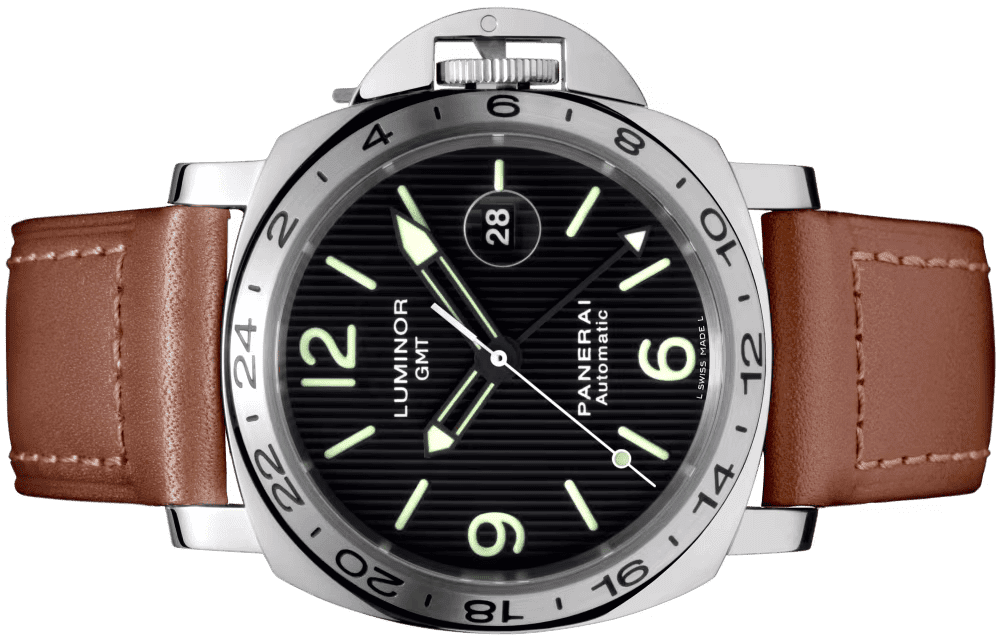
- The “tuxedo” dial — black with vertical striping — is the defining visual detail of this reference and one of the most distinctive dials Panerai has ever produced; it is not a sandwich and it is not a sausage, and Paneristi have been arguing about it ever since
- The movement is the ETA 2893/2, COSC-certified and honest about what it is — 42 hours of reserve, GMT differential, hacking seconds; it does the job, but you’re not paying for a movement story here
- On the secondary market, A-series originals with cracked tritium and matching papers trade at a meaningful premium over the re-edition — this is one of the few early PAM references where provenance visibly moves the price
Introduction
There’s a short list of Panerai references that exist in two genuinely distinct forms — same PAM number, same name, different watch. The PAM00029 is on that list. It started life in 1997 as one of the earliest civilian Luminors produced during the transition to Vendôme ownership: a GMT-equipped tool watch with a striped black dial that collectors would later nickname the “tuxedo.” Then, thirteen years later, Panerai brought it back — 1,000 pieces, unveiled at SIHH 2010, faithful to the original in most respects and new in others.
If you’re researching the Panerai PAM00029, the version you’re looking at matters enormously. The A-series tritium original and the 2010 re-edition are separated by a serial number, a movement finish, and — depending on who you ask — a meaningful gap in collector credibility. Understanding why requires understanding the dial first. Because the tuxedo is the whole story.
Panerai’s First GMT — Why the PAM00029 Exists
From Blank Bezel to GMT Instrument
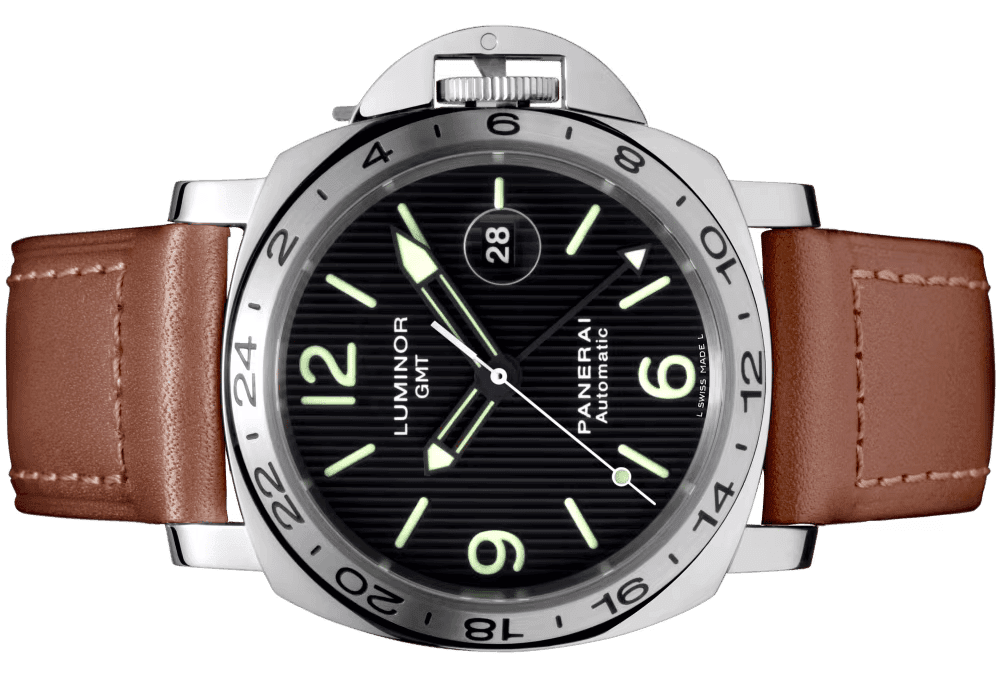
The Luminor’s bezel was, for most of its early civilian life, empty. Visually, that blankness was part of the point — a wide expanse of brushed steel that framed the dial and contributed to the watch’s particular kind of blunt authority. So when Panerai engraved 24-hour markers into that bezel and added a second time-zone hand at the centre of the dial, it was a meaningful departure. Not a cosmetic one.
As Chrono24’s model evolution feature notes, the GMT complication arrived with an awareness of a growing global clientele — collectors and travellers who wanted something that worked across time zones without requiring a mentally taxing conversion. The GMT hand slots between the hour and seconds hands, pointing to the 24-hour bezel ring; home time at a glance, local time on the main dial. It’s a sensible implementation. Clean, readable, and — critically — entirely consistent with the Luminor’s tool-watch character. The bezel wasn’t dressed up; it was put to work.
1997–98 A-Series: Born at the Handover
The original PAM00029 appeared in 1997 and ran through 1998, serial numbers falling in the A-series. This places it right at the moment of Vendôme’s acquisition — the brand had just transitioned from Italian-built, Florence-directed watches to something altogether more Swiss and commercially structured. Pre-Vendôme models carry a mystique that post-Vendôme references simply don’t, and the A-series PAM00029 sits in that liminal space: not quite Pre-Vendôme in the strict 5218-era sense, but close enough to carry some of that gravity.
The A-series pieces came with applied tritium indices — not SuperLuminova, tritium — and on surviving examples you’ll find the characteristic patina of aged lume: faint yellowing, occasionally hairline cracking around the applied baton markers. One seller listing an A-series example on Value Your Watch specifically highlights the cracked tritium on the minute hand as a selling point — and secured a special exception from Panerai’s international service director to retain the original hands during servicing. That tells you exactly how the collector community values originality on these pieces.
The 2010 SIHH Re-Edition: 1,000 Pieces, a Different Context
The re-edition arrived at SIHH 2010, thirteen years after the original. Panerai limited it to 1,000 pieces, presented it with full documentation, and priced it as a proper limited edition. The case dimensions are the same — 44mm, 16mm thick, AISI 316L steel — and the dial retains the tuxedo striping. The movement is the same ETA 2893/2 calibre, COSC-certified with the same 42-hour reserve. So far, so faithful.
The differences are real but subtle. The 2010 pieces have rhodium-plated movement finishing versus the earlier execution, the dial’s vertical stripes read slightly crisper due to tighter modern production tolerances, and — perhaps most importantly — they come without aged tritium. They look new because they are new. Whether that’s a virtue or a limitation depends entirely on why you’re buying.
The Tuxedo Dial — Panerai’s Most Underrated Dial
Let me be direct about this: the tuxedo dial doesn’t get nearly enough attention in mainstream Panerai coverage. Most write-ups lead with the GMT function and treat the dial as a secondary detail. I’d argue it’s the other way around. The GMT is what makes the PAM00029 useful; the tuxedo dial is what makes it worth writing about.
What “Tuxedo” Actually Means on the Wrist
The dial features vertical black-on-black striping — fine alternating matte and semi-gloss bands running the full height of the dial surface. In flat light it barely registers; in raking light or direct sun it catches and separates, creating a subtle depth that flat black simply doesn’t have. The effect is closer to a woven textile than to a printed surface — unusual for a watch dial and entirely alien to Panerai’s usual aesthetic vocabulary.
The applied baton indices are luminous — tritium on the A-series originals, SuperLuminova on the 2010 re-edition — set against the striped background with Arabic numerals at 6, 9, and 12. The date sits at 3 o’clock under a Cyclops lens in the crystal, which is period-correct but feels mildly incongruous against the otherwise restrained composition. The GMT arrow hand distinguishes itself cleanly from the main hour hand. In practice, reading the watch is not difficult. The striping doesn’t compete with the hands; it provides context.
The Tritium Question
On A-series originals, the applied tritium indices age. A well-preserved example from 1997 or 1998 will show a cream-to-yellow patina and may have hairline cracks in the compound around the baton edges. This isn’t damage in any functional sense — it’s documentation. It tells you the watch hasn’t been re-dialled, that the hands are original, that the piece has a history rather than a recent service that erased it. When Amsterdam Vintage Watches lists an A-series PAM00029, this detail is mentioned prominently. Rightly so.
“The cracked tritium on the minute hand. I had this piece sent to Switzerland on special order to provide a certificate of authenticity — and to do so without replacing the tritium hands, something that required a special exception from the International Customer Service Director.” — A-series PAM00029 seller, Value Your Watch
The 2010 re-edition uses SuperLuminova, which reads brighter in the dark, no question. But it doesn’t carry the same story.
Sandwich, Sausage — and Neither
I get tired of Panerai coverage that reduces every dial discussion to “sandwich or sausage?” and moves on. The tuxedo dial doesn’t fit that binary, and that’s precisely what makes it interesting.
A sandwich dial uses two plates: a lower luminescent layer with the upper plate cut out so the lume glows through, creating recessed hour markers with visible depth. A sausage dial applies luminescent material directly to a single dial surface, leaving the indices slightly raised. The tuxedo is a single-surface construction — closer to sausage technically — but the applied baton indices give it a three-dimensional quality that distinguishes it from a purely printed surface. The vertical striping adds another layer of visual complexity. The result is a dial that reads as more refined than either, without attempting to replicate the military utility of the former.
Whether that refinement belongs on a Luminor is a legitimate question. Panerai’s core design language is deliberately austere — legibility over elegance. The tuxedo dial introduces elegance. Some Paneristi find this transgressive. Others consider it one of the rare moments Panerai dressed up without losing itself. I lean toward the latter, but I understand the sceptics.
The Case for the Tuxedo Being Correct
Here’s my actual take: the PAM00029 arrived precisely at the moment Panerai was transitioning from combat instrument to luxury object. The Vendôme acquisition was happening. The brand was about to become something different. The tuxedo dial documents that transition honestly — it’s a Luminor that’s dressing for a new occasion without pretending it’s something it isn’t. The crown guard is still there. The 300-metre water resistance is still there. The scale is still 44mm.
It’s not a dress watch. It’s a tool watch that acknowledged, for the first time, that its audience was changing. I find that historically coherent. You can argue about the aesthetics — but the context makes the dial defensible.
The Movement — ETA 2893/2, Honestly Assessed
What You’re Getting
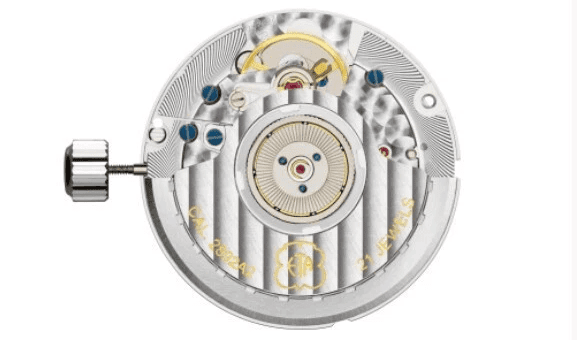
The ETA calibre 2893/2 is a competent automatic movement, COSC-certified in this application, running at 28,800 beats per hour with 21 jewels, a Glucydur monometallic balance, and an Incabloc anti-shock device. The GMT differential allows the local hour hand to be set independently in one-hour increments without stopping the watch. Power reserve sits at 42 hours — adequate, not generous.
Panerai modified the base movement with their own bridges featuring Côtes de Genève decoration, and the 2010 re-edition adds rhodium plating to visible components. It can be serviced by any competent watchmaker familiar with ETA-based movements, which is one of its genuine practical virtues. That’s not nothing — Panerai’s own service network can be slow and expensive, and having options matters.
What You’re Not Getting
An in-house movement. A distinctive power architecture. Anything that would make a movement enthusiast pause.
I’m not going to pretend this matters the same way to every collector — because it doesn’t. If you’re buying the PAM00029 for its history, its dial, and its position in the Luminor chronology, the ETA 2893/2 is perfectly appropriate. But if you’re comparing this to similarly-priced modern Panerai references housing the P.9010 or P.3000, you’re paying for heritage rather than movement sophistication — and you should know that going in.
Is the PAM00029 Worth Buying Today?
A-Series Originals vs. the 2010 Re-Edition: The Collector’s Real Choice
These are meaningfully different purchases. The A-series original is a collector’s object. You’re buying 1997 provenance, tritium patina, and a chapter of Panerai history that can’t be reproduced. The complication is the same; the context is not. An A-series piece with original box, papers, matching warranty card dated 1998 or 1999, and an unpolished case commands a premium the re-edition simply cannot touch — not because the re-edition is inferior as a watch, but because it exists as a tribute rather than as the thing itself.
The 2010 re-edition is, I’d argue, slightly undervalued in the current market. Limited to 1,000 pieces, it carries genuine scarcity. The dial is faithful. The COSC certification adds documented accuracy. For a collector who wants to wear the PAM00029 regularly without the anxiety of daily use on a tritium-handed original, the re-edition is the more practical answer.
Secondary Market Pricing
Active listings on Chrono24 currently place PAM00029 examples between roughly $4,700 and $8,900 depending on series, condition, and documentation. The lower end reflects re-edition examples in average condition. The upper end reflects A-series originals in full-set condition — box, papers, warranty card, original strap. A tritium A-series with a Panerai-issued certificate of authenticity confirming original hands sits at the top of that window, and rightly so.
The PAM00024 — the early Luminor Submersible from the same civilian era — offers a useful comparison point; you can read more about that reference here on Panerey. The PAM00029 tends to trade at a slight premium on the strength of the GMT complication and the distinctive dial, though the gap isn’t vast.
Who This Watch Is Really For
The PAM00029 is not a starter Panerai. The tuxedo dial will confuse people expecting a sandwich, and the ETA movement won’t satisfy collectors chasing in-house. What it will satisfy is the collector who wants a Luminor that occupies a specific historical moment — the brief, strange window when Panerai was becoming a luxury brand without having fully committed to looking like one.
It’s also, genuinely, a dual-time watch you can use. The GMT function is clean, the 24-hour bezel is legible, and 44mm in steel wears as well in 2026 as it did in 1997. For a collector who wants something to wear rather than vault, the 2010 re-edition in good condition is hard to fault at current market prices.
Conclusion
The PAM00029 is not Panerai’s most celebrated reference, and it’s not trying to be. What it is — more precisely than most watches in the Luminor family — is a document. It records the exact moment Panerai started dressing for a different audience. The tuxedo dial is a deliberate act of formality on a watch built for the sea floor. Whether you find that fascinating or slightly off-brand probably determines whether you’ll ever seriously consider owning one.
I find it fascinating. The A-series originals are small, specific pieces of Panerai history. The 2010 re-edition is a thoughtful tribute that makes the dial accessible without the preservation anxiety. Both versions are worth knowing. If you’re interested in how the Luminor evolved from military instrument to luxury object, the PAM00029 is one of the clearest illustrations of that shift you’ll find on a wrist.
Does the tuxedo dial belong on a Luminor — or does it break something fundamental about the DNA? I’d genuinely like to know where you land on that one.
Extended Summary
- The PAM00029 exists in two forms — A-series originals from 1997–98 with tritium indices, and the 2010 SIHH re-edition limited to 1,000 pieces — and they represent different propositions for collectors; don’t conflate them
- The tuxedo dial is the watch’s defining feature: vertical black-on-black striping on a single-surface construction with applied baton indices, neither sandwich nor sausage, more refined than typical Luminor dials and historically coherent with the brand’s mid-1990s transition toward civilian luxury
- The ETA 2893/2 is COSC-certified, capable, and honest — but if you’re buying this watch primarily for the movement, you’re buying the wrong watch
- Secondary market pricing ranges from approximately $4,700 to $8,900; A-series originals with unpolished cases, original tritium hands, and full documentation occupy the top of that range and have earned it
- Best suited to collectors who want a historically specific Luminor with a functional GMT, are comfortable with an ETA movement, and are drawn to the brief, strange era when Panerai hadn’t yet fully decided what kind of brand it was going to be