Quick Takeaways
- PAM00330 is a 50-piece pink gold Radiomir from 2009 — the rarest execution of Panerai’s P.2005 tourbillon GMT, and the only one to combine that calibre with an Oro Rosa case in the Radiomir cushion architecture rather than the Luminor
- The PAM00330 carries Panerai’s own manufacture tourbillon — and it’s not like other tourbillons — the P.2005 calibre inside it was designed entirely in Neuchâtel, featuring a patented 30-second perpendicular-axis cage that sets it apart from virtually every other tourbillon in production at any price
- 48mm polished 18ct pink gold, removable wire loop lugs, brown sandwich dial — the case geometry traces directly back to 1936; the material and dial colour create a warmth that brushed steel or titanium simply cannot and that polished platinum doesn’t either
- Six-day power reserve, three spring barrels in series, GMT differential, 239 components — this is a complication watch that earns that description; nothing here is decorative and nothing is borrowed from another manufacturer
- Fifty pieces were made and almost none surface publicly — last known retail was around $136,800; pre-owned examples are genuinely rare, complete sets with original documentation are rarer still — if this watch calls to you, waiting for the perfect moment is not a strategy
Most Panerai Collectors Will Never See This Watch in Person
That’s not a provocation. Fifty pieces were made. The steel and titanium siblings in the P.2005 family were themselves limited to 150 pieces each — and those are already considered genuinely rare in collector circles. The PAM00330 sits above them. Pink gold. Brown sandwich dial. Eighteen carat. Forty-eight millimetres of cushion-shaped Radiomir architecture — and inside it, Panerai’s most ambitious in-house achievement at the time: a manufacture tourbillon with a patented cage geometry that the brand had developed from scratch in Neuchâtel.
This is a watch I want. In the way that Paneristi will understand immediately — not because it’s the loudest or the most legible or the simplest to live with, but because it represents a convergence I’m not sure Panerai has achieved in quite this form again. The raw, cushion-cased utility of a design born from military necessity, carrying one of the most technically considered movements the manufacture had yet produced, in rose gold, in fifty examples.
I haven’t held one. I’ve studied it closely enough that I almost feel like I have. And every time I come back to the same conclusion: the PAM00330 is the top of the Radiomir collector pyramid. Not the most famous Panerai. Not the one with the loudest forum following. But the one where everything that defines this brand — heritage, manufacture credentials, material integrity, design restraint despite mechanical extravagance — arrives at once.
Fifty Pieces and the Family That Built Up to It
The P.2005 Tourbillon Siblings — What Surrounds the PAM00330
To understand what the PAM00330 is, you first need to understand what it came from.
The P.2005 calibre debuted in 2007, introduced alongside the P.2003 and P.2004 as part of Panerai’s expanding manufacture output from Neuchâtel. It was the brand’s first in-house tourbillon — and they didn’t build a standard one. More on that in the movement section, because it deserves the space.
The PAM00276 came first: a Luminor 1950 in steel, 150 pieces, the original home for the P.2005. Then PAM00306 — titanium, same Luminor 1950 case, again 150 pieces. Then the Radiomir versions. PAM00315 in titanium, PAM00316 in platinum — both wearing the quieter cushion-case architecture. And in 2009, at the end of this production sequence, the PAM00330: pink gold, fifty pieces, the final and rarest member of the original P.2005 Radiomir family.
Fifty is not a production run. It’s an allocation.
The practical consequence is a secondary market that’s close to theoretical. At any given moment there may be two or three examples visible globally across all major platforms. More often there are none. When something appears, it tends to move quickly — the kind of transaction that happens between people who already know exactly what they’re looking at, rather than a listing that sits long enough to be properly evaluated by anyone still discovering the reference.
This is not a complaint about scarcity. When rarity reflects genuine production constraints — the cost of 18ct polished pink gold, the build time of a manufacture tourbillon, the commercial reality of who this watch was built for — it’s honest. The PAM00330‘s fifty pieces are precisely that kind of honest.
Why Pink Gold Works in a Radiomir Case
There’s a version of this argument where pink gold in the Radiomir case feels wrong.
The Radiomir originated in 1936 as a precision instrument for the Italian Royal Navy’s underwater demolition units. The history of the brand is inseparable from that context — steel, because military instruments required steel. The cushion case with wire lugs, functional rather than decorative. The whole design philosophy built around legibility under pressure, durability in the field, and nothing else.
So what does rose gold add to that conversation? More than you’d expect.
The Radiomir case architecture — cushion form, no crown guard, wire loop lugs, round sapphire over a clean dial — is one of the most restrained shapes in modern watchmaking. It doesn’t demand attention the way the Luminor does with its bridge device. It sits on the wrist with quiet mass. Polished pink gold gives that shape a warmth that steel refuses to have. The contrast between the military-derived silhouette and the precious metal softens neither element — it creates something that reads simultaneously as heritage object and high watchmaking expression.
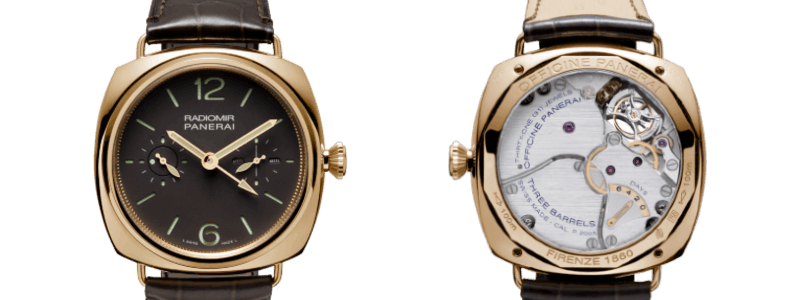
The brown sandwich dial is what holds it all together. Brown against steel would feel theatrical. Against pink gold, it’s coherent. The knurled pink gold ring on the outer edge of the dial — a detail that most product photography doesn’t capture cleanly — adds a fine concentric texture that picks up light differently from the polished case. Depth without noise. A decision that only becomes apparent on the actual object.
This is not Panerai making a dress watch. The hands are luminous. The numerals are Arabic, oversized, unmistakably tool-watch in proportion. It’s a Radiomir that happens to be built from rose gold, and the distinction between those two things matters considerably.
The PAM00330’s Movement — Why Panerai’s Tourbillon Is Not Like Other Tourbillons
This section runs longer than the rest. That’s deliberate. The movement inside the PAM00330 is the reason this watch exists at the price it commands, and the reason it belongs at the top of any serious Radiomir list. Understanding it properly requires patience — but none of it is obscure if you take it one step at a time.
What a Tourbillon Actually Does
A tourbillon is a rotating cage containing the balance wheel and escapement — the components responsible for regulating a mechanical watch. The cage rotates continuously, and the purpose of that rotation is to cancel the effect of gravity. When a watch rests in a fixed position for an extended time, the consistent gravitational pull on the escapement introduces small timing errors. The tourbillon counters this by making those errors cycle through every direction as the cage turns, averaging them out rather than letting them accumulate in one direction.
Abraham-Louis Breguet patented the concept in 1801, designed specifically for pocket watches that sat in fixed positions — crown up in a waistcoat pocket — for hours at a time. In a wristwatch, the argument is more nuanced. A wristwatch moves constantly on the wrist, which already provides some natural averaging of positional errors. Whether a tourbillon delivers meaningful practical accuracy improvement in a wristwatch versus a conventional escapement is a genuine debate in horology, and the honest answer is: it depends on the implementation, and the margin is smaller than marketing would suggest.
What a tourbillon does unambiguously in a wristwatch is demonstrate manufacture capability. Building one — the tiny components, the cage geometry, the gear trains required — represents a genuine mechanical achievement. And in some implementations, including Panerai’s, there’s a serious attempt to push the correction principle further than a standard tourbillon allows for wristwatch use specifically.
The PAM00330‘s movement falls into that second category. Which is where it becomes genuinely interesting.
The Cage That Rotates Differently
In a traditional tourbillon, the cage completes one full rotation per minute. The rotation axis is parallel to the plane of the movement — the cage spins flat, like a slow wheel. In a wristwatch, this compensates effectively for positions a watch stays in longest (crown up or crown down), but less effectively for the wide range of intermediate positions a wristwatch cycles through during normal wear.
Panerai’s engineers at the Neuchâtel manufacture took a fundamentally different approach.
In the PAM00330’s calibre, the cage rotates on an axis perpendicular to the balance wheel’s own axis. A different geometry — not a refinement of the classical construction, but a departure from it. Additionally, the cage completes one full rotation every thirty seconds, not sixty. Two full rotations per minute instead of one.
The result is a tourbillon that compensates more precisely for the positional accuracy errors specific to a wristwatch — which cycles through far more varied positions than the pocket watches Breguet originally designed around. The perpendicular axis means the cage fights gravity on a different plane. The double-speed rotation means the compensation happens twice as frequently.
This is patented. The gear train architecture required to achieve the faster, geometry-shifted rotation — comparable in mechanical concept to an automobile differential — had to be designed from scratch. Other manufacturers use the classical parallel-axis, 60-second rotation because it is the established construction. Panerai chose to build something that required its own engineering solution.
You can see the tourbillon on the PAM00330‘s dial. At 9 o’clock, a small rotating dot on the sub-dial — connected directly to the cage — completes a full circuit every thirty seconds. Watch it for a minute and you’ll see it complete two rotations. Inside that dot’s movement: a cage carrying a balance wheel and escapement assembly, spinning twice a minute, designed and assembled in Neuchâtel. That is not nothing.
Three Barrels, Six Days, 239 Components
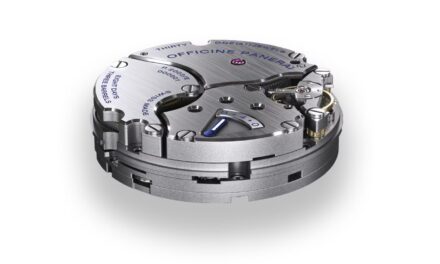
The PAM00330 is hand-wound. Three spring barrels connected in series — a patented Panerai arrangement — deliver the six-day power reserve. Series connection, rather than parallel, provides more consistent power delivery across the full reserve, which matters for positional accuracy over extended periods without winding. The movement runs at 28,800 vph, 31 jewels, Glucydur balance wheel, Incabloc anti-shock protection. At 9.1mm thick for a calibre of this complication — tourbillon, GMT differential, independent seconds — it’s a disciplined physical achievement.
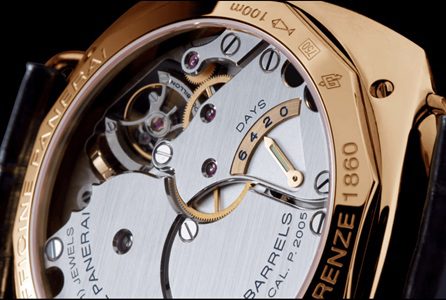
The power reserve indicator lives on the caseback, not the dial. This is the right decision. The dial carries the time, the GMT complication, and the tourbillon indicator — adding a power reserve sector to that face would tip the layout into crowded. Putting it on the back means the owner sees it every time they wind the watch, through the exhibition sapphire, alongside the movement itself. It makes the act of winding deliberate. You turn the watch over, check the reserve, watch the movement for a moment, and wind. For a calibre this complex, that ritual feels appropriate.
Through that exhibition caseback: bridges decorated with Côtes de Genève, the three barrels visible in their configuration, the cage — if you catch it at the right moment — in its thirty-second rotation. This is one of the few Panerai movements that genuinely rewards the reverse view.
The GMT Differential — Not an Afterthought
The GMT function in the PAM00330 is driven by a differential mechanism — a gear-based system, not a simple additional hand pushed by a modified date mechanism. The sub-dial at 3 o’clock shows a 24-hour hand indicating day/night for the second timezone; the second timezone can be set independently without stopping the movement.
For a watch with roots in Panerai’s naval instrument history, the GMT function is coherent rather than added for commercial completeness. Officers and operators who needed to track multiple time zones required a reliable mechanical solution. The PAM00330 delivers that through differential gearing — the same engineering principle used in automotive drivetrains, scaled to fit within 9.1mm of movement height. The fact that it works is not accidental.
The Case — What 48mm Polished Pink Gold Actually Means
At 48mm, this is not a watch that hides. The Radiomir cushion case sits wide on the wrist, and polished pink gold — fully polished, no brushed relief surfaces — means it catches light from every angle. There is nowhere for the material to absorb attention. You commit to this watch or you don’t; there is no middle position.
The wire loop lugs keep the design philosophically honest. No fixed lug architecture, no integrated strap system. A simple wire that sits in channels on the case, removable without tools, accepting a standard strap. This is the Radiomir’s original logic applied without compromise: the case is the case, the strap is interchangeable, and the connection between them is functional rather than precious. At this price point and in this metal, that restraint is notable.
The sapphire crystal over the dial is 1.9mm thick with anti-reflective coating. The exhibition caseback is the same quality sapphire, sealed to the same water resistance standard as the rest of the case. 100m / 10 bar water resistance on a watch with a tourbillon movement and a screw-crown without a bridge device is a genuine engineering achievement — the crown architecture has to be precise, the case sealing has to be reliable, and the exhibition back has to contribute to rather than undermine the overall integrity. On the PAM00330, it does.
Is 48mm too large? That depends entirely on the wrist and the willingness to be present on it. What I’d say is this: the Radiomir cushion case wears closer to the wrist than its diameter suggests. No exaggerated lugs, no crown guard adding width, no protruding bezel. It sits flat and wide. On a larger wrist it settles with authority. On a smaller one it will be a statement. For the PAM00330, with everything it carries inside, I don’t think 48mm is the wrong answer.
The Dial — Brown Sandwich, Depth, and the Detail That Moves
The brown sandwich dial is, for me, the element that makes the PAM00330 the most complete and tonally unified watch in its sibling group.
A sandwich dial construction: two plates. The lower carries the luminescent material. The upper has the hour markers and numerals cut through it, so the lume glows from beneath the surface rather than sitting on top of it. The result is visual depth — the markers appear to recede slightly into the dial, the luminescence has dimension rather than lying flat. Paneristi care about this construction because it affects both the daytime aesthetic and the lume-in-darkness experience in ways that a printed single-layer dial simply cannot replicate.
The brown upper plate — warm, tobacco-toned — against the polished pink gold case creates a combination that rewards time with the actual object. In photographs, the warmth is visible. In hand, it’s considerably more so. The knurled pink gold ring around the outer edge of the dial is the specific detail most images miss: fine concentric knurling that separates the chapter ring from the dial field, connecting dial to case material without announcing itself.
Two sub-dials: 24h GMT indicator at 3 o’clock, small seconds with tourbillon indicator at 9 o’clock. The layout is symmetrical. No date window — and the absence is correct. A date complication on a dial carrying this much information would compromise the balance, and the PAM00330 doesn’t need the addition to justify its existence.
The tourbillon indicator — a small rotating dot at 9 o’clock — is worth understanding before you look for it. It is not the seconds hand. It moves at twice the speed, completing one rotation every thirty seconds, tracking the cage rather than elapsed time. If you know what you’re looking at, it’s the most compelling single detail on the entire dial. If you don’t, you might not register it at all.
That ambiguity is very Panerai. And on this reference, it feels exactly right.
How the PAM00330 Sits Against Its Closest Siblings
The honest comparison runs between the PAM00330 and the other Radiomir P.2005 references: PAM00315 in titanium and PAM00316 in platinum.
The titanium version is the purest tool argument — lightest, closest in spirit to the original Radiomir DNA, and for collectors where the movement is the primary draw and material prestige is secondary, it makes a coherent case. It was also produced in a larger edition, which means fractionally better secondary market access. Though “fractionally better” is relative when you’re discussing 150 pieces.
The platinum version occupies its own corner. Anyone familiar with the PAM00373 Radiomir Platinum on this site will understand that platinum Radiomir references carry a specific weight — literally and in terms of collector perception. But platinum is a cold material, and cold doesn’t flatter the warm-toned brown dial the way pink gold does. The PAM00316 is technically exceptional. The PAM00330 is more unified.
For context in the broader precious-metal Radiomir complication space, the PAM00502 — a red gold Radiomir 1940 with a monopusher chronograph and eight-day reserve — shows that Panerai has explored this territory more widely. But the PAM00502 is a different calibre, a different era, a different proposition. The PAM00330 doesn’t have catalogue competitors. It has context.
Is the PAM00330 Worth Buying Pre-Owned in 2026?
The watch rarely appears. When it does, three factors determine what it’s worth paying.
Completeness. The original delivery included numbered documentation, edition-specific certification, and Panerai packaging. A complete set commands a genuine premium over a watch offered without papers — and on a 50-piece reference, provenance is more than sentimental. It’s verifiable identity. An undocumented example is a harder proposition at any price.
Service history. The movement inside the PAM00330 is a manufacture tourbillon. Its service is not something a generalist watchmaker should attempt without specific training and component access. Panerai-serviced examples — or those with documented service from a highly credentialed independent with confirmed experience on this calibre — carry real additional value. A tourbillon that hasn’t been opened in fifteen years is a risk, and the purchase price needs to reflect that honestly.
Caseback sapphire condition. The exhibition back is the most handled surface on this watch — every winding requires turning it over. On examples that have lived in collections for a decade and a half, check carefully for micro-abrasion on that crystal. Replacement is achievable but not inexpensive.
Last known retail was approximately $136,800. Pre-owned examples — when they surface on platforms like Chrono24 — will be priced variably depending on all three factors above. Complete, recently-serviced examples may command at or above original retail in some circumstances; 50-piece productions with informed collector demand and minimal public availability tend to hold value asymmetrically. Distressed examples — no papers, unknown service, caseback wear — are theoretically available at lower entry points, but the due diligence requirement increases in proportion.
I would not buy this watch without confirmed service documentation or a pre-purchase inspection from a watchmaker who knows this movement specifically. That’s not excessive caution. It’s what a complication of this density deserves.
“The cage makes one rotation in 30 seconds — genuinely Panerai’s own geometry, not the classical arrangement.” — La Cote des Montres, technical coverage of the P.2005 calibre, 2007
Who Is It For?
- The Radiomir collector who wants the apex of the line — not the most available reference, not the most recognisable, but the one where movement ambition, case heritage, and material choice converge without compromise
- A Paneristi who understands what the manufacture programme meant — the tourbillon inside the PAM00330 landed differently in 2007 than it does now; knowing that history gives this watch its full weight
- Someone who accepts that pink gold in a tool case is not a contradiction — this requires a specific sensibility; if you have it, the PAM00330 is immediately coherent
- A collector with patience and standards — fifty pieces worldwide means the right example, with the right papers and service history, takes time to find; this is not a watch you compromise on condition to acquire faster
- Anyone drawn to watches that don’t perform their own value — the PAM00330 doesn’t announce itself; the people who recognise what it is, already know
- If you want manufacture credentials in a Radiomir at a more accessible price point, the PAM00323 is a different conversation entirely
Not for: Collectors who need active forum communities and peer validation around their pieces. Buyers who require a movement to be manufactured entirely in-house but can’t reconcile that with the Neuchâtel manufacture building it completely from design to assembly. Anyone looking for a first Panerai, or a daily tool watch with easy service access. And not for collectors who want legible complications at a glance — the tourbillon indicator on the PAM00330 rewards those who already know to look for it.
Conclusion
The PAM00330 sits in a strange, quiet position. Fifty pieces made. Almost no public discourse. A manufacture tourbillon inside a military-derived case, in 18ct polished pink gold, from a brand that most of the collector world still primarily associates with brushed steel and simple dials.
It doesn’t fit any of the dominant Panerai narratives cleanly.
That’s exactly why it’s on my wishlist.
The movement inside is a genuine achievement — a patented tourbillon geometry that differs from the classical construction, built entirely in Neuchâtel, running at 4Hz with a six-day reserve from three barrels in series. The Radiomir cushion case is the most honest shape in the collection. Brown sandwich dial. Rose gold. And only fifty of them in the world.
My argument is simple: this is what the Radiomir looks like when it’s treated as a platform for serious watchmaking — not just a quieter alternative to the Luminor, but a case architecture worthy of the best movement Panerai had yet built. Whether that proposition justifies the price is a question only you can answer.
If you’ve owned one, or ever had it in hand — I want to know what it’s actually like to wear it. Leave a comment below.
Extended Summary
- The PAM00330 is the rarest and most complete watch in its sibling group: 50 pieces, 18ct polished pink gold, 2009, the apex of Panerai’s first-generation manufacture tourbillon programme within the Radiomir collection — the only precious-metal Radiomir tourbillon in this case architecture
- The PAM00330 carries a tourbillon that works differently from every other on the market: the cage rotates on a perpendicular axis (not parallel) at one rotation every 30 seconds (not 60), a patented design developed at the Neuchâtel manufacture to more precisely compensate for the positional accuracy errors specific to a wristwatch — this is documented engineering, not marketing
- The pink gold and brown sandwich dial make the PAM00330 the most tonally unified watch in the group: warmer and more coherent than the steel, titanium, or platinum variants — the case, dial, and material speak the same language in a way the siblings don’t quite achieve
- Secondary market access is genuinely rare and demands thoroughness: last known retail ~$136,800; pre-owned examples surface infrequently, and service history plus documentation completeness are the critical variables when one does appear — a distressed example at a low price is a more complicated proposition than it sounds
- This is a watch for the Radiomir collector at the top of their journey: not a first Panerai, not an easy find, not a conversation piece for casual observers — but possibly the reference where heritage, manufacture ambition, and material craft land together most completely in the entire Radiomir catalogue
At a Glance
| Reference | PAM00330 |
| Collection | Radiomir |
| Name | Radiomir Tourbillon GMT Oro Rosa |
| Introduced | 2009 |
| Edition size | 50 pieces |
| Case material | 18ct polished pink gold |
| Case diameter | 48mm |
| Case back | Exhibition — see-through sapphire |
| Lug attachment | Removable wire loop (patented) |
| Water resistance | 100m / 10 bar |
| Movement | Panerai P.2005 (manufacture) |
| Winding | Hand-wound, manual |
| Beat rate | 28,800 vph (4 Hz) |
| Power reserve | 6 days — three spring barrels in series |
| Components | 239 |
| Jewels | 31 |
| Complications | Tourbillon, GMT differential, 24h indicator, power reserve indicator (caseback) |
| Dial | Brown sandwich — luminous Arabic numerals and hour markers |
| Last known retail | ~$136,800 USD |
| Availability | Pre-owned only |