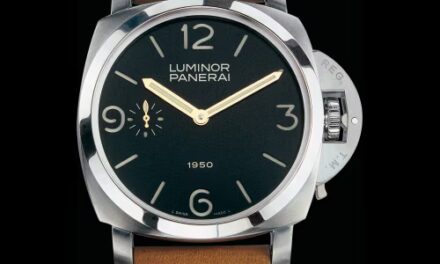
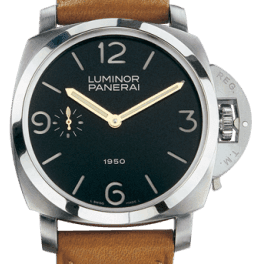
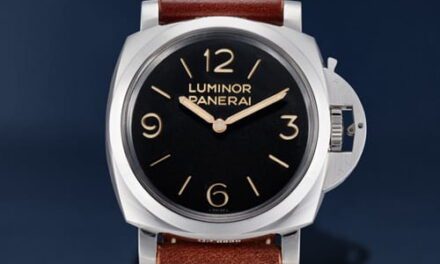
Introduction – A Complication-Rich Panerai in a Compact Size
Quick Takeaways
- The PAM00537 packs a genuine in-house automatic movement, the P.9002, into a 42mm Luminor 1950 case. One of the few references where you get full manufacture credentials without asking a 47mm case to fit under a cuff.
- GMT, power reserve indicator, date, and zero-reset seconds run off two barrels and 237 components. Complication density most collectors don’t associate with Panerai at all.
- The Clous de Paris hobnail dial is the most visually distinct texture Panerai has put on a 1950 case. It’s also the reason some Paneristi don’t fully embrace this reference.
- Produced 2014–2016 and discontinued in 2017 in favor of the PAM01537. The P.9012 replacement is genuinely thinner, which raises a real question about which one to actually buy.
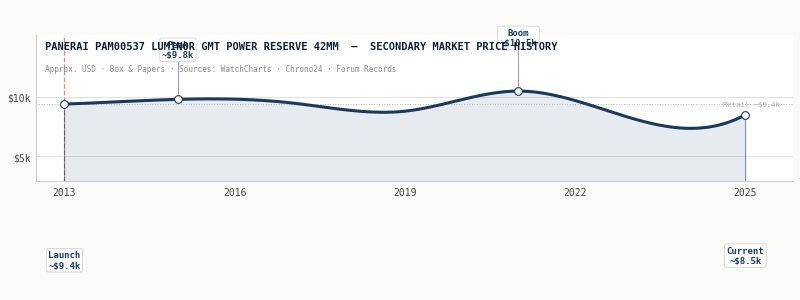
- Secondary market runs roughly $4,500–$9,500 depending on condition, box, and papers. For a fully manufacture-built automatic complication, that’s a reasonable point of entry.
Jump directly to the spec sheet.
Panerai’s Size Identity Crisis Has an Exception
Panerai has an identity built on size. Ask most people what a Panerai looks like and they’ll describe something in the mid-40s to high-40s millimetres, a case that announces itself before you’ve said a word. So it’s easy to overlook the PAM00537, a reference that took a different approach: bring the Luminor 1950 case down to 42mm, load it with a genuine in-house automatic movement, and give it a dial texture nothing else in the catalogue wears quite the same way.
Produced between 2014 and 2016 before Panerai replaced it with the PAM01537 in 2017, this is the Luminor 1950 3 Days GMT Power Reserve Automatic Acciaio, a name that undersells exactly how much is happening inside a 42mm case. It’s discontinued now, which means every example on the market today is pre-owned, and the community’s read on this watch has had years to settle. That read is more divided than you’d expect from a watch this technically accomplished.
If you already know the PAM00372, the hand-wound, 47mm side of the 1950 family, the PAM00537 is worth understanding as its opposite number: same case DNA, automatic instead of manual, and built at a size the PAM00372 never touches. Panerai’s own history is full of these quieter forks in the catalogue, references that solve a specific problem rather than chase a headline.
I haven’t worn this exact reference. It’s not currently in my collection, but it’s one I keep coming back to when I think about what a genuinely sensible Panerai actually looks like.
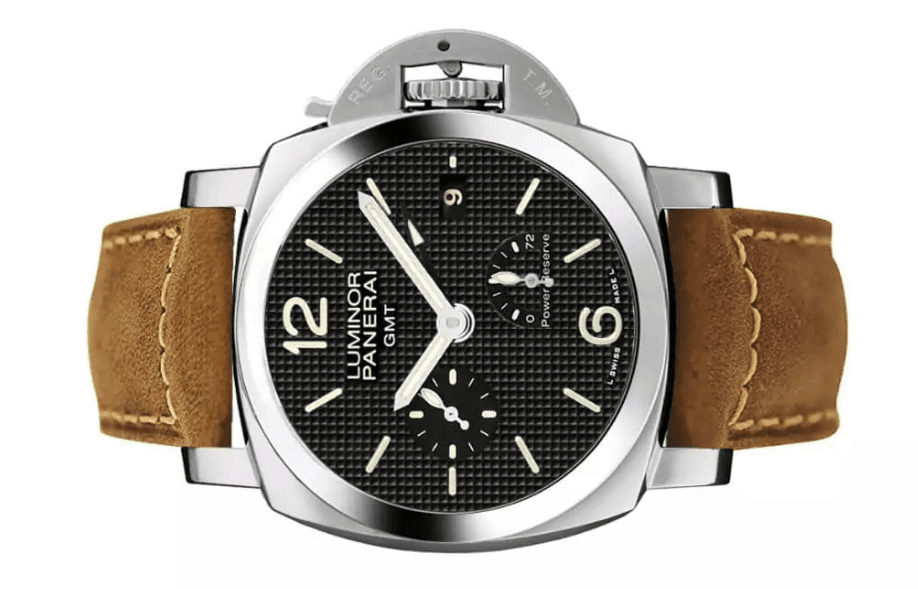
A 1950 Case That Doesn’t Ask You to Choose a Size
What “1950 Case” Actually Means at 42mm
The Luminor 1950 case is defined by its cushion shape: barrel sides, crown-protect bridge, a silhouette that reads as unmistakably Panerai from across a room. Most references wearing that case sit at 44mm or 47mm, sizes that work brilliantly for some wrists and end the conversation for others before the movement is even discussed.
The PAM00537 uses the same architectural language at 42mm. That’s a genuinely different proposition, not a scaled-down photocopy. The crown-protect bridge, the lug geometry, the case-back profile are all present, all correctly proportioned, just built around a smaller footprint. For collectors who admire the 1950 case but have spent years talked out of buying one over size alone, this is the reference that actually answers the objection.
The case itself is AISI 316L stainless steel, polished on the bezel and brushed across the caseband, a fairly standard Panerai steel treatment, executed cleanly rather than dramatically. The caseback is a skeleton sapphire window, letting you see straight into the P.9002 rather than staring at a solid caseback the way most vintage-inspired Panerai references do. Water resistance sits at 100 metres, enough for genuine daily-wear confidence, without being pitched as dive-rated the way a Submersible would be.
Why This Reference Exists: Panerai’s Mid-2010s Sizing Pivot
By the mid-2010s, Panerai had a wearability problem it wasn’t ignoring. The brand’s identity had been built on oversized cases through the 2000s, but a meaningful slice of the collector base was asking for something that didn’t require an eight-inch wrist to look intentional rather than accidental.
The PAM00537 was part of that answer, alongside a handful of other 42mm-and-under references introduced across the same stretch. What sets it apart from most of those is that Panerai didn’t simplify the movement to fit the smaller case. It went the other direction: GMT, power reserve display, zero-reset seconds, all built into a fully in-house automatic caliber, then packaged into the compact case rather than the reverse.
Most brands shrink the case and simplify the movement. Panerai shrank the case and kept the complication stack intact. That’s the detail that gets skipped in most coverage of this reference.
The Hobnail Dial: Texture Over Tradition
The dial is where the PAM00537 stops being subtle. Rather than the sandwich construction Panerai typically leans on, the PAM00537 wears a black Clous de Paris (hobnail) texture across the entire surface. The pattern comes from an old guilloché tradition of small raised pyramids that catch and scatter light differently depending on the angle you’re looking from, a texture more commonly associated with dress-watch guilloché than with a brand built on legibility-first military instruments.
Mixed Arabic-numeral and index hour markers sit over that textured surface. A date window occupies 3 o’clock, small seconds sit at 9, an arc-shaped power reserve indicator reads near 5, and a central GMT hand with an arrow tip cuts across all of it. It’s a busy dial by Panerai standards. Four functions competing for space on a 42mm face is a genuine amount of information, and the hobnail texture underneath adds visual noise rather than quieting it.
A Dial That Divides Opinion, and Why
This is where the PAM00537 conversation genuinely splits. Some collectors treat the hobnail texture as one of the most interesting dial decisions Panerai made in this era, a departure from sandwich-dial orthodoxy that’s hard to dismiss as gimmicky once you’ve seen it catch light in person. Others read it the opposite way: a dial trying to do too much, wearing a texture with nothing to do with Panerai’s military DNA, layered under complications that crowd a 42mm face that was already asking a lot of itself.
I lean toward the first camp, with a caveat. The hobnail texture works. The complication density is what pushes the dial toward busy. Take away either the GMT hand or the power reserve arc and you’d have a genuinely clean, distinctive dial. With both present, it asks your eye to do more work than a 42mm Panerai comfortably allows.
The P.9002: Panerai’s Case for Full In-House Automatic
This is where the PAM00537 earns real attention, and where most coverage of this reference undersells what’s actually happening under the caseback.
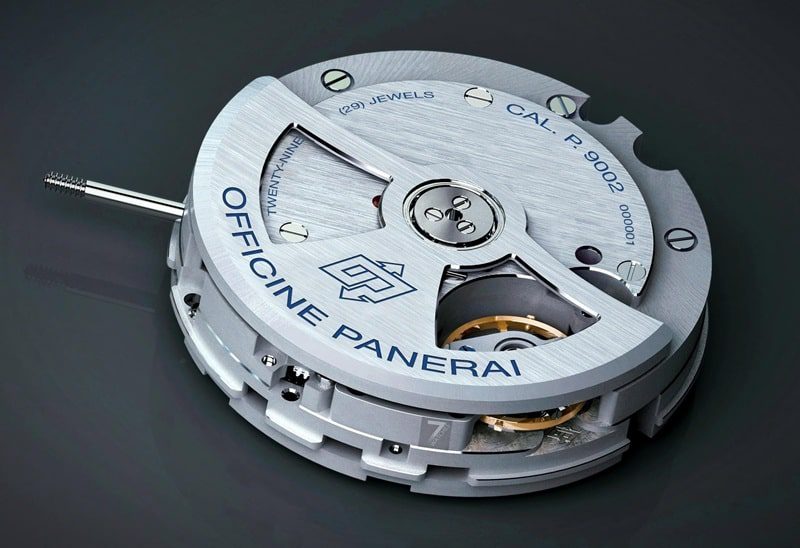
What “Entirely Made by Panerai” Actually Means
The P.9002 isn’t an ETA-derived movement wearing a Panerai badge. It’s built start to finish inside Panerai’s own manufacture: 237 components, 29 jewels, a Glucydur balance running at 28,800 vph, Incabloc shock protection. Two series-coupled barrels deliver a 72-hour power reserve, a genuinely useful spec that lets the watch sit unworn over a weekend without needing a full reset. The movement carries COSC certification, meaning it passed the Swiss chronometer testing standard before it ever reached a case.
For context: when the PAM00537 launched, Panerai’s in-house automatic programme, which had only begun with the P.9000 in 2008 and would later branch into calendar variants like the P.9010/AC, was still relatively young. Fitting a fully manufacture movement with this level of complication into a compact 42mm case wasn’t the easy option. The easy option would have been an ETA-based movement in a simplified case, the standard approach most brands take when building a “smaller, more wearable” version of a flagship reference.
GMT, Power Reserve, and Zero-Reset: Function Stacked on Function
The GMT function runs off a central hand rather than a sub-dial. You read the second time zone at a glance, off the same scale as the primary hours, instead of squinting at a 24-hour sub-register. The power reserve indicator, arced near 5 o’clock, tells you exactly how much of the 72-hour reserve remains, which matters more on a watch you might not wear every single day.
The zero-reset seconds function is the detail that gets glossed over most often. Pull the crown, and the seconds hand snaps back to zero rather than simply stopping, letting you set the time to the second against a reference signal, the same hacking behaviour built into far more serious tool watches. It’s a small mechanical courtesy that plenty of automatic movements at this price point skip entirely.
Honest Take on the Finishing
Let’s be direct: the P.9002 isn’t finished for a display-back audience expecting hand-bevelled anglage and Côtes de Genève. The bridges are broadly finished, functional rather than decorative, and through the sapphire caseback you’re looking at solid engineering rather than haute-horlogerie flourish. That’s consistent with Panerai’s whole philosophy: these are instruments first. But it’s worth being upfront about, especially at the price this reference commands pre-owned.
What you’re paying for isn’t decoration. It’s a fully in-house, COSC-certified, four-function automatic movement in a 42mm case, a combination rarer in Panerai’s catalogue than the brand’s size reputation would suggest.
PAM00537 vs PAM01537: Was the Replacement Actually Better?
When Panerai discontinued the PAM00537 in 2017, it didn’t retire the concept. It refined it. The PAM01537 replaced it directly: same 42mm case, same hobnail dial, same function set, but built around the newer P.9012 caliber.
The differences are real, not cosmetic. Per WatchBase’s caliber records, the P.9012 uses 231 components against the P.9002’s 237, carries 31 jewels against 29, and, critically, measures 6mm thick against the P.9002’s 7.9mm. That’s not a marginal refinement; it’s a genuinely slimmer movement, which translates to a genuinely slimmer watch on the wrist.
So why would anyone buy the PAM00537 over its own successor?
Availability and price. The PAM01537 had a longer production run and turns up more often pre-owned, which tends to keep pricing on the newer reference more predictable. PAM00537 listings on Chrono24 show wider swings, driven by condition and completeness rather than a tight, well-established market band.
The thicker case has a presence argument. Collectors who’ve handled both note that the PAM00537’s slightly thicker profile gives it a touch more heft on the wrist, a small thing, but consistent with the general Panerai preference for a watch that reminds you it’s there.
First-generation status. The PAM00537 is the reference that proved the concept, full in-house automatic complication in a 42mm 1950 case, worked. The PAM01537 refined the execution. It didn’t originate the idea.
My honest read: if thinness and easier sourcing matter more to you than any of that, the PAM01537 is the rational buy. If you want the reference that established this idea in the first place, and you don’t mind a movement that’s 1.9mm thicker, the PAM00537 is where the story actually starts.
Is the PAM00537 Worth Buying Pre-Owned?
Every PAM00537 on the market today is pre-owned. Production ended in 2016, and Panerai has never revisited the reference. That changes the calculus in a few specific ways.
Papers and box completeness matter more than usual. As with most discontinued references, a full set, box, warranty card, hang tags, holds value more reliably than a watch-only purchase, and it materially affects resale liquidity down the line.
Service history is worth asking about directly. The P.9002 is a fully in-house movement with real complication density, GMT, power reserve, zero-reset, and not every independent watchmaker services Panerai manufacture calibers with the same familiarity they’d bring to an ETA-based movement. A documented service history from an authorised centre is a genuine premium driver here, not a nice-to-have.
Pricing spreads widely. WatchUSeek listings and dealer stock alike show the PAM00537 trading across a broad range depending on strap condition, box completeness, and whether the sale is private or backed by dealer warranty. A private, box-and-papers-complete example in strong condition sits well above a stripped, aftermarket-strap watch, and that gap is wider than on more commonly traded references.
At the lower end of that range, you’re buying a genuinely complicated, fully manufacture-built automatic Panerai for less than plenty of ETA-based Swiss GMT watches command new. That’s a proposition worth taking seriously, even if the dial isn’t for everyone.
“A great option for someone who prefers a smaller case than the usual 44mm+.” WatchUSeek Panerai forum, seller listing description
Who Is It For?
- Collectors who want the 1950 case without the 47mm commitment. The case architecture is fully intact, just built at a size more wrists can wear daily. The 42mm, at approximately 17mm thick, is still a substantial watch, not as slim as some would want, but genuinely wearable in a way the 47mm references aren’t.
- Buyers who prioritise in-house engineering over display-back finishing. The P.9002 is a genuine manufacture movement with real complication density, robust but plainly finished through the sapphire back, rather than dressed up for the caseback.
- Collectors who appreciate texture over minimalism. If the hobnail dial appeals to you, nothing else in the current or past Panerai catalogue reads quite the same way. It works well as both a sports watch and a dressier daily wearer.
- Pre-owned buyers comfortable doing diligence. This is a discontinued reference; box, papers, and service history all carry real weight in what you’re actually buying.
- Anyone deciding between the PAM00537 and PAM01537. Understanding what the extra 1.9mm of movement thickness buys you, or doesn’t, matters before committing.
Not for: Collectors who want Panerai’s classic sandwich-dial minimalism, the dial’s busyness with four competing indicators won’t suit purists. Anyone who wants a movement finished for maximum caseback theatre. Buyers uncomfortable navigating a discontinued reference’s service and provenance questions. Or anyone convinced a “real” Panerai starts at 44mm, the PAM00537 doesn’t carry the cult status of simpler or more iconic Panerai references, and it isn’t trying to.
Conclusion
The PAM00537 occupies an odd space in Panerai’s catalogue: genuinely ambitious under the caseback, genuinely divisive on the dial, and sized in a way that quietly solves a problem a lot of collectors have with the brand without ever being marketed as the solution. It didn’t earn a nickname the way the Fiddy did. It didn’t become a cult reference. It just did something unusual, packed a fully in-house, COSC-certified, GMT-and-power-reserve automatic movement into a 1950 case at 42mm, and mostly went under-discussed for it.
The PAM01537 refined the idea. It didn’t replace the reason the PAM00537 is worth understanding in the first place.
Where do you land on the hobnail dial: distinctive, or too much for a 42mm face? And if you’ve owned both the PAM00537 and PAM01537, which one actually won you over on the wrist?
Extended Summary
- The PAM00537 fits a full in-house automatic movement into a 42mm 1950 case: a combination Panerai rarely attempts at this size. Most compact references simplify the movement; this one didn’t.
- The P.9002 caliber is genuinely manufacture-built: 237 components, 29 jewels, COSC certified, 72-hour reserve via two barrels. GMT, power reserve display, and zero-reset seconds all included.
- The Clous de Paris hobnail dial is the most divisive element: distinctive and unusual for Panerai, but layered under enough complications to read as busy on a compact case. The texture works; the density is the real debate.
- Discontinued in 2017 in favour of the PAM01537: the successor’s P.9012 caliber is thinner (6mm vs 7.9mm) and more available, but didn’t originate the concept. The PAM00537 is where this idea actually started.
- Secondary market runs roughly $4,500–$9,500: box, papers, and documented service history are the decisive variables on a discontinued in-house complication. At the lower end, a genuinely rare specification for the price.
<a id=”jump”></a>
At a Glance
| Reference | PAM00537 |
| Collection | Luminor 1950 |
| Case | 42mm brushed/polished AISI 316L steel |
| Crystal | Sapphire, scratch-resistant |
| Caseback | Sapphire, skeleton |
| Movement | Panerai P.9002 (automatic, in-house) |
| Power Reserve | 72 hours (3 days) |
| Frequency | 28,800 vph |
| Jewels | 29 |
| Complications | GMT (central hand), date, power reserve indicator, zero-reset seconds |
| Water Resistance | 100 metres |
| Production | 2014–2016 (replaced by PAM01537 in 2017) |
| Secondary Market | ~$4,500–$9,500 |
| Availability | Pre-owned only |