Quick Takeaways
- The PAM273 is a 250-piece rose gold Radiomir from 2007, released alongside the white gold PAM00235 and the platinum PAM00274 as a deliberate precious-metal trilogy built around the same in-house movement. A statement release, not a standard collection piece.
- The P.2003 is Panerai’s first automatic movement designed and built entirely at Neuchâtel. Ten days of power reserve from three spring barrels in series, at an unusually high 28,800 vph.
- The 45mm rose gold case is smaller than the 47mm Radiomir standard, keeping the wire-lug architecture without a crown guard. More wearable than the specification suggests.
- The dial runs five active indicators: hours, minutes, small seconds, 24h GMT, date, and a linear power reserve, all handled by sandwich construction without feeling cluttered.
- Secondary market pricing runs roughly $15,000–$22,500 for documented full sets. Performing meaningfully better than the broader Panerai Radiomir index over comparable periods.
Jump directly to the spec sheet.
The PAM273’s Rose Gold Is the Distraction
Most people who look at the PAM273 see the rose gold first.
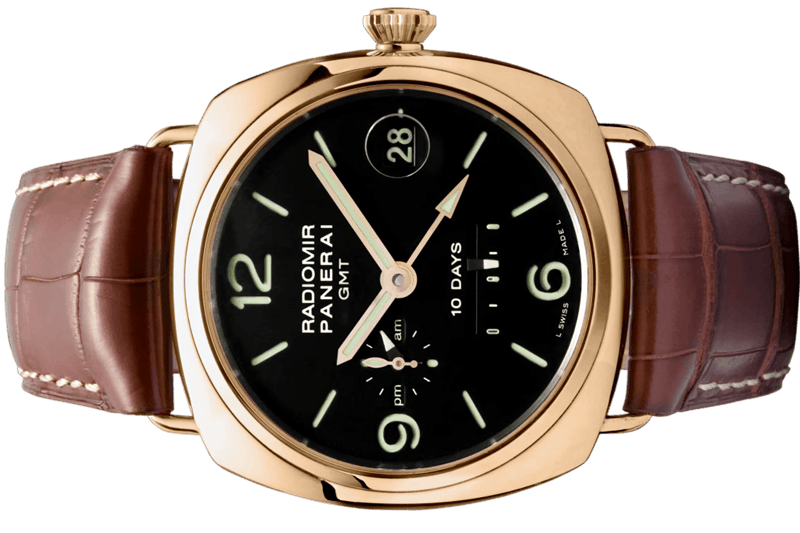
They notice the warm flush of 18k pink gold against a black dial, the wire lugs that wrap the case in the Radiomir’s characteristic architectural simplicity, the deployant buckle that matches the case metal. It’s a striking watch. It reads immediately as Panerai while simultaneously reading as something more restrained and refined than the typical steel or titanium tool watch the brand is associated with.
What they should probably be looking at first is what’s underneath the exhibition caseback.
The P.2003 calibre, Panerai’s first automatic movement designed and built entirely at the Neuchâtel Manufacture, is the reason this watch exists as a special edition rather than a standard collection piece. Released in 2007 alongside the white gold PAM00235 and the platinum PAM00274 as three expressions of the same technical achievement, the PAM273 is essentially Panerai saying: here is our most capable in-house automatic. Here it is in rose gold, limited to 250 pieces, with a rose gold deployant buckle and a black sandwich dial that has more going on behind it than almost anything else in the Radiomir line.
The case is what it is. The movement earns the price.
A Family of Three – How the 2007 Precious Metal Trio Works
PAM235, PAM273, PAM274 – The Same Engine, Three Different Registers
Understanding the PAM273 requires knowing where it sits in a deliberately structured 2007 release. Panerai launched three precious-metal Radiomir references simultaneously, each housing the same P.2003 automatic calibre in a 45mm case with wire lugs.
The PAM00235 is 18k white gold, 250 pieces. The coldest of the three: cool grey-white against a black dial, maximum contrast, the most architectural of the set. It and the PAM273 share identical production numbers and identical movement specification.
The PAM00273 is 18k rose/pink gold, 250 pieces. The warmest of the trio. The pink gold gives the cushion case an Italian warmth that reads differently against the black dial than either the white gold or steel versions.
The PAM00274 is platinum, 50 pieces, with a brown dial rather than black. The rarest and most elevated of the three. Nicolas on WatchProSite described this platinum sibling as offering:
“A reliable movement, a heavy platinum case, and a gorgeous clean, sober brown dial.” — WatchProSite, Officine Panerai forum, on the PAM00274
These three watches make the same mechanical argument with different finishing positions. The PAM273 sits in the centre: more available than the platinum, warmer in character than the white gold, and carrying the rose gold hand finish that gives the dial a distinctive identity the white gold version doesn’t have.
The relationship to Panerai’s P.2003/6 calibre family runs deep. The 10 Days architecture powers some of Panerai’s most significant precious metal Radiomirs across multiple years. The PAM273 is an early expression of that capability in a Radiomir wire-lug case. Before the architecture became a staple, it was a statement.
The P.2003 Calibre — Panerai’s First Automatic Manufacture Movement
Three Barrels, Ten Days, 28,800 vph — Why the Architecture Matters
Let me be specific about what the P.2003 is and what makes it genuinely significant.
Panerai’s P.2002, the first in-house calibre, which debuted in the PAM00201 in 2005, was hand-wound. A remarkable achievement, but hand-wound is the easier technical path when designing for extended power reserve. Automatics have to solve a fundamentally harder problem: winding energy must be captured passively and reliably from wrist motion, then stored and delivered consistently over a 10-day cycle without the torque curve degrading so badly that accuracy suffers in the final days.
The P.2003 is Panerai’s first automatic movement designed entirely at Neuchâtel. The WatchBase calibre documentation is direct about its significance: it inherits all the P.2002’s functions but takes one step further with automatic winding via an oscillating weight mounted on a ball bearing, winding in both directions.
The triple-barrel series architecture is the engineering solution. Three spring barrels connected in series, not parallel, not decorative, distribute the energy storage load across three mainsprings, each running at lower individual tension. The result is a flatter torque curve across the full 10-day cycle: more consistent force to the escapement from day one through day ten. This is why Panerai ran the P.2003 at 28,800 vph, an unusually high beat rate for a long-reserve movement, where most manufacturers sacrifice frequency to conserve energy. The three-barrel design provides enough energy headroom to maintain that rate throughout.
Two of the three barrels are stacked vertically. The third links to them through a gear train, which also drives the power reserve indicator on the dial. The differential gear that runs the linear PR indicator is one of the 296 components in the calibre, a specific piece of engineering that translates barrel rotation into the sliding indicator you can read at 6 o’clock.
The winding rotor is mounted on ball bearings, a specific choice for durability and drag reduction when the wrist motion is low. The oscillating weight winds both clockwise and counterclockwise. Under normal daily wear, most wearers will rarely see the PR indicator reach its minimum.
GMT Differential, Zero-Reset Seconds, Linear Power Reserve
The P.2003’s complication set is worth understanding in operational terms, not just spec-list terms.
GMT differential in the P.2003 is a true 24-hour GMT: an arrow hand indicating the second time zone against a 24-hour scale, with AM/PM indication in the shared sub-register at 9 o’clock alongside the small seconds. This is not a simple second-time-zone hand but a differential gear arrangement that allows rapid adjustment of local time via the crown intermediate position without disturbing the GMT hand or the running seconds. Set the GMT to home time and leave it there indefinitely. Adjust local time when you travel.
Zero-reset seconds: pull the crown to setting position and the seconds hand snaps to zero and stops. Push the crown back in and the seconds restart. This feature, standard across the P.2000 series, allows precise time synchronisation against a reference signal without requiring a separate hacking function.
Linear power reserve: the sliding indicator at 6 o’clock moves left-to-right as power diminishes. Fully wound, the slider is hard right. At zero reserve, hard left. After 10 days without winding, the indicator will be reading empty. The visual progression of the slider across the calibrated scale over a week-plus of use is one of the genuinely satisfying functional experiences this watch offers. You can see the reserve building as you wind, then see it slowly drawing down over the days.
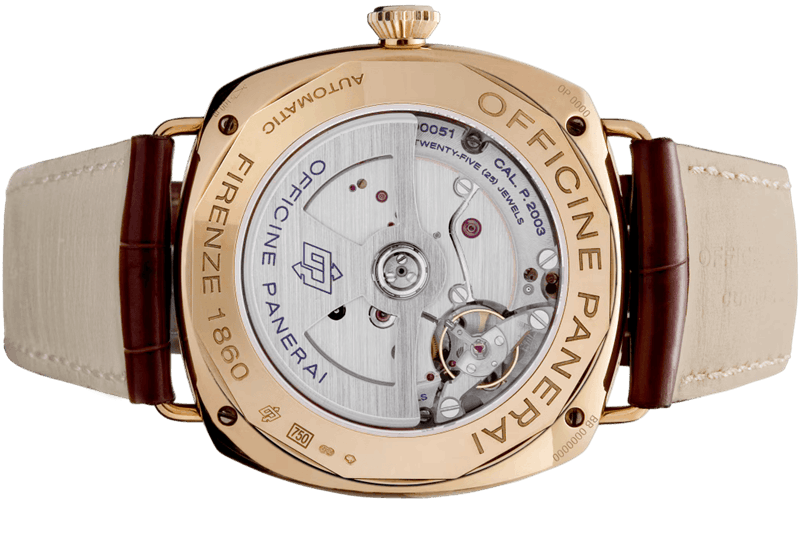
Through the exhibition sapphire caseback, all three barrel drums are visible in a row. The oscillating weight rotates above them. The calibre doesn’t have the skeletonized finishing of the P.2003/10 variant (which appeared in the later Radiomir 1940 Oro Rosso references), but the three-barrel view through the caseback reads as intentional architecture rather than mere mechanism.
The Dial — Five Indicators and the Black Sandwich
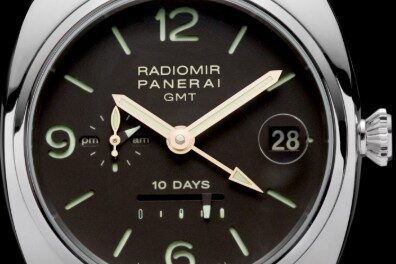
The PAM00273’s dial carries five active indicators. By standard Panerai purity reasoning, this is a heavily complication-loaded watch. By any objective reading of the layout, it’s remarkably clean.
The sandwich construction handles the legibility challenge. The black upper disc is perforated for the luminous Arabic numerals and markers of the lower disc to glow through. The sub-registers at 9 o’clock share space neatly for seconds and 24h GMT. Date sits at 3 o’clock under a magnified window formed from the crystal itself. The magnification is built into the crystal’s underside rather than being a separate cyclops lens, which eliminates the risk of that component separating.
The rose gold hands carry luminous centres. Against a black dial, rose gold hands read differently from silver or white gold. There’s a warmth to the timekeeping presentation that ties the dial to the case material in a way that reinforces the overall aesthetic register.
The linear power reserve at 6 o’clock is the detail most people forget until they own one. It changes how you relate to the watch. Every morning you can glance at the slider and calibrate your sense of where the ten-day cycle stands. After the second or third day without winding, the movement feels independent, running reliably without any input, doing exactly what it was engineered to do.
Pairing the Goldtech material context at Panerai helps calibrate where rose gold sits in the brand’s precious metal vocabulary. Goldtech™ is Panerai’s proprietary gold alloy developed later for greater scratch resistance and a deeper colour tone. The PAM273’s standard 18k rose gold is the classic alloy: warmer, softer, and polished to a mirror finish that catches light with genuine depth.
45mm Rose Gold and Wire Lugs — The Radiomir in Precious Metal
The Luxury/Tool Tension — What Collectors Actually Think
The Radiomir case has no crown guard. This is the most relevant formal distinction from the Luminor. The wire lugs and bare crown give the Radiomir a cleaner, more refined silhouette that lends itself to precious metal treatment in a way the Luminor’s industrial crown guard doesn’t. A rose gold Luminor would look incongruous. A rose gold Radiomir follows a logic: the case shape is restrained enough to carry the material without looking like a category error.
At 45mm the PAM273 is measurably smaller than the 47mm Radiomirs that defined the early modern Panerai era. At 15.2mm thick the profile is significant but not extreme, a figure confirmed by European Watch Co’s J-series documentation of the 2007 production run. The polished finish throughout, case body, bezel, lugs, creates a coherent luxury statement rather than the mixed brushed/polished finish of steel tool watches. This is a watch made to be seen at dinner, in a boardroom, on a long-haul flight. Not in the sea.
The 100-metre water resistance is genuinely appropriate here. The Radiomir is not a dive watch in any practical sense once it’s wearing 18k rose gold. The water resistance exists because it’s a Panerai, and Panerai’s case construction delivers it by default. Nobody is taking the PAM273 to 100 metres.
The PAM00690 Radiomir 1940 blue dial provides useful comparison: another limited precious-metal Radiomir using a different case architecture. The PAM273’s wire-lug format versus the PAM00690’s conical-crown 1940 case represent two different vintage references within the same precious-metal Radiomir category.
The broader Panerai conversation about precious metals and Radiomirs is not new. The 2024 Watches and Wonders releases continued that conversation about how precious metal Radiomirs sit within the brand’s strategic positioning: heritage-led luxury at the top tier of the Radiomir line, with the P.2000 series movements providing the technical substance.
PAM00273 Secondary Market – 250 Pieces and the Secondary Market
The 250-piece ceiling places the PAM273 in Panerai’s meaningful-rarity tier. Limited enough that secondary market examples are encountered rather than sought in volume, but not so thin that they’re effectively unobtainable. The PAM00274 platinum sibling at 50 pieces is dramatically more scarce; the PAM00235 white gold at 250 pieces is equally matched in production number.
On Chrono24‘s current PAM273 listings, full-set examples range from $15,010 to $22,500 USD. WatchCharts secondary market data shows the PAM273 down 4.7% over one year, but performing 4.7% better than the Panerai brand average over the same period, and outperforming the Panerai Radiomir Index by 6.4% over five years. The precious metal and limited production provide meaningful relative insulation against the broader Panerai correction.
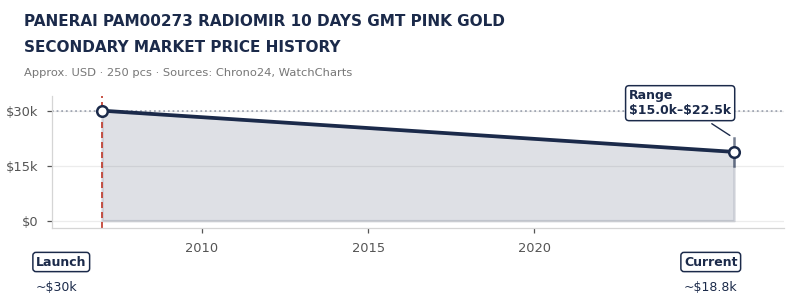
The thin trading volume (2 recorded August 2025 sales on WatchCharts) generates a high liquidity risk score, which is worth noting honestly. This is not a watch you turn over quickly if circumstances require. It sits in a collector’s position: held by people who understand what it is, surface infrequently, and transact at patient prices.
The Panerai Radiomir Annual Calendar references demonstrate how the P.2000 series movement family evolved beyond the PAM273’s era. The 10-day GMT automatic was the foundation upon which subsequent complications were built. Owning a PAM273 means owning an early, precious-metal expression of that foundation.
Full-set documentation, rose gold deployant buckle present, certificate, wood presentation box, all booklets, is the baseline for proper valuation at the upper range. Examples without papers or with replacement straps sit noticeably lower. The rose gold deployant buckle in particular is a component that distinguishes a complete example from an incomplete one.
Who Is It For?
- The collector who wants P.2003 architecture in a Radiomir case. The PAM273 is a direct expression of Panerai’s manufacture automatic in the wire-lug format. That combination is specific and largely absent from the standard catalogue.
- A Paneristi building across precious metal references. The rose gold PAM273 has a different character from the white gold PAM00235 and the platinum PAM00274. Rose gold reads warmer and pairs differently with leather. Each of the three members of the 2007 family makes a distinct aesthetic argument with the same movement.
- Someone who finds the 47mm Radiomir too large. The 45mm case at 15.2mm thick wears more moderately than the brand’s 47mm references. This is a genuine wearability consideration that matters for many collectors.
- A collector comfortable with illiquid precious-metal positions. The PAM273 is not a reference you liquidate on a Monday morning. It is a position you hold with patience and relinquish intentionally.
Not for: Collectors who prioritise depth of movement architecture over wearability, the P.2003 is fully in-house and genuine, but it predates the more ornate finishing of later Panerai manufacture calibres. Not for buyers who need active, liquid market support, 250 pieces and thin trading volume make quick transactions difficult. Not for Paneristi who find the tool-watch/precious-metal combination philosophically incoherent, the rose gold wire-lug Radiomir is exactly that paradox, and those who find it unresolvable are correct to avoid it. And not for collectors who specifically want the watch to perform as a dive instrument, 100 metres in rose gold is a technical specification, not a practical invitation.
Conclusion
The Panerai PAM273 is easy to misread on first encounter. The rose gold case catches the eye and establishes a register, luxury, precious metal, Italian elegance, that can obscure what’s actually happening behind the exhibition caseback.
What’s happening is that Panerai’s first automatic manufacture movement is storing ten days of energy across three spring barrels and delivering it consistently to a 28,800 vph escapement, while simultaneously tracking two time zones, displaying a linear power reserve, and supporting zero-reset seconds. All of this in a 45mm wire-lug case with no crown guard, at a production run of 250 pieces.
The rose gold is the finish. The P.2003 is the argument.
Do precious metals change how you relate to a tool-watch heritage? Does the material elevate it or undermine it? Share your take below.
Extended Summary
- PAM273 is the Radiomir 10 Days GMT Pink Gold: 250 pieces from 2007, the rose gold member of a three-watch precious metal trilogy alongside the white gold PAM00235 (250 pieces) and platinum PAM00274 (50 pieces), all housing the same P.2003 in-house automatic calibre.
- The P.2003 calibre is Panerai’s first automatic movement designed and created entirely at the Neuchâtel Manufacture: distinguished from the manual-wind P.2002 by automatic winding via a bi-directional ball-bearing rotor, with three spring barrels in series delivering consistent torque across 10 full days at 28,800 vph.
- At 45mm and 15.2mm thick, the rose gold case is slightly smaller than the 47mm Radiomir standard and carries the wire-lug architecture without a crown guard: a proportional choice that makes it the most wearable precious-metal expression in the 2007 10 Days GMT set.
- The black sandwich dial carries five active indicators: hours, minutes, seconds/24h GMT at 9, date at 3, linear power reserve at 6, with rose gold hands and a magnified date window formed from the crystal’s underside rather than a separate cyclops lens.
- Secondary market pricing of $15,000–$22,500 USD for documented full-set examples reflects both the rose gold material premium and meaningful relative outperformance versus the broader Panerai Radiomir index over five-year holding periods, per WatchCharts data.
At a Glance
| Spec | Detail |
|---|---|
| Reference | PAM00273 |
| Collection | Special Editions |
| Released | 2007 |
| Limited to | 250 pieces |
| Case material | 18k polished rose/pink gold, 45mm |
| Case thickness | 15.2mm |
| Lugs | Removable wire lugs (patented) |
| Water resistance | 100 metres |
| Crystal | Domed sapphire (magnified date) |
| Caseback | Exhibition sapphire |
| Movement | Panerai P.2003 (in-house automatic) |
| Power reserve | 10 days (240 hours), triple barrel series |
| Beat rate | 28,800 vph |
| Jewels | 25 |
| Components | 296 |
| Complications | GMT/24h, date, small seconds, linear power reserve, zero-reset seconds |
| Dial | Black sandwich; Arabic numerals; date at 3; seconds/24h at 9; linear PR at 6 |
| Hands | Rose gold; luminous centres |
| Strap | Brown leather with rose gold deployant buckle |
| Lug width | 27mm |
| Availability | Discontinued; 250 pieces only |
| Original retail | ~$30,000 USD |