Quick Takeaways
- Panerai BMG-Tech is a bulk metallic glass alloy of zirconium, copper, aluminium, titanium and nickel, cooled so fast that its atoms never form a crystal. A metal with a glass-like structure.
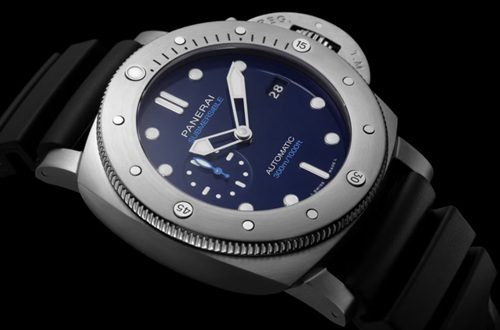
- The PAM00692 introduced it at SIHH 2017 as a 47mm Submersible, and it was the first watch built around a full BMG case.
- The material is described as about five times stronger than steel, harder than steel, lighter than steel and tougher than titanium, and it is highly resistant to corrosion, shocks and magnetic fields.
- The PAM00799 (2019) pairs a BMG-Tech case with a Carbotech bezel, and the current PAM02692 carries a blue dial.
- BMG-Tech does not age. That is its strength and its weakness, because it offers none of the patina that makes bronze so loved.
Jump directly to the timeline.
The Story of a Quiet Revolution
Panerai has always told stories through materials. Steel defined the brand’s naval past, titanium took weight out of the oversized Luminor cases, and bronze made headlines in 2011 with the Bronzo and its changing patina. Ceramic brought stealth, and Carbotech added layered carbon.
Then, in 2017, came a material that did not announce itself at all. The Luminor Submersible 1950 BMG-Tech PAM00692 looked like polished steel. Inside the silvery-grey case sat bulk metallic glass, an alloy that is about five times stronger than steel and built to shrug off scratches, shocks and corrosion.
Panerai BMG-Tech is the quietest radical move in the catalogue, and it has been oddly easy to overlook for collectors. In this article I look at what it is, how the three BMG-Tech Submersibles differ, how it stacks up against bronze, ceramic and Carbotech, and why collectors still argue about whether a Panerai should age at all.

What Is Panerai BMG-Tech?
BMG stands for bulk metallic glass. Panerai did not invent it, but it was the first to bring it into watchmaking. The alloy starts as a molten blend of zirconium, copper, aluminium, titanium and nickel. It is then cooled so quickly that the atoms have no time to settle into the orderly crystal lattice of normal metals. They freeze in a disordered, amorphous arrangement, which is where the word “glass” comes from.
That structure gives the material a set of properties that suit a dive watch:
- Strength. It is about five times stronger than steel, and it is harder than steel, so it resists everyday scratches better.
- Toughness. It is tougher than titanium and, unlike ceramic, it takes a knock without shattering.
- Weight. It is lighter than steel.
- Resistance. It is highly resistant to corrosion, shocks and magnetic fields.
- Appearance. It does not patinate, tarnish or change colour.
“It’s a Panerai case designed not to age: indestructibility disguised as simplicity.”
That last point is where the argument starts. The material looks quiet because it is designed to stay exactly as it is. Panerai itself describes BMG-Tech simply as a metallic glass made from a special alloy for exceptional robustness, and the watches are marketed on that basis. The company does not publish hardness figures or test data, so the numbers above are best read as the material’s character, not a lab sheet.
The Debut: Luminor Submersible 1950 BMG-Tech (PAM00692)
When Panerai unveiled the PAM00692 at SIHH 2017, the watch world did not quite know what to make of it. On one side it was a familiar Submersible:
- 47mm Luminor 1950 case
- 300 metres of water resistance
- Unidirectional rotating bezel
- The signature crown-protecting bridge
- Black dial with electric blue accents
- P.9000 automatic movement with a three-day power reserve
On the other side, the case, the bezel, the crown and the crown guard were all made of BMG-Tech, with a titanium screw-in caseback. For fans used to bronze that ages dramatically, or Carbotech with its visible carbon layers, the PAM00692 looked conservative. On paper it is the opposite: lighter than steel, tougher than titanium and built for resilience.
The US launch price was $10,200, and it was not a limited edition. That matters, because it makes the PAM00692 the accessible way into the material. It was, as far as watchmaking goes, the first watch built around a full bulk metallic glass case, and it set the blueprint for what followed.
The new BMG-Tech, PAM02692
Price History: What the PAM00692 Costs Now
The PAM00692 has not behaved like the Bronzo or the limited Platinumtech pieces. It started at $10,200 and current pre-owned asks sit around $6,500 to $7,500, which puts it well below launch.
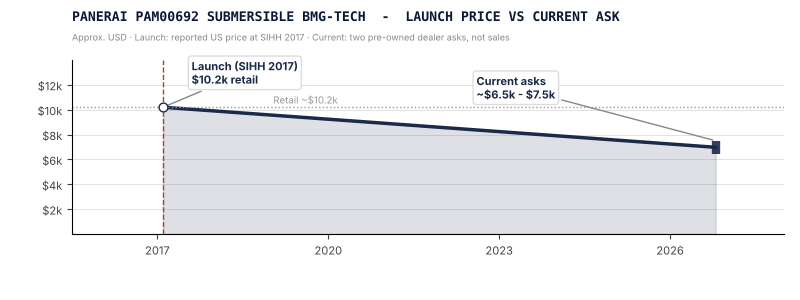
The line above is an estimate. It joins the launch price with current dealer asks, so it shows the direction of the price, not a year-by-year history.
For a buyer that is the useful part. A 47mm Submersible in an unusual material, with a three-day movement and 300 metres of water resistance, now costs less than many steel divers did new. For a seller it is a reminder that quiet watches get quiet money.
The PAM00799: BMG-Tech Meets Carbotech
Panerai did not stop with the first Submersible. At SIHH 2019 it showed the Submersible BMG-Tech 47mm, PAM00799, and this one is not a simple refinement of the 692. It is a different build.
- Case: BMG-Tech
- Bezel: Carbotech, the carbon-fibre-based material
- Caseback, crown guard and buckle: brushed titanium
- Movement: P.9010, with 31 jewels and a three-day power reserve
- Water resistance: 300 metres
- Strap: black rubber
Panerai presented it as the first time two of its own innovations, BMG-Tech and Carbotech, came together in a professional diving watch. The result is a watch that keeps the grey, understated BMG-Tech case but adds the marbled carbon look on the bezel. For collectors who found the 692 too plain, this was Panerai answering the complaint. It is also the only hybrid of the two materials I would point you towards.
The Current Submersible BMG-Tech (PAM02692)
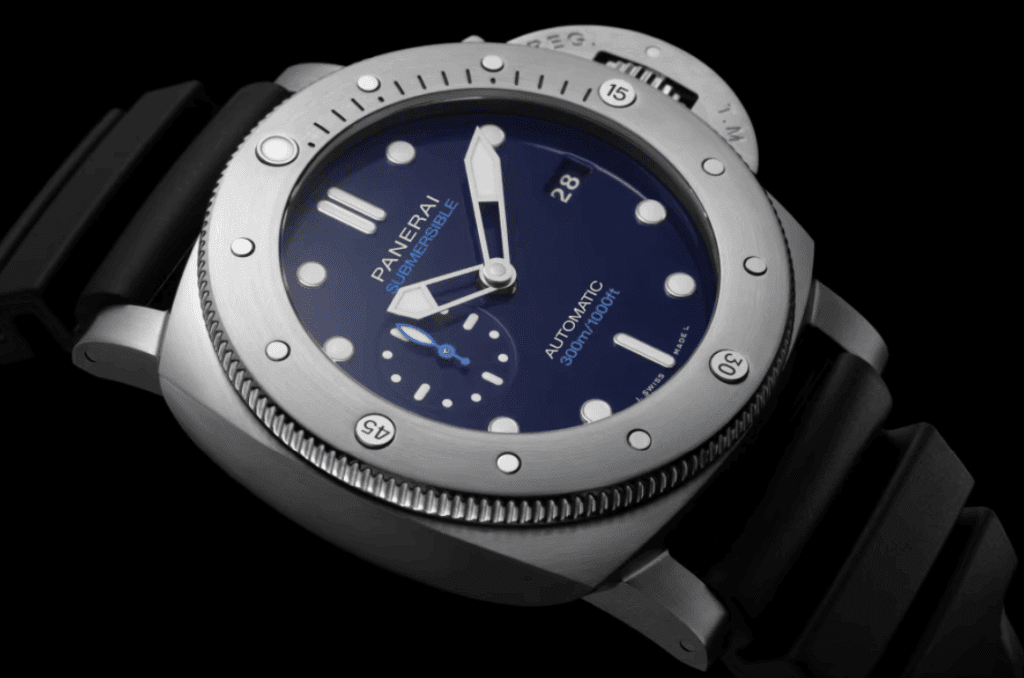
Today the material lives on in the PAM02692, a 47mm Submersible with a blue dial, small seconds at 9 o’clock and a date at 3. The case and the unidirectional bezel are both BMG-Tech, the caseback is brushed titanium, and the P.9010 inside gives three days of power reserve. It weighs 132 grams, carries 300 metres of water resistance, and comes with a black rubber strap and a grey textile strap.
It is the clearest statement that BMG-Tech has a future. The bezel returns to the same material as the case, so the watch is monochrome and understated again, now with a colour that brings it to life.
A Material That Refuses to Age
The appeal of bronze lies in its patina, and Carbotech wins collectors with its one-of-a-kind marbling. BMG-Tech is the opposite: it refuses to change. After years of wear it looks almost untouched, and it stays free of the scratches that mark steel and the corrosion that marks lesser alloys.
For traditionalists, that was a flaw. Panerai built its aura on the romance of dials that fade and cases that age like relics. For practical collectors it was the dream: a Panerai that takes abuse and still looks fresh. That tension explains why BMG-Tech has always split opinion. Should a Panerai wear its history on its skin, or resist history entirely?
How it compares with the rest of the materials:
- Bronze ages and develops personality. BMG-Tech resists time entirely. My Bronzo overview covers that side.
- Ceramic shrugs off scratches but can chip or crack. BMG-Tech resists both scratches and shocks.
- Carbotech is light, unique and instantly recognisable. BMG-Tech is understated, favouring hidden strength over style. See Carbotech.
- Steel and titanium remain the classics, but BMG-Tech was designed to outlast them, both physically and cosmetically.
- Goldtech and Platinumtech work the other way round, adding hardness to precious metals. The Goldtech and Platinumtech pages show how differently Panerai uses its laboratory.
In short, bronze is about romance, Carbotech is about aesthetics and BMG-Tech is about science and permanence.
Collector Reception: Admiration Without Hype
Unlike the Bronzo, which generated far more conversation, or Carbotech, which gave Panerai a modern face, the BMG-Tech watches have always been quieter. Collectors respect the technical merit but often admit it does not “feel” special when you look at it. To the untrained eye it is polished steel.
That subtlety shows in the market, as the price section above makes plain. For connoisseurs, the PAM00692 holds a unique appeal as the first BMG case. For casual buyers, it is overshadowed by flashier Panerai experiments.
“BMG-Tech is the Panerai you don’t brag about at the table, but it might just outlast everything else in your watch box.”
BMG-Tech has also stayed with the Submersible, the dive-watch branch of the catalogue, rather than spreading into the Luminor dress-leaning references. Its character suits a professional diver more than a dressier watch, and the history of the Submersible shows how naturally the line has taken on new materials.
Strengths and Weaknesses
Strengths
- Highly scratch- and corrosion-resistant.
- Shock-resistant, unlike brittle ceramic.
- Resistant to magnetic fields.
- A true industry first: bulk metallic glass in a watch case.
- Lighter than steel, with the 132-gram PAM02692 as an example.
Weaknesses
- Visually plain, and hard to tell from steel.
- Few references, and little variety.
- No patina, so it lacks the romance of bronze and the drama of Carbotech.
- Pre-owned values have fallen from launch prices, which is good for buyers and less good for sellers.
Who Is It For?
- The collector who wants a Panerai that stays box-fresh and can take abuse
- Someone drawn to materials science, not just design
- A buyer who likes the 47mm Submersible and wants something different from steel and bronze
- Paneristi building a collection of Panerai’s proprietary materials
Not for: collectors who want a watch to develop character over time; anyone who needs a visibly distinctive case; buyers who prefer the drama of Carbotech or bronze.
Conclusion
Panerai BMG-Tech may never become a cult object like the Bronzo or Carbotech. But in Panerai’s history it marks a bold chapter: the first watch to harness bulk metallic glass, a material born from advanced metallurgy and engineered to resist time itself.
It is the Panerai that hides its innovation instead of flaunting it. The one that does not age, does not corrode and does not change. For some collectors that makes it sterile. For others it makes the ultimate tool watch, a diver as unyielding as the sea it was built for.
Should a Panerai wear its history on its case, or resist it altogether? Tell me where you stand in the comments.
Extended Summary
- Panerai BMG-Tech is bulk metallic glass, an alloy of zirconium, copper, aluminium, titanium and nickel with a disordered, glass-like atomic structure.
- The PAM00692 (2017) was the first, a 47mm Submersible with a BMG case, bezel, crown and crown guard and a US launch price of $10,200.
- The PAM00799 (2019) is a different build, pairing the BMG-Tech case with a Carbotech bezel and titanium back, crown guard and buckle.
- The PAM02692 is the current version, a 47mm blue-dial Submersible with a BMG-Tech case and bezel.
- BMG-Tech does not age, which is both its selling point and the reason it divides collectors, and pre-owned asks sit well below launch.
At a Glance
| Year | Reference | Watch | Case | Bezel | Movement | Note |
|---|---|---|---|---|---|---|
| 2017 | PAM00692 | Luminor Submersible 1950 BMG-Tech 3 Days Automatic | 47mm BMG-Tech | BMG-Tech | P.9000 | Debut, not limited, $10,200 at launch |
| 2019 | PAM00799 | Submersible BMG-Tech 47mm | 47mm BMG-Tech | Carbotech | P.9010 | First BMG-Tech and Carbotech combination |
| Current | PAM02692 | Submersible BMG-Tech 47mm | 47mm BMG-Tech | BMG-Tech | P.9010 | Blue dial, 132g, grey textile strap included |