A Material That Shaped the Modern Identity of the Brand
Introduction – Why Materials Define Panerai
Carbotech by Panerai – From the beginning, Panerai has been defined as much by the materials of its cases as by its bold design language. The brand’s earliest watches were crafted in steel, chosen for toughness in military use. Later came titanium, bronze, ceramic, and gold alloys — each expanding the Panerai vocabulary. But among these experiments, one material stands apart as a true proprietary innovation: Carbotech.
Unveiled in 2015, Carbotech was Panerai’s way of pushing beyond traditional luxury watchmaking materials into something more futuristic, tactical, and unique. It didn’t just expand the brand’s toolkit — it became a signature of Panerai’s modern identity. This is the story of how Carbotech emerged, evolved, and continues to shape the way collectors think about Panerai.
The Early Eras – Steel as the Foundation
For decades, stainless steel was the backbone of Panerai. The original Radiomirs and Luminors worn by Italian Navy commandos in the 1930s and 1940s were built from robust steel, chosen for seaworthy durability. When Panerai entered civilian production in the 1990s, steel remained the natural choice.
It was the perfect canvas for Panerai’s oversized cases — rugged, weighty, and authentic to the tool-watch aesthetic. But by the mid-2000s, Panerai began to face a question: how do you innovate within such a material-driven brand?
Titanium and Bronze – Panerai Experiments with Character
The answer came with new case metals.
- Titanium introduced a lighter, hypoallergenic option, softening the weight of 47 mm cases while maintaining strength.
- Bronze debuted in 2011 with the now-legendary PAM00382 “Bronzo.” Its living patina and maritime roots resonated deeply with collectors.
Both materials carried stories — titanium for modern utility, bronze for seafaring heritage. Yet Panerai wasn’t content to stop there.
Ceramic – The First Step Toward the Future
Before Carbotech, there was ceramic. Watches like the PAM00335 Luminor 1950 10 Days GMT Ceramica showed Panerai could work with advanced materials. Black ceramic offered scratch resistance and stealth appeal, especially in the Ceramica and Tuttonero lines.
But ceramic also had limitations: it was brittle under shock and not uniquely “Panerai.” Other brands were already using ceramic extensively. Panerai needed a proprietary solution — something unmistakably their own.
The Arrival of Carbotech – 2015
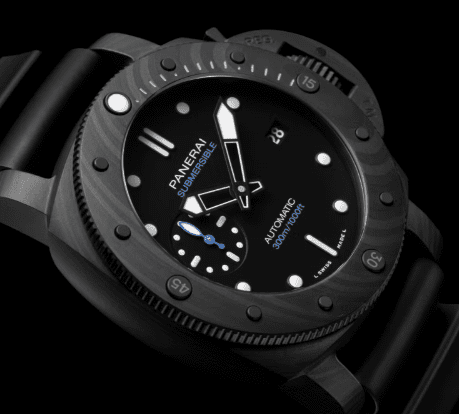
In 2015, Panerai introduced Carbotech, first seen in the Luminor Submersible 1950 PAM00616. Unlike bronze or ceramic, it’s was not a borrowed material — it was a true innovation created for Panerai.
Carbotech is made by compressing thin sheets of carbon fiber under high pressure with a high-end polymer (PEEK – Polyether Ether Ketone). This process creates a dense, layered block that is both stronger and lighter than ceramic or steel. The result:
- Lightweight – significantly reducing wrist fatigue compared to steel or bronze
- Toughness – resistant to stress, impact, and corrosion
- Hypoallergenic – skin-safe like titanium
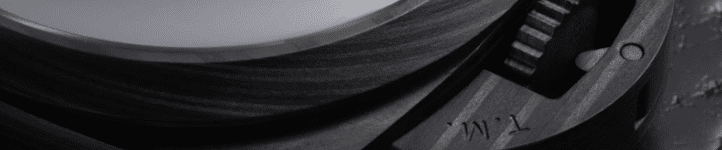
- Unique Aesthetics – every case has a swirling, woodgrain-like pattern, ensuring no two watches are alike
This wasn’t just material innovation. It was a statement: Panerai was no longer only about military nostalgia — it was now also about cutting-edge material science.
The First Reference – PAM00616
The PAM00616 set the tone. A 47 mm Submersible 1950 case, black Carbotech body, and a textured black dial with electric blue accents. Inside beat the P.9000 automatic movement with 3-day reserve, but the star was the case itself.
Collectors were struck by how light a 47 mm Panerai could feel. For a brand associated with bulk, this was revolutionary. The swirling matte-black aesthetic added a stealth factor — tactical, futuristic, and unlike anything else on the market.
The 616 wasn’t just a watch. It was proof of concept.
Expansion of the Carbotech Line
Panerai quickly realized Carbotech’s potential, and the material spread across the catalog:
- PAM00616 (2015) – The original Submersible, 47 mm
- PAM00617 – with flyback chronograph complication
- PAM00960 & PAM01616 – 42 mm and 47 mm Submersible models, expanding wearability
- PAM00961 Marina Militare – A limited edition with bold military branding, strengthening the tactical narrative
- PAM01616 (2019) – Modernized Submersible with updated caliber P.9010
Each model reinforced the same message: Carbotech wasn’t a novelty, it was becoming a pillar of the Submersible family.
Collector Impact
Carbotech watches found a strong following among Paneristi and new collectors alike. For those who found bronze too heavy or unpredictable, Carbotech offered lightness with character. For those who considered ceramic too sterile, Carbotech offered warmth in its organic, marbled patterns.
Unlike Goldtech or bronze, this new material didn’t lean on nostalgia. It was Panerai looking forward — giving collectors a reason to see the brand as more than a heritage label.
Over time, Carbotech became one of the defining identities of the Submersible line, positioning it as Panerai’s “modern warrior” compared to the vintage-inspired Radiomir and Luminor families.
How The Material Differs – Strengths and Weaknesses
Strengths
- Uniqueness – Every case has an individual carbon pattern
- Lightness – Particularly impactful on oversized 47 mm cases
- Durability – Resistant to corrosion, scratches, and stress
- Hypoallergenic – A safe option for sensitive skin
Weaknesses
- Aesthetic divisiveness – Not everyone loves the marbled, layered look
- Premium pricing – Carbotech models sit at a higher tier in Panerai’s catalog
- Niche identity – Strongly tied to Submersible, limiting broader appeal across Radiomir or classic Luminor lines
Carbotech and Panerai’s Modern Identity
Panerai’s journey through materials reflects its larger evolution. Steel defined the military years. Titanium softened the heft. Bronze connected to naval heritage. Ceramic hinted at the future.
But Carbotech crystallized Panerai’s modern identity: innovative, bold, and proprietary. It gave the Submersible line its own visual and technical DNA, distinct from other Panerai families.
For collectors, the models of this proprietary represent the brand’s willingness to evolve. For Panerai itself, they represent a commitment to innovation that doesn’t abandon the oversized, distinctive presence Panerai is known for.
Closing Thoughts – The Material of the Future
Carbotech isn’t just another case alloy. It’s the material that signaled Panerai’s ability to innovate beyond heritage. Where bronze aged and ceramic fractured, Carbotech combined strength, lightness, and individuality in a way no other Panerai material had.
It may not appeal to purists who prefer the austerity of steel or the romance of bronze. But for Panerai’s modern era, Carbotech is essential — a bold reminder that this is a brand still willing to take risks.
As Panerai continues to explore high-tech alloys like BMG-Tech and proprietary gold blends, Carbotech remains the foundation of its modern material identity. And in the Submersible family, it’s no exaggeration to say that proproetary materials have become the face of Panerai in the 21st century.
Panerai Material Innovation Timeline
1930s–1940s → Stainless Steel
- The foundation of Panerai’s military tool watches.
- Durable, corrosion-resistant, perfectly suited for naval divers.
1990s → Titanium
- Introduced in civilian models after the Vendôme acquisition.
- Lighter and hypoallergenic, softening the heft of 44–47 mm cases.
2011 → Bronze (PAM00382 Bronzo)
- A nod to maritime hardware.
- Case develops a living patina, making each watch unique.
2013 → Black Ceramic
- Luminor 1950 Ceramica and Tuttonero models.
- Scratch-resistant, stealthy, but brittle under impact.
2015 → Carbotech (PAM00616)
- Proprietary carbon fiber composite.
- Lightweight, tough, hypoallergenic, with unique marbled patterns.
2016 → BMG-Tech
- Bulk Metallic Glass, another proprietary alloy by Panerai.
- Five times stronger than steel, resistant to corrosion and shocks.
2019 onward → Goldtech
- Panerai’s proprietary red gold alloy.
- Enhanced with copper and platinum for color stability.
Panerai Carbotech – Frequently Asked Questions
What is Panerai Carbotech?
Carbotech is a proprietary carbon-fiber composite developed by Panerai. It is made by compressing carbon fiber sheets with a high-end polymer (PEEK), creating a lightweight, durable, and hypoallergenic case material. Each watch case has a unique marbled pattern.
When was Panerai Carbotech introduced?
Panerai introduced the new material in 2015, debuting it with the Luminor Submersible 1950 PAM00616.
Why did Panerai create Carbotech?
Panerai wanted a material that was lighter than steel or bronze, tougher than ceramic, and uniquely tied to the brand. Carbotech also emphasizes individuality, since no two cases share the exact same pattern.
Which Panerai watches use Carbotech?
Notable references include:
- PAM00616 (47 mm Submersible)
- PAM00960 (42 mm Submersible)
- PAM01616 (updated Submersible, 47 mm)
- PAM00961 (Marina Militare , limited edition)
Is Carbotech better than ceramic?
Yes it is lighter and less brittle than ceramic, making it more resistant to shocks. However, ceramic typically resists scratches better. The choice depends on collector preference.
Does Carbotech change over time like bronze?
No. Unlike bronze, Carbotech does not develop patina. Its marbled black-and-grey pattern remains stable, though each case is unique from the start.

Footnote on the LAB-ID PAM00700
Attentive readers may notice that one of the most striking Carbotech creations — the LAB-ID PAM00700 — is absent from the list of references above. That’s not an oversight, but a conscious choice. The PAM00700 deserves a stage of its own.
Unveiled in 2017 at SIHH, the LAB-ID wasn’t just another Submersible or Luminor variant clad in Carbotech. It was a concept watch masquerading as a production piece — limited to only 50 examples, each carrying a staggering 50-year guarantee. Panerai used the Carbotech case not merely for strength and aesthetics, but as a platform to showcase radical movement innovation.
Inside, the P.3001/C caliber was re-engineered with an array of carbon-based components — from the plates and bridges coated in tantalum-based ceramic to the silicon escapement and dry lubricated jewels. The result was a manually wound caliber requiring no lubrication, designed to operate maintenance-free for half a century. The dial itself was carbon nanotube-coated, creating an otherworldly blackness that absorbed nearly all incident light.
This watch sits outside the typical Carbotech narrative. While models like the PAM00616 and PAM01616 established Carbotech as a pillar of the Submersible line, the LAB-ID represented a futuristic vision piece — equal parts prototype and collector’s trophy.
For that reason, it will be covered in a dedicated article rather than reduced to a bullet point here. The PAM00700 isn’t just “another Carbotech Panerai.” It’s a different conversation entirely.