Quick Takeaways
- PAM00349 is a 12-piece titanium Radiomir from 2010 — one of the rarest California dial references Panerai has ever produced, pairing the brand’s most historically significant dial layout with a Minerva-based movement in a brushed titanium cushion case that has no business being this good
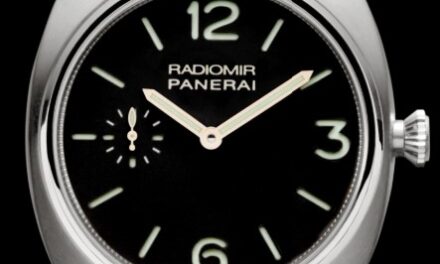
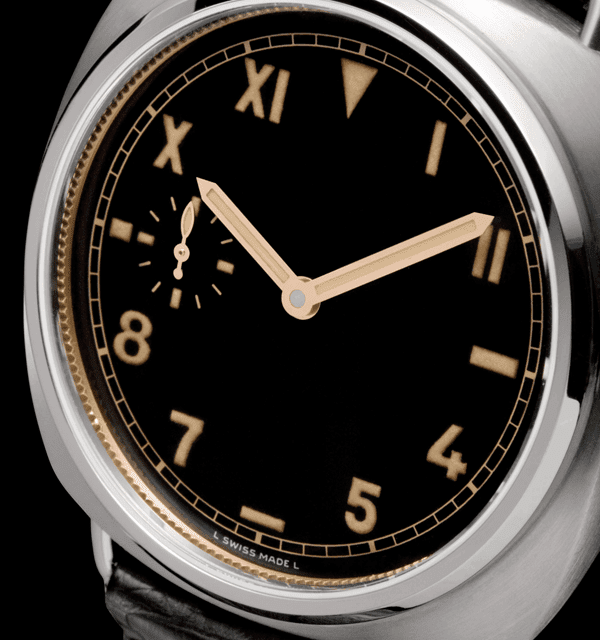
- The California dial here is a black sandwich construction — two-layer depth, lume beneath the surface, half Roman half Arabic numerals, with a knurled pink gold ring on the outer edge and pink gold hands that create a warmth against the black dial no standard Radiomir achieves
- The movement is the OP XXVII, built on a Minerva 16-17 ébauche from Villeret — hand-wound, 18,000 vph, 55-hour power reserve, swan-neck regulator, Côtes de Genève on German silver bridges — this is one of the most characterful calibres Panerai ever housed
- Forty-seven millimetres of brushed titanium — lighter than steel, no crown guard, screw crown, removable wire loop lugs, 100m water resistance and an exhibition caseback through which the movement genuinely deserves to be watched
- Twelve pieces were made — full stop — there is no public secondary market for this reference in any conventional sense; finding one requires patience, network, and the willingness to pay whatever the seller asks when it surfaces
Jump directly to the spec sheet.
Twelve Pieces. The California Dial. A Minerva ébauche. In Titanium.
There’s a small category of Panerai references that never found their way into the mainstream collector conversation — not because they aged poorly or failed commercially, but simply because they were made in numbers so small that even serious Paneristi have never encountered one in the metal. The PAM00349 belongs firmly in that category.
Twelve pieces. Not 150. Not 500. Twelve examples of a 47mm brushed titanium Radiomir carrying what many collectors consider Panerai’s most historically loaded dial configuration — the California — and underneath the exhibition caseback, a hand-wound movement built on a Minerva 16-17 ébauche from Villeret, a manufacture with roots stretching back to 1858. A slow-beat calibre with a swan-neck regulator, Côtes de Genève finishing on German silver bridges, and the kind of character that movements running at twice the speed simply don’t have.
I’ve written before about watches where the convergence of elements feels greater than the sum of its parts. The PAM00349 is that, almost aggressively so. The California dial has the deepest backstory of any dial Panerai has ever used. The Minerva ébauche has one of the most respected pedigrees in Swiss hand-wound horology. Brushed titanium in a 47mm Radiomir cushion case is the most honest material choice possible for a watch whose DNA is military utility. And twelve pieces means almost no one owns this.
So why does nobody talk about it? That’s the question I keep coming back to. And it’s one this article is going to try to answer.

Understanding the PAM00349’s Place in the OP XXVII Titanium Family
Three Watches, One Movement, One That Stands Apart
The PAM00349 didn’t emerge in isolation. To understand what it is, you need to understand the two siblings that share its movement and case architecture.
PAM00309, released in 2008, was the first titanium Radiomir to carry the OP XXVII calibre. Black dial, knurled pink gold ring on the outer edge, pink gold hands — the same case configuration as the PAM00349, but with a standard Arabic numeral layout. Then came PAM00322 in the same year: identical case, same OP XXVII movement, but a brown dial with Arabic numerals and pink gold accents. Both were limited productions, both used the same brushed titanium cushion architecture, and both gave the community its first extended exposure to the Minerva-based calibre in a Radiomir case.
The PAM00349 arrived in 2010 as the final member of this trio — and the most specific. The case and movement architecture are shared. What changed is the dial. And the dial changes everything.
Twelve pieces. The PAM00309 and PAM00322 were also limited, but the PAM00349’s production number sits in a different category entirely. The reason for it isn’t arbitrary branding — it reflects the reality of how many examples of this movement Panerai could commit to this particular configuration. The Minerva 16-17 ébauche isn’t produced in industrial quantities. It’s assembled in small batches in Villeret, by hand, by watchmakers who know every component by name. Twelve pieces is an honest number.
The Constraint Is the Story
There’s a version of watch collecting that prizes limitation as a marketing strategy. Then there’s the version where limitation reflects genuine manufacture constraints — where the number stamped on the caseback corresponds directly to how many movements were available, how many cases were built, and how many dials passed quality approval.
The PAM00349‘s twelve examples fall into the second category. For a California sandwich dial in particular — where the upper plate must be cut precisely to align the mixed numeral layout, and the lume beneath must be applied and checked through each aperture — the production process is more demanding than a standard single-layer dial. Add the Minerva-based movement’s hand-finishing requirements, and twelve starts to look less like a marketing decision and more like a production ceiling.
The California Dial — Panerai’s Most Historically Loaded Design
I’ll be direct: this section runs longer than every other section in this article. That’s correct. The California dial is the reason the PAM00349 exists as a distinct reference rather than another brushed titanium Radiomir with an Arabic dial. Understanding it properly is understanding why this watch matters.
Where It Came From
The California dial’s origins sit in the 1930s and 1940s, in the working relationship between Panerai and Rolex. Panerai, operating as a precision instrument supplier to the Italian Royal Navy, was sourcing cases and movements from Rolex for its military watches. The dials — luminescent, robust, built for legibility in darkness and underwater — were produced under that same working arrangement.
The mixed-numeral layout that collectors now call “California” — Roman numerals on the upper half of the dial, Arabic on the lower — wasn’t an aesthetic choice. It was a legibility solution. A diver surfacing at night in the Adriatic, salt water in their eyes, needed to orient the dial instantly. The combination of numeral styles allows the eye to distinguish 12 o’clock from 6 at a glance regardless of orientation, without needing to read a specific number. It was, in Rolex’s own terminology at the time, an “error proof” dial. The military brief was survival. The design delivered.
The “California” name came much later, coined — according to Fratello’s investigation into its origins — by a US-based dial restorer who worked on these dials in the decades after the war. The nickname stuck, spread through the collector community, and eventually Panerai themselves adopted it officially for references like the PAM00424. The dial was born in wartime pragmatism and arrived at collector iconography by accident.
Panerai’s own brand history is inseparable from this context — the Navy connection, the instrument mandate, the partnership with Rolex that produced some of the most historically significant watch dials in existence. The California dial isn’t a design flourish Panerai invented for modern collections. It’s a direct inheritance from that original brief.
What Makes the PAM00349’s California Dial Specifically Exceptional
There are California dial Panereai in the catalogue at various price points. The PAM00349‘s version earns a separate discussion.
First: sandwich construction. Two plates — the lower carries the luminescent material, the upper is precision-drilled with the numeral and marker apertures so the lume glows up from beneath the surface rather than sitting on top of it. This creates a dial with genuine depth. In daylight, the markers appear to recede slightly into the face. In darkness, the lume has dimension — it’s in the dial, not painted onto it. Panerai’s own California dial page describes this construction accurately; it’s one of the reasons serious collectors prize sandwich-construction California references over their single-layer counterparts.
Second: the knurled pink gold ring on the outer edge. This is the micro-specific detail that most product photography doesn’t capture properly. Fine concentric knurling — not rough, not decorative in an obvious sense, but textured — sits between the chapter ring and the case, connecting the dial to the material accents elsewhere. It picks up light at an angle that the flat brushed titanium case refuses to. The visual effect is a dial that feels more considered, more complete, than the sum of its components.
Third: pink gold hands on a black dial. The pairing is unusual for a Radiomir — most California dial references use blued steel hands, which are cooler and arguably more militarily appropriate. Pink gold hands introduce warmth that the cold brushed titanium case explicitly withholds. The tension between the two is not accidental. The case is tool. The dial is history. The hands are the bridge.
Fourth: the mixed numeral layout itself on a sandwich construction in 47mm. The Roman numerals — tall, angular, severe — occupy the upper hemisphere. The Arabic numerals below are rounder, more organic. By any conventional design standard they don’t belong together. On this dial, in this size, they create exactly the organised dissonance that made the original Italian Navy instruments so effective. You can read this dial across a room. That was always the point.
The California Dial in the Collector Community
The California dial is one of the genuine dividing lines in Panerai collecting. Not every Paneristi responds to it — some find the numeral mix too unconventional, too visually busy for a brand whose strongest DNA is the clean, minimal dial. But among collectors who understand what the layout signifies and where it came from, owning a California dial Panerai carries a specific meaning. It signals that you’re collecting the heritage, not the marketing.
The PAM00249 — a 2006 special edition limited to 1,936 pieces, released to mark the year of the original Radiomir’s introduction — is the reference that reignited California fever in the modern collector community. When that watch appeared, the demand for it immediately exceeded supply. The PAM00424, released in 2012 as the more accessible California option, brought the dial into broader reach — though not without controversy. The original 424 carried a date window at 3 o’clock that many collectors rejected outright as an intrusion on the dial’s visual coherence. Panerai later corrected course and removed it.
The PAM00349, by contrast, has no date window, no compromises on the dial layout, no concessions to commercial volume. Twelve examples, all correct, all complete. In a world of California dial Panereai at various levels of accessibility and authenticity, this reference is the most uncompromising of the modern production era.
The OP XXVII — Why a Minerva ébauche Changes This Watch’s Character Entirely
Here’s what most people who encounter the PAM00349 don’t immediately know: the movement inside it was made in Villeret, in the Swiss Jura, by one of the oldest and most historically significant calibre manufacturers in Switzerland.
Minerva SA, Villeret — 166 Years of Movement Making
The company that became Minerva SA was founded in 1858 by brothers Charles-Yvan and Hyppolite Robert in Villeret. For the next century and a half — surviving the Quartz Crisis when most of their peers did not, pivoting to military instrument production when the commercial market contracted, maintaining continuous production in the same factory building on the Rue Principale — Minerva built a reputation as one of the most respected calibre manufacturers in Swiss horology.
Their specialisation was precision chronometry. By 1916, Minerva stopwatches could measure to 1/100th of a second. Their Calibre 13-20 of 1923 — a column-wheel monopusher chronograph — became one of the most influential movement architectures in the history of motor racing timing. Military clients included forces that demanded reliability under conditions far worse than a collector’s wrist. The brand survived not because it chased volume but because its output was genuinely exceptional and its client base valued that.
Richemont acquired Minerva in 2006 and integrated the manufacture into Montblanc. The Villeret factory — still producing movements in the same building where production began — is now Montblanc’s haute horlogerie centre. But the calibres predate that acquisition. The Minerva 16-17 base movement — which Panerai designated OP XXVII — was in use before Montblanc arrived in Villeret. Its DNA is independent of corporate ownership.
What the OP XXVII Actually Delivers
The OP XXVII, based on the Minerva 16-17 ébauche, is a hand-wound calibre running at 18,000 vph — 2.5 Hz, or five beats per second. In a contemporary watchmaking landscape where most movements beat at 28,800 vph and some at 36,000, this is a deliberately slow pace. The balance swings wide and unhurried. You can see it through the exhibition caseback of the PAM00349 and understand immediately that this is an older philosophy of timekeeping — one that prioritises mechanical stability and finishing visibility over positional accuracy claims.
The swan-neck regulator is the component most worth explaining. In a standard lever-regulated movement, the regulator — the device that fine-tunes the rate by adjusting the effective length of the hairspring — is held in position by a coil spring, which can introduce slight positional play. A swan-neck regulator replaces that coil spring with a flat spring blade shaped in a gentle curve, pressing against the regulator with consistent, even pressure. The result is finer, more stable rate adjustment. It’s a traditional haute horlogerie solution, used in high-end pocket watches for over a century, and it requires more careful finishing and fitting than a standard lever.
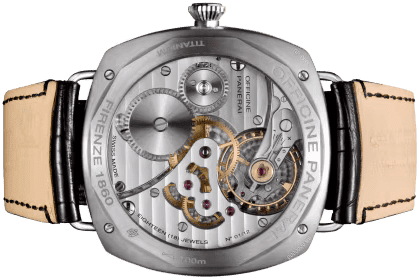
On the PAM00349, that swan-neck is visible through the exhibition caseback alongside the rest of the movement’s display: Côtes de Genève stripes on the bridges, German silver plates with oxidation-resistant properties, and a Glucydur balance wheel — a beryllium-copper alloy that maintains dimensional stability across temperature changes, reducing rate variation as the watch moves between environments. KIF Parechoc antishock protects the balance jewel from shock impacts. Eighteen jewels throughout.
The 55-hour power reserve is modest by modern standards — some Panerai references carry six days — but it’s honest for a single-barrel movement of this calibre and construction. Wind the PAM00349 every other day and it repays that habit with consistent, characterful running. As Watchfinder noted in their coverage of the OP XXVII family, this is “a slow, vintage beat” — and in the context of the PAM00349, that description is exactly right. This watch doesn’t hurry. Everything about its construction argues for a different relationship with time than a modern tool watch offers.
The bridges are finished to a standard that Monochrome Watches confirmed in their coverage of other OP XXVII references: nickel-silver plates with Côtes de Genève striping, a large screwed balance wheel, and a Breguet hairspring with Phillips curve. Through the sapphire caseback of the PAM00349, this isn’t a movement you glance at. It’s one you watch.
The Case — 47mm Brushed Titanium, Done Right
The PAM00349 uses the standard Radiomir cushion case — no bridge, no lever device, no crown guard of any kind. A screw-down crown sits flush with the case at 9 o’clock, providing the seal for the 100m / 10 bar water resistance rating without any additional architecture to enforce it. The case does the job through precise machining and crown sealing alone.
Brushed titanium is the correct material here, and not only for reasons of weight. The brushed finish absorbs light rather than reflecting it — the opposite of the polished pink gold in the PAM00330 we covered separately. Against a black California dial with pink gold accents, brushed titanium creates a contrast that sharpens the visual hierarchy: the dial earns all the attention, the case simply holds it. There’s no competition between surface and content.
The removable wire loop lugs are Panerai’s patented strap attachment system — simple, functional, requiring no tools to change. At 26mm lug width, strap options are broad. The exhibition caseback is sealed to the same water resistance standard as the front crystal.
At 47mm, the PAM00349 sits wide on the wrist. The Radiomir cushion case wears closer than its diameter suggests — no extended lugs, no crown guard adding width, no protruding bezel architecture. But 47mm brushed titanium is still a presence. On a larger wrist, it settles with authority. On a smaller one, it becomes the watch. Neither outcome is wrong. A watch with this dial and this movement deserves to be noticed by the person wearing it, at least.
Is the PAM00349 Worth Finding Pre-Owned in 2026?
I want to be honest about what “pre-owned market” means for a 12-piece reference.
It doesn’t mean browsing Chrono24 listings and comparing three or four examples. At any given time there may be zero public listings for the PAM00349 anywhere. If one surfaces, it will likely be through a specialist dealer, a private collector network, or an auction — and it will ask a price that reflects the reference’s rarity rather than any conventional secondary market logic. There is no comparable sales data to anchor a valuation. Twelve pieces across fifteen years of collector circulation is not enough to establish a market.
What that means practically is this: if you find one, the question isn’t “is this fairly priced?” The question is “is this the right example?”
Documentation. The PAM00349 should arrive with original Panerai papers and numbered packaging confirming its edition status. On a 12-piece reference, provenance isn’t a nice-to-have — it’s the only thing separating a verified example from an unanswered question. An undocumented PAM00349 is a different proposition entirely.
Movement condition. The Minerva 16-17 base is a robust calibre but it is not a commodity movement. Service requires a watchmaker with specific knowledge of this architecture — the swan-neck regulator, the Breguet hairspring with Phillips curve, the German silver bridges. Panerai-serviced examples are the cleanest buy. Independently-serviced examples are acceptable if the watchmaker can be identified and verified. An unserviced example from 2010 running on its original service is a risk that the purchase price needs to reflect.
Exhibition caseback condition. The most-handled surface on this watch. Check for micro-abrasion on the sapphire — fifteen years of winding interactions add up, and replacement is achievable but not inexpensive.
Strap. The original black alligator with trapezoidal brushed titanium buckle is correct for the reference and worth preserving. A replacement strap doesn’t affect the movement or case, but for a collector buying completeness, originality matters.
If you’re researching the PAM00349 but the reality of hunting a 12-piece reference doesn’t match your timeline, the PAM00323 offers a very different proposition — a 10-day GMT movement in a Radiomir case, more available, and a strong argument for the collection in its own right.
“The California dial wasn’t born to be admired. It was born to be used, read quickly, and survive.” — Panerey.com, The California Dial: Panerai’s Functional Anomaly
Who Is It For?
- The Paneristi who collects history, not just design — the California dial’s origins in Italian Navy utility, the Minerva movement’s heritage in Swiss precision chronometry, the titanium Radiomir case’s direct descent from military instrument logic: the PAM00349 carries more authentic backstory per square millimetre than almost any watch in the modern catalogue
- A collector who understands what a slow-beat Minerva movement means — 18,000 vph isn’t a weakness; it’s a character statement, and through that exhibition caseback it’s a display worth making time for
- Someone willing to hunt seriously — twelve examples doesn’t mean impossible, but it means committed; casual interest won’t find this watch
- A Radiomir collector at the top of their journey — this is not a first Panerai or a daily wearer; it’s a reference that rewards the collector who already understands the line and wants the piece that says something no other reference does
- Anyone drawn to the California dial in its most honest, uncompromised form — no date window, no concessions, sandwich construction, pink gold accents on brushed titanium, twelve examples made correctly and left alone
Not for: Collectors who need community validation and active forum discussion around their pieces — the PAM00349 has almost none. Buyers who require movement to be entirely in-house from Panerai’s own Neuchâtel manufacture. Anyone looking for a watch with easy service access from any competent watchmaker. And definitely not for collectors who find the California dial layout gimmicky — if the mixed-numeral dial doesn’t speak to you historically, this watch has nothing else to sell you on it.
Conclusion
The PAM00349 occupies a position in Panerai’s history that almost no other modern reference can claim: a watch where the case, the dial, and the movement each carry independent historical weight, and where the combination produces something considerably more compelling than any one element alone.
Twelve pieces. A California sandwich dial with a knurled pink gold ring and pink gold hands — the most historically authentic dial Panerai uses, delivered without compromise. A hand-wound Minerva 16-17 ébauche at 18,000 vph, with a swan-neck regulator and Côtes de Genève finishing, visible through an exhibition caseback in a brushed titanium Radiomir cushion case.
I don’t think this watch was ever meant to be discovered by the general Panerai market. It was made for twelve collectors who knew exactly what they were looking at. Whether you ever find one or not, knowing it exists changes how you think about what the Radiomir line is actually capable of.
If you own one, or have held one, tell me about it in the comments. What does 18,000 vph feel like on the wrist?
Extended Summary
- The PAM00349 is a 12-piece titanium Radiomir from 2010 carrying Panerai’s most historically significant dial configuration — the California — in sandwich construction with pink gold accents, making it the rarest and most historically coherent California dial Panerai in the modern production era
- The California dial’s origins are military, not aesthetic — developed for Italian Navy divers in the 1930s/1940s for instant orientation in darkness; the mixed Roman/Arabic numeral layout is a legibility solution that became a collector icon entirely by accident and the PAM00349 delivers it without modification or compromise
- The OP XXVII movement is built on a Minerva 16-17 ébauche from Villeret — founded 1858, precision chronometry specialists, swan-neck regulated, 18,000 vph, Côtes de Genève finishing on German silver bridges; one of the most characterful hand-wound calibres Panerai has ever housed in any reference
- There is no conventional secondary market for 12 pieces — finding the PAM00349 requires network, patience, and thorough due diligence on documentation and service history when an example does surface; pricing will reflect rarity rather than comparable sales data
- This is a collector’s collector watch — not a daily wearer, not a first Panerai, not a reference for casual acquisition; but for the Paneristi who understands what the California dial means and what a Minerva movement sounds like at 18,000 vph, nothing else in the Radiomir catalogue touches it
At a Glance
| Reference | PAM00349 |
| Collection | Radiomir |
| Name | Radiomir Titanio |
| Introduced | 2010 |
| Edition size | 12 pieces |
| Case material | Brushed titanium |
| Case diameter | 47mm |
| Case back | Exhibition — see-through sapphire |
| Lug attachment | Removable wire loop (patented) |
| Lug width | 26mm |
| Water resistance | 100m / 10 bar |
| Movement | Panerai OP XXVII (Minerva 16-17 base) |
| Winding | Hand-wound, manual |
| Beat rate | 18,000 vph (2.5 Hz) |
| Power reserve | 55 hours |
| Jewels | 18 |
| Regulator | Swan-neck |
| Balance | Glucydur® |
| Antishock | KIF Parechoc® |
| Dial | Black California sandwich — mixed Roman/Arabic numerals, pink gold knurled ring, pink gold hands |
| Seconds | Small seconds at 9 o’clock |
| Availability | Pre-owned only |