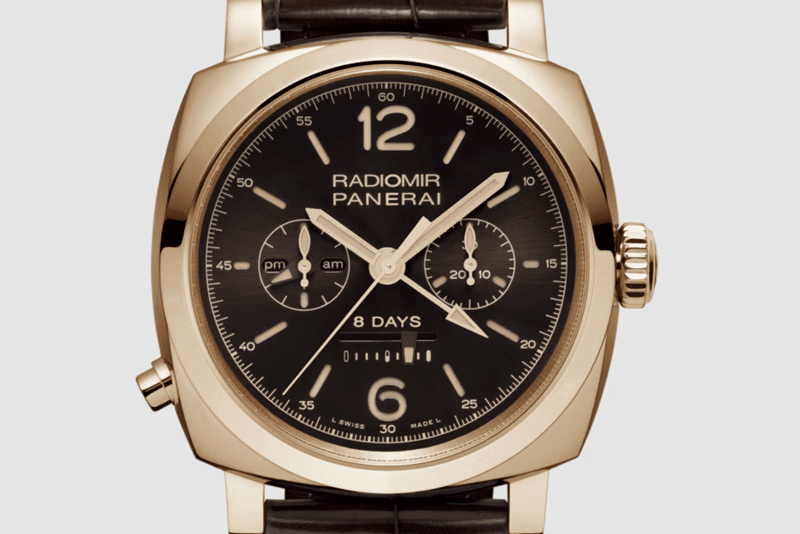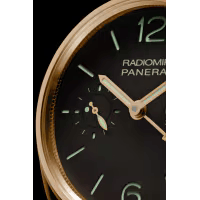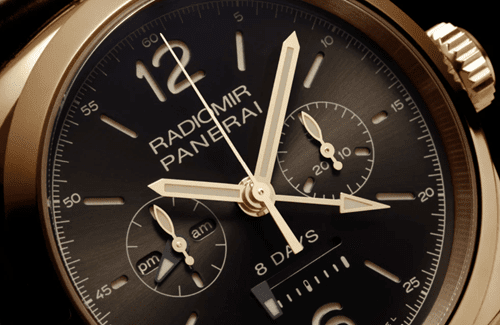
An eight-day, manually wound chronograph in red gold that reveals the P.2004/10 calibre at its finest — a union of power, precision, and refinement limited to 300 pieces.
Origins — When Radiomir Turned Sophisticated
PAM502 – By 2013 Panerai had mastered its manufacture era. The brand’s early tool-watch identity had evolved into something more ambitious: movements designed in-house, complications that served function rather than fashion.
The Radiomir 1940 Chronograph Monopulsante 8 Days GMT Oro Rosso arrived at that peak — a red-gold chronograph combining Radiomir purity with contemporary mechanical confidence. Introduced at the 2013 SIHH, the PAM502 appeared alongside two siblings in white gold and titanium, each built around the same in-house engine, the P.2004/10.
It was a statement piece — modern Panerai distilled into one reference: monumental case, long reserve, transparent mechanics, and a single pusher that controlled everything.

Case and Dial
The Radiomir 1940 case bridges Panerai’s evolution from the wire-lug Radiomir to the crown-guarded Luminor. Its 45 mm form, here in 18 ct 5N red gold, is sculpted and balanced, polished on top with brushed flanks and integrated lugs that sit closer to the wrist than dimensions suggest.
- Material: 18 ct red gold (5N)
- Diameter: 45 mm
- Thickness: ≈ 17 mm
- Crystal: sapphire, 2 mm thick, anti-reflective coating
- Case back: sapphire exhibition
- Water resistance: 50 m
The dial — a deep brown sunburst sandwich — layers modern execution over vintage cues. Beige Super-LumiNova fills the cut-outs, and gilt hands echo the warmth of the case. At 3 o’clock sits the chronograph minute counter; at 9, small seconds and a GMT indicator. A linear power-reserve indicator rests at 6, balancing the layout without clutter.
A single cylindrical-style crown conceals the chronograph pusher, performing start, stop, and reset in sequence — a minimalist gesture that keeps the case pure.
Calibre P.2004/10 — The Transparent Heart
Inside beats the P.2004/10, Panerai’s first fully skeletonised chronograph calibre and one of its most technically complete hand-wound movements.
Key Specifications of the PAM502
- Hand-wound mechanical movement
- Diameter 31 mm; thickness 8.2 mm
- 29 jewels; frequency 28,800 vph (4 Hz)
- Power reserve 8 days (192 hours) via three barrels in series
- Column-wheel monopusher chronograph with vertical clutch
- GMT function with independent hour hand
- Linear power-reserve indicator
- Seconds-reset mechanism
Engineering and Chronograph Layout
The P.2004 architecture derives from the hand-wound P.2002 but integrates a chronograph mechanism rather than adding a module. This integration maintains thinness and ensures stable energy delivery.
- The column wheel governs start, stop, and reset with a crisp click.
- A vertical clutch engages the central seconds hand smoothly — no jump, no lag.
- The three barrels distribute torque evenly across the eight-day cycle, maintaining amplitude even with the chronograph running continuously.
The chronograph’s single pusher simplifies operation, and the layout — small seconds at 9 o’clock, 30-minute counter at 3 — preserves symmetry on the dial.
When setting the time, the zero-reset seconds function halts and returns the hand precisely to twelve, a subtle but welcome refinement for synchronising.
Finishing — Function Made Beautiful
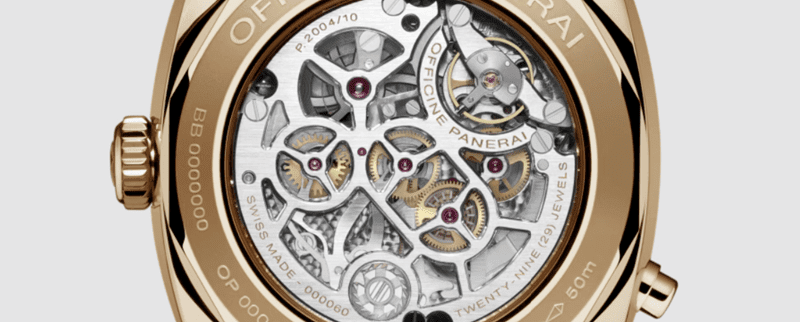
Unlike the closed-bridge versions of the calibre, the P.2004/10 is deliberately open in the PAM502 . Its skeletonised bridges expose the gear train, *column wheel, and barrel trio, finished in a satin brushed texture with polished bevels and heat-blued screws.
Under magnification you see the logic of Panerai’s approach: structural rather than decorative. Each bridge is thick, edges are bevelled just enough to catch light, and the overall impression is of strength, not delicacy. Geneva stripes and over-polish give way to coherence and clarity.
The skeletonised barrels reveal their mainsprings, a visual reminder of the eight days of power stored inside. Few Panerai calibres communicate their mechanics this openly.
*The column wheel explained in a video by Bill Sanders
Performance
In daily use the P.2004/10 is smooth and deliberate. Winding requires around 80 turns from empty, producing a steady increase in tension without harsh resistance. The column-wheel actuation feels firm and precise, and the vertical clutch prevents hand jump when the chronograph engages.
Accuracy typically sits within ±5 seconds per day; amplitude remains stable for roughly seven and a half days, then declines slightly — a remarkable figure for such an extended reserve.
Servicing intervals average six to eight years, thanks to the low-stress triple-barrel system and solid construction of the chronograph train.
Back View — The Engine Room
Flip the case and you’re rewarded with one of Panerai’s most compelling views. The sapphire back reveals the skeletonised bridges, the column-wheel poised like a turret, and the three coiled mainsprings visible through their open barrels. The engraving “P.2004/10 – Officine Panerai” sits at the lower bridge, clean and discreet.
This is where the PAM502 distinguishes itself — the interplay of gold warmth and mechanical transparency creates genuine theatre without losing function.
Limited Edition and Availability
Officially produced as a 300-piece limited edition for 2013, the PAM502 Radiomir 1940 Chronograph Monopulsante in red gold was positioned at the top of Panerai’s SIHH presentation that year. Each watch carried an individual BB-number and “Oro Rosso” engraving.
- Production year: 2013
- Edition: 300 pieces
- Launch price: ≈ €44,000 / US $55,000
- Current market range: ~£35,000–£45,000 depending on completeness and condition
The model was accompanied by the PAM 503 (Oro Bianco) and PAM 506 (Titanio), all sharing the same base calibre family.
Place in the P.2004 Lineage
The P.2004 series remains one of Panerai’s most significant mechanical families.
| Reference | Case Material | Movement Variant | Notable Traits |
|---|---|---|---|
| PAM317 | Ceramic Luminor 1950 | P.2004 | Earliest 8-day monopusher chronograph |
| PAM396 | Composite Luminor 1950 | P.2004/1 | Simplified bridge layout |
| PAM502 | Red Gold Radiomir 1940 | P.2004/10 | Skeletonised, GMT, 300 pcs |
| PAM503 | White Gold Radiomir 1940 | P.2004/10 | Same movement, alternate case |
| PAM506 | Titanium Radiomir 1940 | P.2004/9 | Closed bridges, lighter build |
Within this family, the P.2004/10 sits at the top — both mechanically and aesthetically — representing the most open and visually expressive evolution of Panerai’s in-house chronograph platform.
Wrist Presence
At 45 mm, this is unapologetically large, but the 1940 case’s short lugs and balanced weight distribution make it wearable. The red-gold case adds satisfying heft, and the brown sunburst dial tempers its opulence.
Paired with a deep brown alligator strap and gold buckle, it wears less as a diver’s instrument and more as a statement of mechanical artistry. The single pusher keeps the profile clean — elegance through restraint.
Collector Insight
For collectors of Panerai, this model embodies the sweet spot of Panerai’s modern era: an in-house calibre built for endurance, packaged in a design that acknowledges history without imitating it.
Its appeal lies in:
- The only skeletonised hand-wound chronograph Panerai produced in this period
- Integrated P.2004 movement — not a modular retrofit
- Balanced power and beauty: eight days of reserve visible through open bridges
- Finite production, ensuring genuine exclusivity
While later automatic chronographs brought practicality, none matched the raw presence of this manually wound engine in red gold.
Summary
| Specification | Detail |
|---|---|
| Model | Radiomir 1940 Chronograph Monopulsante 8 Days GMT Oro Rosso |
| Reference | PAM502 |
| Movement | Panerai Calibre P.2004/10 |
| Power Reserve | 8 days / 192 hours |
| Chronograph Type | Manual-wind monopusher column-wheel / vertical clutch |
| Case | 45 mm 18 ct red gold |
| Dial | Brown sunburst sandwich, beige lume |
| Water Resistance | 50 m |
| Edition | 300 pieces (2013) |
Reflection — Endurance, Elegance, and Engineering
The PAM502 isn’t about nostalgia or showmanship; it’s about mechanical conviction. The P.2004/10 translates Panerai’s utilitarian roots into horological language — power reserves and torque curves turned into sculpture.
It’s a watch that rewards time spent studying it, not just wearing it. The skeletonised bridges reveal a mind at work; the red-gold case reminds you that engineering and beauty can share the same space.
Eight days of power, one pusher, one purpose: to show how far Panerai could go once it decided to build everything itself. they managed with the PAM502!