PAM372 A Modern Panerai That Understands Its Past
Quick Takeaways
- The PAM00372, often shortened to PAM372 among collectors, is a 47mm polished stainless steel Luminor 1950 with a hand-wound in-house P.3000 calibre, 72-hour power reserve, and a genuine sandwich dial. Panerai’s most historically accurate regular-production Luminor when it launched at SIHH 2011
- This watch exists because collectors refused to accept that the PAM127 “Fiddy” would stay a limited edition forever. Nine years of community pressure produced a regular-production “Base Fiddy” with no seconds hand, better proportions, and a manufacture movement
- The sandwich dial with engraved ecru text is one of the most faithful dial executions in modern Panerai. The engraved Luminor Panerai inscription, in the original vintage font, filled with a warm cream paint rather than printed on, is a detail that separates the PAM372 from almost everything else in the catalogue
- The 3mm domed Plexiglass crystal is not a compromise, it’s the point. The way it refracts light, distorts the dial at oblique angles, and adds warmth to the face is precisely what makes this watch feel connected to the 1950s original
- On the secondary market, the PAM372 has outperformed the broader Panerai brand index over the past year and holds a medium-risk rating, a genuinely liquid reference that is easier to find and easier to sell than its mythologised predecessor, the Fiddy
Jump directly to the spec sheet.
Introduction
Some watches exist because a brand decided to make them. The Panerai PAM00372 exists because collectors refused to stop asking.
For nearly a decade after the PAM127 “Fiddy” sold out in 2002, Paneristi had one recurring request: give us the same case, the same spirit, the same historical proportions, but without the small seconds hand, without the 1950 print on the dial, and this time with an in-house movement. A base Luminor 1950. Clean, honest, two-handed. In the language of the forum, a “Base Fiddy.”
Panerai answered at SIHH 2011 with the Luminor 1950 3 Days, ref. PAM00372. 47mm of polished steel, a P.3000 manufacture calibre, a sandwich dial with engraved ecru text, and a 3mm domed Plexiglass crystal that distorts the dial at exactly the right angle to remind you what this watch is reaching back toward: a 1950s Italian Navy instrument that spent decades as a classified military secret before it became one of the most sought-after watch designs on earth.
The Panerai PAM00372 review you’ll find on most sites stops at the spec table. This one doesn’t.
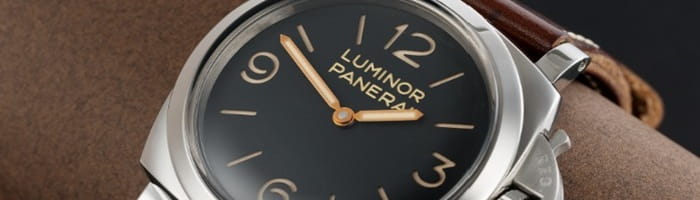
From the Navy to Your Wrist — The 6152/1 Lineage That Made the PAM372 Inevitable
The Vintage Ref. 6152/1: Panerai’s Italian Navy Dive Watch of the 1950s
To understand why Paneristi fought so hard for the PAM372, you need to go back seventy-odd years.
The reference 6152/1 was the crown-protected Luminor that Officine Panerai produced for the Italian Navy in the early 1950s, a 47mm cushion-shaped case housing a Rolex Calibre 618 movement, built for the incursori, Italian Navy special forces frogmen who swam under enemy ships planting explosives. These were classified instruments. They never reached the public, they were never advertised, and most of them were swallowed by the sea, by service, or by time.
What survived is extraordinary. The 6152/1 has a sandwich dial, two layers of material with the indices cut through the top plate, so the luminous material glows up from below, a Luminor Panerai inscription engraved into the metal rather than printed, and the original lever-type crown-protecting bridge patented by Panerai in 1955. The case sits closer to the wrist than any modern Luminor at 19.1mm tall, a profile more organic and sea-worn than anything that came after. These watches are not just rare, they are the entire reason modern Panerai has the design vocabulary it does.
The PAM127 “Fiddy” — The 2002 Limited Edition That Proved the Demand
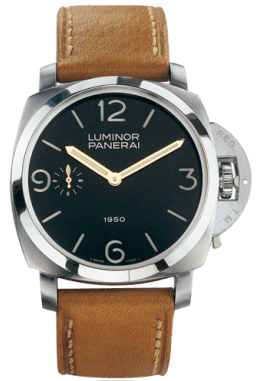
When Richemont’s Panerai introduced the PAM127 in 2002, a 47mm, 1,950-piece Special Edition built as a close homage to the 6152/1, the reaction was almost instant. Demand crushed supply. The watch sold out. Prices doubled on the secondary market within three years. The PAM127, nicknamed the Fiddy for Nineteen-Fiddy, became the modern holy grail for the Paneristi who had been following the brand since the pre-Vendome years.
But the Fiddy had a small seconds sub-register at 9 o’clock, a 1950 print on the dial that some collectors found superfluous, an ETA-based movement, and a brushed case finish, all departures from the 6152/1 original. The 1950 text in particular became a recurring point of debate in the collector community: for a watch positioning itself as a faithful homage, printed text that wasn’t on the original felt to some like an intrusion on the vintage authenticity the rest of the design worked hard to earn. The community loved the watch. They also immediately started arguing about how it could be better.
How Paneristi Finally Got Their Base Fiddy in 2011
The Radiomir’s cushion-influenced case shape had always pointed toward what a truly vintage-accurate Luminor 1950 could look like. Collectors on WatchUSeek, WatchProSite, and Paneristi forums spent years articulating it: no seconds hand, cleaner dial, better font, engraved text rather than printed, in-house movement, polished case. The “Base Fiddy” became a recurring fixture in Panerai wish-lists from around 2004 onward.
At SIHH 2011, the PAM00372 appeared. Panerai announced it as a regular-production watch, not a limited edition, with 3,000 units in the first year and ongoing production thereafter. The collector community’s response was enthusiastic. Vintagepanerai.com, a well-known vintage Panerai research site, published a detailed side-by-side comparison against a real 6152/1 and called the result:
“…really a wonderful watch, the star of the 2011 Panerai collection…” Vintagepanerai.com, comparing the PAM372 against a vintage 6152/1, 2011
The Case — Polished Steel, Cushion Profile, and the 1950 Geometry
The PAM372 case is 47mm and polished stainless steel, entirely polished, unlike the Fiddy’s brushed finish, with the single exception of the crown-protecting lever bridge, which retains its brushed treatment. That contrast is not an accident. The polished body reads vintage; the brushed lever reads functional. Together they capture the dual nature of this watch precisely.
The case band has a rounded, cusp-shaped profile derived from the cushion form of the early Radiomirs, the same rounded middles that made the 6152/1 look less brutalist and more organic than the later straight-sided Luminor cases. The lugs are slimmer than the Fiddy’s, which actually improves wrist integration at 47mm. Reviewers who wore both consistently noted the PAM372 sits closer and more naturally than the slightly chunkier PAM127, despite identical diameters.
One detail worth looking for: the reference number is engraved between the lugs, in the manner of the vintage originals which carried their Rolex reference and individual case numbers in the same position. It’s a micro-detail that most photographs miss entirely. Hold one in your hand and you’ll find it immediately.
The Luminor crown-protecting device, the half-crescent lever bridge that locks down over the crown, closes upward on the PAM372 rather than downward as on the PAM127. Again, a nod to the vintage orientation of the 6152/1 original. Paneristi noticed. At 100 metres water resistance, the PAM372 is not a dive watch in the technical sense, but it’s more than adequate for everyday wear, swimming, and the occasional sea dip that the watch’s design so obviously invites.
The Dial — Why the PAM372’s Face Is the Watch’s Strongest Argument
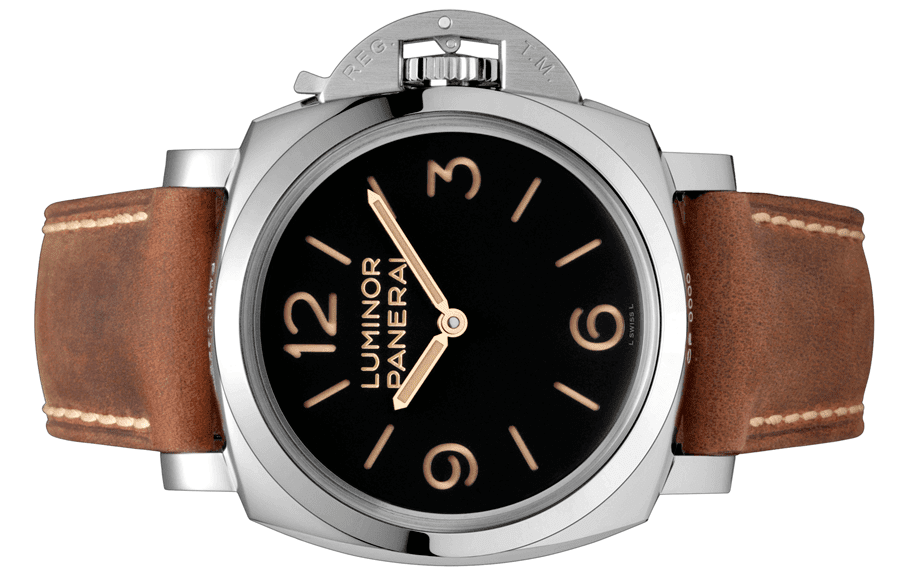
Here’s my honest take: the dial is everything.
I’ve handled a lot of modern Panerais. Most of them have excellent dials by any objective measure, legible, well-executed, technically correct. But very few of them make you feel something the moment you look at them. The PAM372 dial does.
Sandwich Construction, Engraved Text, and What “Ecru” Actually Means
The dial is a genuine sandwich construction, two plates, with the indices cut through the upper layer so the luminous SuperLuminova glows upward through the gaps rather than sitting on the surface. This gives the markers genuine depth, a layered quality that no single-layer printed dial can reproduce. It’s the construction used on the 6152/1 originals. For a deeper look at how Panerai’s dial variants diverge, the site’s piece on the California dial is worth reading alongside this, the California is Panerai’s other great dial conversation piece, and the contrast with the PAM372’s minimalism is instructive.
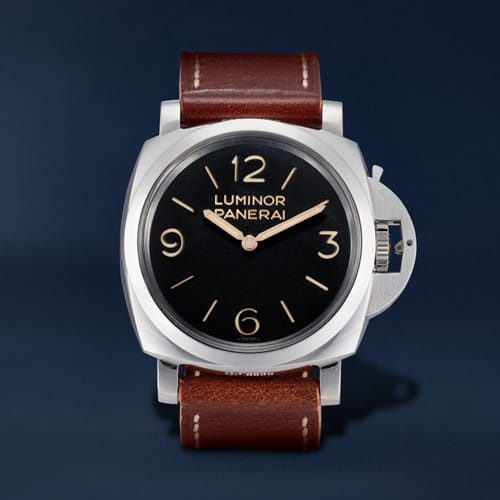
The text, Luminor Panerai, above the 6 o’clock position, is engraved into the dial metal and filled with a warm cream paint. Not printed. Not applied. Engraved. The font is the original vintage Panerai typeface, not the Helvetica-adjacent modern version that appears on most of the catalogue. The effect is warm, organic, and slightly aged-looking from the factory. The markers carry the same ecru treatment: not the sharp white of modern lume, but a softer, browner cream that suggests the tritium patina of vintage dials without faking it.
The hour and minute hands are gold, not gold-plated, but finished in gold coloration, matching the warmth of the indices and text. The result is a dial that appears to have been through time even when new.
The Plexiglass Crystal and Why It’s the Right Call
The 3mm domed Plexiglass crystal is the most discussed feature of the PAM372, and I’d push back hard against anyone who dismisses it as a backward step.
Plexiglass scratches more easily than sapphire, that’s true, and Panerai includes a spare crystal in the box precisely because of it. But what Plexiglass does that sapphire cannot is distort. The thick dome refracts light in a way that makes the dial appear to have depth beyond what it physically has. At certain angles, the numerals seem to float just below the surface. The crystal adds warmth rather than clarity, which for a watch explicitly reaching back toward a 1950s instrument is not a compromise, it’s the brief.
“…it distorts the dial at certain angles…” aBlogtoWatch, hands-on review of the PAM00372, on how the Plexiglass crystal refracts light and adds warmth
Their word for it was warm. That’s exactly right.
Minor scratches on Plexiglass can be polished out at home with Polywatch or a Cape Cod cloth. Many PAM372 owners consider the accumulation of micro-scratches over time to be part of the watch’s character, closer to the old 6152/1, as some Paneristi describe it. A later production run moved some batches to a sapphire front crystal. Both versions have their advocates. My preference is the Plexiglass, unambiguously.
No Seconds Hand: The Right Decision, Made for the Right Reason
The PAM372 shows only hours and minutes. There is no seconds sub-register. The dial is utterly, defiantly empty below the 6 o’clock index.
For some newcomers to Panerai this initially reads as a limitation. It isn’t. The absence of a seconds hand is what gives the PAM372 its directness. Every other element on the dial has more room to exist. The Luminor Panerai engraving has space. The four numeral positions, 3, 6, 9, 12 in Panerai’s characteristic block font, have authority. The hands sweep across a face that doesn’t compete with itself.
“Panerai fans have a new, modern-day grail in the PAM00372 Luminor 1950 3 Days.” — John B. Holbrook II, WatchTalk Forums, 2011
Inside the P.3000 — A Movement That Changed Panerai’s Credibility
The P.3000 is the movement Paneristi had been waiting for. Not the most complex in the catalogue, not the flashiest, but the one that finally answered a criticism that had followed Panerai for over a decade.
For most of its civilian life, Panerai’s historic-style references ran on the Unitas 6497, a bought-in, off-the-shelf Swiss lever movement. Reliable, long-serving, and entirely respected in the watch world, but an outsourced calibre inside cases that cost the better part of ten thousand dollars. Every time a collector turned over a Panerai to service it, the Unitas was a reminder that the brand’s manufacture ambitions were still catching up with its prices. The P.3000, unveiled in late 2010 and shown publicly at SIHH 2011 inside the PAM372, changed that conversation permanently.
Here’s what the P.3000 actually is, beyond the spec sheet. It’s a hand-wound calibre designed and built entirely at Panerai’s manufacture in Neuchâtel, Panerai’s eighth in-house movement at the time of its introduction. The diameter is 16½ lignes, which is the same footprint as the historic Unitas 6497 it replaces. That was a deliberate decision: the movement was sized to the heritage, not the other way around. The architecture resembles a three-quarter plate design, a large bridge alongside a smaller one covering most of the mechanical parts, fixed down by thick screws that form a structure more rigid than a conventional cage-style layout. It looks purposeful under the display caseback, even if the finishing is brushed rather than côtes de Genève. You’re not looking at a decorated showpiece. You’re looking at a working machine.
The work horse P.3000 sit nicely in the PAM372
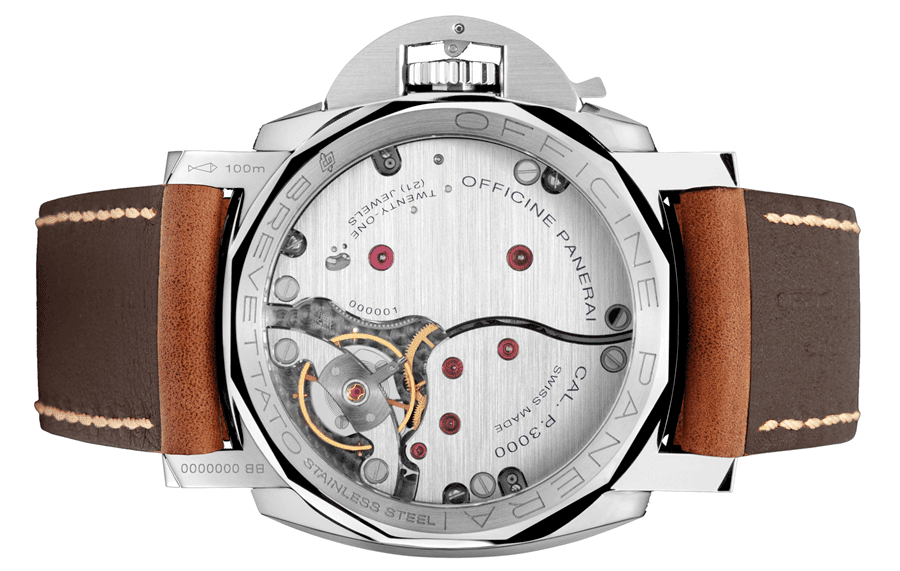
Two spring barrels are connected in series, meaning they run sequentially rather than in parallel. This arrangement allows thinner, longer springs, which deliver a more even torque curve across the full reserve. The practical result: the watch runs more consistently on day three than a single-barrel movement of similar reserve would. The 72-hour power reserve is generous without being extravagant, and wind time is short given the PAM372’s size, a few dozen turns of the crown is all it asks for each morning.
The balance wheel is enormous at 13.2mm, larger than most modern movements of any size, with variable inertia adjustment via four externally placed screws. You can regulate the rate without disassembling the balance assembly. At 21,600 vph (a slow beat by modern standards, 3Hz), the P.3000 has a deliberate, unhurried tick that suits the watch’s temperament entirely. It does not race. It measures.
The most practically useful feature of the P.3000 is one that almost no review gives enough credit: the independent hour-jump mechanism. Pull the crown to the second position and a star wheel with 12 points allows the hour hand to advance one position at a time, without touching the minute hand and without stopping the running of the movement. For travel across time zones, this is genuinely useful in a way that crown-and-date adjustment mechanisms simply aren’t. It’s a considered feature for a time-only watch, and it rewards the collectors who use the PAM372 as their daily driver.
The caseback is sapphire and displays the movement fully. Honest assessment: the bridges are brushed, the screw heads are functional, and there’s no skeletonizing or visible jewel work. This is not a movement you’ll want to stare at for its decorative beauty. But it has an integrity, the architecture makes sense, the components are proportioned for the case, and the fact that it’s entirely Panerai’s own design means it will be serviceable by Panerai for generations. That matters more to me than aesthetic finishing.
Is the PAM00372 Still Worth Buying on the Secondary Market?
Short answer: yes, with eyes open about what you’re actually buying.
The PAM372 was produced as a regular-production watch, initially approximately 3,000 units per year. From around the R-series onward, Panerai reportedly trimmed production, and some later batches featured a sapphire front crystal rather than Plexiglass. The crystal variant matters to collectors: the original Plexiglass examples carry more of the watch’s character and are what most collectors seeking the “Base Fiddy” experience actually want. Confirm the crystal before you buy.
On Chrono24, the PAM372 currently trades between approximately $5,000 and $8,000 USD depending on condition, crystal variant, and whether the piece comes with its original triple box and documentation. Clean Plexiglass examples with full box and papers sit at the higher end; polished-out cases without paperwork at the lower. The spread is real and worth understanding before negotiating.
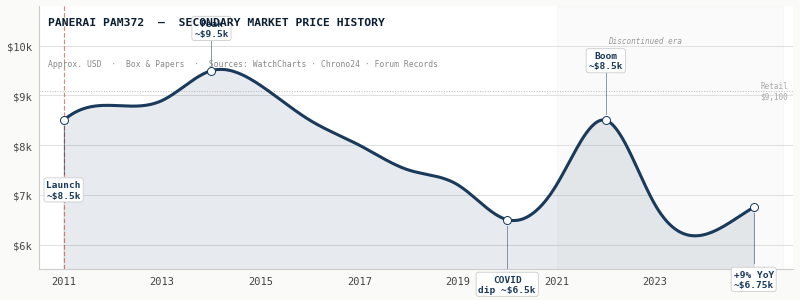
Secondary market data from WatchCharts tells an interesting story: the PAM372 has outperformed the broader Panerai Luminor index by around 14.6% over the past year, registering modest positive appreciation while the general Panerai market has contracted. It sells with a median time on market of around 20 days, faster than roughly half of tracked watches. Over five years the picture is less rosy (down ~14.3%), but this mirrors the broader luxury watch correction post-2022 rather than anything reference-specific. Among discontinued Panerais with genuine collector pedigree, the PAM372 is one of the more liquid references you’ll find.
The key question, honestly, isn’t whether it holds value. It’s whether it belongs in your collection. I’d argue the PAM372 is the single reference that most directly answers the question “what is Panerai actually about,” more so than any Submersible, more so than any complication piece. It’s two hands, a vintage dial, and an in-house movement in a case that traces its lineage back to the Italian Navy frogmen of the 1950s. That’s the whole story, unadorned.
Who Is It For
- The collector who wants Panerai’s purist soul in a regular-production reference. No limited-edition anxiety, genuine vintage DNA, accessible on the secondary market
- A Paneristi upgrading from an ETA-powered Luminor who wants an in-house calibre without the price premium of the higher complication references
- Someone drawn to the vintage 6152/1 aesthetic but who wants a modern wearable piece rather than a museum-condition original trading above $50,000
- Daily-driver collectors who appreciate a hand-wound ritual and value the independent hour-jump for travel
- Those who find the PAM127 Fiddy’s secondary market price or its small seconds hand a dealbreaker. The PAM372 is the honest, democratic version
Not for: Collectors who need significant water resistance (100m limits this to pool-depth casual use, not serious diving), anyone who wants a seconds indicator, or those for whom the PAM673’s Marina Militare dial and pencil hands matter enough to pay the premium for more precise historical accuracy.ho need significant water resistance (100m limits this to pool-depth casual use, not serious diving), anyone who wants a seconds indicator, or those for whom the PAM673’s Marina Militare dial and pencil hands matter enough to pay the premium for more precise historical accuracy.
Conclusion
The Panerai PAM00372 is not a compromise watch. It doesn’t exist because Panerai ran out of ideas or needed to fill a price point. It exists because the Paneristi community looked at the PAM127 Fiddy, one of the most coveted Panerai references ever made, and articulated, clearly and persistently, exactly how it should be improved. And Panerai listened.
What they built is a watch that traces a direct line back to Italian Navy instruments that most people will never touch, priced and produced in volumes that mean a serious collector can actually own one. The in-house P.3000, the sandwich dial with engraved ecru text, the polished cushion case, the domed Plexiglass crystal, every element earns its place. None of it is decoration.
I’d call it one of the most resolved Panerai references of the modern era, and I don’t say that lightly. The question I’d put to you: does your collection have a watch that answers the question “what is this brand actually about?” If not, the PAM372 is a strong argument for starting there.
What’s your take on the Plexiglass vs sapphire debate, does the original crystal make or break it for you?
Extended Summary
- The PAM00372 is a 47mm polished-steel Luminor 1950 introduced at SIHH 2011 as the regular-production “Base Fiddy”, the direct response to nearly a decade of collector demand for a two-handed, historically accurate Luminor 1950 with an in-house movement
- Its design DNA traces back to the vintage ref. 6152/1, the classified Italian Navy dive watch of the early 1950s, via the PAM127 “Fiddy” limited edition of 2002. The PAM372 corrects the Fiddy’s key departures: no seconds hand, engraved rather than printed dial text, in-house movement, and a more slender polished case
- The sandwich dial with engraved ecru markers, vintage-font Luminor Panerai inscription, and 3mm domed Plexiglass crystal is one of the most historically faithful dial executions in modern Panerai production, and the primary reason the reference resonates so strongly with serious collectors
- The P.3000 calibre, entirely designed and built by Panerai in Neuchâtel, is a hand-wound, twin-barrel, three-quarter-plate movement running at 21,600 vph with a 72-hour power reserve and a genuinely useful independent hour-jump function; it replaced the long-used Unitas 6497 and represented a significant milestone in Panerai’s in-house manufacture story
- On the secondary market, the PAM372 trades between ~$5,000 and ~$8,000 USD depending on condition and crystal variant. Plexiglass examples with original box and papers command the premium, it sells faster than most comparable references, and its short-term secondary market performance has outpaced the broader Panerai index, making it both a credible collector piece and a relatively liquid one
At a Glance
| Spec | Detail |
|---|---|
| Reference | PAM00372 |
| Collection | Luminor 1950 — Historic |
| Introduced | SIHH 2011 |
| Case material | Polished stainless steel |
| Case diameter | 47mm |
| Case thickness | 16mm |
| Lug width | 26mm |
| Water resistance | 100 metres |
| Crown device | Lever-type Luminor crown-protecting bridge (brushed finish) |
| Crystal | 3mm domed Plexiglass® (early production); sapphire on later R-series batches |
| Caseback | Sapphire display crystal |
| Movement | Panerai in-house Calibre P.3000 |
| Movement type | Hand-wound mechanical |
| Complications | Hours, minutes; independent hour-jump function |
| Power reserve | 72 hours (3 days) |
| Beat rate | 21,600 vph |
| Jewels | 21 |
| Dial | Black sandwich dial, engraved ecru text and markers, gold hands |
| Strap | Brown leather with brushed tang buckle (two straps supplied) |
| Production | Regular production; initial ~3,000 units per year |
| Availability | Discontinued — secondary market only |
| Secondary market price | ~$5,000–$8,000 USD depending on condition, completeness, and crystal variant |