The PAM700 a 50-Year Promise
Quick Takeaways
- The PAM00700, the Luminor 1950 Carbotech 3 Days LAB-ID, is a 50-piece Special Edition unveiled at SIHH 2017. Collectors nicknamed it the “50-50-50”: 50 pieces, a 50-year guarantee, €50,000 at retail. No other modern Panerai carries that specific triple coincidence.
- The movement genuinely needs no liquid lubrication anywhere, an industry-first claim at the time. Silicon escapement components, tantalum-ceramic bridges and plate, DLC-coated barrels and jewels all work together to eliminate the oil that normally dries out and degrades over decades
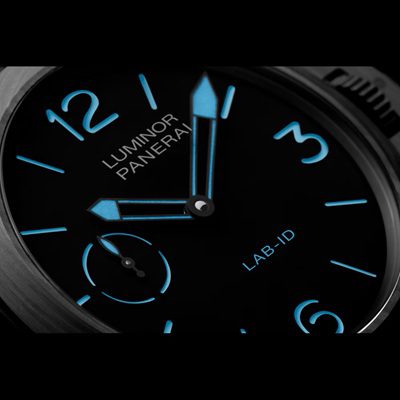
- The dial isn’t printed. It’s coated in carbon nanotubes that absorb almost all light, a surface so effective at killing reflection that Panerai couldn’t stamp text onto it. “Officine Panerai” and “LAB-ID” are printed on the underside of the crystal instead.
- The Carbotech case is a direct descendant of the PAM00616 Submersible, the reference that introduced the material a year earlier, but the LAB-ID pushed the same carbon-fibre-and-PEEK composite into a role no Panerai case material had held before: not just cosmetic, but load-bearing for a genuinely different mechanical philosophy
- The 50-year guarantee has an honest asterisk. Panerai itself recommends the watch be checked roughly every 6 years, not for the movement, but to verify the gaskets that keep it water-resistant haven’t dried out. The movement doesn’t need service. The case still does.
Jump directly to the spec sheet.
The Watch Panerai Built to Outlive Its Warranty Card
Most watch brands measure innovation in complications: another hand, another sub-dial, another way of displaying the same 24 hours. In 2017, Panerai measured innovation differently. It asked what would happen if a mechanical watch simply never needed anyone to open it up.
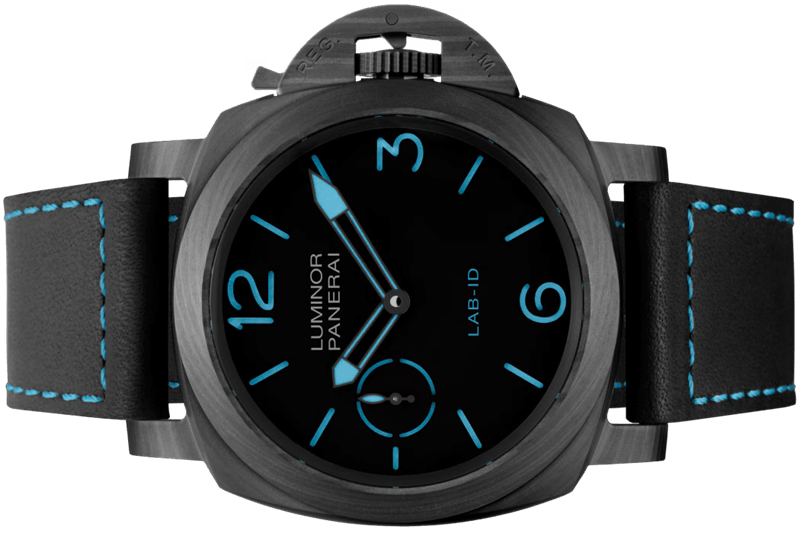
The PAM00700, known officially as the Luminor 1950 Carbotech 3 Days LAB-ID, is Panerai’s answer. Fifty pieces, unveiled at SIHH 2017, built around a movement that Panerai engineered to run for decades without a drop of oil anywhere inside it. The case is carbon fibre. The dial absorbs light instead of reflecting it. The whole object reads, at a glance, like a standard 49mm Luminor 1950. Underneath, almost nothing about it is standard.
This is not a review built around whether the watch looks good on a strap. It’s built around what Panerai actually did, and what that meant for a brand whose reputation, up to that point, had rested more on heritage than on materials science.
The Laboratorio di Idee: Where the Name Actually Comes From
LAB-ID isn’t a stylised abbreviation invented for marketing. It’s a direct reference to the Laboratorio di Idee, Panerai’s internal research and development division based at the Neuchâtel manufacture, “Laboratory of Ideas” in Italian. This is the same team responsible for the brand’s material experiments across the 2010s: Composite (BMG-Tech), Carbotech, and the various tantalum, ceramic, and silicon components that increasingly found their way into Panerai movements.
The PAM00700 is best understood as that division’s thesis statement, a single reference where every major material innovation the Laboratorio had been developing came together at once, rather than being introduced piecemeal across several years and several watches. Two years of dedicated testing went into the movement’s barrel coating alone, according to Panerai’s own technical documentation at launch, a detail that signals this wasn’t a rushed novelty built to generate press before SIHH. It was a genuine R&D exercise that happened to also be a wearable, sellable watch.
Case: Carbotech, One Year After Its Debut
The Carbotech case material didn’t originate with the LAB-ID. Panerai first used it a year earlier on the Luminor Submersible 1950 Carbotech PAM00616, a titanium-and-carbon dive watch that introduced the material to the catalogue. The LAB-ID’s contribution was to push Carbotech into a context where its properties mattered mechanically, not just visually.
Carbotech is a composite built from thin sheets of carbon fibre, compressed under controlled temperature and high pressure with a polymer called PEEK, Polyether Ether Ketone, that bonds the layers into something stronger and more resistant than conventional carbon fibre composites. Panerai patented the process in 2015. The result is a material that is not cold to the touch the way titanium or steel is, and whose surface pattern is genuinely unique on every single case: because the sheets are cut after compression rather than moulded to a uniform finish, no two Carbotech cases show quite the same swirl. Owners and reviewers alike have noted that the case appears to shift hue slightly depending on the ambient light, a side effect of the material’s layered, non-homogeneous structure rather than any applied coating.
At 49mm, the case follows the Luminor 1950 architecture: cushion shape, crown-protecting lever, screw-down crown, 100 metres of water resistance. The lever and hardware are titanium, chosen for the same reasons titanium appears throughout Panerai’s catalogue, corrosion resistance and a favourable strength-to-weight ratio, paired with a case material that is dramatically lighter than steel at the same volume.
The Dial You Cannot Print On
Here is the detail most casual coverage of this watch gets wrong or skips entirely: the black surface of the PAM00700’s dial is not paint, not a printed finish, and not a standard matte black treatment. It’s a coating of carbon nanotubes, a material developed for its ability to absorb an extraordinarily high percentage of incident light. Panerai’s engineers reportedly considered licensing Vantablack, the carbon nanotube coating whose commercial and artistic rights were, at the time, controversially held under exclusive licence by artist Anish Kapoor via the firm MCT, before deciding to develop their own alternative rather than work within that arrangement.
The practical consequence of that coating is stranger than it sounds. Carbon nanotube surfaces are extremely fragile and cannot be printed on; ink simply won’t hold or read correctly against a surface engineered to prevent light from bouncing back at all. So the Officine Panerai and LAB-ID markings that would normally sit on the dial itself are instead printed on the underside of the sapphire crystal, which carries a double anti-reflective coating on both faces. Look at the dial and the text appears to float fractionally above the black surface, because it genuinely does; it’s on a different physical plane entirely.
The dial retains Panerai’s familiar sandwich construction beneath that nanotube layer: a lower luminous plate, an upper plate pierced for the hour markers, with the lume showing through in the brand’s signature style. Blue Super-LumiNova was chosen specifically to contrast against the near-total blackness above it, matching the blue contrast stitching on the black calf leather strap. Small seconds sit at 9 o’clock; a power reserve indicator sits at 6, information the watch can display even though, mechanically, it’s asking almost nothing of the components delivering that information.
The Movement: P.3001/C, and the Case Against Lubrication
This is the section that matters most, because everything else about the PAM00700, the case material, the dial treatment, is in service of what happens inside the movement.
Why Lubrication Is the Problem in the First Place
Every conventional mechanical watch relies on oil. Pivots, escapements, barrels, they all generate friction, and friction generates wear, so watchmakers apply specific lubricants engineered for each component’s speed, load, and material. The problem is that oil degrades. It oxidises, migrates, thickens, or dries depending on the specific lubricant and the conditions the watch experiences, which is precisely why mechanical watches need periodic service, typically every five to seven years, largely to clean out and replace that ageing lubrication before it starts causing measurable wear.
The Laboratorio di Idee’s premise for the LAB-ID was straightforward to state and extraordinarily difficult to execute: if you could eliminate the need for lubrication entirely, component by component, you could eliminate the primary reason a watch needs regular service at all.
Three Separate Engineering Problems, Three Separate Solutions
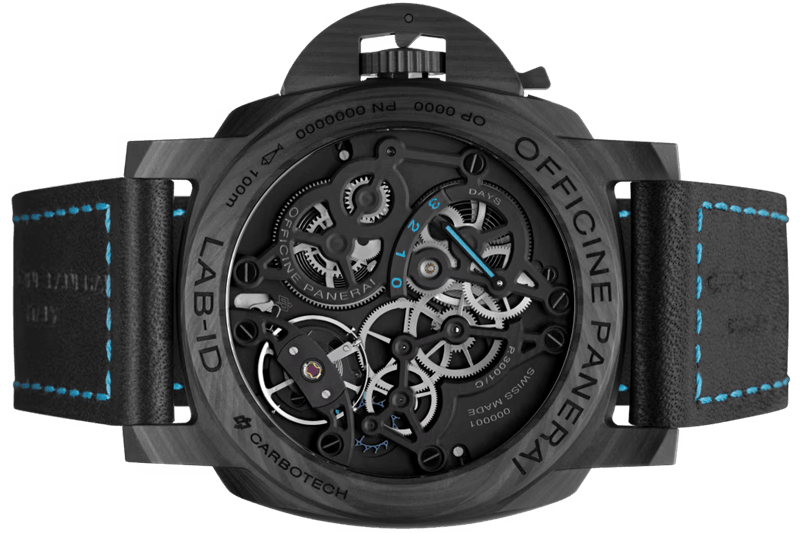
The P.3001/C calibre, hand-wound, 3-day power reserve, presented for the first time in a semi-skeletonised form, solves this across every major friction point in the movement, and it does it with three genuinely distinct engineering approaches rather than one universal trick.
The bridges and main plate are built from a new composite material integrating a tantalum-based ceramic with an unusually high carbon content. That high carbon percentage minimises pivot friction directly, to the point where the jewels traditionally needed to manage that friction, and the lubrication those jewels would normally require, become unnecessary at those specific contact points.
The escapement, arguably the most friction-critical assembly in any mechanical movement, uses components made from silicon rather than traditional steel, finished with a DLC (Diamond-Like Carbon) coating across the wheel train. Silicon is naturally low-friction and doesn’t corrode; the DLC layer on top reduces surface friction further still, together removing the need to lubricate the single mechanism most watches depend on oil for most heavily.
The mainspring barrels, two of them, connected to deliver the watch’s 3-day reserve, took the longest to solve. Panerai’s engineers spent roughly two years testing coating formulations before settling on a carbon-based, multi-layer treatment, with a DLC surface layer, applied specifically to make the barrel’s internal friction manageable without any conventional grease. The same DLC treatment extends even to the movement’s four jewels and its Incabloc anti-shock device, eliminating the last conventional lubrication points in the entire calibre.
The result, according to Panerai and repeated across every technical writeup of this movement, is a calibre with only four jewels total, a startlingly low number for a mechanical watch of this complexity, because so much of what jewels normally do has been engineered out of the equation entirely by the choice of materials rather than compensated for by adding more of them.
Reading the Numbers
The P.3001/C runs at 21,600 vph (3Hz) with a 13.2mm balance wheel, delivers 72 hours of power reserve from its twin barrels, and displays that reserve on the caseback rather than the dial. Water resistance for the complete watch sits at 100 metres. None of these figures are exotic on their own; the P.3001/C’s real distinction isn’t performance, it’s the complete absence of a category of maintenance every other mechanical watch assumes as inevitable.
A professional watch publication’s hands-on assessment of the claim struck the right balance between genuine interest and appropriate scepticism about an unprecedented promise:
“…Panerai is nothing if not confident in its claims.” QP Magazine, hands-on review of the Panerai LAB-ID
That’s the correct posture for anyone evaluating a claim this large. The engineering behind it is real, documented, and consistent across every technical source that covered the launch. Whether it holds up across an actual half-century of ownership is, by definition, not something anyone could verify in 2017, and it still isn’t fully verifiable today.
The 50-Year Promise: What It Actually Covers
Panerai’s guarantee on the LAB-ID’s movement runs for 50 years, an unprecedented figure in modern watchmaking and the claim that gave the “50-50-50” nickname its third digit. It’s worth being precise about what that guarantee actually covers, because the honest answer is more interesting than the marketing headline.
The 50-year promise applies specifically to the movement’s need for lubrication-related service. Because the P.3001/C has no oil to degrade in the first place, there is, in principle, no lubrication-driven reason to open the movement for half a century. That is a genuinely different proposition from a standard watch warranty, which typically covers manufacturing defects for a few years and says nothing about eliminating the need for eventual service.
What the guarantee does not cover, and what Panerai itself has been upfront about, is the case. Gaskets, the rubber and synthetic seals that keep the watch water-resistant at the crown, caseback, and crystal, degrade over time regardless of what’s happening to the movement inside. Panerai has recommended that LAB-ID owners have the watch’s water resistance checked roughly every six years, not because the movement needs attention, but because a gasket that’s dried out and failed will let moisture in regardless of how well-lubricated, or unlubricated, the calibre underneath happens to be.
This isn’t a contradiction of the 50-year claim. It’s a distinction between two different kinds of maintenance that most owners, and most marketing copy, conflate. The movement genuinely may not need conventional service for decades. The case, like every case on every watch ever made, still needs its seals checked.
50-50-50: A Nickname That Actually Explains the Watch
Collectors settled on “50-50-50” almost immediately after the SIHH 2017 unveiling, and it’s one of the rare watch nicknames that functions as an actual specification summary rather than just a memorable tag. Fifty pieces worldwide. A fifty-year movement guarantee. A retail price of fifty thousand euros, roughly $54,000–$55,400 depending on the exchange rate at the time of sale, confirmed directly on Panerai’s own archived product listing for the reference.
That triple coincidence wasn’t manufactured for the sake of the number; it’s simply what the watch happened to land on once the engineering, the production run, and the pricing were finalised. But it’s become the shorthand the collector community reaches for whenever the PAM00700 comes up, often before the official reference number does.
Provenance: The Prototype That Sold Before the Watch Did
One detail rarely covered elsewhere: before the 50 numbered production pieces reached collectors, Panerai and Sotheby’s auctioned an actual LAB-ID prototype in a November 2018 online sale titled “Panerai: The Prototypes,” alongside unique prototype examples of the Mare Nostrum PAM00300 and the Radiomir Firenze PAM00672. That prototype had been presented publicly in 2017 ahead of the general release and carried an estimate of £40,000–£60,000, a genuinely different object from any of the 50 numbered production examples, and a reminder that the watch’s development history includes at least one documented pre-production piece that predates the reference most collectors think of as the LAB-ID.
On the Wrist
At 49mm, the LAB-ID wears with the same physical presence any Luminor 1950 does, but the Carbotech case changes the sensory experience more than the dimensions suggest. It’s noticeably lighter than a steel equivalent, and the material’s surface temperature never quite matches the coolness of metal against skin, a small but consistently noted detail across hands-on coverage.
The black calf leather strap with contrasting blue stitching ties the case directly to the dial’s lume colour, a deliberate, unified colour story rather than an afterthought. Because the case is genuinely unique piece to piece, no two LAB-ID owners are looking at quite the same pattern in their carbon fibre, which is an unusual thing to be able to say about a modern production watch, even one limited to 50 examples.
Rarity and the Secondary Market
Fifty pieces is a genuinely thin population, and the PAM00700 rarely appears on the open secondary market in the way more common special editions do. Documented recent transaction data specific to this reference is sparse precisely because of that scarcity; when a LAB-ID does change hands, it tends to happen through specialist dealers or private sale rather than routine listings. What can be said with confidence is that original retail sat at approximately $54,000–$55,400, and that a landmark reference this historically significant, first-ever lubrication-free movement, first Panerai carbon-nanotube dial, would be expected to command a premium over that figure among Panerai collectors who specifically understand what it represents, though buyers should treat any specific pricing claim for this reference with more caution than usual given how infrequently genuine market data surfaces.
Who Is It For?
- The collector who values engineering firsts over aesthetic novelty. The PAM00700 isn’t the prettiest Panerai ever made; it’s arguably the most technically consequential one, a genuine attempt to solve a problem every mechanical watch shares
- A Paneristi who already owns the PAM00616 and wants to see where Carbotech went next, from a dive watch’s cosmetic and functional material to the structural and philosophical core of an entirely different kind of movement
- Someone drawn to Panerai’s Laboratorio di Idee output specifically. The LAB-ID is the clearest single expression of that R&D division’s thinking, more so than any other reference carrying similar materials
- A collector who wants genuine rarity backed by genuine substance. Fifty pieces is a real number, not a marketing-friendly round figure, and the engineering behind the watch justifies the scarcity rather than manufacturing it artificially
Not for: Anyone expecting the 50-year guarantee to mean the watch never needs attention at all, the gasket-check recommendation is real and matters. Collectors who want a display-case-friendly decorative movement, the P.3001/C is impressive precisely because of what’s absent, not because of ornamental finishing. And not for buyers hoping to find one easily on the open market, this is a genuinely difficult watch to source, and pricing data is thin by design of its own rarity.
Conclusion
The Panerai PAM00700 asked a question most watch brands never bother to ask: what if the thing that makes a mechanical watch need you, periodic service, aging oil, gradually accumulating wear, could simply be engineered away? The answer Panerai built is a 49mm Carbotech Luminor 1950 with a light-swallowing dial, a movement running on silicon and tantalum-ceramic instead of oil, and a guarantee that asks collectors to trust an unprecedented claim for an unprecedented length of time.
Fifty pieces. Fifty years. Fifty thousand euros. The nickname does the watch justice, but the engineering underneath it is the real story, two years of barrel-coating research, a movement stripped to four jewels, a dial too advanced to print on directly. Whether every claim holds up across an actual half-century is something only time will confirm. What’s already confirmed is that Panerai built something genuinely unlike anything else it, or arguably anyone else, had made before.
If you could design a watch that genuinely never needed service, what would you be willing to give up to get there? Tell us what you think in the comments.
Extended Summary
- The PAM00700, the Luminor 1950 Carbotech 3 Days LAB-ID, is a 50-piece Special Edition from SIHH 2017, nicknamed “50-50-50” for its 50-piece run, 50-year movement guarantee, and €50,000 retail price, a genuine engineering exercise from Panerai’s Laboratorio di Idee research division rather than a themed limited edition
- The Carbotech case, patented by Panerai in 2015 and first used on the PAM00616 a year earlier, is unique piece to piece; the dial’s carbon nanotube coating absorbs almost all incident light and is too fragile and reflective-treatment-resistant to print on, so the “Officine Panerai” and “LAB-ID” text sits on the underside of the crystal instead
- The P.3001/C movement eliminates conventional lubrication across every major friction point: tantalum-ceramic bridges and plate, a silicon escapement with DLC coating, and carbon-coated mainspring barrels developed over roughly two years of dedicated testing, resulting in a calibre with just four jewels total
- The 50-year guarantee covers the movement’s freedom from lubrication-related service specifically, not the case; Panerai itself recommends checking the watch’s gaskets roughly every six years to maintain water resistance, an honest distinction between two different kinds of maintenance
- A documented prototype predates the 50 numbered production pieces, auctioned through Sotheby’s in November 2018 alongside other Panerai prototypes; the reference remains genuinely difficult to source on the secondary market given its scarcity, with thin and inconsistent pricing data as a direct result
At a Glance
| Reference | PAM00700 |
| Collection | Luminor 1950, Laboratorio di Idee |
| Name | Luminor 1950 Carbotech 3 Days LAB-ID |
| Introduced | SIHH 2017 |
| Limited to | 50 pieces |
| Nickname | “50-50-50” |
| Case material | Carbotech (carbon fibre and PEEK composite), titanium crown guard and hardware |
| Case diameter | 49mm |
| Water resistance | 100 metres |
| Crystal | Sapphire, double anti-reflective coating, carries “Officine Panerai” and “LAB-ID” text |
| Caseback | Sapphire, exhibition |
| Movement | Panerai P.3001/C (in-house, hand-wound, semi-skeletonised) |
| Power reserve | 72 hours (3 days), twin barrels |
| Beat rate | 21,600 vph (3Hz) |
| Balance | 13.2mm |
| Jewels | 4 |
| Lubrication | None; guaranteed lubrication-free for 50 years |
| Key materials | Tantalum-based ceramic (bridges/plate), silicon with DLC coating (escapement), DLC-coated barrels and jewels |
| Functions | Hours, minutes, small seconds, power reserve indicator |
| Dial | Carbon nanotube coating, deep black; blue Super-LumiNova sandwich construction |
| Strap | Black calf leather with blue contrast stitching |
| Original retail | €50,000 (~$54,000–$55,400) |
| Availability | Discontinued; extremely scarce on the pre-owned market |