Quick Takeaways
- PAM00193 is a 600-piece Luminor 1950 Submersible in 47mm brushed titanium, introduced 2007 as part of the “Special Instruments” collection — the first Panerai to combine an automatic watch movement with an electronically certified depth gauge in a single case
- The depth gauge is battery-operated and METAS-certified — each module individually tested by the Federal Office of Metrology in Berne, measures to 120 metres with ±20cm accuracy, memorises maximum dive depth — this is not a complication that decorates the dial; it’s certified precision equipment
- The OP XV automatic movement is COSC chronometer certified, 42-hour power reserve, 28,800 vph — the timekeeping side holds its own; the depth gauge module lives on the solid caseback, not competing with it
- Service dependency is real and non-negotiable: Panerai recommends biennial calibration at an authorised service centre; battery lasts 500 operating hours, and the module locks when exhausted — always verify the calibration certificate before purchase
- Secondary market pricing sits around $9,000–$13,000 depending on condition, completeness and calibration certificate status — a limited, METAS-certified professional instrument at that price point is genuinely undervalued relative to comparable horology
Jump directly to the spec sheet.
The Watch That Closed Panerai’s Loop
Before Panerai made watches for the Italian Navy, it made instruments.
Depth gauges. Wrist compasses. Timing devices for detonators. The dive watch — the Radiomir, then the Luminor — was one item in a larger toolkit issued to combat swimmers of the Decima Flottiglia MAS. On the same wrist that wore the watch, a Panerai depth gauge was strapped alongside it. Two separate instruments, built by the same Florentine company, doing two separate jobs at depth.
The Panerai PAM00193 closes that loop.
Introduced in 2007 as a 600-piece limited edition in the brand’s “Special Instruments” collection, the Luminor 1950 Submersible Depth Gauge does what sixty-plus years of separate instruments couldn’t: it combines a COSC-certified automatic dive watch with a METAS-certified electronic depth gauge in a single 47mm titanium case. Not as a marketing proposition. As a functional convergence with a documented historical precedent.
There are plenty of Panerai Submersibles worth owning. The PAM00193 is the one that actually makes the argument for what a Panerai should be — an instrument built for a purpose, accurate enough to stake a dive on, and rare enough to matter.
Two Instruments, One Case — Why This Watch Exists
Here’s what most reviews of the PAM00193 skip entirely: the depth gauge isn’t a novel idea Panerai invented for this watch. It’s a return.
From the 1930s through the 1950s, Panerai supplied Italy’s Panerai Submersible lineage and the underwater commandos it served with a full suite of precision diving instruments. The wrist depth gauge was standard kit — a mechanical device readable at depth, worn on the opposite wrist from the Radiomir timepiece. When Panerai transitioned from military supplier to civilian watchmaker in the 1990s, the watch came with it. The depth gauge didn’t.
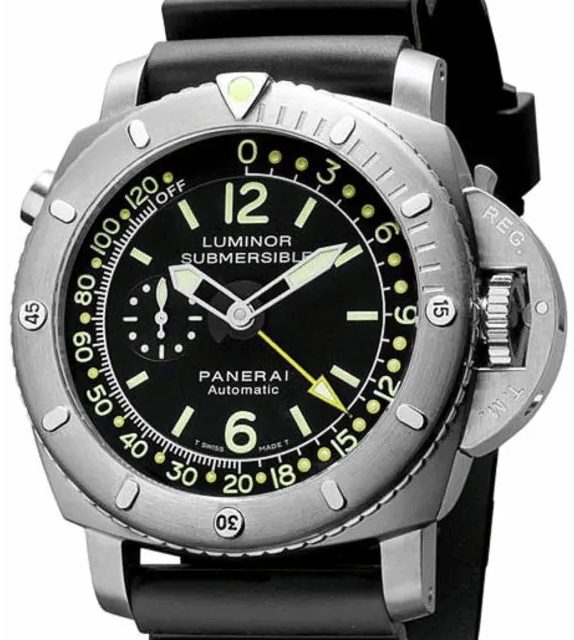
The PAM00193 represents Panerai’s first serious attempt to reassemble those two instruments in modern form. The movement handles time. The depth gauge module handles depth. Both are independently certified — COSC for the watch, METAS for the depth gauge. The integration is clean enough that the dial doesn’t read as cluttered; the gauge lives on an inner scale ring around the periphery, the yellow hand sweeps its own scale without interfering with the time display.
This is what distinguishes the PAM00193 from every other Panerai Submersible before or since: it’s not a dive watch that happens to have a complication. It’s two professional instruments that happen to share a case.
The Depth Gauge — How It Works, Why It Was Certified, and What Ownership Means
Let me give this section the space it deserves, because most coverage of the PAM00193 summarises the depth gauge in two sentences and moves on. That’s a mistake.
The Module Architecture
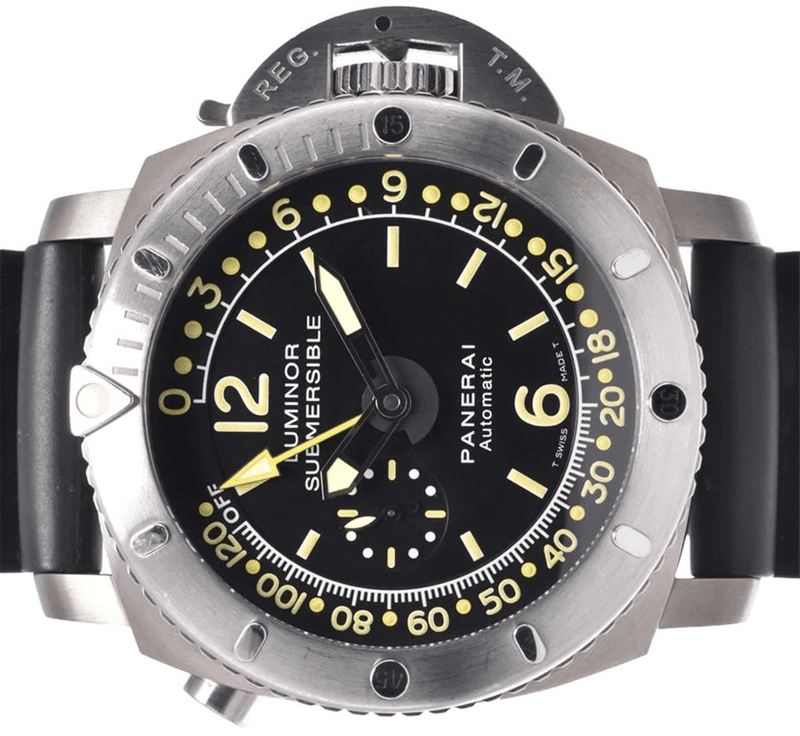
The depth gauge module is housed inside the case, mounted against the solid caseback. The back itself — machined titanium, incised with six deep grooves — doesn’t open for exhibition. Those grooves aren’t decorative. They’re functional: water pressure enters through a silicone membrane at the caseback, where a pressure transducer converts it into an electrical signal. A microprocessor interprets the signal. A micro-motor moves the hand.
The result is a depth reading updated continuously during the dive, accurate to ±20cm — a precision figure that belongs in the specification sheet of a dedicated dive computer, not a luxury watch.
The Depth Scale
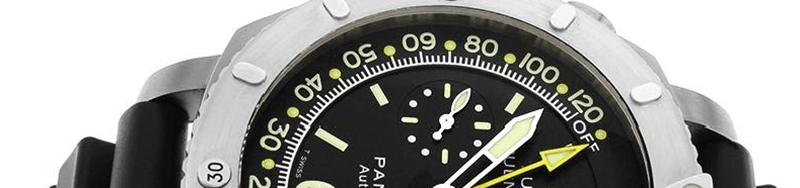
The inner dial ring carries a three-zone graduated scale. From 0 to 20 metres: individual metre markings with luminous studs. From 20 to 60 metres: individual metre lines with a numeral or stud every five metres. From 60 to 120 metres: a marking every two metres. At the end of the scale, past 120m: the word “Off” — the resting position of the yellow hand when the module is inactive.
That three-zone compression is a practical design choice. Recreational diving mostly happens in the 0–30 metre range, where you want the finest resolution. Deeper working dives need a broader span. The scale serves both.
The Yellow Hand
The depth gauge hand is an arrowhead pointer in yellow — luminous-filled, distinctly different from the white sword hands of the main dial. At depth, in dim water, you’re not squinting to find it. It’s the yellow thing. That contrast is deliberate and correct.
How to Operate It
Press the pusher at 10 o’clock before entering the water. The yellow hand moves from “Off” to show the maximum depth of the previous dive. Hold the pusher for six seconds: the hand resets to zero, and the module begins recording the current dive. It updates continuously, tracking both live depth and logging the maximum depth reached. After four hours — adequate for virtually all recreational and technical dives — the module shuts off automatically and the hand returns to “Off.”
Four hours of continuous operation per activation. 500 hours of total battery life from the lithium cell. The battery warning system is sensible: when power runs low, the hand moves slowly from Off to zero and then retreats back. If the hand locks in that sequence, the module is done and needs a Panerai service for battery replacement.
The METAS Certification
This is the part that separates the PAM00193 from other watch brands that have offered depth gauges as marketing features.
METAS — the Swiss Federal Office of Metrology, based in Berne — is the same body that certifies the accuracy of professional measuring equipment used in Swiss industry and scientific research. As Panerai’s official press documentation confirms, “the measurement accuracy of the depth gauge has been individually tested and certified by METAS” — not batch-tested, not type-approved, but per-module certification. Every single PAM00193 depth gauge received its own certificate. That’s the standard applied to professional diving equipment, not lifestyle accessories.
As noted by the dive watch community on WatchUSeek, the battery-dependent nature of the module generates some debate — purists prefer the idea of a fully mechanical backup in case electronics fail at depth. That’s a legitimate philosophical position. But the METAS accuracy standard answers a different question: when the module works, it works correctly and its accuracy is verified.
The Ownership Reality
Own this watch as a professional dive instrument, and you need a current METAS calibration certificate. Panerai’s recommendation is biennial servicing at an authorised centre. This is not optional if you intend to dive with it — the certification lapses, and with it any claim to professional-grade accuracy.
Own it as a collector piece, and the service obligation is less pressing — but the depth gauge will eventually exhaust its battery and lock out. A locked-out DG doesn’t compromise the watch’s timekeeping; the OP XV keeps running regardless. But you’ve bought a complication you can’t use, and battery replacement requires Panerai authorisation.
This is the honest trade-off with the PAM00193: it’s the most operationally credible depth gauge wristwatch ever made by Panerai. That credibility comes with a maintenance relationship that most pre-owned watches don’t require. When buying pre-owned, always ask for the calibration certificate date. Exquisite Timepieces listed a PAM00193 with a calibration certificate dated November 2022 — that’s the kind of documentation that tells you the watch has been maintained as an instrument, not stored as a display piece.
The Case — 47mm Titanium, Crown Guard, Dive Bezel
The PAM00193 case is a 47mm cushion-form titanium body — brushed throughout, with the crown-protecting bridge and lever in contrasting brushed steel rather than titanium. That material distinction is intentional. The crown guard has always been the structural centrepiece of the Luminor silhouette, and in brushed steel against a titanium case body it reads with a purposeful two-tone quality: the working part in one material, the case body in another.
At approximately 20mm case thickness, this is measurably chunkier than a standard Luminor 1950 Submersible. The depth gauge module adds bulk at the back. On the wrist, 47mm titanium at 20mm doesn’t disappear, but titanium’s low density means it carries better than those dimensions suggest — the weight distribution is comfortable in a way that a steel equivalent at the same size wouldn’t be.
The solid caseback carries six deep machined grooves. As noted above, those grooves aren’t decorative — they’re the interface through which the pressure transducer reads ambient water pressure via a silicone membrane behind them. It’s an elegant engineering solution to a real problem: how do you integrate a depth-sensitive membrane into a case that also needs to be watertight?
The unidirectional rotating bezel in brushed titanium completes the dive tool specification: graduated for immersion time calculation, one-minute detents, oval raised markers every five minutes. The 120-metre water resistance rating matches the depth gauge’s operational range precisely. Below 120 metres, both the watch and the gauge are beyond spec.
The Dial — Military Black, Tritium Markers, Inner Depth Scale
Let’s be direct about the dial construction: this is not a sandwich dial.
The PAM00193 uses a sausage-style black dial — a single-layer construction with applied tritium-filled hour markers and numerals rather than the two-layer luminous architecture of the classic Radiomir and Luminor Marina sandwich faces. Tritium, used here in sealed capsules, glows independently without requiring light charging. It also decays over time — at roughly 12 years’ half-life, original tritium capsules from a 2007 watch are dimmer now than at production but not dead. Replacement is possible during service.
The dial carries Arabic numerals at 6 and 12 o’clock only. The 3 and 9 positions are occupied by the small seconds sub-dial (at 9) and the depth gauge scale ring sector (at 3 and across the full inner periphery). Sword hands in white with luminous tips are the hour and minute indicators. The contrast with the yellow depth gauge hand is sharp and intentional — you read time and depth with different visual registers, and the dial architecture supports that.
The inner depth scale ring wraps the entire dial perimeter, populated with the three-zone graduation described above. It adds visual density compared to a clean Submersible dial, but not confusion. Each element has its own register and colour logic. As a working instrument, the layout is correct.
One honest observation: the PAM00193 dial reads darker and more austere than its successor, the PAM00307 Pangaea, which swapped the black face for deep blue and applied SuperLuminova. If you prefer the earlier, more sober military aesthetic — black dial, tritium, no colour drama — the 193 is the right version.
The OP XV — Automatic, Certified, Correctly Specified
The OP XV is Panerai’s designation for a modified Valjoux 7750-P1. The Valjoux 7750 is one of the most reliable automatic movements in the Swiss watchmaking industry — here it’s been simplified by removing the chronograph mechanism, leaving a clean time-and-seconds calibre with automatic winding. The modification is sensible: a depth gauge wristwatch doesn’t need a chronograph; the immersion time calculation is handled by the bezel.
21 jewels, 28,800 vph, 42-hour power reserve. The Côtes de Genève bridge decoration and personalised oscillating weight confirm proper finishing for the price point. COSC chronometer certification covers the timekeeping function independently of the depth gauge. Stop-seconds is included — pull the crown and the small seconds halts, allowing you to synchronise the watch to an exact second before entry.
There’s no exhibition caseback to admire the movement through. The depth gauge module occupies that space. For collectors used to peering at decorated bridges, that’s a genuine aesthetic trade-off. I’d argue the module is the more interesting thing — but the absence of a visible movement is worth acknowledging.
The PAM00537 shows what the Luminor 1950 case architecture can carry when the caseback is free — GMT, power reserve, hobnail dial. The PAM00193’s solid back is a different kind of commitment: everything on the back is in service of the depth, not the display.
PAM00193 vs PAM00307 — The First vs the Successor
The PAM00307 followed the PAM00193 by a year — launched in 2008, 500 pieces rather than 600, built around the Pangaea expedition of explorer Mike Horn. Both use the OP XV movement. Both carry METAS-certified depth gauge modules. The architecture is the same.
The differences matter for collectors:
The PAM00193 has a black dial with tritium and a screw-and-tool strap change system. The PAM00307 has a deep blue dial with SuperLuminova and a tool-free push-pin strap change. The 307 also carries a Pangaea map engraved on the caseback — a specific expedition commemorative that either adds meaning or feels like personalisation-for-someone-else, depending on your relationship with Mike Horn’s journey.
For the Paneristi collector who wants the purer, less contextualised version of this complication: the PAM00193. Black dial, tritium, earlier production, slightly larger edition. For the collector who prefers the blue dial drama and the expedition narrative: the PAM00307. Both are correctly reviewed on this site — the 307’s full treatment is on the Pangaea Depth Gauge page.
What I’d push back on is the assumption that the 307’s Mike Horn association automatically makes it more desirable. The 193 came first, carries the first production iteration of this complication, and its black-on-black operational aesthetic is arguably more coherent with what the depth gauge function is actually for.
Pre-Owned Market — The Calibration Certificate Is Everything
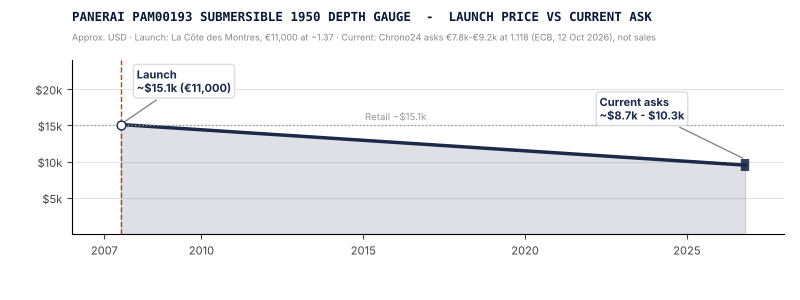
A 600-piece limited edition from 2007 means the pre-owned market is thin. You might find three to six examples active globally at any given moment. WatchCharts data shows the average private market price around $10,000 (December 2022 data); real asking prices on WatchUSeek have ranged up to $11,500 for a 92% condition example with complete set. Chrono24 listings reference the original $16,000 MSRP as an anchor, with pre-owned typically pricing well below that.
“The measurement accuracy of the depth gauge has been individually tested and certified by METAS — the Luminor 1950 Submersible Depth Gauge is officially recognised as a professional instrument.” — Panerai official press documentation, 2007
That designation — professional instrument — is what drives the ownership calculus here. A watch that is officially certified as professional equipment operates under different rules than a complication that’s decorative.
When buying pre-owned, the calibration certificate date is the single most important document. Panerai’s recommendation is biennial calibration. A watch with a certificate dated within the last two to three years — as with the Exquisite Timepieces example carrying a November 2022 calibration stamp — has been maintained as the instrument it was designed to be. A watch without traceable service history may have an exhausted or expired module.
Complete set documentation should include: the original wooden presentation box, rubber strap and cloth alternate strap, COSC certificate, METAS calibration certificate, and booklets. The numbered case position — 426/600, for example, as seen on one Betteridge listing — is on the caseback and verifiable.
One more practical point: the OP XV movement itself is well-supported and straightforward to service by any watchmaker familiar with the Valjoux 7750 family. The depth gauge module is a different matter — it requires Panerai authorisation for battery replacement and recalibration. Ownership is therefore partly a relationship with Panerai’s service network, which is worth factoring into the purchase price and ongoing cost.
Who Is It For?
- The collector who wants the most technically serious Panerai Submersible ever made — METAS certification, 600-piece production, professional instrument status: the PAM00193 makes an argument most Submersibles don’t even attempt
- A working diver who wants a timepiece that is also certified depth equipment — this is genuinely one of the only wristwatches in the history of the category to carry individual METAS depth gauge certification; the PAM00024 early civilian Submersible tells you where the Submersible line came from; the 193 tells you where it could go
- A Paneristi who already owns the core references and wants the most operationally coherent special edition in the collection
- The pre-owned buyer who appreciates complexity that holds its value — limited production, dual certification, and a complication that genuinely required METAS testing to bring to market; scarcity is earned here, not manufactured
- Someone drawn to the black-dial, tritium version of this complication rather than the PAM307’s blue-dial expedition narrative
Not for: Collectors who want an exhibition caseback, or who aren’t prepared for the service relationship a METAS-certified module requires. Also not for anyone who wants a simpler Submersible — there are cleaner options in the line. The PAM00193 earns its bulk; if you don’t want the depth gauge to matter, buy a Submersible without one.
Conclusion
The Panerai PAM00193 is the quietest and most technically serious thing Panerai has produced in the Submersible line. Six hundred pieces. A 47mm titanium case carrying an OP XV automatic and an electronically certified depth gauge that measures to 120 metres with individual METAS documentation. A yellow arrowhead hand that moves from “Off” to your last maximum depth and back. A solid caseback that hides the instrument inside it rather than displaying it.
Most Panerai Submersibles are very good dive watches. The PAM00193 is something more specific: a functional reunification of two instruments Panerai built separately for Italian naval divers over seventy years ago. One for time. One for depth. Both on a single wrist.
If you’ve dived with a PAM00193 — or kept one as a calibrated professional instrument without ever putting it in the water — I’d genuinely want to know: does the METAS certificate change the way you think about wearing it?
Extended Summary
- PAM00193 is a 600-piece Luminor 1950 Submersible in 47mm brushed titanium, introduced 2007 as Panerai’s first watch to integrate an electronically certified depth gauge — part of the “Special Instruments” collection, it carries both COSC (timekeeping) and METAS (depth gauge) certification independently
- The depth gauge module is individually METAS-certified per unit: pressure transducer, microprocessor and micro-motor in a solid-back case reading through a silicone membrane, accurate to ±20cm, three-zone scale to 120m, maximum-depth memory, 500-hour lithium battery — this is not a decorative complication; each PAM00193 received its own calibration certificate from the Swiss Federal Office of Metrology
- The dial is a sausage-style black face with tritium-filled indices, not a sandwich — Arabic numerals at 6 and 12 only, sword hands, small seconds at 9, inner depth scale ring, yellow arrowhead depth hand — the PAM307 successor switched to blue dial and SuperLuminova; the 193’s black-and-tritium aesthetic is darker and more austere
- Service dependency is non-negotiable for operational use: biennial Panerai calibration recommended, battery replacement requires authorised service centre, module locks when battery exhausted — always verify calibration certificate date before purchase; a recently serviced example with traceable documentation commands a legitimate premium
- Secondary market pricing around $9,000–$13,000 places this among the most undervalued professional-grade Panerai complications — 600 pieces, dual certification, and an operational pedigree that most dive complications at any price cannot match; condition, completeness, and calibration status are the decisive variables
At a Glance
| Reference | PAM00193 |
| Collection | Luminor Submersible / Special Instruments |
| Name | Luminor 1950 Submersible Depth Gauge |
| Introduced | 2007 |
| Edition size | 600 pieces (I-serial) |
| Case material | Brushed titanium (crown guard: brushed steel) |
| Case diameter | 47mm |
| Case thickness | ~20mm |
| Lug width | 26mm |
| Water resistance | 120 metres |
| Movement | Panerai OP XV (Valjoux 7750-P1 base) |
| Movement type | Automatic |
| Power reserve | 42 hours |
| Beat rate | 28,800 vph |
| Jewels | 21 |
| COSC certified | Yes |
| Depth gauge | Electronic, battery-operated; METAS certified; 0–120m; max-depth memory |
| Depth gauge activation | Pusher at 10 o’clock |
| Battery life | 500 operating hours (lithium) |
| Caseback | Solid (depth gauge module mounted internally) |
| Bezel | Unidirectional rotating titanium; one-minute clicks |
| Dial | Black; luminous Arabic numerals at 6 and 12; sword hands; small seconds at 9; inner depth scale ring; yellow depth gauge hand |
| Strap | Black rubber; cloth alternate strap included |
| Availability | Pre-owned only |
| Secondary market | ~$9,000–$13,000 (condition and calibration status dependent) |