Guido Panerai invented the thing his family’s entire modern reputation is named after, and it had nothing to do with a watch. In 1915, working out of the Florence shop his grandfather had opened decades earlier, he patented a radium-based luminous compound designed to help naval gunners aim in the dark. He called it Radiomir. Twenty years would pass before anyone thought to put it on a wristwatch.
That gap matters. Understanding Guido means understanding that the most famous name in Panerai’s catalogue wasn’t conceived as a watch feature at all. It was a solution to a targeting problem, invented by a man whose actual business was precision instruments, not horology.
Taking Over Two Businesses at Once
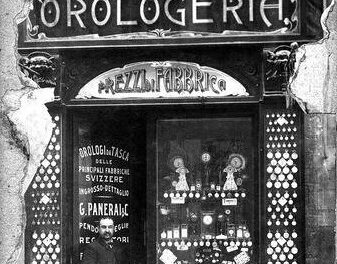
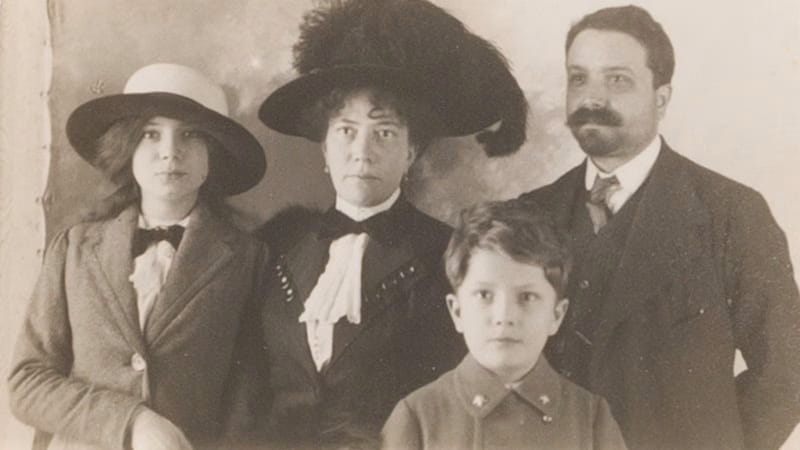
Guido Panerai was born in 1873, Giovanni’s grandson, and inherited the Florence shop at a moment when it was still primarily what his grandfather had built: a retail and repair operation with an attached watchmaking school. Guido changed its trajectory almost immediately, and he did it by combining two separate inheritances rather than one. The invention that followed would prove crucial to the company’s entire future.
He married into a family that owned a mechanical workshop, and took that business over alongside his grandfather’s watch shop. That’s the detail most brand histories skip past too quickly. Panerai’s later reputation for precision military instruments doesn’t trace back to watchmaking skill inherited from Giovanni. It comes from this merger, a watch retailer combined with an actual mechanical engineering operation, both now under one roof and one name.
Becoming the Navy’s Supplier
With that combined capability, the business Guido now ran was positioned to do something Giovanni’s original shop never could: build precision instruments to specification for a demanding institutional client. By the early 1900s, Guido had turned the company into an official supplier to the Regia Marina, the Royal Italian Navy, providing compasses, depth gauges, and firing mechanisms built to naval requirements rather than sold off a shelf.
This is the point where Panerai stops being a Florence watch shop with a good reputation and starts being something closer to what the brand is now: an instrument maker whose primary client wears a uniform.
1915: The Patent
Here’s the invention itself, and it deserves to be described precisely rather than summarised into vague brand mythology.
In August 1915, Guido filed a British patent titled “Improvements in Sighting-devices for Firearms and Torpedo Tubes.” The invention was a compound of radium-226 and zinc sulfide powder, sealed inside small, hermetically-closed vessels, luminous enough to let a gunner or torpedo operator aim accurately in complete darkness without any external light source. A French patent followed on 23 March 1916, and it’s that document’s addendum where the name first appears in writing: Radiomir, from the Italian radio (radium) and mira (sight). Radium sight. Nothing about a dial, a case, or a wrist.
The compound worked exactly as intended. Naval sighting instruments illuminated with Radiomir became genuinely useful equipment for a service that needed to operate in darkness, underwater, or both. Panerai’s own brand archive later described the stakes in blunt terms:
“The Radiomir wasn’t invented to be a watch dial treatment.” Panerai brand archive documentation
It was invented to keep sailors alive in situations where visibility was the difference between a successful operation and a fatal miscalculation. That’s what Guido actually built. The watch came decades later, borrowed from a solution that had already proven itself in a completely different application.
What Guido Didn’t Know
It’s worth being direct about this, because the historical record is direct about it too: nobody working with radium in 1915 fully understood what it was doing to the people handling it. Radium’s radioactivity was still an active area of scientific study; Marie Curie herself, whose research made compounds like this possible, would die decades later from conditions linked to her own prolonged radiation exposure. Guido patented a genuinely dangerous substance without the knowledge to recognise it as dangerous, which was the standard condition of nearly everyone working with radium compounds at the time, not a specific failure on his part.
The consequences of that gap in understanding wouldn’t become Panerai’s problem to solve until decades after Guido’s death, when the compound was eventually phased out in favour of the tritium-based Luminor.
Working With His Son
By 1920, Guido’s son Giuseppe, then just 17, was already working alongside him on technical projects, including early concept work on what would eventually become the Mare Nostrum chronograph, a design that wouldn’t reach actual production for another 23 years. It’s a small detail, but it marks the beginning of a handoff that would define the company’s next chapter: the son learning the instrument business at his father’s side, years before he’d be the one running it.
1934
Guido Panerai died in 1934. The business, by then a genuine precision-instrument supplier to the Italian Navy carrying a nineteen-year-old patented invention as its technical foundation, passed to Giuseppe. What Giuseppe did with that inheritance, commissioning the first Radiomir watch prototypes for the Navy’s classified combat-diver program just one year later, is a different story. But he was building on a compound, a name, and a Navy relationship his father had already spent nineteen years establishing.
Every Watch That Carries His Word
Pick up any modern Panerai Radiomir, and the name on the dial is a direct, unbroken line back to a British patent filed in 1915 for a torpedo sighting device. Guido never designed a watch case. He never worked with Rolex, never saw a combat diver wear his invention, never lived to see the compound applied to anything with hands and a crown. What he built was the actual technical substance, the light itself, that his son would eventually decide belonged on a wrist.
The fuller story of how that happened, how a gun-sight compound became a watch dial, and eventually a whole collection, is its own chapter. Guido’s part in it ends in 1934, with a patent number, a Navy contract, and a son who was already paying attention.
Does it change how you see the Radiomir name, knowing it started as a weapons component rather than a watchmaking innovation? Or does that origin make more sense of what the watch actually is?
Guido Panerai: Key Dates
| Born | 1873 |
| Inherits Giovanni’s watch shop | Early 1900s |
| Marries into a family mechanical workshop, merges both businesses | Early 1900s |
| Becomes official supplier to the Regia Marina | Early 1900s |
| Patents the Radiomir compound (Britain) | August 1915 |
| Radiomir patent filed (France), name first documented | 23 March 1916 |
| Works with son Giuseppe on Mare Nostrum concept | 1920 |
| Died | 1934 |
| Succeeded by | His son, Giuseppe Panerai |