Quick Takeaways
- The Panerai PAM00216 — the Luminor Sealand Jules Verne — is a 100-piece limited edition from 2005, released to mark the centenary of Jules Verne’s death, sold exclusively through five Panerai boutiques worldwide.
- Its defining feature is a hand-engraved hinged hunter cover depicting Captain Nemo using a sextant aboard the Nautilus — sourced directly from an original 1871 illustration by engraver Alphonse de Neuville for the deluxe edition of Twenty Thousand Leagues Under the Seas.
- The case is the 44mm Luminor Sealand format — the same hunter-lid architecture introduced by Panerai in 2002 for the James Purdey & Sons collaboration — though the PAM00216 sits outside the Purdey lineage as one of only two independent Sealand editions.
- The movement is the OP III — an automatic, COSC-certified calibre based on the Valjoux 7750-P1 with a 42-hour power reserve. It is not in-house — and for a watch built around a literary narrative, that is rarely the first thing collectors care about.
- Secondary market pricing ranges from $17,000–$31,500 USD depending on condition and provenance, representing a meaningful premium over the original ~$14,000 retail — driven entirely by story, scarcity, and the enduring appeal of the Verne connection.
Jump directly to the spec sheet.
Panerai PAM00216 Review — The Luminor That Hides a Legend Under Its Lid
Most Panerai watches announce themselves immediately. The crown guard is right there. The dial is wide open. The whole design philosophy is legibility — nothing hidden, nothing decorative for its own sake.
The PAM00216 works differently.
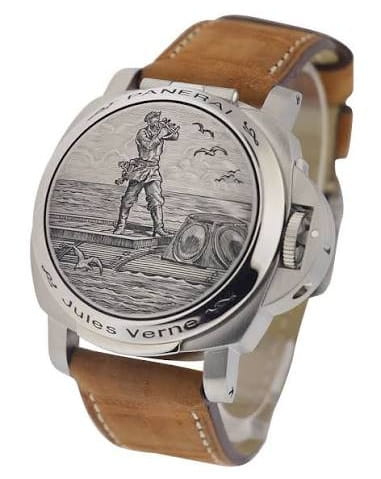
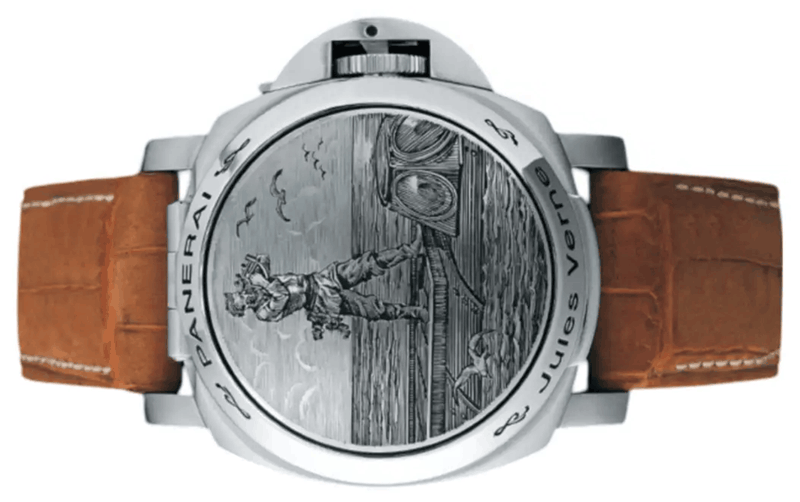
Close it and you’re holding a 44mm brushed-steel Luminor with a flat metal lid where the crystal should be. Open it and there’s a hand-engraved scene that stops you: Captain Nemo, standing at the rail of the Nautilus, taking a celestial reading with a sextant. The image is borrowed from a 154-year-old illustration by Alphonse de Neuville. It was first published in the 1871 deluxe edition of Vingt Mille Lieues sous les mers — what the English-speaking world knows as Twenty Thousand Leagues Under the Seas.
Released in 2005 to mark the 100th anniversary of Jules Verne’s death, the Luminor Sealand Jules Verne is a Panerai special edition that exists almost entirely outside the usual collector conversation about the brand. It doesn’t get compared to the PAM372. Nobody debates its movement choice on WatchUSeek forums the way they debate the Bronzo’s comps. It simply sits in its own category — part instrument, part artefact, and wholly unusual.
One hundred pieces were made. The watch deserves more attention than it gets.
The Sealand Case — A Brief History of the Hinged Lid
From Purdey Gunmakers to Jules Verne — How the Hunter Case Got Here
To understand the PAM00216, you first need to understand the Sealand case, which is not obviously a Panerai design at all. The hunter-style case — a hinged metal lid that protects the crystal and opens on a hinge to reveal the dial — is a watchmaking form with roots deep in the 19th century. Pocket watches used them for exactly the same reason: protection. A sprung lid kept the crystal safe in rough conditions. The inside of the lid often doubled as a polished mirror, which on early Sealand editions served a documented secondary purpose as a signalling mirror for use in the field.
Panerai adopted the format in 2002 for a collaboration with James Purdey & Sons, the London gunmakers founded in 1814. Purdey and Panerai are both part of the Richemont group, and the partnership made conceptual sense: both brands share what Purdey’s own documentation describes as the use of “barrels, calibres, levers and engravings.” As detailed in Purdey’s account of the collaboration, the first Purdey Sealand in 2002 — a lion-head engraving — sold its run of 100 pieces and spawned a series that ran through British birds (2003), flowers and acanthus leaves, and ultimately the Big Five African game animals in 2016.
The PAM00216 sits outside this Purdey lineage entirely. La Côte des Montres noted in its 2005 coverage that the Jules Verne edition was one of only two Sealand models that are not part of the Purdey series, alongside the PAM00076 Black Seal. Same case architecture. Different creative origin. Where the Purdey editions were decorated by Purdey’s own gun-engravers, the Jules Verne engraving draws from an independent literary source — and that distinction matters for what the PAM00216 actually is.
The story of Panerai’s special editions through the mid-2000s is largely a story of the brand learning to use its own history as creative material. The Jules Verne watch sits in that tradition but pushes it somewhere unexpected: outside Panerai’s own naval heritage and into French literary fiction, specifically fiction that was itself inspired by real submarine development. The connection is thematic rather than institutional, and it’s all the more interesting for it.
The Hunter Cover — What Is Actually Engraved There?
Captain Nemo, a Sextant, and a Scene Drawn in 1871
Let me be specific about the engraving, because most descriptions of this watch are frustratingly vague.
The scene on the PAM00216’s hunter cover is derived from an original illustration by Alphonse de Neuville, one of two primary illustrators who worked on the canonical 1871 deluxe edition of Twenty Thousand Leagues Under the Seas published by Pierre-Jules Hetzel. De Neuville contributed 57 illustrations to that edition; his work established the visual vocabulary of Verne’s Nautilus that has persisted in popular imagination ever since. The specific image used on the PAM00216 shows Captain Nemo on deck, sextant in hand, conducting a celestial navigation reading — a deliberate choice by Panerai, because it links the image to the watch’s core identity as a precision navigation instrument.
“The ‘Jules Verne Sealand’ joins the very exclusive clan of special Sealand series… the ultimate version of its famous Sealand.” — La Côte des Montres, 2005, on the PAM00216 at its launch
There’s a layer here worth dwelling on. Jules Verne died in March 1905. The book in which Captain Nemo sailed the world’s oceans was serialised from 1869 to 1870, three decades before Panerai began making watches for the Italian Royal Navy in any meaningful way. The fictional Nautilus — electrically powered, capable of extraordinary depth, operated by a man who rejected the surface world entirely — appeared in print before practical submarines existed in any serious form. Verne was imagining the technology, not documenting it.
And yet the DNA of the PAM00216 is entirely of the sea. The Luminor case is descended from dive watches built for Italian Navy frogmen in the 1940s. The Sealand case format, with its protective lid, exists because someone thought about instruments that survive rough environments. The hunter cover is polished on the inside — functional, not just decorative. You can read the parallel between the Nautilus and Panerai’s own naval instruments history as a coincidence or as a resonant collision. Either way, Panerai made the connection explicit in 2005 by choosing de Neuville’s illustration rather than commissioning original artwork.
I’d argue that choice is the most interesting thing about the PAM00216. It’s not simply branded with Jules Verne — it’s borrowing from a specific visual tradition, a specific engraver, a specific edition of a specific book. That level of intentionality is rare in watch design and it lifts the PAM00216 above the category of merely pretty special edition.
The engraving process itself matches the Purdey approach in craft even if not in origin: first outlined in chalk or magnesium powder, then traced with a burin steel cutting tool, depth and shading built through fine parallel lines. The result on the PAM00216 carries the characteristic quality of 19th-century illustration translated into metal — precise, tonal, with a density of detail that you have to hold under proper light to fully read.
One collector on WatchUSeek who’d handled an example noted that the polished interior of the hunter lid catches light at an angle that makes the scene read almost like a photographic negative when first opened — the engraving visible in relief before your eyes adjust. It’s a genuinely surprising object to encounter for the first time. That surprise does not diminish on repeated handling.
The Dial and Case — Behind the Lid
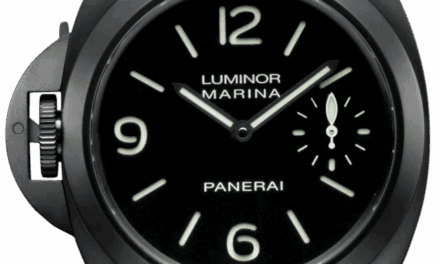
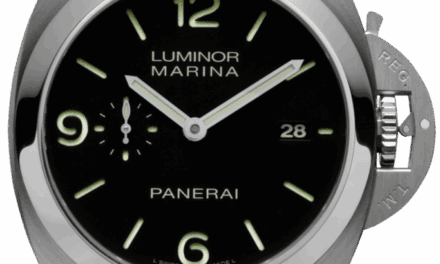
Open the PAM00216 and the dial that greets you is, deliberately, unspectacular. Black with luminous Arabic numerals and baton hour markers. Date at 3 o’clock. Small seconds at 9. The same dial architecture that appears on Panerai’s Submersible references — a connection that is thematic rather than accidental, given the watch’s underwater literary subject matter.
The PAM00024 Luminor Submersible gives you a sense of the dial register: maximum legibility, no unnecessary elements, large numerals that read in low light without ambiguity. On the PAM00216 the SuperLuminova charges green and the numerals glow with the characteristic depth of the sandwich construction — lower layer luminous, upper layer perforated. The contrast between this functional plainness and the engraved theatrics of the hunter cover is deliberate. Close the lid: art object. Open it: instrument. Panerai kept the dial honest so the engraving could do all the talking.
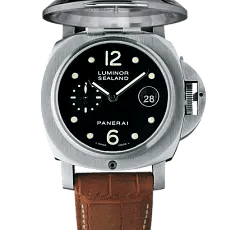
The 44mm case is brushed steel throughout, the crown guard in the familiar Luminor lever configuration. Water resistance to 50 metres — limited by the hinged lid’s seal relative to Panerai’s deeper-diving references. This is not a watch you’d take diving. The hunter lid tells you that before the specification sheet does.
The gold-toned alligator strap that ships with the PAM00216 is the single detail that most clearly signals this isn’t a tactical tool watch. It’s a deliberate shift in register — warm, dressy, calibrated to the literary and collectible identity of the piece rather than to the marine instrument tradition. On the wrist, the effect is somewhere between a pocket watch companion piece and a very serious conversation starter.
The OP III Movement — What You Need to Know
ETA Roots and COSC Honesty
I’m not going to pretend the movement is the reason to own the PAM00216. It isn’t.
The OP III is Panerai’s designation for a movement derived from the Valjoux 7750-P1 — an ETA base with the chronograph complications stripped out, the bridges and oscillating weight finished with Côtes de Genève decoration and personalised Panerai engraving. As WatchUSeek’s technical threads on the OP III confirm, the movement is sent to SOPROD for modification and finishing before Panerai installs it. The result is automatic, runs at 28,800 vph, carries a 42-hour power reserve, and holds COSC chronometer certification — which means it was independently tested to the standard of -4/+6 seconds per day.
The 2005 timeframe matters here. The P.2002 — Panerai’s first fully in-house calibre — launched the same year as the PAM00216. The transition from ébauche-based movements to manufacture calibres was underway but far from complete. The OP III was the workhorse of Panerai’s automatic line through the mid-2000s, appearing across everything from the Luminor Marina to the Submersible references. It’s not a weak movement — it’s a practical, proven, COSC-certified automatic that has shown decades of reliability in the secondary market. What it isn’t is architecturally interesting.
For a watch where the interest is entirely in the case and engraving, the OP III serves its role: it keeps time accurately, it’s easy to service worldwide, and it doesn’t demand your attention. You wind the PAM00216 for its story. The movement simply makes that story tick.
Where the movement choice does invite honest reflection is at the watch’s price point — both at retail and on the secondary market. A ~$14,000 watch in 2005 carrying a modified ETA rather than an in-house calibre is a tradeoff the buyer makes consciously. Most who sought out the PAM00216 at launch weren’t comparing it to in-house alternatives; they were buying access to 100 numbered pieces of a specific literary moment. The secondary market premium — pieces trading well above the original retail — confirms the movement’s non-in-house basis hasn’t damaged collector appetite.
One Hundred Pieces and Five Boutiques — Rarity in Context
Secondary Market and What It Says About Collector Appetite
The production ceiling of 100 pieces is meaningful, not promotional. Panerai distributed the PAM00216 exclusively through five boutiques at launch: Shanghai (Plaza 66), Hong Kong (Prince Building), Florence (Palazzo Arcivescovile), Portofino, and Beverly Hills — a short list that tells you something about where Panerai saw the primary market for a literary-themed, engraved special edition in 2005.
Finding one now takes patience. On Chrono24’s current listings, examples range from approximately $17,000 to $31,500 USD, with the spread reflecting condition, completeness of provenance, and — critically — box and papers. For a watch whose entire value proposition rests on narrative and documentation, a full set with original limited-edition certificate is not optional. A PAM00216 without papers loses a disproportionate share of its identity alongside its documentation. The numbered certificate tying a specific piece to its production sequence is part of what you’re buying.
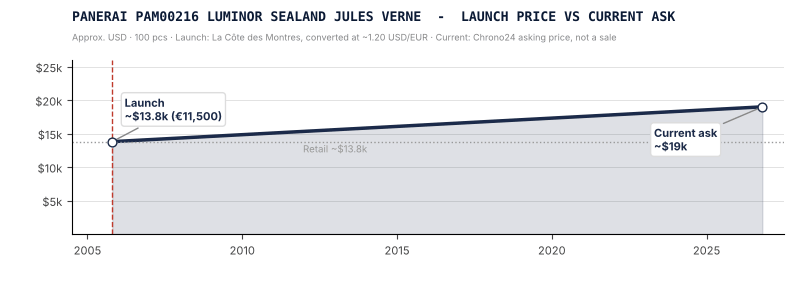
The premium above original retail is real and has held. The watch has not become liquid — 100 pieces is thin enough that you won’t find five of them available simultaneously — but when examples surface in good condition, they sell. The collector base that wants a PAM00216 is specific, but it exists: Panerai collectors with a taste for the brand’s more obscure special editions; literary-minded watch enthusiasts who appreciate the de Neuville connection; and collectors attracted to the Sealand case family for its intrinsic rarity.
Placing the PAM00216 alongside Panerai’s standard Radiomir references like the PAM00424 makes the point clearly. The California dial PAMs are celebrated for their visual personality and open availability to the collector community. The Jules Verne exists at the other extreme — not for the collector browsing forums for their next accessible Panerai, but for someone who has specifically decided they want this one.
Who Is It For?
- The Panerai collector who thinks in terms of artefacts, not just watches. The PAM00216 has a specific story, a sourced illustration, a documented literary context, and a numbered place in a 100-piece run. Those things don’t wear out.
- Anyone drawn to the Sealand case format — the hinged hunter lid is a genuinely unusual object in modern watchmaking, and the Jules Verne edition is the only version that draws from literary rather than sporting iconography.
- A collector with dual passion — watch enthusiasm and a genuine interest in the history of science fiction, submarines, or Jules Verne specifically. The de Neuville engraving is not merely decorative; it has a documented visual provenance that rewards knowing.
- A Paneristi building a collection around Panerai’s most specific special editions — the PAM00216 has no equivalent. There is no “Jules Verne II.” Once the 100 pieces are gone, they’re gone.
Not for: Collectors whose primary interest is in Panerai’s in-house movement architecture — the OP III is reliable but not architecturally interesting. Not for buyers who want a Panerai they’ll wear hard and daily — the hunter lid and 50-metre water resistance make the PAM00216 better suited to rotation than regular use. And not for anyone who needs the watch to announce itself when closed — wearing a PAM00216 without opening it is wearing a flat-lidded steel Luminor. The whole experience is in the reveal.
Conclusion
The Panerai PAM00216 is the kind of special edition that doesn’t make sense to evaluate purely as a watch. It exists because a French author died in 1905, because his most famous novel imagined submarines thirty years before practical ones existed, and because an engraver named Alphonse de Neuville drew Captain Nemo with a sextant in 1871 in a way that resonated strongly enough to be borrowed a century and a third later.
One hundred people own a numbered, documented piece of that connection. The OP III ticks reliably inside. The dial is sensibly plain. And when you open the lid at the right angle under good light, the engraving reads like a ghost image from another century — which, technically, it is.
For the right collector — someone who came to Panerai because of the sea, who knows the Sealand family history, who can tell you why 1905 mattered — the PAM00216 isn’t a special edition. It’s the obvious next piece.
Does a watch’s story change how you relate to wearing it? Leave your thoughts below.
Extended Summary
- PAM00216 is the Luminor Sealand Jules Verne — a 100-piece Panerai special edition from 2005, marking the centenary of Jules Verne’s death, distributed through just five boutiques worldwide and never repeated.
- The hand-engraved hinged hunter cover depicts Captain Nemo with a sextant aboard the Nautilus, drawn directly from an original 1871 illustration by Alphonse de Neuville — giving the watch a specific, documented visual provenance that separates it from generically themed editions.
- The Sealand case format — a 44mm Luminor with a sprung, hinged lid protecting the crystal — was introduced by Panerai in 2002 for the James Purdey & Sons gunmaker collaboration; the PAM00216 is one of only two Sealand editions that exist outside the Purdey lineage.
- The OP III calibre is a COSC-certified automatic based on the Valjoux 7750-P1 with a 42-hour power reserve — not in-house, but reliable, serviceable, and appropriate for a watch whose primary value is narrative rather than mechanical.
- Secondary market values of $17,000–$31,500 USD confirm sustained collector appetite above the original ~$14,000 retail; full provenance — box, papers, and numbered limited-edition certificate — is essential for a watch whose identity is inseparable from its documentation.
At a Glance
| Spec | Detail |
|---|---|
| Reference | PAM00216 |
| Collection | Special Editions |
| Introduced | 2005 |
| Case material | Brushed stainless steel |
| Case diameter | 44mm |
| Water resistance | 50 metres |
| Movement | Panerai OP III (base Valjoux 7750-P1, COSC certified) |
| Power reserve | 42 hours |
| Beat rate | 28,800 vph |
| Jewels | 21 |
| Complications | Date, small seconds |
| Hunter cover | Hand-engraved — Captain Nemo with sextant, Nautilus scene |
| Dial | Black with luminous Arabic numerals; date @ 3; seconds @ 9 |
| Availability | Discontinued; limited to 100 pieces |
| Original retail price | ~$14,000 USD |