Quick Takeaways
- The Panerai PAM00312, the Luminor 1950 3 Days Automatic Acciaio, is the 2009 reference that debuted the P.9000 manufacture automatic calibre inside the Luminor 1950 Marina format, marking the first time the 1950 case received both a genuine in-house movement and an exhibition sapphire caseback simultaneously.
- The P.9000 is Panerai’s foundational automatic calibre: two spring barrels, 28 jewels, 28,800 vph, 72-hour (3-day) power reserve, and a Magic Lever bi-directional winding mechanism, the engine that became the standard against which every subsequent Luminor automatic was measured.
- The 44mm Luminor 1950 case in brushed steel carries all of the format’s defining characteristics, the crown-protecting bridge, cushion-shaped case with polished bezel, 300m water resistance, at a size that remains broadly wearable without compromising the watch’s visual authority.
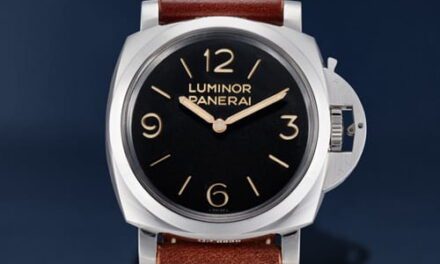
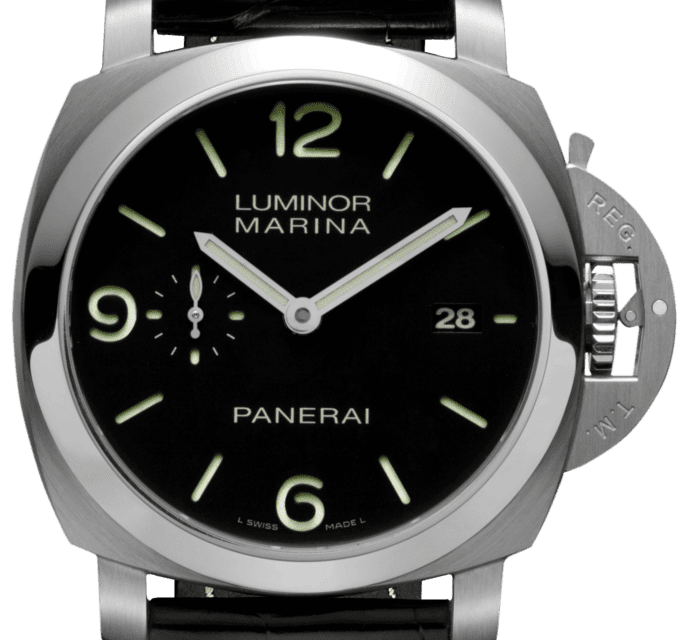
- The black sandwich dial delivers Panerai’s canonical legibility: luminous Arabic numerals at 6, 9, and 12, baton indices, date at 3, small seconds at 9. Clean, uncluttered, impossible to misread.
- The secondary market is among the most active in the entire Panerai catalogue, ranked top 1% of all Panerai watches by sales volume, selling in a median of 21.5 days, with pricing that consistently outperforms the broader Panerai brand index.
Jump directly to the spec sheet.
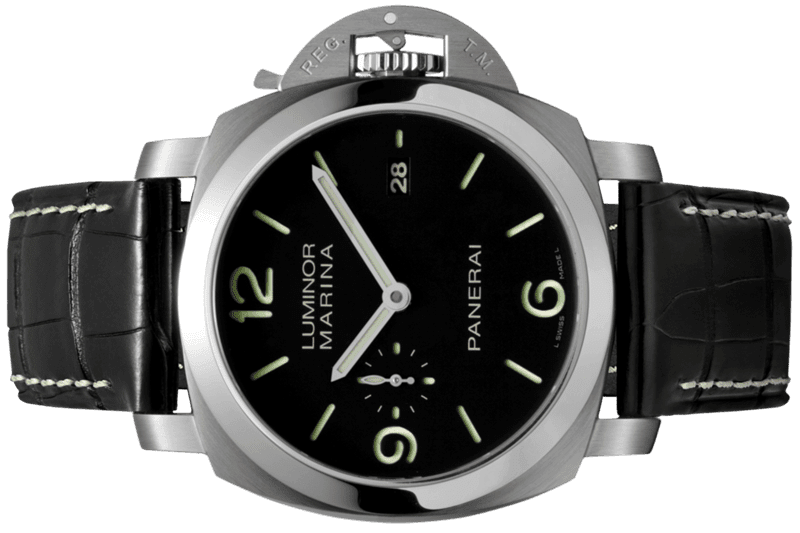
The PAM00312 does not shout its significance. It looks exactly like what it is: a 44mm Luminor 1950 Marina in brushed stainless steel, black sandwich dial, crown guard, date at 3, small seconds at 9. Clean, purposeful, unmistakably Panerai.
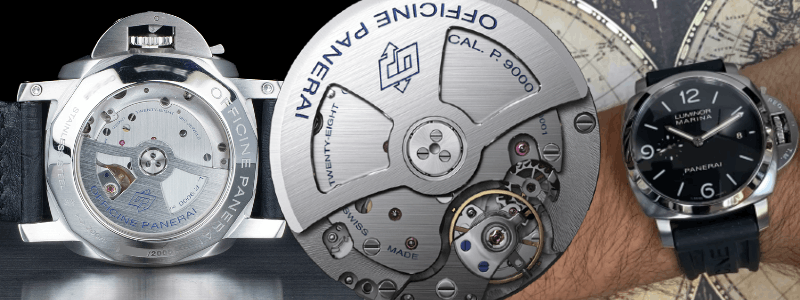
What it changed is less visible from the front. Turn it over and the exhibition sapphire caseback, the first ever fitted to the Luminor 1950 Marina, opens onto the P.9000 calibre: Panerai’s foundational manufacture automatic, debuting here in 2009, two barrels visible in the layout of a movement that would go on to power more Paneristi daily wearers than any other calibre in the brand’s modern history.
Before the PAM00312, the Luminor 1950 Marina ran on sourced automatics. After it, every serious Luminor 1950 collector knew what the format was capable of. Swisswatches Magazine’s Luminor Marina lineage review documents it plainly: the PAM00312 represented “the switch to the in-house P.9000 automatic calibre with a three-day power reserve” and “an open sapphire crystal caseback installed for the first time”, two changes that together defined what the modern 1950 standard would be.
Four thousand pieces. Eight years in production. A secondary market that still ranks in the top 1% of all Panerai watches by sales velocity. The PAM00312 earned its place the honest way: by being exactly right.
The Moment the Luminor 1950 Got a Manufacture Engine
What Came Before and Why It Mattered
Panerai’s route to the P.9000 inside the Luminor 1950 is worth understanding, because it explains why the PAM00312 landed so well with collectors.
The Luminor 1950 case was reintroduced for the civilian market in 2006 in a 47mm format. The 44mm that followed was intended as the more accessible expression of that heritage. But through the early years, the 44mm Luminor 1950 Marina ran on sourced movements, first the ETA/Unitas-based OP calibres, then the Valjoux 7750-derived OP III for automatics. These were honest movements. They were not Panerai’s own architecture, and as the brand built its Neuchâtel manufacture through the mid-2000s, the gap between what the case promised and what the movement delivered was an active collector conversation.
The P.2002 hand-wound calibre arrived in 2005, establishing Panerai as a genuine manufacture. The P.2003 automatic followed in 2007. What remained was bringing that credibility into the standard-production Luminor, the watch most collectors were actually buying. The PAM00312 resolved that in 2009. First Luminor 1950 Marina with the P.9000. First exhibition caseback on the format. A single reference that closed the gap between what the case looked like and what lived inside it.
The Lepage documentation captures this precisely: this PAM “marked a real turning point in the history of the House by inaugurating the Luminor 1950 case and the manufacture movement” in the same reference.
P.9000 Arrives: The Exhibition Caseback Opens for the First Time
The decision to open the caseback was not merely commercial. On a 300-metre watch running an in-house calibre, an exhibition sapphire caseback requires engineering confidence, seal integrity under hydrostatic pressure is a more demanding specification than a solid caseback. Panerai achieved 300 metres with the exhibition back on the PAM00312, a benchmark the format has held across every successor.
The view through that caseback was the point. Paneristi had been told for years that Panerai was becoming a genuine manufacture. The P.9000 visible through the PAM00312’s caseback was proof, not in a press release, but on the back of a watch you could put on a table and look at. For a collector community that prizes direct evidence over brand narrative, that transparency matters in a way that no amount of marketing can replicate.
Inside the P.9000 Panerai’s Workhorse Explained
Two Barrels, Magic Lever, 72 Hours
The P.9000 is not an exotic calibre. The SJX Watches teardown describes it precisely: “Panerai’s workhorse movement, self-winding with twin barrels and a three-day power reserve [that] serves as the base for several other complications.”
The twin-barrel architecture is the foundational design choice. Two barrels in series means two mainsprings at lower individual tension, with a flatter torque curve across the full 72-hour cycle. The P.9000 beats at 28,800 vph throughout that three-day run, a frequency the twin-barrel architecture sustains without the degradation observable in lower-spec movements approaching empty.
The winding mechanism is the Magic Lever, a Seiko-invented bi-directional system used by ValFleurier across Panerai, Montblanc, Cartier, and IWC. A V-shaped lever captures rotor energy in both directions with minimal mechanical complexity. WatchBase’s P.9000 documentation confirms: “a single piece rotor which winds by moving in both directions thanks to an automatic ratchet device.”
The quick-set hour mechanism is the daily-use feature that separates functional from excellent. Pull the crown to the intermediate position, step through hours, push back, minutes and seconds keep running undisturbed. Time zone adjustment becomes frictionless. In a watch you intend to wear every day, this matters.
One honest observation from users: the rotor is audible in quiet environments. You can hear it when the room is still. Most owners come to associate this with the specific mechanical character of the PAM312, confirmation the movement is working. It is not a defect. It is the sound of a well-engineered automatic doing what it was built to do.
28 jewels, 197 components, 13¾ lignes, correctly sized for a 44mm wristwatch case, filling the caseback view without the pocket-watch bulk of calibres designed for a different format.
The Architecture Through the Caseback
Through the exhibition caseback the two barrel drums are identifiable. The oscillating weight swings. The balance wheel oscillates at 4Hz. The bridges carry workmanlike but honest finishing, appropriate for a calibre built to run accurately in daily use across decades, not to serve as decoration.
This caseback answers a question rather than creates a spectacle. Is there a real manufacture movement inside? Yes, and there it is. The SJX Watches P.9000 teardown remains the most thorough technical treatment available, worth reading before buying.
The Luminor 1950 Case at 44mm – What This Format Does
Brushed Steel, Polished Bezel, Crown Guard
The Luminor 1950 case at 44mm is Panerai’s worked solution to making the 1950s design language wrist-viable. The original references ran at 47mm, correct for their era, challenging for many contemporary wrists. The 44mm preserves the cushion-shaped case, the polished-bezel-on-brushed-case contrast, the integrated lug construction, and the crown guard in proportions that make daily wear realistic without surrendering the visual authority that makes a Panerai recognisable from across a room.
At 17mm thick and 53mm lug-to-lug, the PAM00312 is not slim. The case depth accommodates the P.9000’s rotor and the exhibition caseback while maintaining 300 metres, that engineering reality occupies vertical space. On the wrist, the result reads as presence rather than bulk: a watch you are aware of, without the aggressive lug overhang that makes a 47mm Luminor impractical on moderate-sized wrists.
The mixed finish, brushed case body, polished fixed bezel, is the Luminor 1950’s signature grammar. Brushed surfaces handle working wear without marking every contact scratch. The polished bezel catches light with precision. Together they create a watch that looks deliberately constructed, which is the right aesthetic for something worn every day for years.
The crown guard functions exactly as designed. Pressed lever closes firmly, seats the crown against the case, maintains the seal. Seventy-plus years of refinement in that mechanism. It does not require explanation, it simply works.
The Dial is the Sandwich Construction, Numerals, Small Seconds
The PAM00312’s dial is the black sandwich that defines modern Panerai legibility. The upper disc is perforated for Arabic numerals at 6, 9, and 12, and for baton indices at remaining positions. The luminous material in the lower disc glows through these cut-outs with the characteristic depth that makes Panerai dials readable where flat-printed dials fail. The hands carry luminous infill. In genuine darkness the PAM312 reads time without ambiguity.
Date at 3, framed cleanly without a cyclops. Small seconds at 9 in the characteristic round Panerai sub-register. Three complications, none competing with the others. The dial communicates time, date, and seconds, nothing else.
Production examples across the eight-year run vary slightly by series, L-series (2009) through later series, with minor typography nuance that dedicated series collectors track. All share the same fundamental dial character that made this reference the daily-driver benchmark it became.
4,000 Pieces, Eight Years of Production, and the Secondary Market
Four thousand pieces is a different kind of ceiling than the 50 or 150-piece editions reviewed elsewhere on this site. The PAM00312 was not a boutique collector edition. It was a production statement, Panerai bringing manufacture quality to a format that would be worn, serviced, traded, and appreciated across a decade.
That philosophy is reflected perfectly in what the secondary market does with it. WatchCharts’ PAM312 data is unusually emphatic for a discontinued reference: top 1% of all Panerai watches by sales volume, 24 recorded sales in January 2026 alone, selling at a median of 21.5 days faster than 85% of tracked watches. The price trend shows a 2% decline over one year against 4.2% for the broader Panerai brand, consistently outperforming the index on both one-year and five-year horizons. Price volatility sits below 85% of qualifying watches, meaning acquisition and exit pricing is stable and predictable.
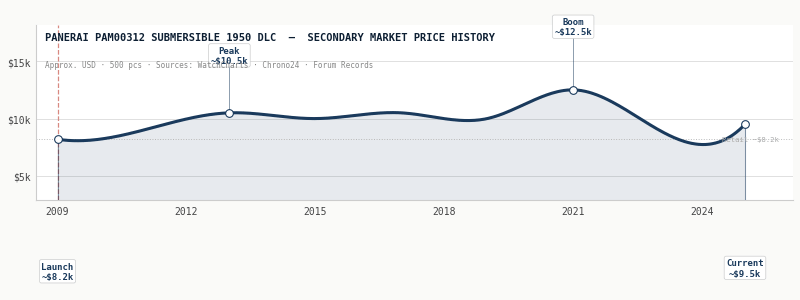
On Chrono24’s current PAM312 listings, 47 active examples span approximately $4,800 to $7,500 USD depending on series, condition, and documentation. Accessible territory for a manufacture automatic in a canonical Panerai case.
The WatchUSeek community thread on choosing a first Panerai captures the PAM00312 acquisition experience in the most Paneristi-authentic way possible:
“…a very reliable and desirable Panerai watch.” WatchUSeek forum, Officine Panerai discussion thread on the PAM00312
That is what the PAM00312 does. It goes on the list. It stays there. Then one day it doesn’t, because you bought it.
The PAM01312 replaced it from 2017, introducing the P.9010 calibre with hacking seconds, a slimmer profile, and beige SuperLuminova. Both watches look nearly identical from the front. Collectors who understand the lineage know which came first and what it established. Both are excellent references. Only one changed the standard.
Who Is the PAM00312 For?
- The collector approaching Panerai seriously for the first time, the PAM00312 answers the question “which Luminor gives everything the case and brand promise without compromise?” Manufacture automatic, exhibition caseback, 300m, canonical dial. Nothing missing.
- A daily-wear Paneristi who wants a manufacture movement without a precious-metal price tag, the P.9000 in brushed steel at the PAM312’s secondary market pricing is one of the strongest value propositions in the modern Panerai catalogue. Full manufacture credentials, full tool-watch functionality, genuine daily wearability.
- A collector building the P.9000-era reference into a historical arc, anyone who owns the PAM00233 (P.2002 debut) or the PAM00273 (P.2003 debut) and wants to understand the complete manufacture movement story needs the PAM00312 as the chapter where the automatic became the daily standard.
- A buyer who values secondary market liquidity, 21.5 days median sale time, consistent index outperformance, low volatility. If you need to exit a PAM00312, the reference cooperates in ways more exotic references rarely do.
Not for: Collectors for whom 17mm case thickness is a firm wrist limit, the PAM00312 has genuine presence and requires a personal trial on more moderate wrist sizes. Not for those committed to the 47mm Luminor 1950 format, the 44mm is a different wearing experience, and if the larger format is the target, this is the wrong reference. Not for buyers seeking a scarcity-driven collector play, 4,000 pieces over eight years means historical standing rather than rarity premium. And not for collectors who specifically require hacking seconds and the updated lume of the PAM01312., the P.9000 does not stop the seconds hand; if that precision matters to your daily routine, the P.9010 generation is the answer.
Conclusion
There are references in the Panerai catalogue that exist to commemorate, to demonstrate, to push the outer limits of what the brand can achieve. The PAM00312 is not one of them.
It exists to be the best version of what a Luminor 1950 Marina should be. Manufacture automatic. Exhibition caseback. Brushed steel. Three days. Three hundred metres. Nothing that was not asked for, nothing that was not appropriate.
In 2009 that was a new proposition for the 1950 format. In the years since, it became the baseline. Four thousand collectors got the watch before it was discontinued. The secondary market continues to prove, transaction by transaction at 21.5 days median, that the proposition was right.
PAM312 or PAM01312 for a daily-driver Luminor 1950, does the original P.9000 or the revised P.9010 make the stronger argument? Tell us where you land below.
Extended Summary
- PAM00312 is the Luminor 1950 3 Days Automatic Acciaio. 4,000 pieces produced from 2009, the reference that debuted both the P.9000 manufacture automatic calibre and the exhibition sapphire caseback in the Luminor 1950 Marina format simultaneously, closing the gap between the case’s design promise and its movement reality.
- The P.9000 calibre is Panerai’s foundational daily-driver automatic: two spring barrels delivering 72 hours at 28,800 vph, Magic Lever bi-directional winding, 28 jewels, 197 components, quick-set hour, the movement that became the base architecture for more than twenty subsequent Panerai references.
- The 44mm Luminor 1950 case in brushed steel with polished bezel delivers 300m water resistance at 17mm thickness and 53mm lug-to-lug, the working specification the format was designed to carry, with an exhibition caseback that proved manufacture credibility through direct visual evidence rather than brand narrative.
- The secondary market position is exceptional: top 1% of Panerai watches by sales volume, median sale time of 21.5 days, consistent outperformance of the Panerai brand average, price volatility below 85% of qualifying watches, making this one of the most liquid and predictable discontinued references in the Panerai catalogue.
- The PAM00312 was succeeded by the PAM01312 in 2017 (P.9010, hacking seconds, beige lume); its place in Panerai’s historical canon is as the reference that established the modern Luminor 1950 standard, what the format should do, how it should run, and what it should cost a serious Panerai collector to own.
At a Glance
| Spec | Detail |
|---|---|
| Reference | PAM00312 |
| Collection | Luminor 1950 |
| Released | 2009 |
| Limited to | 4,000 pieces |
| Case material | Brushed stainless steel, 44mm |
| Case thickness | 17mm |
| Lug-to-lug | 53mm |
| Lug width | 24mm |
| Water resistance | 300 metres |
| Crystal | Domed sapphire with anti-reflective coating |
| Caseback | Exhibition sapphire |
| Movement | Panerai P.9000 (in-house automatic) |
| Power reserve | 72 hours (3 days) dual barrel |
| Beat rate | 28,800 vph |
| Jewels | 28 |
| Components | 197 |
| Complications | Date at 3, small seconds at 9 |
| Dial | Black sandwich; Arabic at 6, 9, 12; baton indices |
| Straps | Black rubber + black leather; both included |
| Buckle | Stainless steel tang |
| Availability | Discontinued; 4,000 pieces total production |