Quick Takeaways
- The Panerai Perpetual Calendar arrived in 2021 with two 44mm Luminors: the Goldtech PAM00742 (blue dial, 270 pieces) and the Platinumtech PAM00715 (green dial, 100 pieces).
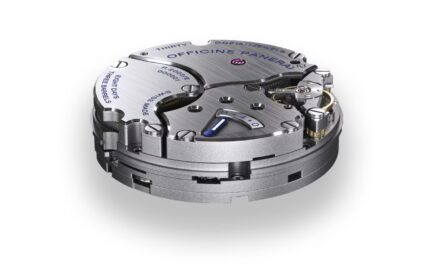
- Both run the P.4100, an automatic with an off-centre micro-rotor, 55 jewels, 28,800 vph and 72 hours of reserve. It is the first perpetual calendar movement Panerai has built itself.
- On the front you get day, date, GMT and small seconds. Month, year, leap year and power reserve sit on the sapphire caseback.
- In 2022 the Goldtech PAM01269 put the calendar discs behind a smoky sapphire dial, limited to 33 pieces at around €80,000. Same movement, a very different face.
- Launch prices were €46,000 and €66,000 for the 2021 pair. Serious money, even by precious-metal Luminor standards.
Jump directly to the spec sheet.
Introduction: Panerai Meets the Perpetual
A perpetual calendar is the complication watch people respect most and read least. It knows the length of every month and the leap year, and it still tends to bury that knowledge under a crowded dial. The Panerai Perpetual Calendar takes a different route, and then, a year later, a second one.
In 2021 Panerai put its first in-house perpetual calendar movement into two 44mm Luminors, the PAM00742 in Goldtech and the PAM00715 in Platinumtech. The front looked like a normal Luminor with an extra window. In 2022 the PAM01269 turned the dial into tinted sapphire and let you look at the mechanism.
I find the contrast more interesting than either watch alone, because it shows a brand still working out how a Panerai should wear a complication. This guide covers all three references, the dial and caseback layout, the P.4100, the prices and who should care. First question: why would a brand built on tool watches build one of these at all?

What Is the Panerai Perpetual Calendar?
A perpetual calendar adjusts itself for months of different lengths and for leap years, so you set it once and leave it, in principle, until the year 2100. Most of what makes one hard to read is the number of indicators it has to show: day, date, month, year and leap year, usually with a moon phase on top.
Panerai’s answer is a family of three Luminors, all 44mm, all rated to 50 metres, all powered by the P.4100. Before them, the brand’s only perpetual calendars were the Ferrari-branded FER00015 and FER00016 of the 2005 to 2010 period. The P.4100 is the first perpetual calendar movement Panerai has built itself.
It is also a family that has kept growing. Since 2021 Panerai has added a red-dial PAM01688 in Goldtech and a Radiomir Perpetual Calendar GMT, the PAM01453. Neither is the subject of this guide, but they show the movement has found a place in the catalogue.
The 2021 Pair: PAM00742 and PAM00715
The two 2021 references share everything except metal and colour.
The PAM00742 is the Goldtech version, a case in Panerai’s gold alloy with a blue sunburst dial and a deep blue alligator strap with ecru stitching. It weighs about 149 grams. Panerai made 270 pieces and priced it at €46,000, or about $47,200 in the US.
The PAM00715 is the Platinumtech version, which Panerai lists as a boutique exclusive, with a green sun-brushed dial and a dark brown alligator strap. It is heavier at 174 grams and rarer at 100 pieces, and it launched at €66,000, about $67,800.
Both have a polished bezel on a brushed middle case, a sapphire front and back, and the crown-protecting bridge that makes a Luminor a Luminor. The cushion case is the same one you know from the rest of the family, which is the whole point. This is a perpetual calendar dressed as an ordinary Panerai.
“The green sunray-brushed dial is brilliant.” A reader comment on Monochrome’s PAM00715 review
I’d go along with that. The green is the better of the two colours, an olive with a fine radial brushing.
How Does the Panerai Perpetual Calendar Dial and Caseback Work?
This is the section that carries the review, so it runs long.
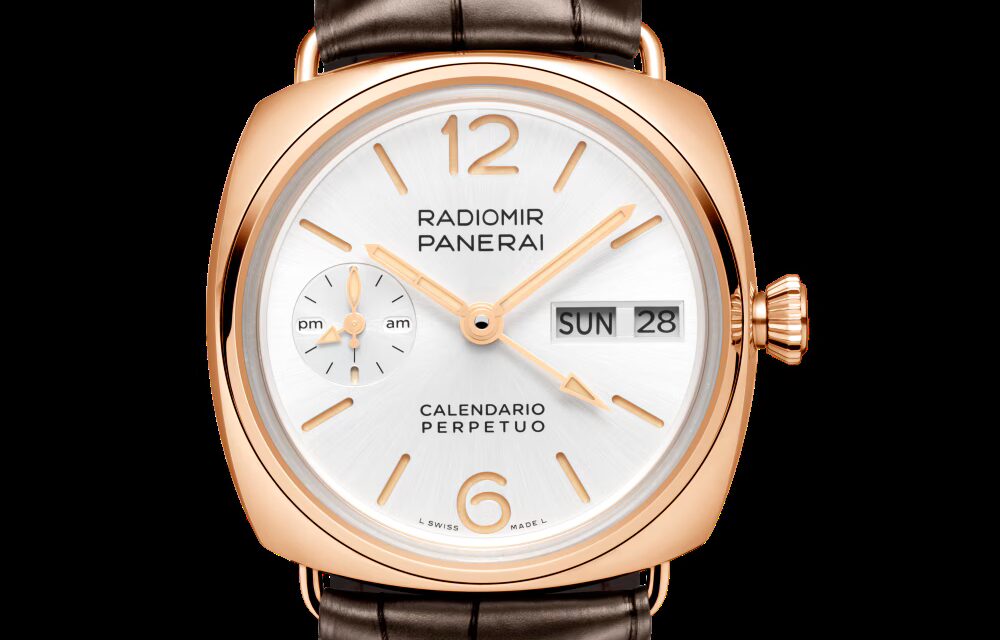
Start with the front of the 2021 watches. Hours and minutes sit in the centre, luminous Arabic numerals and hour markers around them. At 3 o’clock there is a window for the day of the week and the date. At 9 o’clock a sub-dial shows small seconds and a day and night indicator, the 24-hour half of a GMT function. A separate GMT hand tracks a second time zone. The only hint of the complication is the words “Calendario Perpetuo” printed at 6 o’clock.
That is a very short list for a perpetual calendar. A month window, a leap-year indicator and a year display are the usual suspects, and Panerai moved all of them to the back.
What do you see on the caseback?
Turn the watch over and the sapphire back shows four things: the current year, the month, the leap year and the power reserve. The month and leap year are read from a pointer against concentric discs near the crown, the year appears as four digits, and the power reserve indicator sits beside the micro-rotor. None of them needs a daily glance. You check the month when you set the watch and the year when you want to show someone.
Does hiding the information work?
For wearing, I think so. Pontroué, who was Panerai’s CEO at the time, has framed the idea as keeping the dial legible and true to the brand’s character, and the front of the watch bears that out. A Luminor face with a day and date window is something you can read in a second.
For owning, it is more complicated. During a visit to the Panerai manufacture in Neuchâtel, my reaction was blunt: they built a perpetual calendar and then hid half of it. I have not entirely changed my mind. A complication you can only inspect with the watch off your wrist is a complication you will mostly forget about, and the caseback tells the owner a lot but tells the room nothing.
The comparison that matters is the Panerai annual calendar approach, where the P.9010/AC keeps the dial uncluttered by limiting what it shows. That is a design choice you can defend. A perpetual calendar with the key information on the back is the same choice taken a step further, and you either accept it or you do not.
What about the Goldtech and Platinumtech dials in daily use?
Both are sandwich constructions, with the numerals cut out of the top layer and lume behind them, which keeps the glow honest. The blue of the PAM00742 is a sunburst that runs from near black to bright blue as it moves in the light. The green of the PAM00715 stays quieter. Neither has a date window that fights the numerals, which is the practical reason Panerai could get away with a perpetual on a dial this clean.
PAM01269: The See-Through Panerai Perpetual Calendar
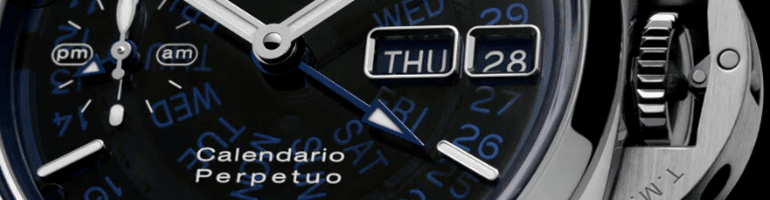
Then came 2022 and the Luminor Goldtech Calendario Perpetuo PAM01269.
The case is still 44mm Goldtech and the movement is still the P.4100. What changed is the dial: tinted sapphire, close to smoky, with the day and date discs sitting behind it in gold frames. Gold hands, applied indices and Arabic numerals share the face with a small seconds sub-dial at 9 and a blue GMT hand. The year, month, leap year and power reserve remain on the back.
It is a see-through dial, so the watch is a little skeletonized in spirit, though it is not a full skeleton. The mechanism you see is the calendar section, not a gear train. The price is the other change: around €80,000, and only 33 pieces.
I’d argue it is the better answer to the question the 2021 watches ask. If a perpetual calendar is going to be hidden, show the owner something to look at on the front. The tinted sapphire does that without adding indicators, and Watches by SJX described it as a look at the inner workings of the calendar, which is accurate.
I won’t pretend it is easy to read. Tinted sapphire over moving discs asks more of the eye than a painted dial, and I haven’t worn it, so I can only say what the layout implies. Whether a busier face contradicts the legible one of 2021 is a matter of taste. Panerai produced two answers, each limited, each sold at a price that suggests the buyer already knew what they wanted.
The P.4100: Does It Match Patek and Audemars Piguet?
The P.4100 is a 15½-ligne automatic, 35.1mm across and 7.0mm thick. It has 55 jewels, a 28,800 vph beat, a Glucydur balance, KIF shock protection and two barrels giving 72 hours of reserve. Winding comes from a 22k gold micro-rotor set off-centre, which keeps the movement thin enough for a 44mm Luminor.
Beyond the calendar, it carries small seconds with a stop-seconds reset, an independent GMT hand, a day and night indicator and a power reserve indicator. For a first perpetual calendar movement, that is a full specification.
Is it in the league of Patek Philippe and Audemars Piguet? Among collectors the common view is no. Those two houses set the standard for perpetual calendar finishing, and Panerai is not in that class. I agree with that, and I also think it is the wrong question. Panerai’s argument is a perpetual calendar you can wear in a 44mm Luminor, with GMT, three days of power and a movement it built itself. That is a different brief.
Where Does the Panerai Perpetual Calendar Fit Panerai Today?
Honestly, in an awkward spot.
I’d argue Panerai has had a rough ride with its core collectors in recent years, and many long-time collectors are walking away. A €46,000 to €80,000 perpetual calendar does not obviously help that, because it speaks to a different buyer than the person who fell for a plain sandwich dial. For the Paneristi who loves a plain sandwich dial, this is a watch from a neighbouring world.
It does make sense as a statement about what the manufacture can do. The Luminor shape holds a complication that Panerai would not have attempted twenty years ago, and the Radiomir Annual Calendar shows the same ambition at a lower price. The perpetual calendar sits at the top of that ladder.
If you are choosing, the order is simple. PAM00715 for the colour and the platinum, PAM00742 for the blue and the lower price, PAM01269 if the open dial is what you came for. All three are scarce, and all three will sit in a boutique or on the pre-owned market, not in a catalogue.
Who Is It For?
- The collector who wants a perpetual calendar that still looks like a Panerai
- Someone who values an in-house movement with GMT and 72 hours of reserve
- A Paneristi who prefers precious-metal Luminors and can pay for rarity
- A buyer who likes an open dial and the look of working discs (the PAM01269)
Not for: collectors who want every calendar indication on the dial; anyone expecting Patek-level finishing; buyers who need more than 50 metres of water resistance.
Conclusion
The Panerai Perpetual Calendar is two answers to one problem. In 2021 the brand kept the dial clean and moved the month, year and leap year to the caseback. In 2022 it opened the dial and let the discs show through tinted sapphire. Both use the same capable P.4100.
Is it worth the money? If you want a Luminor with a perpetual calendar, this is the family to look at, and the green PAM00715 is my favourite of the three. If you are after the Panerai you fell for, this is not it, and it does not pretend to be.
Would you take the hidden calendar of the PAM00715 or the open dial of the PAM01269? Tell me in the comments.
Extended Summary
- The Panerai Perpetual Calendar began in 2021 with the Goldtech PAM00742 (270 pieces) and the Platinumtech PAM00715 (100 pieces), both 44mm Luminors.
- The P.4100 is Panerai’s first self-built perpetual calendar movement, with a micro-rotor, 55 jewels, 28,800 vph, 72 hours of reserve and a GMT hand.
- The front shows day, date, GMT and small seconds, while the caseback carries the year, month, leap year and power reserve.
- The 2022 PAM01269 uses a tinted sapphire dial to show the calendar discs, in 33 pieces at around €80,000.
- Finishing is not Patek or Audemars Piguet territory, but the watch suits collectors who want a perpetual calendar in a recognisable Panerai case.
At a Glance
| Spec | PAM00742 | PAM00715 | PAM01269 |
|---|---|---|---|
| Collection | Luminor | Luminor | Luminor |
| Introduced | 2021 | 2021 | 2022 |
| Case material | Goldtech | Platinumtech | Goldtech |
| Case diameter | 44mm | 44mm | 44mm |
| Water resistance | 50 metres | 50 metres | 50 metres |
| Weight | About 149 g | About 174 g | Not published |
| Movement | P.4100, automatic | P.4100, automatic | P.4100, automatic |
| Power reserve | 72 hours | 72 hours | 72 hours |
| Beat rate | 28,800 vph | 28,800 vph | 28,800 vph |
| Jewels | 55 | 55 | 55 |
| Complications | Perpetual calendar, GMT, day/night, power reserve | Perpetual calendar, GMT, day/night, power reserve | Perpetual calendar, GMT, day/night, power reserve |
| Dial | Blue sunburst, sandwich | Green sun-brushed, sandwich | Tinted sapphire, day/date discs visible |
| Availability | Limited, 270 pieces | Limited, 100 pieces, boutique exclusive | Limited, 33 pieces |
| Launch price | €46,000 / about $47,200 | €66,000 / about $67,800 | About €80,000 |