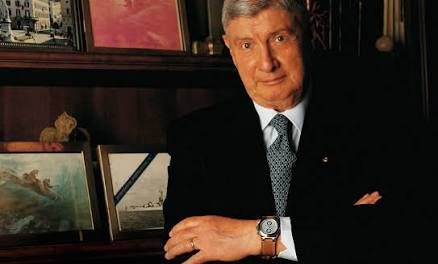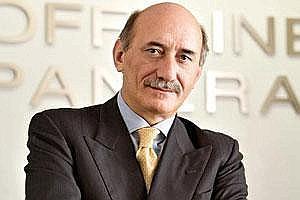
Angelo Bonati arrived at Officine Panerai in February 1997 to find almost nothing to run: no real product line beyond a single watch, no assistant, barely a company at all. Twenty-one years later, when he stepped down, Panerai had its own manufacture in Neuchâtel, boutiques across the world, an in-house movement programme most independent brands would envy, and a collector culture so devoted it earned its own name: the Paneristi.
He died on 15 May 2025, and the tributes that followed used the same word again and again: architect. Not of a single product, but of an entire brand that hadn’t really existed before he built it.
Before Panerai
Bonati was born in Milan in 1951 and studied economics in the city where he grew up. He started in the jewellery business in the mid-1970s, then joined the Vendôme group, later Richemont, in 1980, working as a sales manager across several of the group’s luxury brands on the Italian market before being appointed Director of Sales and Marketing for Cartier Italy in 1987. In 1993 he left watches and jewellery altogether for a stretch, taking sales and marketing roles at the Ginori and Trussardi groups. By the time Richemont called him back in 1997, he’d spent two decades in luxury sales without ever running a brand of his own.
1997: The Empty Office
What he found when he arrived was closer to a curiosity than a company. Panerai had one watch worth talking about and barely any brand identity to speak of. In an interview years later, Bonati described the scene without embellishment:
“I was alone, in one office, one chair, one computer… no assistant. Nothing.” Angelo Bonati, on joining Panerai as sales director in February 1997
Journalists at the time, he later recalled, didn’t even use the Panerai name. They called the watch the Luminor, because that was the only reference point that meant anything. Building actual brand awareness, giving the company a coherent identity rather than a single well-liked product, was, in his own words, the only way to avoid the whole operation collapsing into an unknown private label.
Building a Brand From Nothing
Bonati became CEO in 2000, three years into the job, and from there the expansion was rapid and deliberate. He established the PAM-numbered reference system that every collector now uses as shorthand, opened Panerai’s first boutiques, and in 2002 secured the brand’s place at the Salon International de la Haute Horlogerie in Geneva, effectively placing Panerai on the same calendar as the watch industry’s most established names for the first time.
None of this happened by accident. Bonati approached brand-building the way a strategist approaches infrastructure: marketing, distribution, technical credibility, retail presence, each element built deliberately rather than left to grow organically around a popular watch.
The Manufacture Decision
The turning point that mattered most to serious collectors came in 2005, when Panerai opened its own manufacture in Neuchâtel and debuted the P.2002, an in-house calibre with an eight-day power reserve. Before this, Panerai’s watches had run on movements sourced from outside suppliers for most of the brand’s history, a fact competitors were happy to point out. Bonati’s own explanation for the decision, given late in his tenure, credited the collector base directly rather than any internal strategy document: it was the audience, especially the collectors asking for rare, distinctive limited editions, who made an in-house movement the only proposition that made sense.
The P.2002 was followed by an expanding family of manufacture calibres, the P.4000 with its micro-rotor winding, the P.9000 automatic series, each one reducing Panerai’s dependence on outside suppliers and giving the brand genuine standing among independent manufactures rather than just a design house with a good military story.
The Sailor’s Brand
Bonati was a serious yachtsman, not a marketing department’s idea of one. He personally piloted a wood-hulled ex-America’s Cup J-Class yacht named Eileen, and that wasn’t incidental to how he ran the brand. Panerai’s maritime identity under his leadership wasn’t purely a heritage narrative borrowed from the Italian Navy’s wartime contracts; it was reinforced by initiatives like the Panerai Classic Yachts Challenge, a circuit built around exactly the kind of sailing Bonati did himself. For a brand whose entire founding logic traced back to underwater instruments, having a CEO who genuinely lived on the water gave that identity a credibility that pure marketing couldn’t manufacture.
2018: Stepping Down
Bonati retired in 2018 after 21 consecutive years at Panerai, the only CEO the brand had known throughout its entire modern era. Asked what he wanted his legacy to be, he didn’t reach for a specific product or a sales figure. He answered simply:
“I want to be remembered as the CEO who dared to dream.” Angelo Bonati, in one of his final interviews as Panerai CEO
Under Richemont’s ownership, brand leadership at most maisons rotates every few years. Bonati’s uninterrupted two-decade run was itself unusual, long enough to take a company from one office and one watch through every major phase of its modern identity without a change of vision partway through.
What He Actually Built
It’s worth being precise about the scale of this, because “transformed the brand” undersells it. Bonati didn’t refine an existing luxury operation. He built the operation itself, on top of a name that had just been sold for roughly a million dollars because Dino Zei, its previous owner, had run out of ways to keep it afloat. Boutiques, an SIHH presence, an entire in-house manufacture, a numbering system collectors still use daily, a genuine maritime culture rather than a borrowed one: all of it traces back to a man who started with nothing and treated that as a starting point rather than an obstacle.
Bonati himself credited the collectors for pushing him toward the in-house manufacture decision. Do you think Panerai’s collector community still shapes the brand’s direction that directly today, or has that relationship changed as the company has grown?
Angelo Bonati: Key Dates
| Born | 1951, Milan |
| Joined Vendôme group | 1980 |
| Director of Sales and Marketing, Cartier Italy | 1987 |
| Joined Panerai as sales director | February 1997 |
| Became CEO | 2000 |
| Secured Panerai’s first SIHH presence | 2002 |
| Opened the Neuchâtel manufacture, debuted the P.2002 | 2005 |
| Retired after 21 years as CEO | 2018 |
| Died | 15 May 2025 |