Quick Takeaways
- The PAM00690 (or PAM690 as you wish), affectionately called the Blue Sunburst Radiomir, is a 500-piece Boutique Edition from 2016: a 47mm polished steel Radiomir 1940 pairing the muscular case with a rich, radial sunburst blue dial, the first time that combination appeared on Panerai’s 47mm manual-wind archetype
- The dial does carry small seconds, contrary to what some casual descriptions of this reference claim. It’s a genuinely spare dial, hours, minutes, and small seconds only, no date, no power reserve indicator, but not a pure two-hand watch
- The movement is the in-house P.3000/1, hand-wound, 21,600 vph, twin barrels, 3-day reserve, 160 components, visible through a sapphire exhibition caseback
- Released exclusively through Panerai boutiques, never through general authorised dealers, the PAM690 was a deliberate collector’s indulgence rather than a mainstream catalogue release
- On the secondary market, documented prices commonly run from the high-$8,000s to the mid-$13,000s depending on condition and completeness, a reference that has held its ground well above original retail
Jump directly to the spec sheet.
The Blue That Changed the Mood
If there’s one thing Panerai learned by 2016, it was that collectors had started to crave more than black and brown. The PAM00690 arrived like a cool current under a brand that had been treading familiar waters. It wasn’t the first 47mm Radiomir 1940 with the in-house P.3000 calibre, but it was the first to pair that muscular silhouette with a rich, radial blue dial, a combination that gave the Radiomir line something unexpected: restraint through colour.
Released exclusively as a Boutique Edition, limited to just 500 pieces, the PAM690 was never meant to be a mainstream release. It was a collector’s indulgence, a gesture toward the Paneristi who already owned their fair share of black dials and tobacco hues. The brand, still under the Richemont umbrella, was pivoting toward exclusivity, and this watch captured that perfectly: familiar architecture, but with a tone of quiet luxury.
Design and Case: The Return of the 1940 Form
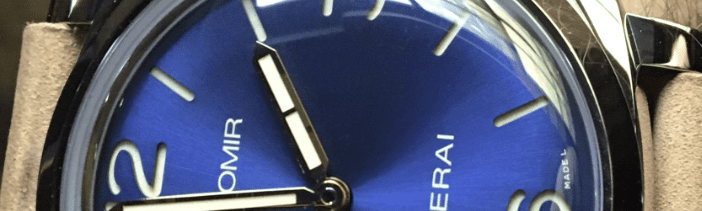
Panerai’s 47mm Radiomir 1940 case has always walked the line between brutal and elegant. In the PAM00690, that case finds its most harmonious balance yet. Made of AISI 316L stainless steel, it’s polished to a near-liquid shine, catching light like a mirror when paired with the domed sapphire crystal. The curve of the mid-case and the bulging crown guard, that unmistakable device protecting the crown, recall the wartime heritage of Panerai’s Radiomir 6152/1, but here it’s tempered by the modern finishing standards that define the brand’s in-house era.
At 47mm, this isn’t a watch for everyone. It dominates the wrist but never feels gratuitous, the short, downward-curving lugs help it hug the wrist better than its measurements suggest. The crown-lock lever operates with that satisfying resistance Panerai owners know well, a tactile assurance that the seal is solid, the mechanics precise.
The caseback is sapphire, offering an unfiltered view of the P.3000 movement, large bridges, wide-open gear train, no unnecessary decoration. It’s industrial honesty at its best, a design language Panerai has leaned into since bringing movement manufacture in-house.
Dial of the PAM00690: The Sunburst Revolution
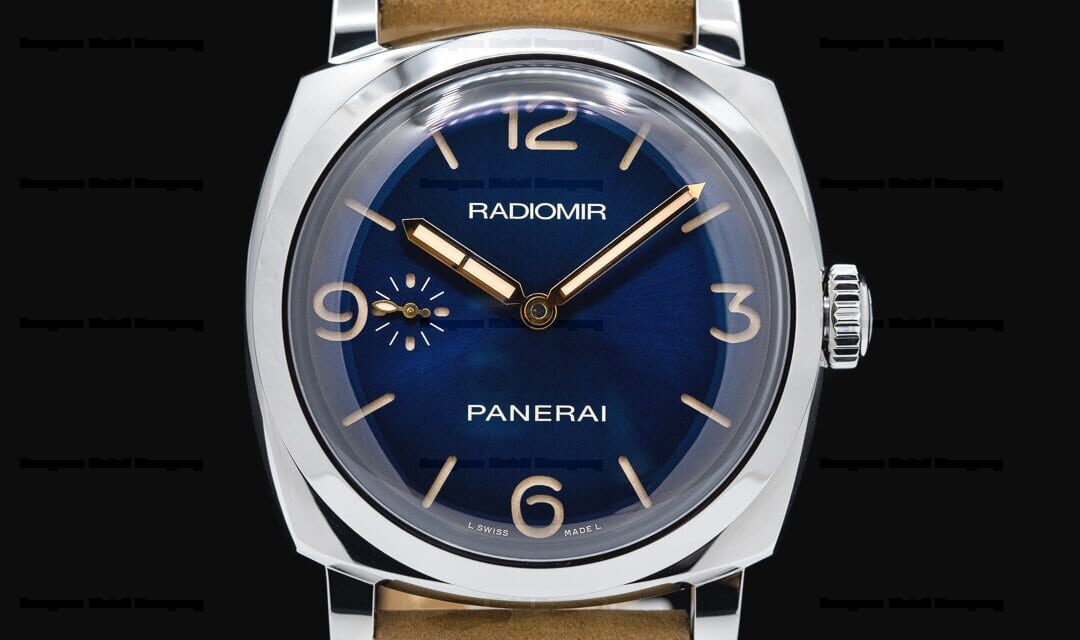
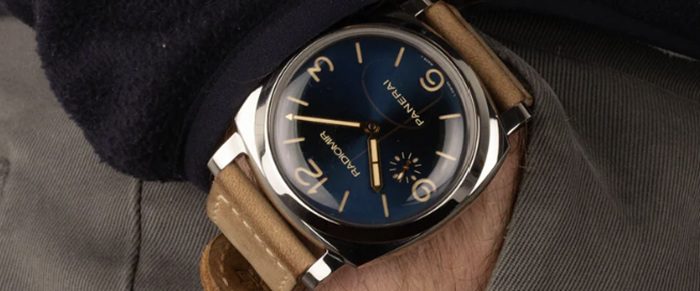
If the case is the muscle, the dial is the mood. The sunburst blue sandwich dial of the PAM690 remains one of Panerai’s most striking. The blue is deep and warm, not metallic or icy, it feels alive, shifting between midnight and Mediterranean depending on the light. The sandwich construction, two plates, the lower one luminous, the upper one cut with numerals, gives that signature Panerai depth, but with a twist: against the blue, the beige Super-LumiNova glows with a vintage, almost parchment hue.
Here’s a detail worth correcting directly: the dial carries hours, minutes, and small seconds, not a bare two-hand layout as some casual descriptions of this reference suggest. There’s no date and no power reserve indicator, so the dial does read as genuinely spare against a busier Panerai like the PAM00372, but the small seconds sub-register is confirmed across multiple independent references to this exact reference, including WatchBase’s own reference documentation.
The sunburst effect is particularly rare in Panerai’s history. This wasn’t just another colour option, it marked the start of a subtle blue era. Later models like the PAM01312, the Submersible Blu Notte, and the Mediterraneo editions would continue the theme, but the 690 remains the purist’s pick, the first time that blue met the 47mm manual-wind archetype. For a completely different expression of Panerai chronograph engineering from the same broader era, the PAM00246 shows how far the brand pushed complication in the opposite direction from this watch’s restraint.
Movement: The Beating Heart, Calibre P.3000/1
At the heart of the PAM690 lies the in-house Calibre P.3000/1, a movement that has become synonymous with Panerai’s modern identity. The base P.3000 was introduced in 2011, designed to replace the Unitas-based calibres that had served Panerai for decades. It was the brand’s statement of independence, large, robust, unmistakably Panerai.mous with Panerai’s modern identity. Introduced in 2011, it was designed to replace the Unitas-based calibres that had served Panerai for decades. The P.3000 was the brand’s statement of independence — large, robust, unmistakably Panerai.
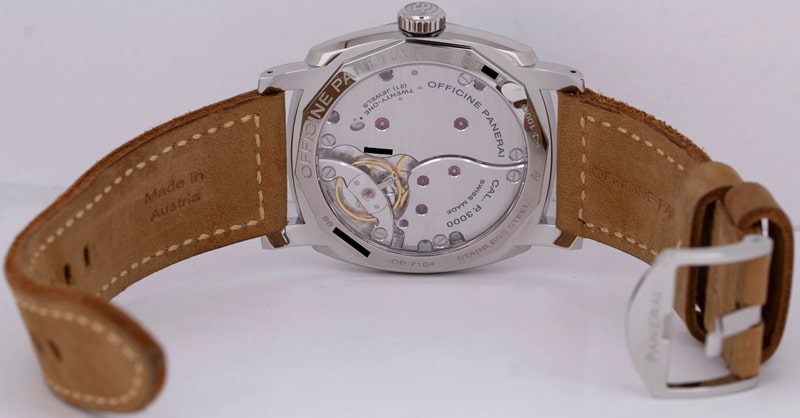
Technical overview of the PAM690:
- Manual-wind, entirely designed and assembled in Neuchâtel
- 16½ lignes (37.2mm) in diameter, massive by modern standards, filling the 47mm case perfectly
- 5.3mm thick, 21 jewels, Glucydur balance
- 21,600 vibrations per hour (3Hz)
- 3-day power reserve, achieved via twin barrels connected in series
- 160 components
- Incabloc anti-shock device
- Independent hour-hand adjustment, allowing quick time-zone changes without stopping the balance
- No hacking seconds, but manual precision setting through tactile feedback
The bridge layout is textbook Panerai, broad, satin-brushed surfaces with engraved text and a warm industrial feel. It’s not haute horlogerie finishing, and it doesn’t pretend to be. The bevels are machine-executed, the edges clean but not flamboyant. This is a tool movement built with intent, and it wears its utility proudly.
Owners report impressive reliability. The P.3000 family has proven itself as one of Panerai’s more robust calibres, with minimal long-term wear issues. Its independent hour adjustment makes it a surprisingly useful travel companion despite lacking GMT. Servicing is straightforward through Panerai’s Richemont network, and collector sentiment around the movement’s longevity remains strong.
On the Wrist: Presence and Poise
The PAM00690 wears exactly as you’d expect from a 47mm Panerai: commanding, but not overbearing if you have the wrist for it. The Assolutamente strap, with its untreated suede-like surface, picks up patina beautifully over time, deepening in tone and texture. The pin buckle is broad and substantial, true to Panerai’s vintage aesthetic.
Despite its size, it balances well, the domed sapphire adds dimensional charm, and the way light dances across the dial ensures the watch never feels static. Every flick of the wrist gives a different shade of blue.
Collectors who’ve worn both the PAM372 (black dial) and the PAM690 often describe the difference this way: the 372 feels historical, the 690 feels emotional. It’s the same movement family, same case family, but a different soul. A vintage-watch dealer’s listing for the reference captures the enthusiasm plainly:
“…only 500 pieces made and this watch is Gorgeous!” The Sutor House, on the PAM00690’s rarity and dial
Historical Context: Panerai’s 2016–2018 Boutique Chapter
When the PAM00690 debuted in 2016, Panerai was navigating an identity crisis of sorts. The brand had spent much of the early 2010s expanding aggressively, releasing reference after reference with minor variations. Boutique Editions, limited runs for brand-owned stores, became the new marketing hook. The PAM690, limited to just 500 units, symbolised both the promise and the problem of that strategy.
On one hand, it showcased Panerai’s ability to reimagine its classics with modern flair. On the other, it sparked frustration among collectors who felt the brand was slicing its core identity too thin through endless limited runs.
Still, hindsight has been kind. The 690 now stands as one of the more tasteful outputs of that period. It avoided gimmicks, no carbon fibre, no ceramic, no unnecessary text. Just steel, blue, and honest watchmaking. That’s why collectors today look back on it fondly, while many other Boutique Editions have faded into obscurity.
A non-numbered Boutique re-release followed in 2017–2018, often confused with the original. It featured the same aesthetic but lacked the original numbered limitation and the early production allure. Purists can tell the difference through serial engraving, caseback markings, and certificate details.
Collector Sentiment: From Boutique Rarity to Cult Favourite
Initially, the PAM00690 was a slow burn. It didn’t explode on the secondary market right away; the blue dial was a novelty, and 47mm was, and remains, a bold statement in an increasingly downsized world. But as the years passed, it became clear that Panerai wouldn’t revisit this exact combination, 47mm, P.3000, sunburst blue dial, again. That scarcity turned intrigue into reverence.
Documented listings show meaningful appreciation over the original retail. Original MSRP was cited around $10,500 USD at launch (some sources place the euro-denominated launch price closer to €8,900–€9,800 depending on market and year); current secondary market listings on Chrono24 commonly run from the high-$8,000s to the mid-$13,000s depending on condition, completeness, and whether the piece is an original numbered 2016 example or a later Boutique reissue. Collectors view it as a transitional icon, a watch that bridges Panerai’s utilitarian past with its more luxurious modern present.
When Restraint Became the New Luxury
Panerai has often been accused of recycling its designs, and not without reason. But the PAM00690 proves that repetition can still yield evolution. In an era when the brand was experimenting with materials and marketing gimmicks, this watch showed that refinement, not reinvention, could still move the needle.
The blue dial wasn’t just a colour change; it was a shift in tone, a softer, more introspective Panerai that hinted at maturity. It reminded collectors why they fell in love with the brand in the first place: oversized honesty, functional beauty, and unfiltered connection to the sea.
Who Is It For?
- The collector who already owns Panerai’s black and brown dial staples. The PAM690 was built specifically for the Paneristi who wanted a genuinely different colour register without abandoning the 47mm Radiomir 1940 architecture they already know
- Someone who values a spare, functional dial over complication density. Hours, minutes, and small seconds only, no date, no power reserve display, this is Panerai demonstrating restraint rather than adding features
- A buyer who wants an in-house manual-wind movement with genuine mechanical presence. The P.3000/1’s twin-barrel architecture and 3-day reserve are properly engineered, not a token gesture toward manufacture credibility
- A collector who specifically wants the numbered 2016 original rather than the later non-numbered Boutique reissue, provenance and production year genuinely affect both story and value here
Not for: Collectors who want small or medium case sizes, 47mm is a genuine commitment regardless of how well the lug geometry manages the wrist. Anyone who needs a date function for daily practicality, this dial deliberately omits one. And not for buyers who can’t distinguish or don’t care about the difference between the original 500-piece numbered run and the later Boutique re-release, that distinction meaningfully affects collector value.
Conclusion
Nearly a decade later, the Panerai Radiomir 1940 PAM00690 stands taller than ever. It’s not the loudest or most complicated Panerai, but it’s one of the most balanced. The P.3000 movement keeps it grounded in the brand’s mechanical roots, while the sunburst blue dial adds emotion to that foundation. For collectors, it marks the sweet spot between tool watch authenticity and boutique-era sophistication.
Panerai’s lineup has since grown more fragmented, smaller cases, more materials, more limited runs, but the PAM690 endures as a reminder of when the brand still knew how to make a statement quietly.
Does the numbered 2016 original matter to you over the later Boutique reissue, or is the dial and case combination enough on its own? Tell us where you land below.
Extended Summary
- The PAM00690, the Radiomir 1940 3 Days Acciaio Boutique Blue, is a 500-piece Boutique Edition from 2016: a 47mm polished steel Radiomir 1940 paired with the brand’s first sunburst blue dial on this case and movement combination
- The dial carries hours, minutes, and small seconds, not a bare two-hand layout as some descriptions of this reference claim; there’s no date or power reserve indicator, keeping the face genuinely spare without being purely minimal
- The in-house P.3000/1 movement delivers a 3-day reserve via twin barrels, 21,600 vph, 160 components, and independent hour-hand adjustment, visible through a sapphire exhibition caseback
- A non-numbered Boutique reissue followed in 2017–2018, sharing the same aesthetic but lacking the original numbered limitation; provenance and production year materially affect collector value on this reference
- Secondary market pricing commonly runs from the high-$8,000s to mid-$13,000s depending on condition, completeness, and whether the example is the original 2016 numbered run or the later reissue, a reference that has held meaningfully above its original retail price
At a Glance
| Reference | PAM00690 |
| Collection | Radiomir 1940, Boutique Editions |
| Name | Radiomir 1940 3 Days Acciaio Boutique Blue |
| Introduced | 2016 |
| Limited to | 500 pieces (numbered original run) |
| Case material | Polished AISI 316L stainless steel |
| Case diameter | 47mm |
| Lug width | 26mm |
| Water resistance | 100 metres |
| Crystal | Domed sapphire |
| Caseback | Sapphire, exhibition |
| Movement | Panerai P.3000/1 (in-house, hand-wound) |
| Movement diameter | 16½ lignes (37.2mm) |
| Movement thickness | 5.3mm |
| Power reserve | 3 days, twin barrels |
| Beat rate | 21,600 vph |
| Jewels | 21 |
| Components | 160 |
| Functions | Hours, minutes, small seconds |
| Dial | Blue sunburst sandwich; luminous Arabic numerals and markers |
| Strap | Brown Assolutamente calf leather, 26/22mm |
| Buckle | Steel pin buckle |
| Availability | Discontinued; pre-owned only |
| Secondary market | ~$8,800–$13,000 depending on condition, completeness, and production year |