The Story of a Quiet Revolution
Introduction – A Different Kind of Panerai
Panerai has always loved to tell stories through materials. Steel defined the brand’s naval past. Titanium lightened the famously oversized Luminor cases. Bronze made headlines in 2011 with the Bronzo and its evolving patina. Ceramic brought stealth and scratch resistance, while Carbotech added futuristic carbon layering.
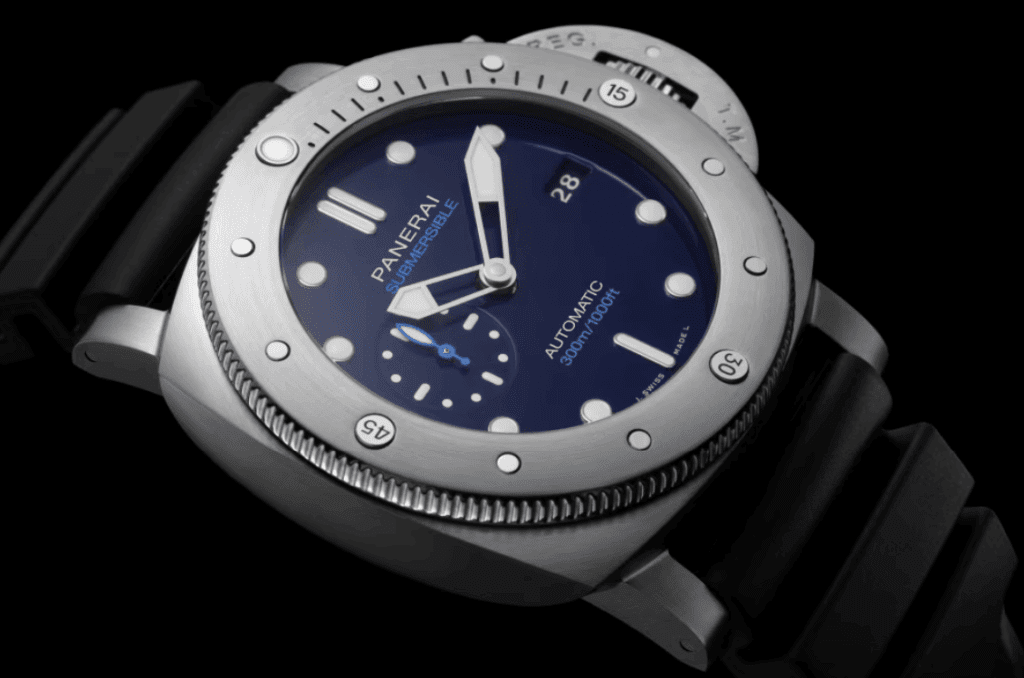
By 2017, Panerai had built a reputation as the brand of bold case experiments. But then came something unexpected — a material that didn’t flaunt itself visually at all. The Luminor Submersible 1950 BMG-Tech PAM00692 looked like polished steel. Yet it hid a breakthrough inside its silvery-grey case: Bulk Metallic Glass, a substance five times stronger than steel, engineered to resist scratches, shocks, and corrosion.
BMG-Tech was Panerai’s quietest but most radical leap forward. Let’s explore how it was born, how it performs, and why collectors still debate its place in the brand’s identity.

What Exactly Is BMG-Tech?
Panerai’s engineers didn’t invent Bulk Metallic Glass, but they were the first to bring it into watchmaking. The material starts as a molten blend of zirconium, copper, aluminum, titanium, and nickel, then is cooled so rapidly that the atoms don’t settle into the neat crystalline structure of normal metals. Instead, they freeze into a disordered, amorphous arrangement — hence the “glass” in the name.
This gives BMG-Tech remarkable qualities:
- Harder than steel and more resistant to everyday scratches.
- Shock-resistant, unlike ceramic, which can shatter under impact.
- Corrosion-proof and non-magnetic.
- Visually stable, meaning no patina, no tarnish, no color change.
“It’s a Panerai case designed not to age — indestructibility disguised as simplicity.”
The Debut – PAM00692 Submersible BMG-Tech
When Panerai unveiled the PAM00692 at SIHH 2017, the watch world didn’t quite know what to make of it. On one hand, it was a familiar Submersible:
- 47 mm Luminor 1950 case
- 300 m water resistance
- Unidirectional rotating bezel
- Trademark crown-protecting bridge
- Black dial with electric blue accents
On the other hand, its entire case, bezel, and crown guard were made of BMG-Tech. For Panerai fans used to bronze cases that aged dramatically or Carbotech cases with visible carbon layers, the 692 looked conservative. Yet on the wrist, it felt different — lighter than steel, tougher than titanium, and with a reassuring sense of resilience.
Summary – Why PAM00692 Mattered
- First-ever watch case in Bulk Metallic Glass
- Subtle looks, radical science
- Blueprint for future BMG-Tech experiments
A Material That Refuses to Age
The appeal of bronze lies in its patina. Carbotech wins collectors with its one-of-a-kind marbling. But BMG-Tech is the opposite: it refuses to change. After years of wear, it looks almost untouched, impervious to scratches and saltwater corrosion.
For traditionalists, this was a flaw. Panerai, after all, built its aura on the romance of dials that fade and cases that age like relics. But for practical-minded collectors, this was the dream: a Panerai that could take abuse and still look box-fresh.
This tension explains why BMG-Tech has always split opinion. It embodies the question: should a Panerai wear its history on its skin, or should it resist history entirely?
Expansion Beyond the 692
Panerai didn’t stop with the first Submersible. Variants like the PAM00799 appeared, refining the design and keeping the formula alive. There were also boutique and limited editions that blended BMG-Tech with Carbotech elements, creating hybrid cases that doubled down on proprietary innovation.
Still, BMG-Tech has remained tied primarily to the Submersible family. It hasn’t spread to Radiomir or Luminor models, likely because its character suits the tool-watch DNA of a professional diver more than the dressier branches of the catalog.
Comparisons – BMG-Tech vs Other Panerai Materials
- Bronze ages, developing personality. BMG-Tech resists time entirely.
- Ceramic shrugs off scratches but can chip or crack. BMG-Tech resists both scratches and shocks.
- Carbotech is visually unique, light, and instantly recognizable. BMG-Tech is visually understated, favoring hidden strength over style.
- Steel and titanium remain classic, but BMG-Tech was designed to outlast them, both physically and cosmetically.
Quick Take
Bronze is about romance. Carbotech is about aesthetics. BMG-Tech is about science and permanence.
Collector Reception – Admiration Without Hype
Unlike the Bronzo, which ignited waitlists, or Carbotech, which gave Panerai a modern icon, the BMG-Tech watches have always been quieter on the market. Collectors respect the material’s technical merit but often admit that it doesn’t “feel” special when you see it. To the untrained eye, it looks like polished steel.
That subtlety has kept secondary market prices steady rather than explosive. For connoisseurs, the PAM00692 holds unique appeal as the world’s first Bulk Metallic Glass case. But for casual buyers, it’s often overshadowed by flashier Panerai experiments.
“BMG-Tech is the Panerai you don’t brag about at the table — but it might just outlast everything else in your watch box.”
Strengths and Weaknesses in Balance
Strengths
- Virtually scratch- and corrosion-proof.
- Shock-resistant, unlike brittle ceramic.
- Non-magnetic, stable under extreme conditions.
- A true industry first — the debut of BMG in horology.
Weaknesses
- Visually plain, hard to distinguish from steel.
- Limited production runs and model variety.
- Lacks the romantic storytelling of bronze or the eye-catching drama of Carbotech.
Closing Reflection – The Silent Innovator
The Panerai Submersible BMG-Tech PAM00692 may never become a cult icon like the Bronzo or Carbotech. But in Panerai’s history, it marks a bold chapter: the first watch to harness Bulk Metallic Glass, a material born from advanced metallurgy and engineered to resist time itself.
It’s the Panerai that hides its innovation rather than flaunts it. The one that doesn’t age, doesn’t corrode, doesn’t change. For some collectors, that makes it sterile. For others, it makes it the ultimate tool watch — a diver as unyielding as the sea it was built for.
In the end, BMG-Tech is not about romance but resilience. And in a catalog where so many references are defined by how they wear their history, the BMG-Tech watches are defined by how they refuse to.