
A Dial That Breaks the Rules
Few watch designs spark as much double-take as the California dial. Roman numerals on top, Arabic on the bottom, a triangle at 12, and simple batons scattered between — at first glance, it reads like a manufacturing error. But this apparent chaos was deliberate. For Panerai in the 1930s, supplying Italian Navy divers, legibility under duress mattered more than elegance.
“If you can’t orient the dial instantly in the dark, it isn’t doing its job.”
That was the design brief. And the California dial delivered.the 1930s, when Panerai (working with Rolex cases and movements) supplied divers who didn’t care about symmetry — only survival.
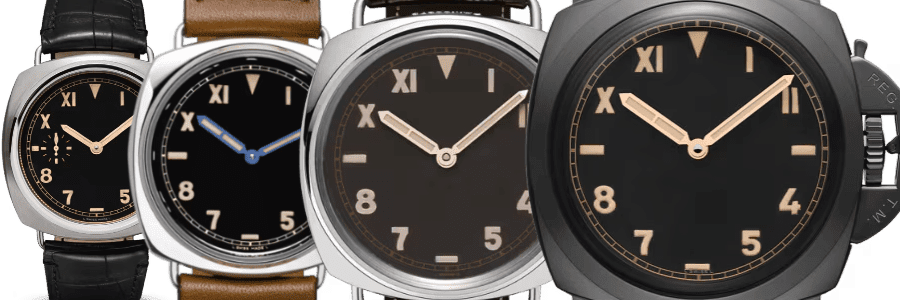
Origins and Utility
The dial first appeared on watches produced by Rolex for Panerai in the mid-1930s. Engraved brass plates, filled with radium, provided both indexes and glow. The hybrid layout meant a diver surfacing in the Adriatic at night could tell 12 o’clock from 6 at a glance. The triangle was the anchor, the mismatch of numeral styles a quirk born from necessity.
It was never meant to be beautiful — only functional. And yet, decades later, the oddity became a cult emblem.
Technical Execution Through Time
Original dials were single-piece plates: engraved numerals, radium paste, and a coat of matte paint. They were crude, radioactive, and inconsistent — but functional.
Modern Californias take a different path. Panerai’s sandwich dial construction uses two plates: the upper layer cut with numerals and markers, the lower filled with luminous compound. Light seeps through the recesses, creating depth. It’s cleaner, safer, and more precise. Domed sapphire crystals, especially on pieces like the PAM 249, mimic vintage plexi’s distortion while resisting scratches.
Typography: Clash as Identity
The dial’s typography is central to its charm. The Romans are tall and angular, almost severe. The Arabics, by contrast, are rounded and playful. By traditional design standards, they don’t belong on the same stage. Yet their juxtaposition creates a rhythm — a subtle visual cue that speeds up time-telling rather than slowing it down.
It is, in essence, organized dissonance.
Notable References
- PAM 249: The 2006 Radiomir special edition that reignited enthusiasm for the California dial. A domed sapphire crystal gave it vintage distortion, while the hand-wound OP X calibre kept it lean and authentic.
- PAM 448: A faithful 2012 follow-up, 47 mm of pure vintage echo, produced in a 750-piece limited edition. The gilt-style hands and tobacco strap sealed its historic feel.
- PAM 424: Also released in 2012, this model brought the California dial into Panerai’s regular lineup. Early runs controversially featured a date window at 3 o’clock — a jarring intrusion that many collectors rejected outright. Panerai corrected course in later versions, removing the date and returning the dial to its clean, two-hand form. Today, the corrected 424 is seen as the “accessible” California option, though purists still prize the limited editions above it.
Collector’s Perspective
Among Paneristi, the California dial is divisive. Some see it as essential DNA — raw, functional, and unapologetically authentic. Others find it too strange, even gimmicky. Yet in collector circles, owning a California dial Panerai is a badge of seriousness. It signals that you care about the history, not just the brand’s modern marketing muscle.
Prices reflect that cult status. Limited runs like the PAM 249 command attention, while more available references like the PAM 424 offer an entry point without sacrificing the design’s essence. The story of the 424’s date window, and its removal, is itself a miniature case study in Panerai’s ongoing tug-of-war between historical fidelity and contemporary usability.
Final Word
The California dial wasn’t born to be admired. It was born to be used, read quickly, and survive underwater missions. But in its stubborn practicality, it stumbled into icon status. Today, it stands as one of the few designs in watchmaking where function accidentally became form — and in Panerai’s case, identity.


