
Quick Takeaways
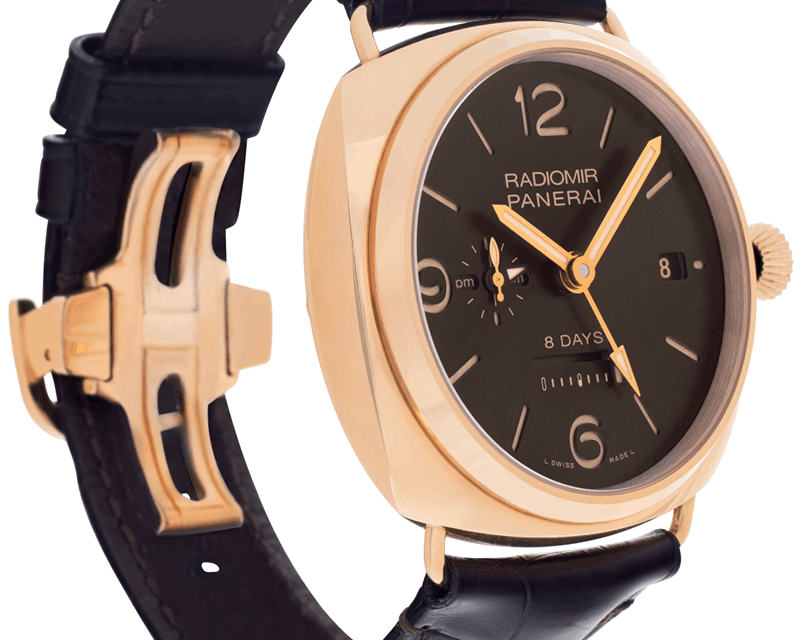
- Panerai PAM00395 is the Radiomir 8 Days GMT Oro Rosso — a 500-piece limited edition from 2012 in 45mm Goldtech™ (Panerai’s proprietary rose-gold alloy), wearing more warmly than conventional rose gold and ageing more gracefully.
- The movement is the headline: the P.2002/10 calibre uses skeletonized bridges and three mainspring barrels in series to deliver a full eight days of hand-wound power reserve — a genuinely unusual architecture, and one that reads spectacularly through the exhibition caseback.
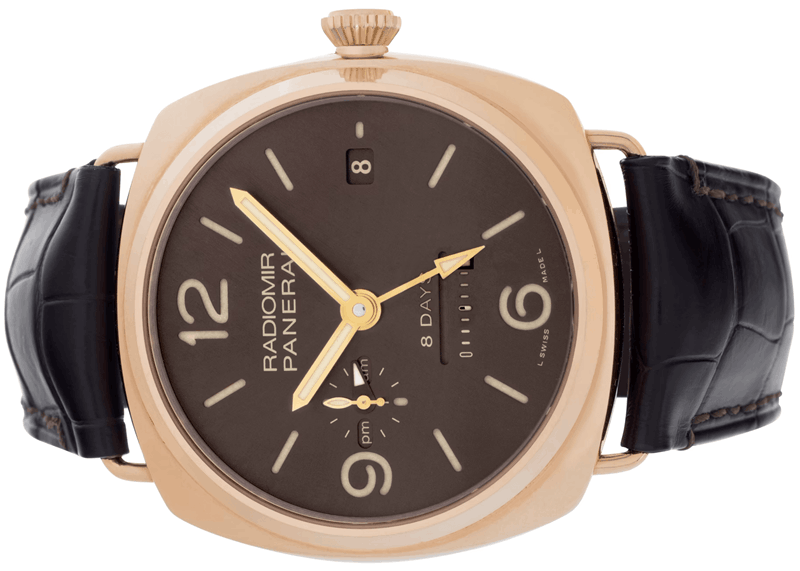
- The brown sunray sandwich dial carries four complications — GMT, date, small seconds, and a linear power reserve — without crowding, a feat that speaks to Panerai’s layout discipline at its best.
- The PAM00395 occupies a narrow but devoted niche: gold Radiomir collectors who want maximum mechanical substance, not just precious-metal presence. You’re not buying it to show off gold — you’re buying it for what’s behind the brown dial.
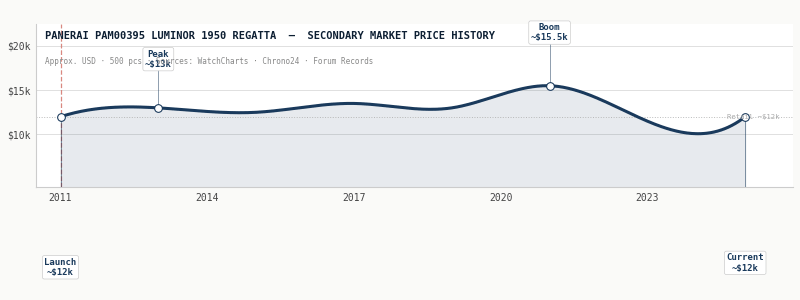
- Secondary market pricing sits in the $16,000–$28,000 USD range depending on condition and provenance, representing a meaningful discount from the original ~$33,700 retail — which makes the Goldtech case and in-house movement argument considerably easier.
Jump directly to the spec sheet.
Panerai PAM00395 Review — The Radiomir That Does Its Talking Through the Caseback
Not every Panerai announces itself loudly. The PAM00395 — the Radiomir 8 Days GMT Oro Rosso — makes its case quietly, through a chocolate-brown dial and an exhibition caseback that reveals one of the most mechanically compelling movements Panerai has ever put inside a Radiomir case.
Released in 2012 as part of Panerai’s Special Editions lineup, this is a 500-piece run in Goldtech™ — the brand’s proprietary rose-gold alloy — housing the P.2002/10 calibre, a hand-wound manufacture movement with skeletonized bridges, three barrels in series, and eight full days of power reserve. On paper it reads like a specification list. On the wrist, and more importantly through that sapphire caseback, it reads like an argument for why the in-house era of Panerai’s Radiomir collection deserves more serious collector attention than it typically gets.
Most Panerai reviews concentrate on the titanium dive watches or the steel Luminors. Gold Radiomirs tend to be left to a smaller, more specific conversation. This review is for that conversation.
A Goldtech Case on a Radiomir Form — What That Actually Means
Goldtech vs Conventional Rose Gold — The Material Distinction
Here’s where most descriptions of the PAM00395 fall short: they call it “rose gold” and move on. But Goldtech™ is not conventional 18k rose gold. It’s a proprietary Panerai alloy combining gold, copper, and platinum in a specific ratio developed at the Neuchâtel manufacture. The platinum content is the functional difference — it slows the oxidation process that makes standard rose gold darken and lose its vibrancy over time. Goldtech holds its warm, slightly reddish hue longer, and it’s harder than most gold alloys, which matters on a 45mm cushion case that’s going to accumulate incidental contact over years of wearing.
You can see the difference most clearly at the wire lugs. The PAM00395 keeps the Radiomir’s signature removable wire-loop strap attachments — a patented design that lets you swap straps without tools — and in Goldtech, those loops catch light differently than polished steel. Warmer. More amber than pink. It’s a subtle distinction until you’ve seen it, and then it becomes the thing you notice first.
The polished case finish is unabashedly dressy. There’s no brushed relief here, no tactical matte — just full-polished Goldtech across the cushion case, the bezel, and the crown. For some collectors, the full polish on a Radiomir feels wrong, too far from the watch’s instrument-grade origins. For others, the contrast between this finish and the P.2002’s workmanlike architecture is precisely the point. Instrument function inside dress-watch clothes.
The Radiomir Silhouette at 45mm — Wrist Presence Without the Crown Guard
The 45mm Radiomir case is the sweet spot of the line — large enough to carry the dial’s information load without crowding it, smaller than the 47mm variants that push toward genuine statement territory. No crown-protecting lever here. No bridge. The Radiomir’s unguarded onion-crown profile means the watch lies flatter and sits less aggressively on the wrist than any of the Luminor siblings.
At 45mm in polished Goldtech, the PAM00395 registers as dress-watch grand, which is a difficult balance to strike. It doesn’t disappear, but it doesn’t need to be noticed from across the room either. The combination of the warm case, the brown alligator strap, and that chocolate dial creates a coherent palette that works with a suit as easily as with a sport coat — rare territory for a Panerai of any kind.
Water resistance to 50 metres keeps it honest. This is not a diver’s watch. It never pretended to be.
The Dial — Brown Sunray and the Art of Information Density
Sandwich Construction, Linear Power Reserve, and Three Sub-Registers
The brown sunray dial is a two-layer sandwich construction — a Radiomir staple, and the right choice here. The lower plate carries the luminous material; the upper plate has cut-out Arabic numerals and baton hour markers that let the lume glow through. In daylight the depth is subtle but present, the brown sunray finish adding a warmth that pairs deliberately with the Goldtech case. Under artificial light it snaps into a different register entirely — the SuperLuminova charges green and the sandwich construction gives the numerals a three-dimensional quality that flat-printed dials simply can’t replicate.
Four separate indicators share the dial without fighting each other. Date at 3 o’clock. Small seconds and a 24-hour GMT hand sharing the sub-register at 9. Linear power reserve indicator at 6. This is the detail that catches most people first — the horizontal bar at the lower dial, moving from full (left) to depleted (right) as the eight-day cycle winds down. It’s functional, legible, and — given that you’re carrying three barrels in series inside the case — appropriately architectural in feel.
Panerai’s decision to run the power reserve indicator on the dial face rather than relegating it to the movement display (as on some P.2002 variants) is the right call for the PAM00395. It makes the watch’s core proposition visible from the front: this is a mechanical system with unusual endurance, and you can see exactly where you are in that cycle at a glance.
The central GMT hand — shorter than the main hour hand to distinguish the second timezone — sits comfortably without dominating. It’s set via the intermediate crown position, and the date updates automatically when adjusting local time. Practically, for a traveller who changes timezones regularly, this is one of the cleaner GMT implementations Panerai has produced — the crown’s three-position logic is intuitive once learned.
The P.2002/10 — Why This Movement Variant Is Special
Three Barrels in Series — What 8 Days Actually Costs a Movement
Let me be direct about why the movement is the reason to care about this watch.
When Panerai launched the P.2002 as its first entirely in-house calibre in 2005, it represented a genuine architectural statement. The design brief traced back to the brand’s earliest military watches — the 1940s-era models that used Angelus movements with eight-day reserves precisely because constant winding in combat conditions was impractical. Panerai’s official history acknowledges this connection explicitly, describing the P.2002 as carrying the same eight-day reserve tradition as those wartime Angelus-powered instruments.
Achieving eight days of hand-wound reserve without creating an unacceptably large movement requires engineering trade-offs. The P.2002’s solution is three mainspring barrels connected in series — not in parallel, not decorative — genuinely mechanically linked so that each barrel feeds power into the next as its own spring depletes. This cascade architecture maintains more consistent torque output across the full eight-day cycle than a single large barrel would. As the Horologue reference piece on the P.2002 calibre notes, fully wound at eight days means fewer fluctuations in accuracy — the system is delivering more stable amplitude to the escapement through the mid-cycle hours when a single-barrel movement would be losing torque.
“When fully wound at eight days, there are fewer fluctuations in accuracy” — Horologue.com, on the P.2002 calibre’s triple-barrel architecture
The practical implication: wind this watch on Sunday morning and you’re winding it again the following Sunday. For collectors who rotate several pieces through their winder, or who simply find daily winding a maintenance chore rather than a ritual, eight days changes the relationship with the watch.
Skeletonized Bridges and the Exhibition Caseback
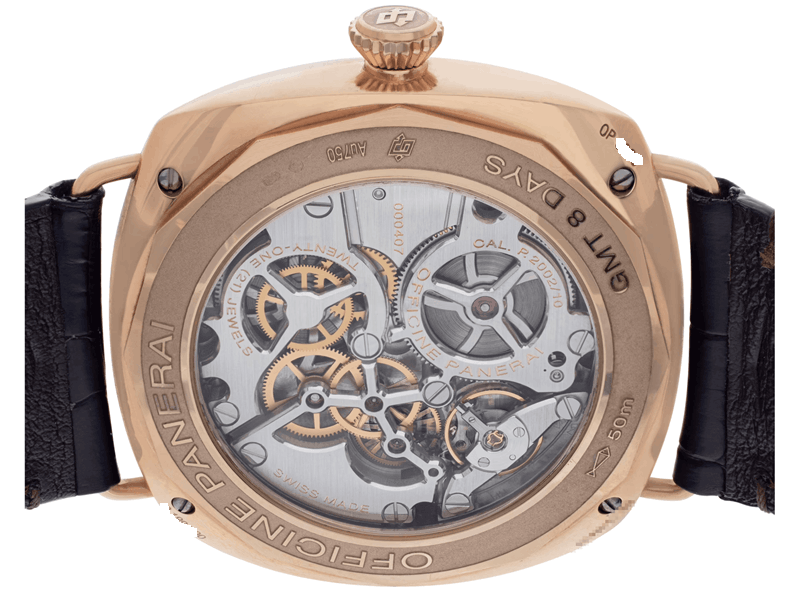
The “/10” suffix in P.2002/10 is the part most descriptions skip. It distinguishes this variant from the standard P.2002 by the finishing on its bridges — most of the primary movement bridges have been partially skeletonized, cut away to reveal the barrel architecture and gear train below. This is not a fully skeletonized movement in the haute horlogerie sense. It’s a purposeful window cut into otherwise solid bridges, and WatchBase’s calibre documentation confirms this is a special-finish variant deployed specifically in precious-metal special edition references.
The result through the exhibition sapphire caseback is genuinely striking. You can see all three barrel drums directly. The gear train from barrel to escapement is visible in sequence. The Glucydur® balance wheel — a beryllium-copper alloy construction that resists magnetism and temperature variation — oscillates at 28,800 vph with a rhythm that reads as purposeful rather than frenetic. The bridges that remain are finished with Côtes de Genève striping, which catches the light at an angle. Nothing about this movement is trying to be decorative. All of it happens to look good because it was built correctly.
At 6.6mm thick for the base calibre (thinner than some in-house Panerai movements), the P.2002 contributes to a case that wears less bulky than you’d expect from a 45mm watch with this much going on mechanically. For a movement carrying three barrels, a GMT differential, and a power reserve mechanism across 245 components, that’s an engineering compression achievement worth acknowledging.
For context, the closely related P.2003 calibre family extended the same triple-barrel architecture into ten-day GMT territory. The P.2002 is the more restrained expression — eight days, no automatic winding, nothing extraneous. For collectors who prefer hand-winding as a deliberate act of engagement with a mechanical object, that restraint is a feature.
Does the PAM00395 Make Sense at Its Price?
Secondary Market Context — What 500 Pieces of Goldtech Trade For
The PAM00395 retailed at approximately $33,700 USD at launch. On the current secondary market via Chrono24, you’re looking at a spread from roughly $16,000 for fair-condition examples without papers to around $28,000 for mint, full-set, boxed-and-certificated pieces. That’s a meaningful discount from retail for a watch with a Goldtech case and an in-house manufacture movement with 245 components.
The comparison to make here isn’t to the steel Radiomir references — it’s to the PAM00502 Radiomir Monopulsante Oro Rosso, the eight-day GMT chronograph in rose gold that commands higher secondary-market values by virtue of its greater complication density and the relative drama of the monopusher architecture. Against that reference, the PAM00395 positions as the quieter choice — more classical Radiomir in spirit, the movement visible rather than immediately obvious from the dial’s face.
The 500-piece limitation doesn’t guarantee scarcity at any given moment, but it does create a defined ceiling. You’re not going to find fifty of these on the market simultaneously. The production number is small enough that condition and provenance genuinely differentiate examples on the secondary market — a mint example with original certificate commands a real premium over a worn example without papers, which isn’t always true of higher-volume Panerai references.
The honest question is whether the gold case commands a premium over the equivalent steel PAM00323 or PAM00346 for a collector primarily drawn to the movement. For most buyers it does — the Goldtech case and the skeletonized bridge finishing of the P.2002/10 are complementary; both are expressions of craft beyond the strictly functional. If you’re indifferent to the case material and want the P.2002 architecture, there are steel alternatives. But the /10 finishing on the bridges exists specifically in the precious-metal editions, and that’s the argument for the PAM00395 that stands up to scrutiny.
The case for owning one: the PAM00424 Radiomir California and references like it are the easy Radiomir entry points, the ones that attract buyers with their visual personality. The PAM00395 attracts buyers who’ve already been around the Radiomir long enough to know what the P.2002/10 represents.
Who Is It For?
- The Panerai collector who has already owned steel Radiomirs and wants a precious-metal reference where the material choice is reinforced by equally exceptional mechanics underneath — not just a gold case on a standard movement.
- A Paneristi drawn to hand-wound Panerai movements with architectural interest — three-barrel series construction, exhibition caseback, the ritual of an eight-day winding cycle.
- Someone who rotates a collection and values the eight-day reserve precisely because it accommodates a watch that doesn’t live on the wrist every day. Wind it fully, rotate other pieces, come back to it a week later.
- A buyer entering the gold Panerai segment at a secondary-market discount. The original ~$33,700 retail for a Goldtech case with a fully in-house movement was reasonable. At $16,000–$22,000 for clean examples, it’s a compelling mechanical argument.
- A collector who appreciates undersung references. The PAM00395 is not discussed the way the PAM00382 Bronzo or the PAM00372 Luminor 1950 are discussed. Some collectors prefer it that way.
Not for: Anyone looking for Panerai’s sporty, tactical identity — this watch belongs to the dressy end of the Radiomir spectrum. Not for collectors whose interest begins and ends with the Luminor crown guard. Not for buyers who need 100+ metres of water resistance. And not for anyone who expects gold Radiomir values to behave like blue-chip steel references — the liquidity is thinner and the price swings are wider.
Conclusion
The Panerai PAM00395 is the kind of watch that reveals itself gradually. The Goldtech case catches the eye first; the brown sandwich dial holds it; the exhibition caseback tells you what you’re actually dealing with. Three barrels in series. Skeletonized bridges. Eight days of in-house manufacture power reserve from the calibre that began Panerai’s transition into a true movement-maker.
It isn’t the most celebrated gold Radiomir Panerai ever produced. It isn’t trying to be. At its best — and a well-preserved, full-set example is genuinely at its best — the PAM00395 makes a coherent argument: that the most interesting expression of a Goldtech Radiomir might not be the one with the most complications, but the one that lets you see how it works.
For a Paneristi who’s arrived at the gold segment and wants substance behind the warmth of the case, this is the reference worth finding. Secondary market values make the conversation accessible. The movement makes it worth having.
Does the P.2002/10’s triple-barrel architecture change how you think about a watch’s relationship to its power reserve? Drop your thoughts below.
Extended Summary
- PAM00395 is the Radiomir 8 Days GMT Oro Rosso — a 500-piece special edition from 2012 in 45mm Goldtech™, Panerai’s proprietary rose-gold alloy that holds its warm hue longer than standard 18k rose gold thanks to its platinum content.
- The P.2002/10 calibre is this watch’s defining feature: a fully in-house hand-wound movement with three mainspring barrels in series, partially skeletonized bridges, and an eight-day power reserve that traces its lineage to Panerai’s 1940s wartime instruments — all visible through the exhibition sapphire caseback.
- The brown sunray sandwich dial carries GMT, date, small seconds, and a linear power reserve indicator across a 45mm canvas without crowding — a disciplined layout that rewards the attention you give it.
- Secondary market pricing of $16,000–$28,000 USD (condition dependent) represents a material discount from the ~$33,700 original retail, making the Goldtech case and skeletonized-bridge movement architecture considerably more accessible than at launch.
- Best suited to experienced Paneristi who’ve moved through the steel Radiomir references and want a precious-metal piece with a mechanical argument to match its material — the PAM00395 is for the collector who looks through the caseback first and at the case second.
At a Glance
| Spec | Detail |
|---|---|
| Reference | PAM00395 |
| Collection | Special Editions |
| Introduced | 2012 |
| Case material | Polished Goldtech™ (proprietary Panerai rose-gold alloy) |
| Case diameter | 45mm |
| Case thickness | ~13mm |
| Water resistance | 50 metres |
| Movement | Panerai P.2002/10 — hand-wound, skeletonized bridges |
| Power reserve | 8 days (192 hours) |
| Beat rate | 28,800 vph |
| Jewels | 21 |
| Complications | GMT, date, small seconds, linear power reserve indicator |
| Dial | Brown sunray sandwich; Arabic numerals; date @ 3; seconds/24h @ 9; linear PR @ 6 |
| Availability | Discontinued; limited to 500 pieces |
| Original retail price | ~$33,700 USD |


