Quick Takeaways
- The panerai pam00088 is the Luminor GMT Automatic Acciaio, produced from D-series 2001 through R-series 2016, discontinued in favour of the PAM01088. WatchBase confirms it “has always been a favorite among Paneristi” and “one of Panerai’s biggest sellers.” Fifteen consecutive production series is not luck; it is what sustained commercial success looks like in the Panerai catalogue.
- 44mm polished AISI 316L stainless steel Luminor case, 16.5mm thick, 53mm lug-to-lug, fully polished, not satin/brushed, Luminor crown guard lever, 300m water resistance. The classic Vendome-era Luminor proportion; bigger on the wrist than its diameter suggests, and deliberately so.
- The OP VIII movement: automatic, ETA Valjoux 7750-P1 base, 21 jewels, 28,800 vph, 42-hour power reserve, Glucydur balance, Incabloc, Côtes de Genève, COSC certified, the GMT variant of the OP III family, adding a 24-hour arrowhead hand reading against an outer ring for a second time zone. Both GMT and date adjusted from the second crown position, no extra pushers.
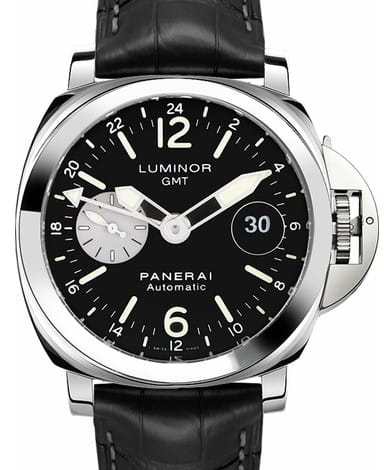
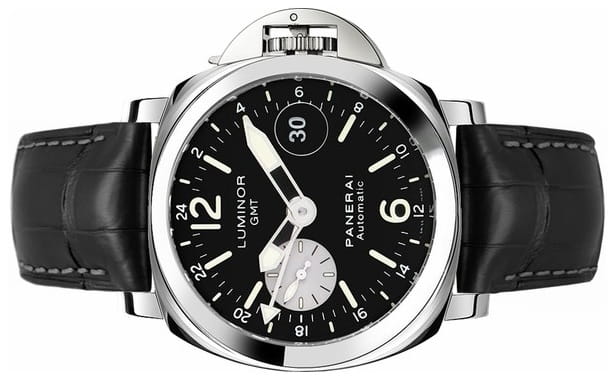
- Black dial with 24-hour outer scale, Arabic numerals at 12 and 6, SuperLuminova hands and markers, small seconds at 9, date at 3 with magnifying lens, applied construction, not sandwich. Dense with information by Panerai standards, but each element earns its place; nothing on this dial is decorative.
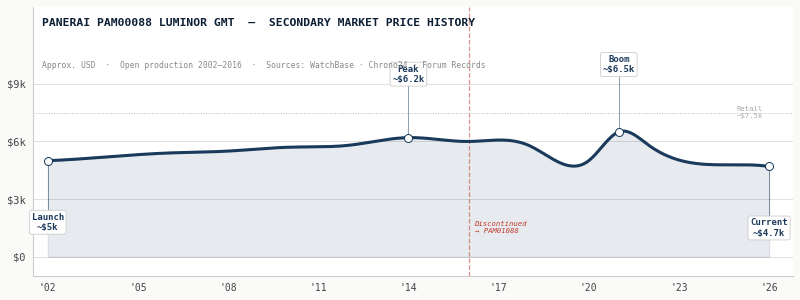
- Secondary market: ~$3,800–$6,100 (Chrono24 listings observed as of publication, April 2026), with an average around $4,700, significantly below the original $7,500 retail. But WatchCharts shows the PAM88 has outperformed the Panerai Luminor collection average by 5.2% and brand average by 11.1% over five years. One of the better-value pre-owned Panerai propositions available today, though listings and averages shift, check current market for up-to-date figures.
Jump directly to the spec sheet.
The Panerai That Needed No Second Chance
There is a specific kind of Panerai that never needed to be rediscovered, never went through a period of being underrated, never required a forum thread titled “is this one undervalued?” to find its audience.
The panerai pam00088 is that watch. The Luminor GMT Automatic Acciaio ran from 2001 to 2016 across fifteen production series. It was one of the brand’s biggest commercial successes. It currently ranks among the five most-searched Panerai references on Chrono24. And ten years after its discontinuation, it still sells reliably, still shows up in collector discussions, still turns up on wrists at watch meetups alongside far rarer references.
None of this is coincidental. The PAM00088 got the recipe right from the beginning: 44mm polished steel Luminor case, automatic OP VIII movement, GMT complication and date, black dial with a 24-hour outer ring. Functional, recognisable, wearable as a daily watch, credible as a travel companion.
For a brand built on tool watches, the most honest verdict on the PAM00088 is also the simplest: it works.
The Luminor GMT That Panerai Kept Making for 15 Years
From D-Series to R-Series: A 15-Year Production Run
The Luminor collection’s commercial expansion after the Richemont acquisition required a GMT reference, a watch that could carry the Luminor’s tool-watch identity into the practical travel category. The PAM00088 debuted in D-series 2001 alongside the titanium PAM00089, sharing a combined millesimation of 2,500 pieces in their first production year. By K-series 2008, annual production for the PAM00088 had reached 4,500 pieces, figures that place this firmly in volume production territory, not special edition.
Fifteen series. D through R. The architecture evolved across them:
Early series (D through F, 2001–2003) used case reference OP6554, BA buckle hardware, and were fully polished, the cleanest execution of the design. J-series (2007) brought strap interchangeability via a runner lever and nut system, a new caseback engraving with the OP logo, and the Panerai logo appearing on the rear of the buckle. K-series (2008) prepared the case architecture for an optional metal bracelet configuration, resulting in case numbers OP6691-6761. Later series (L through R) settled on OP6761 with 1,000–2,000 pieces annually.
The Panerai Reference Database documents each year’s millesimation, case number, and functional evolution in detail, essential reading for anyone buying a specific series.
Why the GMT Function Made Sense for This Era
By 2001, Panerai’s buyer was not a military diver. The brand’s transition from naval instrument supplier to Richemont-era luxury watch manufacturer had produced a customer profile that was affluent, internationally mobile, and drawn to the tool-watch aesthetic precisely because it wasn’t corporate. A GMT reference made obvious sense for that person, the same DNA, the same instantly recognisable Luminor case, but with a complication that justified wearing the watch on a flight rather than just claiming it was a diver.
The PAM00088 delivered exactly this. No chronograph, no perpetual calendar, no tourbillon, just the complication a frequent traveller actually needs, in the watch they already wanted to own.
Commercial Legacy and Collector Standing
The collector community’s reception is not ambiguous. WatchBase summarises it directly:
“The PAM 88 has always been a favorite among Paneristi.” WatchBase, PAM00088 reference entry
In January 2026, Chrono24’s magazine ranked the PAM00088 among the five most popular Panerai references on its platform, a market signal, not a critical judgement, but one that reflects sustained collector demand a full decade after discontinuation. WatchCharts data adds precision: the PAM88 declined 11.2% over five years, versus a 22.3% decline for the Panerai Luminor collection index. Outperforming a benchmark by 11.1% over five years is what a well-regarded reference with sustainable demand looks like.ll decade after discontinuation. WatchCharts data adds precision: the PAM88 declined 11.2% over five years, versus a 22.3% decline for the Panerai Luminor collection index. Outperforming a benchmark by 11.1% over five years is what a well-regarded reference with sustainable demand looks like.
The 44mm Luminor Case and the GMT Dial
Polished Steel at 44mm: The Classic Luminor Proportion
44mm polished AISI 316L stainless steel. Fully polished, not the satin/brushed combination that dominates Panerai’s later production, but a uniform mirror surface on the case body, bezel, and crown guard. The fully polished finish is a characteristic of the early Vendome-era Luminor production; D through F series examples are typically the most completely polished, before later refinements introduced mixed finishing.
At 16.5mm thick and 53mm lug-to-lug, the PAM00088 is a presence. A 44mm Luminor wears larger than its diameter suggests because of the case height and lug geometry, it sits high on the wrist, fills a shirt cuff, and is visible from across a room. Collectors who know Panerai expect this. Those encountering the brand for the first time should size up in person before committing.
The Luminor crown guard lever, polished steel, pivoting on a pin, locking the crown against the case side, is the functional element that delivers the 300m water resistance rating. It is also, for many collectors, the most characteristically Panerai thing on the watch. Push the lever up, unscrew and pull the crown, set the time; press the lever back down, engage the seal. The interaction is tactile and deliberate in a way that crown-guard-free Radiomir models aren’t.
The GMT Dial: Dense but Legible
The black dial carries more information than a Luminor Marina, arranged with Panerai’s characteristic hierarchy. Large Arabic numerals at 12 and 6, luminous stick indexes filling the quarters, SuperLuminova on every hand and marker. The layout is immediately readable.
The 24-hour scale occupies the outermost ring, luminous Arabic numerals running the full circumference of the dial, read by the silver-tone arrowhead GMT hand whose tip is luminous-filled for night readability. This hand moves at half the speed of the hour hand, one full rotation per 24 hours, pointing to the hour on the outer scale to show the second timezone.
At 9 o’clock: the open flange small seconds sub-dial, the silver running seconds that distinguishes this from a base Luminor and confirms the movement is running. At 3 o’clock: the date window, sitting beneath a magnifying lens built into the slightly domed sapphire crystal.
The dial construction is applied, not sandwich. Luminous markers are applied over the dial surface rather than cut through a two-layer construction, the sandwich approach associated with hand-wound Radiomir models. Applied construction produces a slightly different visual texture to sandwich dials, and Paneristi who came to the brand through the Radiomir line notice the difference. It is not inferior, it is the correct construction for an automatic watch of this specification, but it is worth stating plainly for collectors who care about it.
How Does the GMT Function Work on the PAM00088?
The arrowhead GMT hand completes one rotation every 24 hours, reading the time in a second timezone from the outer ring. The ring is divided into two halves, 1 through 12 and 13 through 24, so AM and PM are distinguishable by which half of the ring the GMT hand occupies.
The home timezone runs on the main hour hand. The travel/reference timezone shows on the 24-hour outer ring. Both GMT and date are adjusted from the second position of the crown, no additional pushers drilled through the case, no crown at 2 or 4 o’clock. The entire adjustment architecture uses the lever-guarded crown that Panerai has used since the Luminor’s founding design. Setting GMT on the PAM00088 is the same interaction as setting time on any Luminor, just pulled one position further.
The OP VIII — Panerai’s GMT Workhorse
What the OP VIII Is
The OP VIII is the GMT variant of the OP III calibre family. Both are built on the ETA Valjoux 7750-P1, a chronograph base from which Panerai removed the chronograph function entirely, retaining the automatic winding architecture, the date, and the small seconds. Where the OP III left the resulting movement as a clean three-hand automatic with date, the OP VIII added a 24-hour GMT hand driven from a modified cannon pinion.
The confirmed specification: 13¼ lignes, 21 jewels, Glucydur balance, 28,800 vph, 42-hour power reserve, Incabloc anti-shock, Côtes de Genève decoration on bridges, COSC chronometer certified. The PAM00024 Luminor Submersible used the OP III, the relationship between the two movements is direct; the OP VIII adds one additional hand to the same foundations.
The ETA Base: Honest Assessment
The Valjoux 7750-P1 is one of the most widely serviced automatic bases in Swiss watchmaking. Any qualified watchmaker with access to ETA parts can service the OP VIII; no proprietary components, no specialist training required. For a watch that was produced in quantity across 15 years and is now over a decade into its pre-owned life, this serviceability matters.
What the OP VIII is not: an in-house Panerai calibre. The brand’s own engineering programme did not produce its first movement (the P.2002) until 2005, four series into the PAM00088’s production run. For the first half of this watch’s life, there was no alternative; the OP VIII was what Panerai’s automatic movements looked like. The P.2003 calibre family shows what in-house GMT engineering eventually looked like from Panerai, the contrast is instructive, and so is the price difference.
The 42-hour power reserve is the one specification worth flagging directly. Two days off the wrist without a winder will stop the watch, the movement needs to be restarted and reset on Monday morning. The successor PAM01088’s OP XXXI offered 50 hours, and the improvement was real and noticed. For daily wear the 42-hour reserve is adequate; for collectors who travel frequently and take the watch off at night, it requires attention.
What Côtes de Genève Means at This Level
The bridges carry Côtes de Genève decoration, parallel stripes applied to the movement bridges, visible through the caseback on examples with an exhibition rear (note: standard production is solid steel caseback; some listed examples specify a sapphire back, so verify when buying). The Côtes de Genève is a finishing standard that lifts the OP VIII’s visual presentation above a bare functional movement. It does not affect performance. It is appropriate for a watch at this price point and communicates that Panerai treated the movement as something worth presenting, not just as an engine to be hidden.
Pre-Owned in 2026 — The PAM00088 After Discontinuation
The panerai pam00088 is among the most liquid pre-owned Panerai references available. Discontinued in 2016 means a decade of secondary market trading, deep inventory, and well-established pricing. As of publication (April 2026), Chrono24 listings showed an average price around $4,700, with the full range spanning $3,800 to $6,100; check current listings for up-to-date figures, as pricing shifts over time. The 61% rate of complete sets (box and papers included) is the highest of any comparable reference, collectors kept the paperwork.
The original retail of approximately $7,500 means the watch trades at roughly 60–63% of its new price after a decade. That is below average for a prestige brand reference, but the WatchCharts data provides context: the PAM88 declined 11.2% over five years, while the broader Panerai Luminor collection index fell 22.3% across the same period. Relative to the brand’s overall direction, this is an outperformer.
Series matters. D and E series examples (2001–2002) command a collector premium for their age, early serial numbers, and fully polished case finish. If you want the earliest Vendome expression of the PAM00088, prioritise D or E series with original BA buckle hardware. Later J-series onward bring strap interchangeability and the new caseback engraving, more practical but less historically concentrated.
Box and papers are worth the premium here. The original package, Panerai wood case, guarantee booklet, registration card, warranty card, rubber strap, strap-changing tool, is documented at around 61% of active listings. A $400–$500 premium over a naked example is typically justified by easier resale and confirmed provenance.
Service history: OP VIII service is accessible and well-documented. Unlike the Chézard Cal. 7400 in the PAM00080 or the GP movement in the PAM00077, the Valjoux 7750-P1 base has no parts scarcity. Confirm a service has been done within the last 5–7 years, or factor the cost in. A serviced example at $4,500 is a better buy than an unserviced example at $4,000.
For collectors considering the PAM00088 as a first Panerai or a first GMT, the PAM00537 Luminor 1950 GMT offers an interesting comparison, a more recent reference with a different case profile and similar complication architecture. The PAM00088’s straight Luminor case and long production history make it the more historically grounded choice of the two.
Who Is It For?
- The collector who wants a genuine Panerai daily wearer. The PAM00088 was built in quantity, designed to be worn, COSC certified, 300m rated, and automatic; it has no fragility about it and none of the preciousness that makes limited editions difficult to live with
- Frequent travellers who actually use the GMT function. The 24-hour outer ring and arrowhead hand are practical tools, not ornamental complications; the adjustment from the crown second position is clean and non-intrusive; this is a watch that earns its extra hand
- Paneristi building a working collection rather than a vault. The PAM00088 is the reference you wear to the airport, the restaurant, the dive boat; it is not the reference you put in a watch box and admire; it exists to be used
- Pre-owned buyers entering the Panerai market. At an average around $4,700 as of publication, the PAM00088 offers one of the most recognisable Panerai dial configurations at a fraction of its original retail; COSC certification, 300m depth rating, and accessible service make the ownership proposition solid
- Collectors who value a long production history as a positive. A 15-year run means the community is vast, reference documentation is thorough, service knowledge is widespread, and parts are readily available; the PAM00088 has no collector orphan risk
Not for: Collectors who prioritise in-house movements, the OP VIII is ETA-based; this is a documented fact, not a hidden limitation, but if movement provenance matters to you, the PAM00088 is not where Panerai’s in-house story is told. Anyone wanting a sandwich dial, the applied construction is correct for this watch, but if the layered Radiomir aesthetic is what brought you to Panerai, look at the hand-wound references instead. Collectors who need a subtle wrist presence, 44mm polished steel with a 16.5mm case height is not a small watch and the fully polished finish amplifies it further; this watch is present. And those looking for a limited edition with future rarity potential, the PAM00088 was made in large numbers across many years; its value proposition is utility and heritage, not scarcity.ith a 16.5mm case height is not a small watch and the fully polished finish amplifies it further; this watch is present. And those looking for a limited edition with future rarity potential — the PAM00088 was made in large numbers across many years; its value proposition is utility and heritage, not scarcity.
Conclusion
The panerai pam00088 did not earn its reputation through rarity or complication theatre. It earned it by being exactly what it said it was, a 44mm polished steel Luminor, automatic, with a GMT hand and a date, produced consistently for fifteen years because the market kept asking for more.
Ten years after discontinuation, it remains one of the five most-searched Panerai references on the secondary market, holds value better than most of the collection it belongs to, and sits at a price point that makes it properly accessible. The OP VIII is not a complicated movement story, it is a reliable, serviceable automatic that gets out of the way and lets the watch do its job.
For a brand whose identity is rooted in tool watches made to be used, the PAM00088 is perhaps the purest expression of that idea in the modern civilian catalogue.
Do you wear your PAM00088 as a daily driver, or does it share rotation with other references? Leave a comment below.
Extended Summary
- The panerai pam00088 is the Luminor GMT Automatic Acciaio: 15 production series from D (2001) to R (2016), discontinued in favour of the PAM01088. WatchBase confirms it was “one of Panerai’s biggest sellers” and “has always been a favorite among Paneristi.” Ranked among the five most popular Panerai references on Chrono24 as of January 2026, a decade after discontinuation.
- 44mm polished AISI 316L stainless steel Luminor case, 16.5mm thick, 53mm lug-to-lug, Luminor crown guard lever, 300m water resistance. Case reference evolved from OP6554 through OP6691 to OP6761 across the production run. Fully polished finish is the Vendome-era standard; early D/E series examples are the most completely polished and carry a collector premium.
- The OP VIII movement: ETA Valjoux 7750-P1 base (modified), automatic, 21 jewels, 28,800 vph, 42-hour power reserve, Glucydur balance, COSC certified, Côtes de Genève on bridges. GMT and date both adjusted from the second crown position. The 42-hour reserve is the one honest limitation; the successor PAM01088 improved this to 50 hours with the OP XXXI.
- Black dial with 24-hour outer scale, Arabic numerals at 12 and 6, arrowhead GMT hand in silver-tone, small seconds at 9, magnified date at 3, applied (not sandwich) construction, SuperLuminova throughout. The dial carries more information than a base Luminor Marina but nothing that isn’t functional; every element earns its place.
- Secondary market: ~$3,800–$6,100 (Chrono24, as of publication April 2026), average ~$4,700, below original $7,500 retail but outperforming the Panerai Luminor collection index by 5.2% over one year and brand average by 11.1% over five years. 61% of listings are complete sets with box and papers; OP VIII service is widely available from any ETA-trained watchmaker. Check current listings for up-to-date pricing.
At a Glance
| Reference | PAM00088 |
| Name | Luminor GMT Automatic Acciaio |
| Collection | Luminor |
| Production | D-series 2001 → R-series 2016 |
| Discontinued | 2016 (replaced by PAM01088) |
| Case material | Polished AISI 316L stainless steel |
| Case diameter | 44mm |
| Case thickness | 16.5mm |
| Lug to lug | 53mm |
| Lug width | 24mm |
| Crown | Luminor lever crown guard |
| Caseback | Solid screw-down steel |
| Water resistance | 300m / 30 ATM |
| Movement | Panerai OP VIII |
| Base | ETA Valjoux 7750-P1 (modified) |
| Winding | Automatic |
| Beat rate | 28,800 vph |
| Power reserve | 42 hours |
| Jewels | 21 |
| Certification | COSC chronometer |
| Decoration | Côtes de Genève on bridges |
| Complications | GMT (second time zone), date |
| Dial | Black — 24-hour outer scale — Arabic numerals at 12 and 6 — small seconds at 9 — date at 3 |
| Strap | Brown alligator/crocodile + black rubber (both included) |
| Original retail | ~$7,500 USD |
| Secondary market | ~$3,800–$6,100 |
| Availability | Pre-owned only |