Quick Takeaways
- The Panerai PAM00253, the Luminor 1950 Flyback Regatta, is a 2006 special edition of 500 pieces created to mark the second edition of Panerai’s Classic Yachts Challenge, the international sailing circuit the brand had launched the previous year.
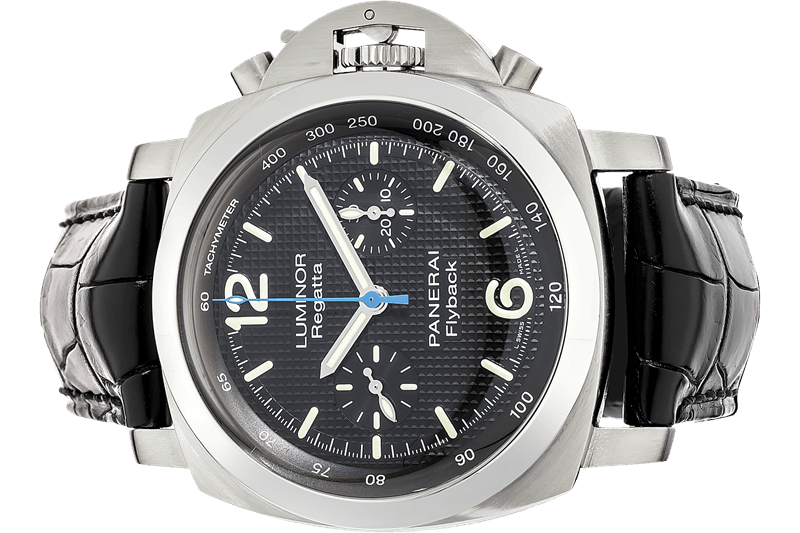
- Its defining feature is the combination of a black Clous de Paris (hobnail) dial, a guilloché technique in watchmaking since the 18th century, and a single blue central flyback hand against that textured black field. Nothing else in the catalogue looks quite like it.
- The movement is the OP XIX, an automatic flyback chronograph based on the Valjoux 7750/7753, COSC-certified, 30 jewels, 42-hour power reserve. Not in-house, but proven and completely right for a watch this size.
- The 44mm Luminor 1950 case carries polished pushers at 2 and 4 o’clock, an exhibition sapphire caseback, and the classic crown guard. “Classic Yachts Challenge 2006” is engraved on the outer rim of the caseback.
- Secondary market examples trade from approximately $8,100–$11,725 USD, with genuine scarcity, at any given moment you’ll find fewer than ten active listings worldwide.
Jump directly to the spec sheet.
Panerai PAM253 – The Hobnail Chronograph That Sails
Not every Panerai special edition earns its context. Some carry sailing or diving associations that feel more like marketing than heritage. The PAM00253 is not one of those.
When Panerai launched the Luminor 1950 Flyback Regatta in 2006, it was the second year of the Panerai Classic Yachts Challenge, a sailing circuit the brand had inaugurated the previous year and would go on to build into one of the world’s most prestigious series for classic and vintage yachts. The timing was deliberate. The watch was a physical statement that Panerai’s relationship with the sea wasn’t corporate branding, it was something the brand was actively investing in, one regatta at a time.
Five hundred watches. Black hobnail dial. One blue flyback hand. The Panerai PAM00253 is a watch that most people haven’t heard of, that surfaces on secondary markets infrequently, and that stops conversation when it does.
The production number of 500 is the floor of the story here, not the ceiling. What matters more is why this particular chronograph looks the way it does, and why, nearly two decades after its release, it holds both its value and its distinctiveness in a brand known for producing hundreds of references.
Panerai and the Sea: How the Classic Yachts Challenge Was Born
The PAM00253 as Physical Trophy: What the PCYC Actually Means
Panerai’s naval roots are not invented. The brand spent decades supplying precision instruments and wrist-worn timekeepers to the Italian Royal Navy’s combat divers, the frogmen of the Decima MAS who piloted manned torpedoes through the harbours of Gibraltar and Alexandria during the Second World War. That military instrument-making heritage runs from the 1930s through the brand’s revival as a civilian watchmaker in 1993, and it’s why a diving and maritime identity carries genuine weight at Panerai rather than being grafted on.
The Panerai Classic Yachts Challenge took that heritage and directed it toward the living world of vintage sailing. Established in 2005, the PCYC became the leading international circuit for classic and vintage yachts, boats launched before 1975, racing across Mediterranean and North American venues under period-appropriate rules. By its third edition Panerai had purchased and restored the Bermudian ketch Eilean, built in 1936, which became the circuit’s iconic centrepiece vessel. The race series grew from a handful of Mediterranean regattas to ten events across two continents, drawing hundreds of vessels representing over a century of yacht-building tradition.
The PAM00253 was produced for the 2006 edition, the circuit’s second year, when the ambition was already clear but the scale was still intimate. Five hundred pieces for a regatta that was, at that point, still earning its identity. The caseback engraving, Classic Yachts Challenge 2006, is a timestamp you can read with your fingernail. Not a marketing phrase but a production record.
The Clous de Paris Dial: Ancient Technique in a Tool Watch
What Hobnail Guilloché Actually Is (and Why It Matters Here)
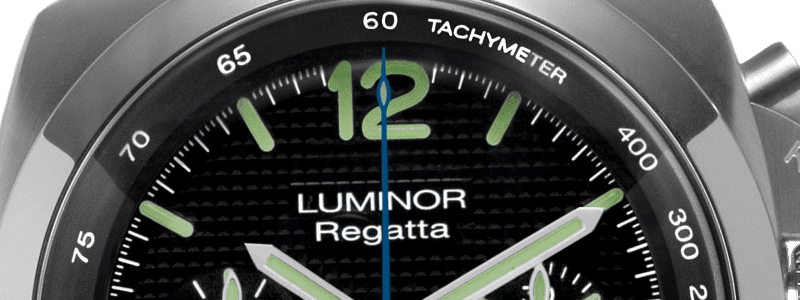
I want to spend real time on this dial, because it’s the reason the PAM00253 is visually distinct from everything Panerai built around it.
The hobnail or Clous de Paris finish is a guilloché engraving technique in use since the 18th century. The name, “nails of Paris,” comes from the paved streets of the French capital, where the heads of cobblestones created a characteristic grid of small raised points. In watchmaking, the pattern is created by engine turning or by hand with a burin: intersecting diagonal lines cut into a metal surface, producing rows of tiny pyramid-shaped raised points that catch and scatter light at different angles as the viewing angle changes. The effect is deeply three-dimensional, the dial surface appears to move as the wrist moves, shifting between matte-flat and glittering-bright.
This is not a technique you typically associate with tool watches. Patek Philippe used it on Calatrava bezels; Audemars Piguet deployed it across the Royal Oak dial; Jaeger-LeCoultre applies it to Reverso cases. The guilloché context is dress watchmaking, high finishing, the métiers d’art tradition.
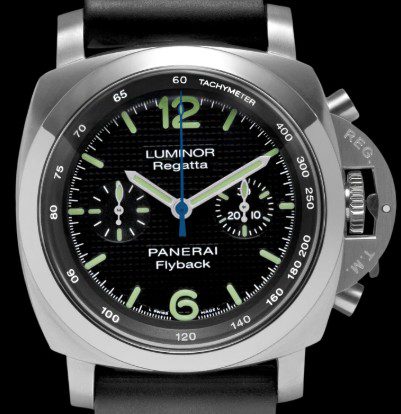
Panerai put it on a 44mm flyback chronograph built to commemorate a sailing regatta. And it works. The hobnail texture on the PAM00253 reads darker than a polished carbon fibre dial and considerably more complex than a matte black. Under direct light, individual pyramid points catch the beam and the dial appears to shimmer in segments, not uniformly, but in moving patches that depend entirely on the incident angle. Under softer light, the overall surface reads as deep textured black, the luminous Arabic numerals lifting cleanly away from it. The sub-registers at 3 and 9 o’clock have smooth black finishing, creating an intentional contrast against the textured main dial field.
The PAM535 and PAM537 from 2014 are usually the first hobnail Panerais most collectors think of. The PAM00253, which predates them by eight years, established the ground. It was the first Panerai chronograph with a hobnail dial, and it did it on a 500-piece sailing edition before the texture became part of the brand’s broader commercial vocabulary.
The Blue Flyback Hand: One Visual Decision That Changes Everything
The central flyback hand of the PAM00253 is blue.
That is, on paper, a minor specification. In practice it’s the element that lifts this watch from “visually interesting” to “immediately recognisable.” Against the hobnail black, a standard silver or white chronograph hand would have registered cleanly but conventionally. The blue, a vivid, saturated blued-steel tone, creates a chromatic accent that draws the eye to the chronograph function specifically. You always know exactly where the flyback hand is, even when it’s in motion. You always know when the chronograph is running.
“The blue second counter is stunning against with the black dial.” Watches24Seven seller listing, documenting a PAM00253 in collector condition, complete with box and papers
The blue hand is deliberate Panerai design language for their regatta line. Later regatta references continued the practice, the PAM00526 with the P.9100/R used dual-colour hands (orange for minute, blue for seconds), but the PAM00253 was the first Luminor 1950 chronograph to use a blue hand as the primary functional accent. On a watch this visually spare, with nothing on the dial except the hobnail texture, luminous hour markers, and sub-registers, that single blue hand carries significant weight.
The flyback function itself: press the pusher at 4 o’clock mid-timing and the hand snaps instantly to zero and immediately restarts. No stop-zero-restart sequence. One press. In sailing, where race start countdowns overlap with the need to immediately re-time after a signal, this is the correct complication, efficient, legible, and genuinely faster to operate under real conditions than a conventional column-wheel chronograph. The PAM00526’s later regatta countdown function added further precision for race start timing, but the PAM00253’s flyback covers the essential use case well.
The 44mm Luminor 1950 Case — Flyback in the Right Architecture
The Luminor 1950 case, not the standard Luminor, is what makes the PAM00253 work dimensionally. The 1950 case brings longer lugs, a U-shaped case middle profile, and the domed crystal that the standard Luminor lacks. At 44mm it’s the smaller end of Panerai’s 1950 offering, and on a chronograph this makes practical sense: the thick 1950 case profile at 47mm becomes challenging to wear with any regularity, whereas the 44mm threads the needle between Panerai’s distinctive presence and daily wearability.
The pushers sit at 2 and 4 o’clock in polished steel, a contrast to the brushed case body, and a finishing choice that references traditional chronograph architecture. The crown guard is polished rather than brushed, which reads as dressier than a standard Luminor crown guard and more appropriate given the hobnail dial’s elevated register.
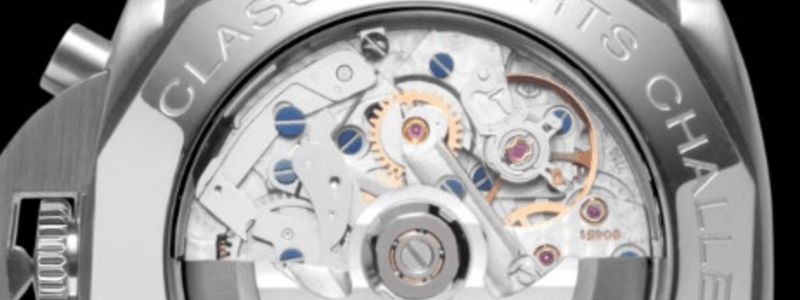
The exhibition caseback reveals the OP XIX movement and carries the regatta engraving on its outer rim. It’s a caseback worth looking at, and not just for the movement. The engraving confirms what you’re holding, which matters when a watch exists in only 500 examples.
Water resistance to 100 metres: sufficient for sailing, sufficient for swimming, not a diving specification. The watch is built for deck use and the rating reflects that honestly.
The OP XIX — Flyback Architecture, Honestly Appraised
The OP XIX is Panerai’s designation for a flyback chronograph calibre based on the Valjoux 7750/7753, the ETA automatic chronograph that powered a generation of sports watches from the 1970s onward. WatchBase’s documentation confirms the OP XIX as a Valjoux 7750/7753-derived automatic with flyback function. The movement is COSC-certified, runs 30 jewels, beats at 28,800 vph with a Glucydur balance, and carries a 42-hour power reserve with Côtes de Genève bridges and blued screws.
It is not in-house. That fact is worth stating clearly, then moving past.
The flyback mechanism in the OP XIX is the relevant functional claim, and it works. The instant reset, one pusher, no intermediate steps, is the entire point of a flyback for on-the-water timing, and the OP XIX delivers it reliably. The movement has four decades of global service history and a servicing network that requires no explanation. If you buy a PAM00253 and it needs a service in ten years, any qualified watchmaker can handle it.
The comparison that matters here is with Panerai’s in-house regatta references like the PAM00502, the Radiomir monopusher, which used a different movement architecture entirely. The PAM00253 predates Panerai’s full manufacture-movement era for chronographs; when it was made in 2006, the in-house P.2004 chronograph calibre had only just been introduced, and it wasn’t destined for this specific case architecture or price tier. The OP XIX was the appropriate solution for the watch Panerai built.
What the exhibition caseback shows is a movement that runs. Not a skeleton architecture, not a skeletonised grand complication, a working flyback chronograph with properly finished bridges. Through the sapphire back, the oscillating weight is visible, the bridges are dressed with Côtes de Genève, and the blued screws add the one chromatic note the caseback gets.
500 Pieces and the Secondary Market
Finding a PAM00253 requires patience. Chrono24’s current listings run from $8,100 to $11,725 USD, five examples, spread across multiple continents. WatchCharts data (from 2023) placed the average private-sale price at $8,327 and the average dealer price at $9,054, figures that have held broadly stable. The spread in active listings reflects condition variation more than model desirability; a worn example without papers sits at the floor, a mint box-and-papers example at the ceiling.
The engraved caseback, Classic Yachts Challenge 2006, is the single most important authenticity marker on this reference. It confirms the production year and the edition simultaneously. Any PAM00253 presented without the caseback engraving should be examined very carefully.
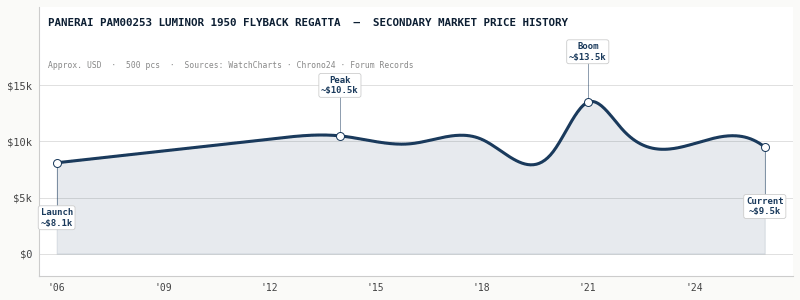
The thin market is simultaneously a drawback (you may wait months for the right example) and a feature (when you find one in proper condition, you’re buying something that won’t show up again quickly). For a collector who has decided the hobnail dial and blue flyback hand combination is what they want in their Panerai chronograph story, the wait is the correct posture.
Later regatta references, the PAM00371 (2011), the PAM00526 (2015), carry in-house movements and more evolved regatta functions, and they’re worth understanding as the PAM00253’s descendants. But the PAM00253 is the origin: the first hobnail Panerai chronograph, the founding watch of the Classic Yachts Challenge edition series, and the reference that proved the Clous de Paris finish worked on a Panerai tool watch. That’s a specific place in the brand’s timeline, and 500 pieces is a thin floor for it.
Who Is It For?
- A Panerai collector building around visual distinctiveness. The hobnail dial and blue flyback hand are genuinely rare in the brand’s catalogue. At 500 pieces from 2006, you won’t find another collector at the table wearing the same reference.
- Someone who understands and values the PCYC context. The PAM00253 isn’t branded with a racing series out of convenience. Panerai spent twenty years building the Classic Yachts Challenge into a serious circuit. This watch is from the second year of that effort, when the ambition was real but the scale was still intimate.
- A collector comfortable with ETA-sourced flyback movements. The OP XIX performs its function without drama. The in-house argument doesn’t apply to a watch bought for its dial and its provenance.
- A Paneristi who wants a chronograph that looks nothing like their other Panerais. The hobnail texture and blue accent hand are a genuine departure from the sandwich dial and clean-field aesthetic that defines most of the collection.
Not for: Collectors whose primary requirement is in-house movement architecture, the OP XIX is ETA-based and there’s no disputing that. Not for buyers who need an active, liquid secondary market, five current Chrono24 listings is a thin pool, and waiting is part of the process. Not for anyone who finds Clous de Paris too dressy for a tool watch context, the tension between guilloché finish and sports chronograph is real, and it’s deliberate. And not for collectors who need a complication portfolio: the PAM00253 gives you a flyback chronograph and a tachymeter, nothing beyond.ché finish and sports chronograph is real, and it’s deliberate. And not for collectors who need a complication portfolio: the PAM00253 gives you a flyback chronograph and a tachymeter, nothing beyond.
Conclusion
The Panerai PAM00253 exists because a brand with genuine maritime roots decided to put its best tool-watch chronograph tradition against a guilloché finishing technique borrowed from dress watchmaking. The result shouldn’t work as well as it does.
But here’s what I keep coming back to: the dial on this watch is not pretentious. The Clous de Paris isn’t there to make a flyback chronograph look like a dress watch. It’s there because Panerai was celebrating a sailing circuit that had everything to do with beauty, craft, and the sea, and they chose a finish that catches light the way water does. The blue hand moves across it. 500 people in the world own the numbered result.
Whether that combination earns its place in your collection is a question only your wrist can answer.
Is there a Panerai reference that surprised you with how well it worked despite a seemingly unlikely design combination? Leave a comment below.
Extended Summary
- PAM00253 is the Luminor 1950 Flyback Regatta: a 500-piece special edition from 2006, released to mark the second year of the Panerai Classic Yachts Challenge, with “Classic Yachts Challenge 2006” engraved on the outer caseback rim.
- The Clous de Paris dial, technically Paris hobnails, a guilloché technique in watchmaking since the 18th century, makes the PAM00253 the first hobnail Panerai chronograph, predating the much-discussed PAM535/537 by eight years; the textured black surface creates genuine three-dimensional depth that photographs cannot fully convey.
- A single blue central flyback hand against that hobnail field is the defining visual detail: immediately readable, chromatic against the black, and functionally central to the regatta timing use case the watch was built around.
- The OP XIX calibre is a COSC-certified automatic flyback based on the Valjoux 7750/7753, not in-house, but proven over decades and correct for a 2006 watch at this size and price tier; the flyback function operates correctly and serviceability is global.
- Secondary market pricing of $8,100–$11,725 USD across a thin pool of active listings reflects both the genuine scarcity (500 pieces, discontinued) and the watch’s specific niche, those who seek it out tend to keep it.
At a Glance
| Spec | Detail |
|---|---|
| Reference | PAM00253 |
| Collection | Special Editions |
| Introduced | 2006 |
| Limited to | 500 pieces |
| Case material | Brushed stainless steel, 44mm |
| Crown guard | Polished steel |
| Water resistance | 100 metres |
| Crystal | Sapphire, 2mm, anti-reflective |
| Caseback | Exhibition sapphire; “Classic Yachts Challenge 2006” engraved on outer rim |
| Movement | Panerai OP XIX (base Valjoux 7750/7753, automatic, flyback) |
| Power reserve | 42 hours |
| Beat rate | 28,800 vph |
| Jewels | 30 |
| Certification | COSC chronometer |
| Complications | Flyback chronograph (2 counters), tachymeter scale |
| Dial | Black with Paris hobnails; minute counter @ 3; seconds @ 9; central blue flyback hand |
| Strap | Black rubber; second calf strap (carbon fibre pattern) included |
| Lug width | 24mm |
| Availability | Discontinued; 500 pieces only |
| Original retail | ~$8,500 USD |