Quick Takeaways
- The Panerai PAM00026 is the black PVD destro Luminor Marina from 1998–1999 — crown guard at 9 o’clock, small seconds at 3 o’clock, the entire case architecture mirrored — and one of the most elusive references from the Vendome era’s founding lineup
- Three distinct series exist: A-series (~95 pieces, tritium dial, 1998), B-series (~200 pieces, tritium dial, 1999), K-series (1,000 pieces, Luminova, 2008) — the A and B series share a millesimation of 200 with the steel PAM00022 destro, making the actual PAM00026 production numbers startlingly small
- “Destro” means right wrist, not left-handed — the crown-at-9-o’clock configuration was designed for Italian Navy frogmen who wore instruments on their left wrist and needed an unobtrusive watch crown on the right; right-handed collectors wear it on the left wrist with the crown facing the arm, where it disappears entirely
- The A and B series carry tritium dials — the vanilla-yellow patina that develops over nearly three decades cannot be replicated or restored; the PAM00026 B-series retained tritium when most of its era’s black PVD siblings switched to Luminova, making it rarer in character than its numbers suggest
- Secondary market ranges from ~$5,000 for K-series to $21,000+ for pre-A full sets — with documented dial-flipping fraud in the early series making provenance verification non-negotiable rather than merely advisable
Jump directly to the spec sheet.
Most People Who Dismiss the Destro Have Never Worn One
That’s not a provocation. It’s an observation. The collector who has actually put a destro Panerai on their left wrist — crown guard at 9 o’clock, facing the arm instead of the hand — understands immediately what the configuration does. The Luminor’s bridge device, which normally sits against the back of the hand and announces itself with every keystroke, simply disappears. Under a long sleeve, the watch appears crownless. The case sits flat, the bridge faces inward, and the watch behaves like a much smaller object than its 44mm diameter suggests.
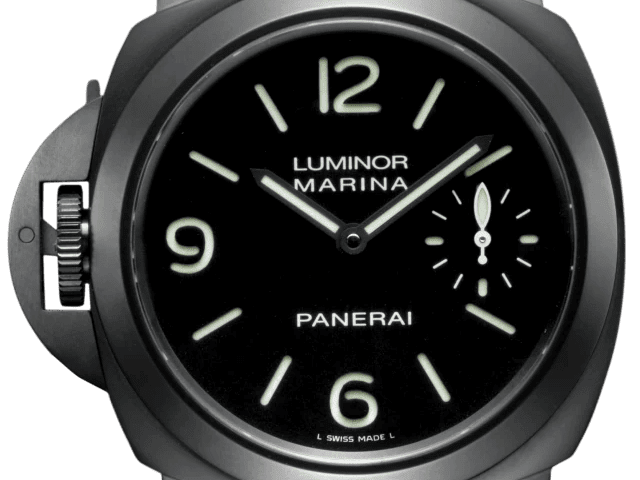
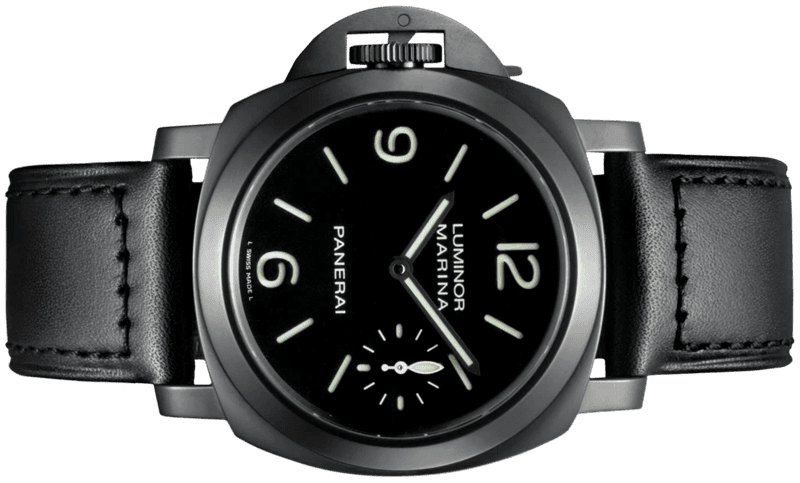
The Panerai PAM00026 is the original expression of that idea in black PVD. A destro Luminor Marina from 1998–1999, crown guard at 9 o’clock, sandwich dial with small seconds mirrored to 3 o’clock, black PVD-coated stainless steel case. Three series exist: an A-series of approximately 95 pieces with a tritium dial, a B-series of approximately 200 pieces also with tritium, and a K-series re-edition in 2008 of 1,000 pieces. The A and B series numbers are not production targets — they’re what actually came out of Panerai’s early Vendome-era production, shared with the steel PAM00022 destro under a joint millesimation of 200.
One of the most elusive Pre-Vendôme models. That’s Sotheby’s assessment of the A-series example they catalogued in 2020. And yet the panerai pam00026 is regularly misunderstood — dismissed as a watch for left-handers, overlooked by collectors who don’t understand the destro logic, undervalued relative to its rarity. This article is an attempt to fix that.
What “Destro” Actually Means — And Why Almost Everyone Gets It Wrong
The Italian Navy Origin — The Two-Wrist System
Destro is Italian for “right.” Not left-handed. Right-wrist.
To understand why that distinction matters, you have to go back to the history of Panerai as a military instrument supplier. The Italian Navy’s frogmen — elite underwater demolition units who conducted covert operations throughout the mid-twentieth century — didn’t wear just a watch. They wore a system. Depth gauge on the left wrist. Compass on the left wrist. The timing instrument on the right.
The problem with wearing a standard watch on the right wrist is the crown. On a Luminor, the crown guard is a substantial piece of architecture — a lever-operated bridge that protects the winding crown at 3 o’clock position. Worn on the right wrist, that bridge points directly outward, away from the arm, catching on equipment and pressing against the back of the hand. For a military diver navigating underwater in restricted conditions, this is more than inconvenient.
Panerai’s solution, first implemented in the 1960s with the variant reference 6152/1, was to mirror the entire case. Move the crown to 9 o’clock. Rotate the dial layout 180 degrees. Now the crown guard faces the arm when worn on the right wrist, the bridge points inward, and the watch sits flat without interference. The ref. 6152/1 was designed specifically for frogmen who needed their left wrist free for instruments — and who needed their right-wrist watch to stay completely out of the way.
That’s what destro means. A watch designed for the right wrist. Not a watch for left-handed people. The confusion has persisted for decades, and it obscures the genuine military logic behind one of Panerai’s most historically coherent design decisions.
The Ergonomic Reality — Why Right-Handers Wear It Too
Here’s the part the destro debate usually misses. The PAM00026 is not only for the right wrist. It’s extraordinary on the left.
On a conventional Luminor worn on the left wrist — the normal position for most people — the crown guard sits at 3 o’clock, pointing toward the back of the hand. On a large wrist, or with a short cuff, it digs in. On the panerai pam00026 worn on the left wrist, the crown guard faces the arm. It disappears under a sleeve. Gear Patrol’s review of the modern Luminor Destro Otto Giorni documented this precisely: the reviewer described moments when they forgot they were wearing the watch entirely — something they had never experienced with a standard Luminor before. The crown guard, Panerai’s most visually dominant case feature, simply stops announcing itself.
Watch Collecting Lifestyle’s coverage of the PAM26K noted the same phenomenon: wearing the destro on the left wrist means the watch “appears ‘sans crown’ if you are wearing a long sleeve.” For a watch as architecturally assertive as the Luminor, that’s a genuinely different experience.
This is why right-handed collectors want the PAM00026. Not because they’re wearing it on the wrong wrist. Because a Luminor Marina that sits quietly on the left wrist — crown hidden, bridge facing inward, case presence reduced — is a different object from the standard version. It doesn’t demand the same negotiation with sleeves and hand positions. It just sits there, doing its job.
The Dial Is Mirrored — Not Just the Crown
One detail that separates genuine knowledge about the panerai pam00026 from casual familiarity: the crown isn’t the only thing that moved.
The entire case is flipped 180 degrees. On a standard Luminor Marina, the small seconds sub-dial sits at 9 o’clock — standard position, conventional layout. On the PAM00026, it’s at 3 o’clock. The crown guard lever, which on a standard Luminor points upward toward 12 o’clock, now points downward toward 6. Every element of the case architecture has been reversed.
This is the immediate tell. If you see a PAM00026 with small seconds at 9 o’clock, something is wrong. The mirrored dial layout is as definitive as the crown position, and it’s the detail that demonstrates Panerai built this as a complete rethink of the case rather than a simple modification.
The Three PAM00026 Series — A Collector’s Map
This section runs longer than the others because it needs to. The panerai pam00026 is not a single watch — it’s three distinct collector propositions with different rarity profiles, different dial characters, and significantly different secondary market realities. Conflating them is where most buying mistakes happen.
A-Series (1998) — The Most Elusive Destro
The A-series PAM00026 was produced in 1998. It shares a millesimation of 200 with the steel PAM00022 destro — meaning the total production across both references was 200 pieces, not 200 of each. The Panerai Reference Database documents approximately 95 A-series PAM00026 examples produced, using case reference OP6504 and BB serial prefix.
Ninety-five pieces.
Each carries a tritium luminous dial marked “T SWISS T.” After nearly three decades, those dials have aged into a vanilla-yellow patina that varies from example to example depending on storage, light exposure, and temperature history. No two A-series dials look identical at this point. Each is a record of its own particular life.
“One of the most elusive Pre-Vendôme models is the present lot, the PAM 26A.” — Sotheby’s, auction catalogue for PAM00026 A-series lot, 2020
Sotheby’s catalogued that specific example with case number A112/200 — the 112th piece in the 200-unit joint millesimation. The full documentation included the original Panerai presentation box, a Limited Warranty Certificate card dated September 2001, a Chronometer Certificate, booklets, and two additional straps. That’s what a complete A-series set looks like. And finding one in that condition, with that documentation, is an event — not a transaction.
The A-series is not just rare in numbers. It’s rare in market visibility. These watches find their forever homes and rarely surface. When they do, private transactions happen before public listings. If you find a genuine A-series on an open platform, examine the documentation with extraordinary care.
B-Series (1999) — Still Tritium, Still Extraordinary
The B-series PAM00026 was produced in 1999, sharing a 500-unit millesimation with the PAM00022 B-series. Approximately 200 B-series PAM00026 examples were produced, using case reference OP6523 and BB serial prefix.
Here’s the detail that distinguishes the panerai pam00026 B-series from nearly every other black PVD Luminor of the same era: it retained tritium. The PAM00004 B-series — the black PVD Luminor Marina with the standard crown — switched to Luminova during B-series production. The PAM00026 B-series kept tritium throughout. That choice, documented in the Panerai Reference Database, means the B-series destro is still a living dial — still developing its vanilla patina, still ageing in a way that a Luminova-equipped watch never will.
For collectors, this matters enormously. The B-series PAM00026 is not the “accessible compromise” version of the A-series. It’s a tritium watch with twice the production numbers — still extraordinarily rare by any conventional standard — and it carries all the dial character of the earlier series. Watch Collecting Lifestyle documented B-series examples trading at $15,000–$20,000 for full sets, a figure that reflects genuine collector understanding of what tritium retention means for this reference.
One important caution, documented by the Panerai Reference Database: dial-flipping fraud exists in this reference. Some B-series examples with Luminova dials have been retrofitted with aftermarket or period-correct tritium dials to increase apparent value. The only protection is serial-number documentation — the case reference, warranty card, and case back engravings must all be consistent and verified before purchase. An expert examination is not optional on this reference.
K-Series (2008) — The Accessible Destro
The K-series was released in 2008 as a 1,000-piece re-edition, explicitly paying homage to the Vendome-era original. Limited to 1,000 examples — documented in the Panerai official archive — it uses a Luminova dial marked “L SWISS L,” the updated Bettarini-style case architecture, and the same OP II movement as the originals.
Watch Collecting Lifestyle documented the physical differences between the K-series and the original B-series clearly: the K-series crown guard is beefier with a better pin system; the case finish is straighter in the lug area rather than fully rounded; the PVD finish reads slightly more matte and graphite-grey in tone. These are not complaints — they’re differences. The K-series is a better-built watch in several mechanical respects. It just doesn’t carry tritium, and it doesn’t carry the specific weight of being one of 95 or 200 examples.
Current Chrono24 listings for the K-series range from approximately $5,000 for worn examples to $10,000 for complete sets with original documentation. That’s the entry point for the panerai pam00026 experience — the destro configuration, the black PVD, the mirrored layout — without the extreme rarity premium and fraud risk of the earlier series.
For a collector new to destro Panereai, starting with a K-series is honest. The configuration is identical. The movement is the same. The experience of wearing it is the same experience that drew collectors to the original.
The PVD Coating — Destro’s Black in Context
The panerai pam00026 combines the two most distinctive characteristics of the Vendome-era Panerai that most collectors never get simultaneously: the destro configuration and the black PVD coating.
What this means in practice is a case that wears differently on the contact points than a standard Luminor PVD. The crown guard lever on a destro points downward — toward 6 o’clock — rather than upward. When worn on the left wrist, the bridge faces the arm, so the contact wear pattern develops at the arm-facing surfaces rather than at the hand-facing edges that show through on a standard Luminor. On a worn A or B-series example, the steel shows through at different places than on a PAM00004. The wear map tells a different story because the wear conditions were different.
This is the kind of observation that only matters if you understand the watch you’re looking at. On the panerai pam00026, the PVD wear pattern is, in a very literal sense, evidence of how the watch was worn.
Against the black PVD case, the crown guard at 9 o’clock creates a silhouette that reads as different — not wrong, not unusual, but different — from the standard Luminor. The symmetry of the case is altered. The bridge sits on the opposite side. For collectors who know what they’re looking at, it’s immediately identifiable from across a room. For those who don’t, it just looks like a Luminor with something slightly off. That particular dynamic — knowable to insiders, invisible to everyone else — is part of what makes the destro so interesting to collect.
The Dial and Movement — The Mirrored Interior
Black Sandwich Dial, Small Seconds at 3 O’Clock
The PAM00026 dial is sandwich construction — two plates, lume beneath the upper surface, markers glowing up through drilled apertures. Arabic numerals, stick hour markers, and the small seconds sub-dial relocated to 3 o’clock as a consequence of the case mirroring.
The A and B-series tritium dials have been aging since 1998 and 1999 respectively. The vanilla patina that develops in tritium dials is not uniform: it concentrates at the numerals and markers, develops faster or slower depending on storage light levels, and creates a warmth that Luminova — which stays precisely white indefinitely — simply cannot produce. A well-aged A-series dial on a panerai pam00026 is a different object from the same reference in Luminova. Not better or worse in terms of legibility, but different in the way that an aged photograph differs from a digital reproduction of the same image. Time has been in it.
The small seconds at 3 o’clock is the immediate diagnostic. Any Luminor Marina with the small seconds at 9 o’clock is a standard configuration. Small seconds at 3 o’clock identifies the destro — and on the PAM00026, it identifies a specific reference within the founding Vendome lineup that most collectors will never own.
OP II — The Same Honest Movement
The OP II inside the panerai pam00026 is the same ETA 6497-1-based calibre used across the Vendome-era Luminor Marina lineup: hand-wound, 21,600 vph, 56-hour power reserve, 17 jewels, COSC chronometer certified. The destro case architecture doesn’t change what’s inside. The movement is placed differently within the case to accommodate the mirrored layout, but the calibre itself is identical.
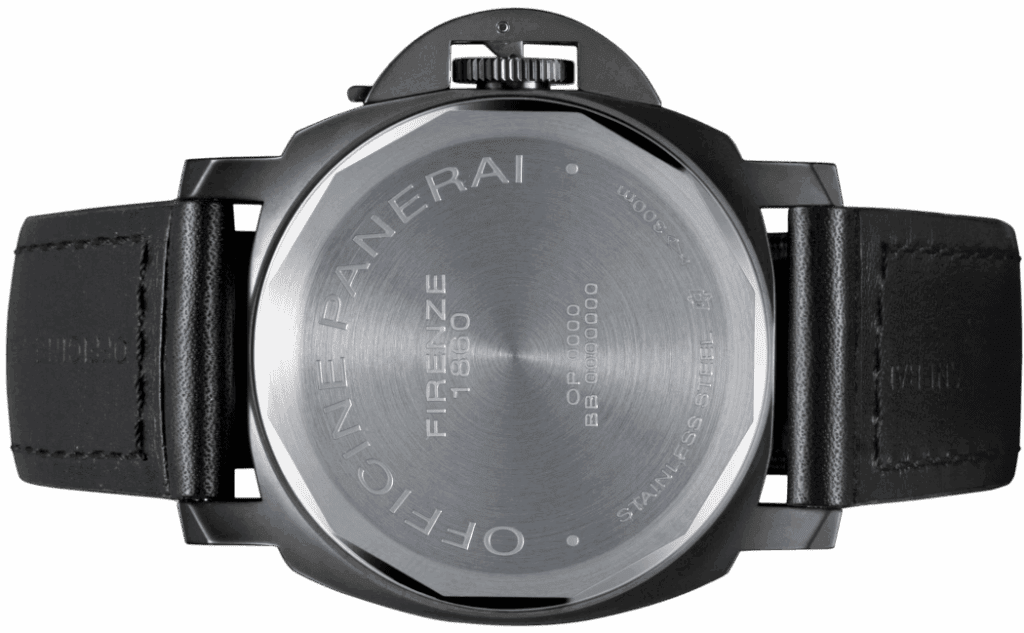
This is the honest assessment: the movement is not the story on the PAM00026. The OP II is reliable, serviceable by any competent watchmaker without specialist components, and perfectly appropriate for a watch whose identity lives entirely in the case architecture and configuration. The solid steel caseback — no exhibition sapphire — confirms that Panerai knew the movement wasn’t the selling point. The case is.
Is the PAM00026 Worth Buying Pre-Owned in 2026?
The answer depends almost entirely on which series you’re considering and how seriously you take documentation.
A-series examples are extraordinarily rare. When they surface publicly — Sotheby’s 2020 auction being the documented reference point — they carry documentation from the original sale, and provenance can be verified against the case number and serial prefix. Pricing reflects their status: expect $15,000–$21,576 and above for documented full sets. The pre-A example visible on Chrono24 at $21,576 represents a genuine market event. If an A-series appears at a price that seems too accessible, treat that as a warning rather than an opportunity.
B-series examples are more available but carry the fraud risk documented above. The Panerai Reference Database is explicit: some B-series cases have had their Luminova dials replaced with tritium dials to inflate value. Before buying any B-series PAM00026, verify the case reference (OP6523), the serial prefix (BB), and the warranty card dating. If the seller cannot provide original documentation, price that gap accordingly. A genuine B-series in full set — warranty card, original box, two straps — trades in the $12,000–$18,000 range based on current market data.
K-series examples are the most straightforward purchase. One thousand pieces were made, the documentation is consistent, the physical differences from the original are documented and verifiable. Chrono24 currently shows K-series examples from $5,068 for worn pieces to over $10,000 for complete documented sets. At that entry point, you’re buying the experience of the destro configuration in a well-made PVD Luminor Marina with zero ambiguity about what you own.
One universal consideration across all series: service. The OP II is straightforward for any qualified watchmaker. The destro case geometry is not a service complication — the movement sits in a mirrored position, but the calibre itself is standard. Service costs are predictable and access is universal, which is more than can be said for many complicated references. For a Luminor Submersible PAM00024 — another early civilian reference from the same era that appears on this site — movement service is equally accessible, but the PAM00026 has the added complexity of verifying the destro case architecture is intact and original.
Who Is It For?
- The Paneristi who understands what the crown position actually means — the destro configuration is military logic translated into wrist ergonomics; collectors who grasp that history don’t need to be left-handed to want the panerai pam00026
- A right-handed collector who has struggled with the Luminor crown guard on larger wrists — the destro worn on the left wrist is a materially different wearing experience, documented across multiple serious reviews; if the crown guard has always bothered you, this is the solution Panerai built in 1960
- Someone drawn to tritium patina in its most historically resonant form — the A and B-series dials have been ageing since 1998 and 1999; no modern watch produces what those dials look like now
- A collector who wants the rarest black PVD Luminor from the founding lineup — the PAM00004 is coveted; the PAM00026 is rarer by production numbers and rarer still by market visibility
- A K-series buyer who wants the destro experience without the authentication risk — 1,000 pieces, consistent documentation, same configuration, dramatically more accessible; the honest entry point to this reference, and far more attainable than the PAM00372 attracts as a modern hand-wound Luminor alternative
Not for: Collectors who need large collector communities and active forum threads around their references — the PAM00026 is a quiet watch in collector discourse, proportionally to its rarity. Anyone who requires an exhibition caseback. Buyers unwilling to conduct thorough provenance verification on A and B-series examples — the fraud risk is documented and real, not hypothetical. And not for collectors who associate the destro purely with left-handedness — if that’s the frame, the deeper history of why this watch exists will always be half-visible.
Conclusion
The Panerai PAM00026 is one of the Vendome era’s defining references — and one of its most consistently underestimated. The misunderstanding starts with the name: destro, right, a watch for the right wrist. Not a quirk for left-handers. A deliberate military engineering solution, first realised in the 1960s for Italian Navy frogmen, brought into the civilian collector world in 1998 in the most striking possible form: black PVD, tritium dial, ~95 examples in the A-series, ~200 in the B.
The pre-Vendome 5218-202a era produced the original civilian excitement around Panerai. The PAM00026 was part of the first formal Vendome-era answer to that excitement — and it answered it with a configuration that neither the public nor most collectors had seen before. Twenty-seven years later, it remains one of the few Luminor references where understanding the watch completely changes how it looks on the wrist.
If you’ve worn a destro — either wrist — I want to know what it changed for you. Leave a comment below.
Extended Summary
- The Panerai PAM00026 is the black PVD destro Luminor Marina from 1998–1999 — crown guard at 9 o’clock, small seconds at 3 o’clock, the entire case mirrored; produced in three series with combined original production under 300 pieces across A and B series, making it one of the rarest Vendome-era references in any condition
- “Destro” is military logic, not a left-handed novelty — the configuration originates from the Italian Navy’s two-wrist system of the 1960s (ref. 6152/1): instruments on the left, watch on the right with the crown facing inward; right-handed collectors wearing it on the left wrist experience the crown guard disappearing entirely under a sleeve
- The A and B-series dials carried tritium throughout — unlike the PAM00004 B-series which switched to Luminova, both original PAM00026 series retained the “T SWISS T” compound; after nearly three decades of natural decay, each dial has aged uniquely and cannot be restored to its original state or replicated
- Dial-flipping fraud is documented and must be taken seriously — some B-series examples have been retrofitted with tritium dials to inflate value; serial-number documentation, case reference verification, and warranty card matching are non-negotiable before purchasing any A or B-series example
- Three distinct buying propositions exist: A-series ($15,000–$21,000+ for documented full sets), B-series ($12,000–$18,000 with verified provenance), K-series ($5,000–$10,000 accessible entry point) — the K-series offers the identical destro configuration and movement with dramatically simpler authentication, making it the honest starting point for collectors new to this reference
At a Glance
| Reference | PAM00026 |
| Collection | Luminor |
| Name | Luminor Marina Left Handed PVD |
| Configuration | Destro — crown guard at 9 o’clock |
| Era | Vendome / early Richemont |
| A-series | 1998 — ~95 pieces, tritium, case ref. OP6504 |
| B-series | 1999 — ~200 pieces, tritium, case ref. OP6523 |
| K-series | 2008 — 1,000 pieces, Luminova, Bettarini case |
| Case material | PVD-coated stainless steel |
| Case diameter | 44mm |
| Case back | Solid stainless steel |
| Lug width | 24mm |
| Water resistance | 300m / 30 bar |
| Movement | Panerai OP II (ETA 6497-1 base) |
| Winding | Hand-wound, manual |
| Beat rate | 21,600 vph (3 Hz) |
| Power reserve | 56 hours |
| Jewels | 17 |
| Certification | COSC chronometer |
| Dial | Black sandwich — Arabic numerals, small seconds at 3 o’clock |
| Lume | Tritium “T SWISS T” (A & B series) / Luminova “L SWISS L” (K series) |
| Secondary market | ~$5,000–$21,500+ depending on series and documentation |
| Availability | Pre-owned only |