Quick Takeaways
- PAM127 is the watch that introduced the 1950 case to the modern Panerai catalogue — every Luminor 1950 reference since 2002 owes its architecture to this one
- 47mm in polished and brushed steel, with ogival middles and a domed sapphire crystal — the proportions are deliberate, not accidental; this case shape was engineered to recreate the original 6152/1 geometry
- The dial is a genuine black sandwich construction with a beige luminescent plate beneath — the patina register here is unlike anything in the current catalogue
- OP XI calibre: hand-wound, COSC certified, 56-hour power reserve — ETA-derived, but visually and technically redesigned to echo the Rolex Calibre 618 the original references carried
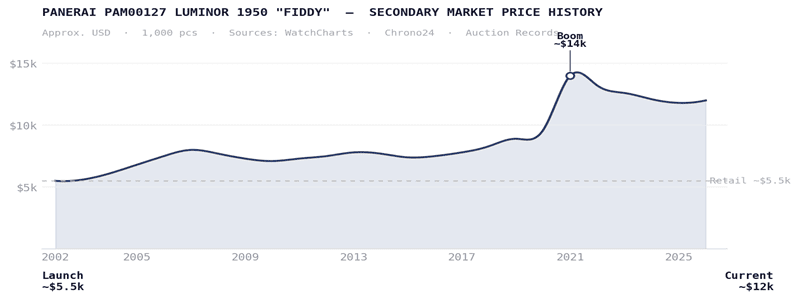
- Limited to 1,000 pieces; secondary market runs $8,000–$18,000 depending on papers, condition, and which series — expensive for a hand-wound steel watch, and completely worth understanding why before you decide

The Watch That Built the Template
There are Panerai references that sell well. There are references that generate buzz. And then there’s the PAM127 — the watch that created the vocabulary every Luminor 1950 has spoken since.
When Panerai released the PAM127 in 2002, limited to 1,000 pieces, they weren’t just launching another Luminor variant. They were doing something architecturally specific: reintroducing the case geometry of the original 6152/1 — the watch supplied to the Italian Navy in the early 1950s — into a modern production reference for the first time. The ogival middles. The domed crystal. The barrel-case silhouette that looks like nothing else in Swiss watchmaking. All of it codified in a single reference and handed to 1,000 collectors.
The Paneristi community gave it the nickname that stuck: the Fiddy. Short for Fifty, as in 1950.
I haven’t worn one. I want to be direct about that. The PAM127 sits on my wishlist in that category of watches where the research you do only makes you want it more — and where the price keeps nudging upward for reasons that are completely comprehensible once you understand what you’re actually looking at.
Here’s what you’re actually looking at.
Why Does a 2002 Watch Get Called the Original?
The Reference It Was Built to Remember
The Panerai that most collectors think of as “original” is not the PAM127. It’s the 6152/1 — the 47mm cushion-cased, black dial, hand-wound instrument supplied to the Decima MAS, the Italian Navy’s elite diving unit, from around 1950 onwards. Those watches were made in small numbers, never sold commercially, and spent decades in obscurity before Richemont acquired Panerai in 1997 and understood what they’d inherited.
What made the 6152/1 visually distinctive — beyond the sheer scale of it — was the case architecture. Barrel-shaped. Pronounced curves at the middles where case meets lug. A crystal that domed outward noticeably rather than sitting flush. A crown-protect lever bolted directly to the case without the angular bridge structure that appeared on later references.
The pre-Vendôme Panerai era produced watches for a limited civilian clientele in the late 1990s that began to approximate this aesthetic, but they weren’t quite there. The case proportions were different. The details weren’t resolved. The Fiddy was the first time the 1950 case arrived in a modern Panerai reference as a coherent, accurate recreation rather than an approximation.
“1950” at 6 O’Clock
The year printed on the dial at 6 o’clock isn’t the year the watch was made. It’s a date marker — a reference to the era the watch is designed to evoke. This is occasionally misunderstood by people new to the reference, and worth stating plainly: the PAM127 was released in 2002, but it carries “1950” on its dial because that’s the decade whose instruments it deliberately recreates. You can see the pre-Vendôme 5218-202A in archive footage to understand what Panerai was working backward from.
The nickname “Fiddy” follows directly from this. Collectors shortened 1950 to “fifty” and the watch became the Fiddy almost immediately after launch. Twenty-plus years later, the name has entirely overtaken the reference number in community discussions.
The 1950 Case — The Architecture That Changed Everything
This is where I want to spend the most time. Because if you want to understand why the PAM127 commands the prices it does and the reverence it gets, you have to start with the case — not the movement, not the dial, not the edition size.
Ogival Middles
Ogival is an architectural term — borrowed into horology to describe a specific lug-to-case junction profile where the curve follows an ogive: a pointed arch shape, steeper than a simple radius. On the PAM127, the transition between the barrel case body and the lug attachment flows through this ogival line rather than a simple angular cut.
This is not a decorative choice. On the original 6152/1, this profile was a byproduct of the manufacturing methods available — the case was turned and milled in a way that produced this specific curve. When Panerai’s team worked to recreate the case for the PAM127, preserving the ogival middle wasn’t optional. It’s what makes the watch read as architecturally correct to anyone who has studied the originals. Without it, you have a large Panerai. With it, you have the Fiddy.
Every subsequent 1950-case reference — the PAM00372, the PAM00422, the PAM02025 Venticinque released in 2025 as an explicit tribute — uses the same case blueprint the PAM127 established.
The Domed Crystal
The crystal on the PAM127 is not flat. It domes outward from the case, following the profile of the original 6152/1’s acrylic crystal — but executed here in sapphire with anti-reflective coating on the interior surface.
This has a specific visual consequence: at certain angles, the dial appears to sit deeper inside the case than it physically does. There’s a slight optical distortion in the upper portion of the crystal — not enough to affect legibility, but enough to remind you this isn’t a modern flat-glass tool watch. It’s a nod to something older, built in a material that didn’t exist when the original was made.
Collectors who have compared the PAM127 side-by-side with the PAM00372 — which uses a flat crystal — consistently note that the domed glass changes the reading experience entirely. The Fratello team put it accurately when they described the domed crystal as the detail that “most clearly separates the Fiddy from anything that came after it.” The PAM00372 is a superb watch. But it reads differently at the wrist, and the crystal is a large part of why.
The Lever-Lock Bridge and Crown Guard
The crown-protect bridge on the PAM127 follows the lever-lock design: a hinged arm that swings across the crown and locks into position with a positive click. This is the correct architecture for a 1950-case reference — the angular, more aggressive crown guard of the standard Luminor line doesn’t appear here.
The lever lock is a smaller, neater piece of engineering. It sits closer to the case. It has a more refined visual profile. And because it doesn’t project as far from the case as the standard bridge, it contributes meaningfully to how the watch sits on the wrist — less likely to catch on shirt cuffs, more integrated with the overall barrel silhouette.
47mm — The Honest Answer
The PAM00127 is 47mm. At this lug-to-lug, on certain wrists, it’s a significant object. On others, the barrel case shape and the ogival middle profile distribute the size differently than you might expect — there’s no sharp angular lug to bite into the wrist, just a continuous curved surface. The watch sits, rather than perches.
Is it big? Yes. Does it wear bigger than 47mm? Probably not — possibly smaller, depending on your wrist architecture.
What I’d push back on is the idea that 47mm is a dealbreaker here. The Paneristi community has been wearing this size since before it was fashionable to do so. If you’re genuinely uncertain, handle the PAM00372 before committing — same case, flat crystal — and calibrate from there.
The Dial — Sandwich Construction, Properly Understood
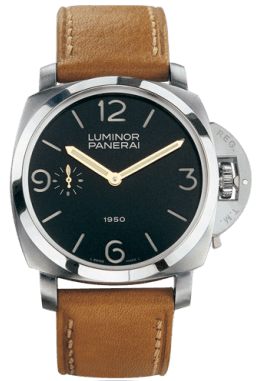
The dial of the PAM127 is a sandwich construction. Two layers: a black top plate with cut-out Arabic numerals and hour markers, and a luminescent underplate — in this case in a vintage beige/patina register — visible through the cutouts. The gold-toned hands complete the patina aesthetic.
This is not the same thing as the lume constructions used on current catalogue references.
The colour of the lume plate on the PAM127 reads warmer and more aged than the creamy white of later references. At certain light conditions, particularly against natural light, the contrast between the black outer plate and the beige underplate is striking in a way the modern SuperLuminova white plates aren’t. It reads vintage — not because someone artificially aged it, but because the material and colour choice were calibrated to that reference point from the start.
The “1950” text sits at 6 o’clock below centre. Seconds counter at 9 o’clock. The dial layout is a faithful recreation of the original field watch layout — legibility first, decoration nowhere.
What this dial is not: a California dial, a coloured sector dial, anything that asks for attention in the modern sense. The PAM127 dial rewards sustained attention rather than demanding it. That distinction matters for a collector making a long-term decision.
The OP XI — What the Movement Actually Is
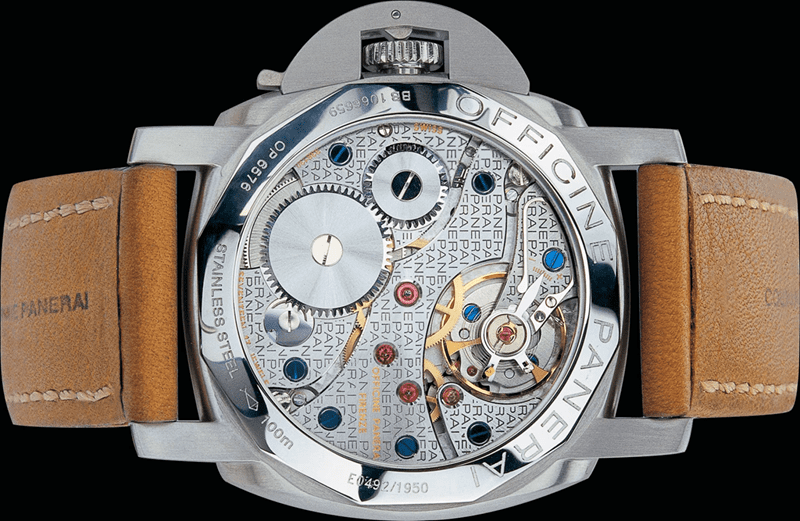
The OP XI is hand-wound. It runs at 21,600 vph with 17 jewels and provides 56 hours of power reserve. It carries COSC certification — meaning it passed the Swiss Official Chronometer Testing Institute’s rate tests across six positions and five temperatures before leaving the manufacturer.
The base is ETA-derived. Panerai used the “OP” prefix across their externally sourced calibres, and the OP XI sits in this lineage. What distinguishes it from a standard ébauche is the finishing and the swan’s-neck regulator — a spring-loaded adjustment mechanism that applies controlled pressure to the regulation lever, preventing the kind of micro-drift you get from friction-fit regulation. Côtes de Genève across the bridges. The caseback is solid on the PAM127 — no exhibition, which suits the intent of a field watch recreation.
Here’s the context that most reviews skip: Panerai specifically redesigned the visual presentation of the OP XI to echo the Rolex Calibre 618 that appeared in the original 6152/1 watches. The relationship between Panerai and Rolex — which supplied both movements and cases to Panerai’s early production — is a documented part of the brand’s founding story, and the OP XI represents a deliberate aesthetic callback to that era. Not a replica movement. A gesture of continuity.
Would I prefer a fully in-house calibre? In the abstract, sure. But the OP XI at 56 hours of hand-wound reserve, with a swan’s-neck regulator and COSC certification, is not a movement to apologise for. At the price the PAM127 commands on the secondary market, it does what it needs to.
PAM127 vs PAM00372 — Is the Fiddy Still Worth It?
This is the practical question for most buyers. The PAM00372 is the direct catalogue successor — 47mm, 1950 case, hand-wound (P.3000 in-house calibre), 3-day power reserve, still in production for years and widely available pre-owned at $4,000–$7,000. Fully in-house movement. More service accessibility. Flat crystal.
The PAM127 costs roughly twice as much on the secondary market for a comparable condition example.
Here’s what you’re paying for:
The domed crystal. The PAM00372 has a flat sapphire. The Fiddy has the dome. This is not a small visual difference.
The patina dial register. The OP XI era sandwich dial on the PAM127 reads differently to the eye than later references. Collectors who care about the vintage-accuracy of the dial will find the Fiddy more correct.
The edition context. 1,000 pieces. First generation. The watch that established the 1950 case in the modern catalogue. Some part of that premium is intangible, but it’s real — the Fiddy is the reference Panerai itself acknowledged when releasing the PAM02025 Venticinque as a 2025 tribute piece.
The in-house movement argument. The PAM00372 wins here: P.3000 in-house, 3-day reserve, more recent design. If the movement is the primary decision point, the PAM00372 is the rational choice.
My honest read: if you want the definitive Fiddy experience — everything the 1950 case was supposed to feel and look like from the moment it was codified — the PAM127 is the one. If you want the better movement and half the price, the PAM00372 is an outstanding watch. They are not the same object, despite sharing a case shape.
“The PAM00127 is not just another vintage-inspired Panerai — it is the original modern Panerai, the reference that established the visual grammar every 1950-case reference since has been measured against.” — WatchUSeek Panerai forum, veteran contributor thread on the PAM02025 Venticinque, 2025
Who Is It For?
- Collectors who want the founding document of the 1950 case — if the case architecture matters to you historically, there is no substitute
- Buyers comfortable with the secondary market — 1,000 pieces, no current production; this is a pre-owned-only purchase requiring due diligence on service history and box/papers completeness
- Wrist presence enthusiasts — the PAM127 rewards being worn, not displayed; it’s a functional object that happens to be historically significant
- Collectors who already have a modern Luminor 1950 — the PAM127 sits differently in a collection alongside a PAM00372 or PAM422 than as a standalone; the comparison is part of the experience
- Anyone who has watched the PAM02025 Venticinque land at boutique prices and wants the original reference instead
Not for: Collectors who prioritise in-house movements above all else. Buyers who want easy after-sales service without pre-qualification. Anyone expecting a current-production buying experience. Or wrists under approximately 17cm that genuinely struggle with 47mm barrel cases.
Conclusion
The PAM127 has had twenty-plus years to prove whether the reverence was warranted. By every measure the collector community applies — secondary market trajectory, forum sentiment, the fact that Panerai’s own 2025 tribute piece explicitly namechecks it — the verdict is consistent. This is the watch that built the template.
The domed crystal, the ogival middles, the patina sandwich dial, the lever-lock bridge: these aren’t details that accumulate into something significant. They are the significance. Every Luminor 1950 that came after borrowed from what the Fiddy established, and none of them have made it redundant.
Is the premium over a PAM00372 justified for your collection, or does the in-house movement tip the scale the other way? Drop your take below — especially if you’ve owned both.
Extended Summary
- The PAM127 introduced the 1950 case to the modern Panerai catalogue in 2002: ogival middles, lever-lock bridge, domed crystal — all elements recreated from the original 6152/1 military references that Panerai supplied to the Italian Navy
- The domed sapphire crystal is the single most differentiating detail: it changes the optical depth of the dial and the wrist-reading of the watch in a way the flat-crystal PAM00372 does not replicate — this is not a cosmetic point; it’s a visual identity point
- The OP XI is hand-wound, COSC certified, and 56-hour power reserve: ETA-derived but finished and regulated to a higher standard, with a swan’s-neck regulator — the movement is not the reason to buy this watch, but it is not a reason not to
- Secondary market pricing runs $8,000–$18,000: service history, box and papers completeness, and case condition are the critical variables — a complete, well-serviced example at the lower end represents a coherent long-term proposition
- The PAM127 is the collector’s Fiddy: not the easiest 1950-case reference to buy, not the one with the best movement spec sheet, but the one every subsequent 1950 reference is measured against — that status took twenty years to earn, and it’s not going anywhere
At a Glance
| Reference | PAM127 |
| Collection | Luminor 1950 |
| Nickname | The Fiddy |
| Year | 2002 |
| Case | 47mm polished/brushed steel, lever-lock crown bridge |
| Crystal | Domed sapphire, anti-reflective coating |
| Movement | Panerai OP XI (hand-wound, COSC certified) |
| Power Reserve | 56 hours |
| Frequency | 21,600 vph |
| Jewels | 17 |
| Water Resistance | 300 metres |
| Edition Size | 1,000 pieces |
| Secondary Market | ~$8,000–$18,000 (Chrono24) |
| Availability | Pre-owned only |