
Introduction: A Bronze Turning Point
Quick Takeaways
On the secondary market, the Bronzo peaked near $40,000 before the post-2022 correction; it currently trades between ~$22,000 and $28,000 — still commanding a multiple of nearly three times its original retail price.
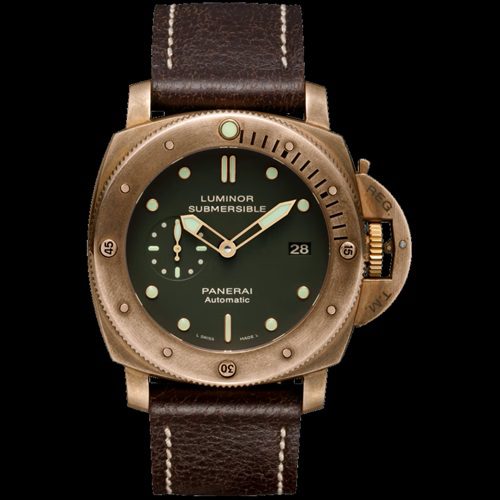
The PAM00382 is the first bronze-cased Panerai — a 47mm Luminor Submersible 1950 introduced at SIHH 2011, limited to 1,000 pieces, housing the in-house automatic P.9000 calibre and debuting the first green dial in Panerai’s history.
The reception at launch was famously lukewarm — the Bronzo sat on boutique shelves while the Paneristi debated whether bronze belonged in a luxury watch case. Within two years, it was a grail. The story of how that happened is inseparable from understanding what the PAM382 actually is.
The CuSn8 bronze alloy — a specific compound of pure copper and tin — is deliberately chosen for its patina behaviour: each watch develops a unique surface character over time, shaped entirely by how and where it is worn. No two Bronzos age identically.
The green dial was entirely new territory for Panerai in 2011, and the colour choice was not arbitrary — it was designed to harmonise with the inevitable grey-green patina the bronze case would develop.
Introduction
In 2011, when the Panerai PAM382 appeared at SIHH in Geneva, the reaction from the Paneristi was — to put it charitably — measured. The forums debated whether bronze belonged in a serious watch case. The watch sat on boutique shelves. Some collectors found it too raw, too unconventional, too far outside the established Panerai palette of steel and titanium and precious metals. That initial hesitation turned out to be one of the great miscalculations in modern watch collecting.
The Panerai PAM00382 Bronzo is today a genuine grail reference — not because the market decided so arbitrarily, but because the watch earned it over time, in exactly the way bronze is supposed to earn its reputation. It aged into its role. The patina that early collectors were suspicious of became the defining reason to own one. The green dial, unprecedented in Panerai’s history at the time, turned out to be a stroke of foresight. And the CuSn8 bronze alloy, chosen with specific maritime engineering logic, proved to be the right material for a brand whose entire identity is rooted in the sea.
This is the full Panerai PAM00382 review — the watch, the material, the movement, and the market.
Before the Bronzo — Why Bronze in a Watch Case Was a Radical Idea
A Material With Ancient Naval Roots
Bronze is not a new idea. It’s the oldest precision engineering material we know of, used for ship propellers, naval fittings, bells, and cannon barrels long before it had any connection to watchmaking. The Roman Navy cast their anchor rings from it. Mediterranean divers pulled bronze salvage from ancient wrecks. For a brand whose entire history is inseparable from the sea, the symbolism was almost too obvious in retrospect.
What made it radical in watchmaking is precisely what makes it compelling: bronze is alive in a way that steel and titanium are not. It changes. It reacts to its environment, to the chemistry of the wearer’s skin, to salt water, to UV exposure, to the passage of time. In a watch industry that had spent decades perfecting alloys specifically designed to be inert and resistant, Panerai’s decision to use an untreated, reactive bronze was an act of deliberate provocation.
Why the Industry Had Avoided It — and Why Panerai’s DNA Made It Right
The practical objections were real. Untreated bronze patinates fast, unpredictably, and not always attractively. It’s heavier than titanium. It can cause skin reactions in people with copper sensitivities — a consideration Panerai addressed directly by using a titanium ring in the caseback to prevent the bronze from contacting the wrist. And the patina cannot be controlled, only managed.
Most watch brands saw those properties as liabilities. Panerai saw them differently. The brand’s aesthetic DNA — tool watches designed for divers and military frogmen, references rooted in the salt-encrusted hardware of the Italian Navy — was built for exactly this kind of material character. Panerai’s Carbotech, introduced years later, would follow the same logic: choose a material that develops character through use rather than despite it. The PAM382 was the first expression of that philosophy.
The Cold Reception That Became a Legend
SIHH 2011 — “Lukewarm, Even Cold”
The Watchonista essay published in early 2012, by a collector who had waited months for delivery, captures the reception honestly: despite initial reports from SIHH 2011, “the PAM382 did not arouse an unrestrained enthusiasm. One could even say it was lukewarm, or even cold.” Watchfinder documented it plainly: “it took a while for the purists to embrace the watch, and it sat on boutique shelves collecting dust.”
The reasons were documented. Many Paneristi still carried a mental framework of fine watchmaking where materials were supposed to be inert, resistant, controlled — a Patek-adjacent standard of custodianship. A watch designed to age visibly, to accumulate surface chemistry, to look different from its neighbour with the same reference number: that was unfamiliar territory. The PAM382 asked collectors to reframe what ownership of a luxury watch meant. Not everyone was ready.
The Chronopassion Effect
The moment that changed the conversation happened not in a boutique or at a trade show, but after ten days of kite surfing in the Caribbean.
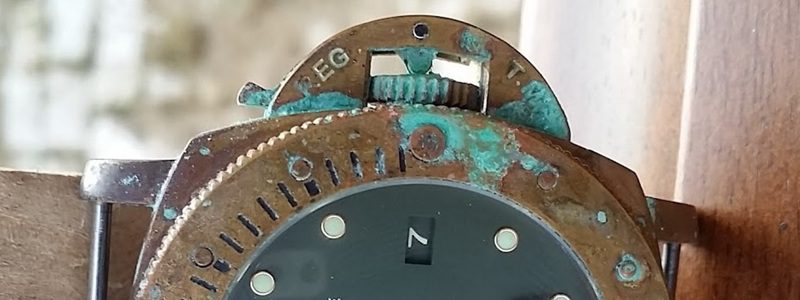
Laurent Picciotto — owner of Paris retailer Chronopassion and one of the most visible Panerai advocates in Europe — had bought his PAM382 at launch and proceeded to wear it relentlessly through a beach holiday, salt water and sun without pause. The photographs of the result circulated online in early 2012 via SJX Watches: a bronze case that had developed a profound, almost green-black patina in the crevices and a warm amber over the flat surfaces, the whole thing looking like a recovered piece of naval equipment from the seabed.
The reaction was immediate and divided — and that division was the pivot. Half the forum said too much, it looks like a pipe. The other half looked at the same photos and felt something shift. Because the watch in those images was utterly unique. There was not another PAM382 on earth that looked like that one. And that was the entire point.
From that moment, the Bronzo’s reputation began its climb. Collectors who had passed at retail started asking boutiques if any remained. They didn’t.
The Case — CuSn8 Bronze, Titanium Caseback, and 300m Depth
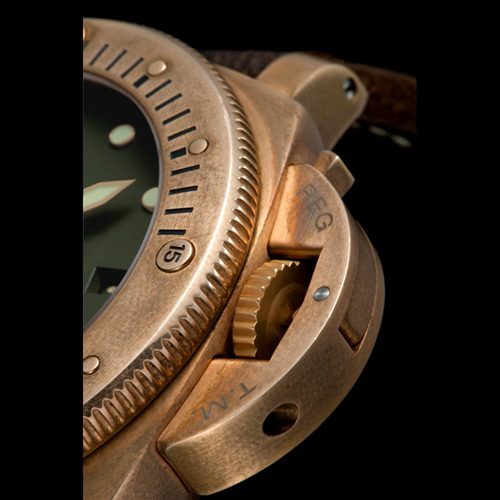
The 47mm case is the same Luminor Submersible 1950 architecture that Panerai had already established in steel and titanium — the cushion-influenced profile, the slimmer lugs of the 1950 series, the unidirectional rotating bezel with a 0–60 graduated dive scale. What changes everything is the material.
CuSn8 is a specific alloy of copper and pure tin — no additional elements. Panerai selected it for a precise combination of properties: strong corrosion resistance to sea water (marine bronze is the standard for boat hardware for exactly this reason), structural strength adequate for a 300-metre rated case, and a natural tendency toward rich, warm-toned patina. The higher copper content gives Panerai’s bronze a distinctly reddish-yellow tone when new — noticeably warmer than the bronzes used by Anonimo or Gerald Genta, whose alloys appear more golden-grey from the outset.
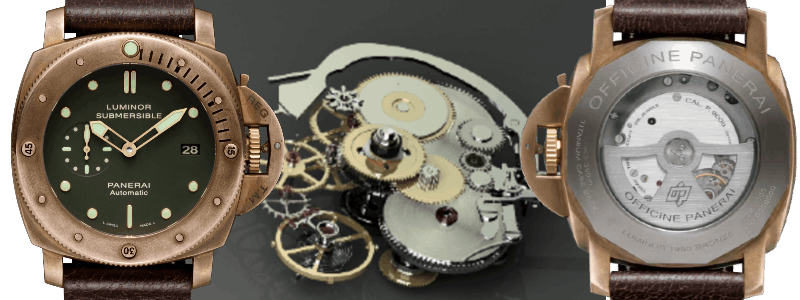
The caseback is titanium, not bronze. This was a deliberate engineering decision: a full bronze back would have kept the warm metal in direct contact with the wrist, a potential irritant for anyone with copper sensitivity. The titanium back solves that cleanly, and the sapphire display window it carries turns out to be a bonus — the P.9000 visible through it is worth looking at.
The rotating bezel is bronze, the crown-protecting lever bridge is bronze, the buckle titanium. The Luminor crown device performs exactly as it always does — locking the screw-down crown securely into the case, maintaining water resistance to 300 metres with the same lever-and-bridge mechanism patented by Panerai in 1955. On a bronze watch that its owner will genuinely take into the sea, that mechanical reliability is not incidental.
On the wrist, 47mm in bronze is different from 47mm in steel. The density of bronze is higher than titanium but close to steel, so the weight is substantial — this is a watch you feel. The warm tone of the case against a tanned wrist has a presence that steel, however well-finished, simply doesn’t produce. There is something organic about wearing bronze. The material doesn’t just tell the time. It tells a story about where it’s been.nze with green. The harmony was instant, and the combination has since become synonymous with the Bronzo line.
The Dial — Green on Bronze, and Why the Pairing Was Deliberate
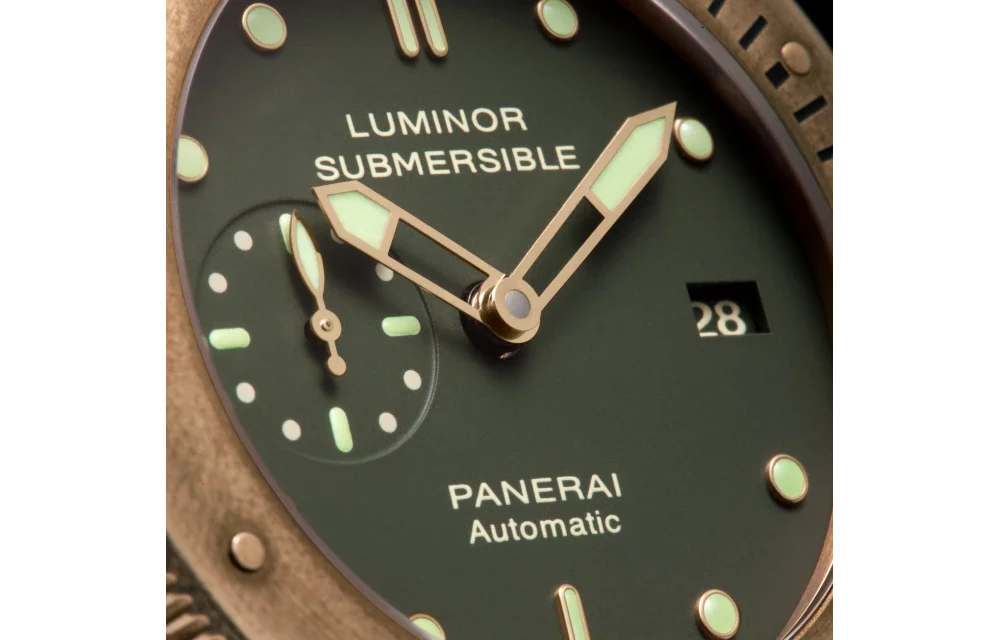
The PAM382’s green dial was the first of its kind in Panerai’s history. Before 2011, Panerai’s dials were black, white, or occasionally brown — the palettes of military instruments and tool watches. Green had never appeared.
The choice was not arbitrary. The dial is sandwich construction — two layers of material with the hour markers cut through the upper plate, the SuperLuminova glowing through from below in a deep green tone that matches the surface colour. It’s a technically precise construction that gives the markers unusual depth. Legibility underwater, which is the entire point of a 300-metre Submersible, is excellent.
The rose gold hands, filled with the same green lume, create a specific colour relationship that is the dial’s defining visual. Warm gold against cool green. When new, with the bronze case still in its reddish-copper tone, the three-colour combination — amber bronze, green dial, rose gold hands — is striking in a way that photographs consistently understate.
Here is what Panerai understood about that combination that most reviewers glossed over: the dial was not designed for how the watch looks when new. It was designed for how the watch looks when it has been worn. As the CuSn8 bronze case ages toward its natural grey-green patina, the dial and case converge tonally. The warm rose gold hands become the visual anchor, popping against a face that grows progressively greener and more textured. The design was made for time. Most watch designs aren’t.
The Patina — Your Watch, Your Fingerprint
This is the section that matters most. Everything else about the PAM382 is excellent Panerai execution of established design language. The patina is what makes it a different kind of object entirely.
The Chemistry of CuSn8 and Why Panerai’s Alloy Behaves Distinctively
Bronze patina is copper oxidation — the same chemistry that turns ancient statues green, that gives old bells their dark lustre, that coats the copper roofs of old European buildings in verdigris. When the surface copper in an alloy is exposed to air, humidity, and contact agents, it oxidises. The resulting oxide layer — copper oxide, copper carbonate, copper sulphate depending on the environment — changes the surface colour and, crucially, forms a protective barrier that slows further corrosion.
Panerai’s CuSn8 alloy has a higher copper proportion than many watchmaking bronzes, which gives it a more reddish starting tone and a faster, greener patina development. SJX Watches documented this directly in 2011, noting that the Panerai alloy was “significantly more reddish than the bronze used by Anonimo or Gerald Genta, which I assume means it has a higher proportion of copper.” The oxidation process is also front-loaded: most of the visible change occurs in the first months of wear, as the initial surface copper oxidises rapidly. After that, the pace slows considerably. The patina you develop in the first summer with the watch will be more dramatic than anything the following three years produce.
What Accelerates It — and What Preserves the Copper Tone
Salt water is the most powerful accelerant. Laurent Picciotto’s Caribbean Bronzo achieved ten days of Caribbean sea exposure without rinsing — that’s an extraordinary experiment in bronze chemistry, and the result was extraordinary. Sweat, in particular the salt and acidity of the wrist, also contributes significantly. Swisswatches Magazine noted that the CuSn8 alloy “is on the one hand very resistant against corrosion but on the other hand predestined for a unique patina” — those two properties are not contradictions; they’re the same chemistry operating at different scales.
Keep the watch dry, polish it occasionally, avoid prolonged salt water exposure without rinsing — and the copper tone holds much longer. Some collectors prefer a clean, fresh-bronze appearance and maintain it actively. Both positions are documented and legitimate.
The Reset Cycle and the Philosophy of Ownership
Many PAM382 owners develop a ritual: allow the patina to build through active wear, then use a Cape Cod cloth or Polywatch to remove the oxidation layer and restore the bright copper tone — effectively resetting the clock. The process works because the bronze itself is not damaged by patina; only the surface layer changes. Some owners cycle through this several times a year. Others let the patina accumulate indefinitely.
This is where the PAM382 becomes philosophically distinct from almost every other watch in this price category. Most luxury watches are custodianship objects — you receive them in a defined state, preserve them in that state, and pass them on. The Bronzo inverts that relationship entirely. You shape it. The patina it develops is a record of your climate, your chemistry, your habits, and your choices. No other Paneristi owns a watch that looks exactly like yours. That’s not a flaw or a quirk. It’s the entire brief.
I’m not going to pretend this is for everyone. Collectors who value consistency and permanence in their watches — who want the same surface in twenty years as the day they bought it — should look elsewhere. But for those who want a watch that becomes genuinely theirs over time, no reference in the Panerai catalogue comes closer to delivering it.
Movement: The Workhorse P.9000 inside the Bronzo PAM382
Inside the P.9000 — Panerai’s Automatic Workhorse
The P.9000 was introduced in 2009 and represents Panerai’s second family of in-house movements, sitting between the complex high-reserve P.2000 series and the hand-wound P.3000 family introduced in 2011. It is an automatic calibre — which the PAM382 specifically required, given that a bronze Submersible being taken into the sea wants the convenience of self-winding rather than a daily wind ritual.
At 13¾ lignes wide and 7.9mm tall, it is a large movement — intentionally sized in the tradition of the historic Panerai calibres. The architecture uses a three-quarter plate construction, visible through the display caseback, with twin barrels in series delivering the 72-hour power reserve. The winding mechanism uses Seiko’s Magic Lever system — a V-shaped bidirectional rotor that winds efficiently in both directions via a compact four-part mechanism. It’s the same system used by Cartier and IWC in movements developed at ValFleurier, Richemont’s movement development company. Practical, reliable, compact.
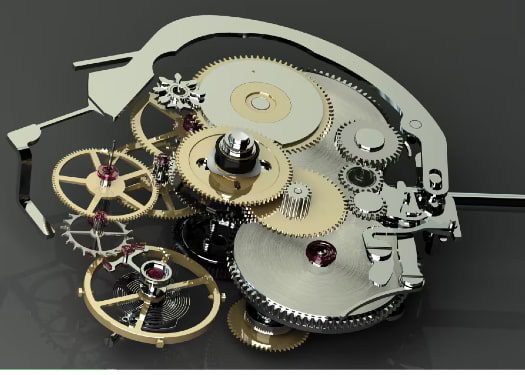
The balance oscillates at 28,800 vph — a modern beat rate that gives the P.9000 better positional accuracy than the slower P.3000, at the cost of some of that movement’s deliberate, old-school character. Glucydur balance wheel, Incabloc anti-shock. The caseback shows the three-quarter plate, the twin barrel arrangement, and the skeletonised rotor clearly. Honest assessment: the movement finishing is brushed rather than decorated. It’s a workhorse, not a showcase piece. But it is entirely Panerai’s own, and it runs the Bronzo with the reliability that a watch this purpose-built demands.
What Does a PAM382 Cost on the Secondary Market?
The Bronzo’s price history is one of the more remarkable arcs in modern watch collecting. At retail in 2011, the PAM382 was priced at approximately $11,600 USD. Even at that level, it sat on shelves. Then patina photos started circulating, the watch found its audience, and demand quietly overwhelmed the 1,000-piece supply. By the watch market peak of 2021–2022, a mint PAM382 with box and papers was trading above $35,000 on Chrono24 — and examples with particularly striking patina commanded premiums above that.
The post-2022 correction brought the market down. WatchCharts data shows the PAM382 has declined approximately 19.4% over five years, broadly in line with the general Panerai index decline of 22%. It carries a high risk score of 71/100 — which reflects the thinness of sales volume rather than fundamental weakness in the reference. The Bronzo is not a frequently traded watch; examples rarely appear, and when they do, they sell at a wide range of prices depending on condition, patina character, and completeness.
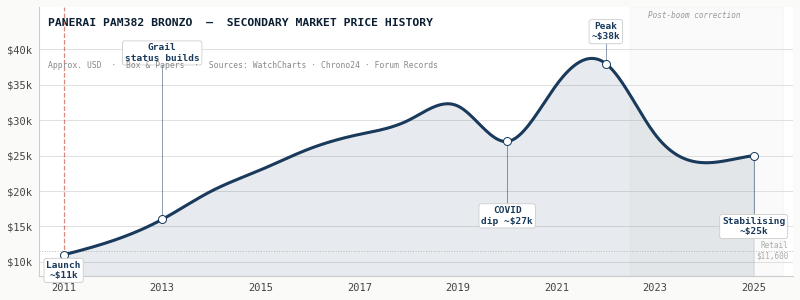
Current secondary market reality: roughly $22,000 to $28,000 USD for well-worn examples with reasonable documentation, climbing above $30,000 for mint or near-mint examples with original full-set packaging. The premium for completeness is significant — the Bronzo’s wooden presentation box is unusual among Panerai special editions and adds real value to a complete set.
For collectors considering the PAM372 as an alternative or complementary reference, the price comparison is instructive: the Bronzo costs roughly four to five times more on the secondary market. That multiple has held even through the correction. The community’s verdict on what the first bronze Panerai is worth — historically, materially, and as a collector object — has not meaningfully shifted.
Who Is It For
- The collector who wants a watch that becomes unique to them — no other Paneristi will ever own a PAM382 with your exact patina signature
- A Paneristi who wants the reference that started the bronze era in modern luxury watchmaking — provenance and historical significance don’t get cleaner than “the first”
- Someone drawn to Panerai’s naval and maritime DNA who wants a case material that physically embodies that heritage rather than just referencing it
- Active wear collectors who will actually take a watch diving, swimming, or into salt air — the CuSn8 alloy was built for exactly this, and the 300m rating means it’s fully qualified
Not for: collectors who want stable, unchanging surface aesthetics; anyone with copper allergy sensitivities who cannot accept even titanium-backed bronze contact; buyers expecting investment-grade appreciation — the risk score is high and the market thin; or anyone unwilling to pay a significant premium over other 47mm Submersible references for the material story alone.
Conclusion
The Panerai PAM00382 Bronzo is the rare watch that deserves its grail status precisely because it didn’t arrive with it. The cold reception at SIHH 2011, the months sitting on boutique shelves, the long slow burn as patina photographs began to tell the story that specifications could not — all of it is part of what the watch is now. A grail that was immediately recognised would have a different kind of meaning.
What the Bronzo represents is Panerai at its most intentional: a material chosen not for visual polish but for living character, a dial colour designed for a watch years into ownership rather than fresh from the box, and a price at the time that reflected confidence in an idea the market hadn’t yet caught up to. The market eventually caught up. It usually does when the idea is right.
Is the patina process something you’d genuinely embrace, or does the thought of an ever-changing case surface give you pause? I’d genuinely like to know — drop a comment below.
Extended Summary
On the secondary market, the PAM382 has corrected from its ~$40,000 peak to approximately $22,000–$28,000 USD, with a high-risk liquidity score reflecting thin sales volume rather than weak desirability — it remains one of the most coveted Panerai limited editions, trading at roughly three times its original retail price despite the broader market correction.
The PAM00382 is the first bronze-cased Panerai, a 47mm Luminor Submersible 1950 limited to 1,000 pieces, introduced at SIHH 2011 with an in-house P.9000 automatic calibre, 300m water resistance, and the first green dial in Panerai’s catalogue.
The reception at launch was documentably lukewarm — the watch sat unsold on boutique shelves before patina photos, particularly Laurent Picciotto’s Caribbean-worn example, circulated online and reframed the entire conversation, turning collector skepticism into active pursuit.
The CuSn8 bronze alloy — a copper-tin compound with a high copper proportion — patinates faster and greener than most watchmaking bronzes, developing a unique surface for each owner determined by their individual wear environment; the green dial was specifically designed to harmonise with this eventual grey-green patina.
The P.9000 calibre is Panerai’s in-house automatic workhorse: twin-barrel, bidirectional Magic Lever winding, 28,800 vph, 72-hour reserve, and a three-quarter plate architecture visible through the titanium-framed sapphire display back.
At a Glance
| Spec | Detail |
|---|---|
| Reference | PAM00382 |
| Collection | Luminor Submersible 1950 — Special Edition |
| Introduced | SIHH 2011 |
| Case material | CuSn8 bronze (copper-tin alloy) |
| Caseback | Titanium with sapphire display crystal |
| Case diameter | 47mm |
| Case thickness | ~16mm |
| Lug width | 24mm |
| Water resistance | 300 metres |
| Bezel | Bronze, unidirectional rotating, 0–60 scale |
| Crown device | Lever-type Luminor crown-protecting bridge |
| Crystal | Sapphire |
| Movement | Panerai in-house Calibre P.9000 |
| Movement type | Automatic, bidirectional winding |
| Complications | Hours, minutes, small seconds at 9, date at 3 |
| Power reserve | 72 hours (3 days) |
| Beat rate | 28,800 vph |
| Jewels | 28 |
| Components | 197 |
| Dial | Green sandwich dial, rose gold hands, green SuperLuminova |
| Strap | Brown leather, titanium buckle |
| Production | Limited to 1,000 pieces |
| Availability | Discontinued — secondary market only |
| Original retail | ~$11,600 USD |
| Secondary market | ~$22,000–$28,000 USD (condition and completeness dependent) |


