

Quick Takeaways
- The Panerai Radiomir is the brand’s original watch, born from Ref. 2533 in 1935: a 47mm steel cushion case on a Rolex base with welded wire lugs.
- The name comes from the radium paste Panerai patented in 1916, and the sandwich dial was built to carry as much of it as possible. The material gave the watch its name.
- Ref. 3646 carried the formula through the 1940s, and the mixed-numeral California dial arrived on it in 1944.
- The first modern Radiomir was the 60-piece platinum PAM00021, with a period Rolex 618, in the late 1990s. The 1993 civilian launch did not include a Radiomir.
- Today’s range runs from the 40mm Goldtech Quaranta to the 45mm Otto Giorni and the annual calendar.
Panerai Radiomir – A Collector’s Chronicle from Combat to Contemporary
The Radiomir is the watch every other Panerai comes from. The Luminor has the lever, the Submersible has the bezel, and the Radiomir has the wire lugs, the cushion case and a dial built to glow in the dark. It is the original, and it still looks like one.
The Panerai Radiomir began as a naval request in the 1930s: a wrist-worn instrument that a frogman could read underwater at night. It was built on a Rolex base, filled with radium paste and made large on purpose. Nearly ninety years later, the same shape is still in the catalogue.
This is an overview of the whole story, from the 1935 prototype and the wartime ref. 3646 to the 1990s return and today’s collection. We follow the shape through the war years, the long pause and the late-1990s return, and then look at what Panerai builds under the name today. Where does the Radiomir really begin?
What Is the Panerai Radiomir?
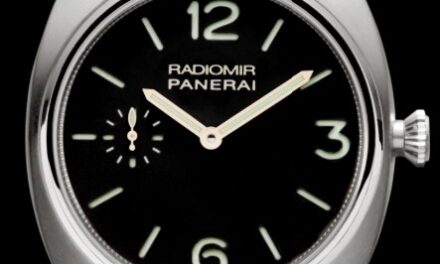
The Radiomir is Panerai’s first and oldest watch family. Its identity rests on three things: a large cushion-shaped steel case, welded wire lugs and a sandwich dial with a luminous layer behind the numerals. There is no crown guard, which is the feature that later separated the Luminor from it.
The name is the clue to everything else. It comes from Radiomir, the radium-based paste Panerai developed for dials, and the watch was named after the material that made it work. A glowing dial was the whole point.

Panerai Radiomir History: How Did It Begin in 1935?
This is the section that carries the story, so it runs long.
In 1935 the Royal Italian Navy commissioned prototypes for underwater use. The best result was Ref. 2533, built on a Rolex-Geneva base and modified by Panerai. It was a large cushion-shaped watch in stainless steel, 47mm across, with wire lugs welded to the case so that a long strap could fit over a diving suit. The early watches had no seconds hand.
Why was Rolex involved?
Because Panerai was an instrument maker in Florence, not a case maker. The Rolex-Geneva base gave it a robust case, and inside was the hand-wound Calibre 618, made by Cortebert for Rolex. Panerai supplied what Rolex could not: the dial and the lume.
What was Radiomir?
A luminous paste based on radium. Panerai filed a patent addendum for it in France on 23 March 1916, working with Lieutenant Commander Carlo Ronconi, and the name was taken from the radium bromide. It could glow for years without exposure to light, which was exactly what a dial needed underwater.
What is a sandwich dial?
It is a dial made of two layers. The upper disc is black, with the numerals and indices cut out of it, and the lower disc carries the luminous material behind them. The paste shows through the openings, so the numerals glow while the rest of the face stays dark.
Panerai’s own description of the dials is overlapping discs. In the earliest prototypes, a multi-layer construction held as much paste as possible, and the version we recognise today followed a few years later. One of the early dials, tied to the Italian Navy’s slow-speed torpedo, the S.L.C., was rejected because it used too little Radiomir. Only two examples are known.
And the wire lugs?
They are thin loops of steel welded to the case, and they define the Radiomir’s silhouette. Modern watches keep the look with removable wire loops under a Panerai patent, which makes strap changes simple.
I’d argue the Radiomir’s whole character sits in those three details: the cushion shape, the wire lugs and the sandwich dial. Each one solved a problem, and none of them was there for style.

What Was the Panerai Radiomir Ref. 3646?
The watch that settled the formula was Ref. 3646. It had a large cushion-shaped steel case with a diameter of 47mm and the Cortebert 618 inside, and it was produced through the 1940s in various configurations. The Royal Italian Navy’s frogmen of the Decima MAS wore the Radiomir, and the S.L.C. in the dial story above is the manned torpedo they rode.
How did the California dial arrive?
In 1944. Rolex had patented a dial mixing Roman and Arabic numerals in 1941, and it appeared on the 3646 three years later. It is a Rolex design that Panerai used, and it is the reason the mixed-numeral dial is still sold today. My Radiomir California PAM00424 review goes deeper into it.
What was the 3646 like?
A tool, not a luxury piece. The steel, the radium dial and the 47mm case were chosen for use. Phillips documents a 3646 in detail, and it is a good place to see what a surviving example looks like.
What Happened After the War?
The Luminor takes the spotlight next: the name was trademarked on 11 January 1949, and the crown-protecting bridge was patented in 1956. The tritium lume that took the Luminor name replaced radium in the 1960s. My Luminor overview covers that chapter.
For the Radiomir, the next big chapter comes at the end of the century.
When Did the Panerai Radiomir Come Back?
Not in 1993. Panerai’s first civilian collection, presented on 10 September 1993, was built around the Luminor, the Luminor Marina and the Mare Nostrum chronograph. There was no Radiomir in it.
The Radiomir returned in the late 1990s, after Richemont acquired Panerai on 18 March 1997. The commemorative re-edition was limited to 60 pieces, in a 47mm platinum cushion case, with a period Rolex movement inside. That is the PAM00021, a tobacco-brown dial on a platinum case and the Rolex 618. I think it is one of the most important modern Panerais, and one of the least known. The platinum PAM00373 is a good later look at the same idea.
How did the movements change?
Panerai built its first in-house calibre, the P.2002, in 2005, followed by the P.9000 in 2008 and the P.3000 in 2011. The P.3000 powers the hand-wound Radiomirs most collectors know today.
What Does the Panerai Radiomir Look Like Today?
In 2023 Panerai relaunched the line, and the new versions show how far the idea has travelled.
“a faithful homage to where it all began” Panerai, on the Radiomir collection
The Radiomir Otto Giorni is a 45mm watch in hand-finished Brunito eSteel with an 8-day reserve, and a degraded brown or blue dial signed “8 giorni brevettato”, a nod to the 1950s watches. The Radiomir Quaranta goes smaller: a 40mm Goldtech case, a white sun-brushed sandwich dial and a P.900 automatic with three days of reserve. The case is 40mm across and about 10mm thick, with 23 jewels in the movement and 50 metres of water resistance, and it came out at Watches and Wonders 2023. It keeps the wire lugs and the layered dial at a size that suits a smaller wrist.
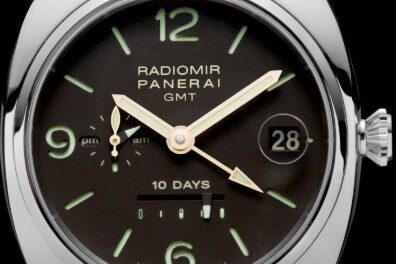
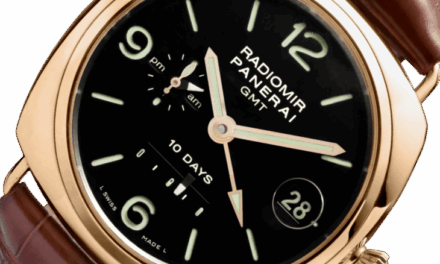
The complications are the surprise. The Radiomir Annual Calendar shows how far a watch designed for frogmen can go. Panerai’s collection also lists the Radiomir California 8 Giorni, the Officine, the Bronzo, the Tourbillon Bronzo, the Perpetual Calendar and the Minute Repeater Tourbillon.
For deeper reading on the early years, the Panerai history page lays out the same dates, and Europa Star tells the early story at length.
Which Panerai Radiomir Should You Look At?
It depends on what you want from the shape.
- For the California dial: the PAM00424.
- For precious metal: the platinum PAM00373 or the Goldtech Quaranta.
- For a calendar: the Annual Calendar.
- For the smallest case: the 40mm Quaranta.
My own lean is towards the simplest of them, a hand-wound Radiomir with a clean dial. That is a taste. The shape does the work, and every reference above gives you the same silhouette that a naval instrument maker settled on in 1935, in a different metal, size or complication.
Who Is It For?
- The collector who wants to understand where Panerai started
- Someone who prefers wire lugs and a cushion case to the Luminor’s lever
- A Paneristi tracing the sandwich dial back to its radium origins
- Readers who value documented heritage more than marketing
Not for: buyers who want a dive watch with a bezel; anyone who needs a crown guard.
Conclusion
The Panerai Radiomir began in 1935 as a naval instrument on a Rolex base and became the template for everything the brand does. The wire lugs, the cushion case and the sandwich dial are all still there.
Is it worth knowing? Yes, because every Panerai is a variation on it. If you want the shape in its purest form, a hand-wound Radiomir is the place to start, and the story behind it is the reason it looks the way it does.
Which Radiomir would you pick: a California dial, a platinum case or a modern Otto Giorni? Tell me in the comments.
Extended Summary
- The Radiomir began in 1935 as Ref. 2533, a 47mm steel cushion case on a Rolex base with welded wire lugs.
- The name comes from the radium paste Panerai patented in 1916, and the sandwich dial carries it in a layer behind the cut-out numerals.
- Ref. 3646 settled the formula in the 1940s, and the California dial arrived on it in 1944 from a Rolex patent of 1941.
- The modern Radiomir returned with the 60-piece platinum PAM00021 after Richemont’s 1997 acquisition. The 1993 launch had no Radiomir.
- Today’s range includes the Otto Giorni, the 40mm Goldtech Quaranta and the Annual Calendar.
The Radiomir Time Line
| Year | Milestone |
|---|---|
| 1860 | Giovanni Panerai opens his shop at Ponte alle Grazie in Florence |
| 1916 | Radiomir radium paste appears in an addendum to a French patent (23 March) |
| 1935 | Navy commissions prototypes; Ref. 2533 on a Rolex-Geneva base |
| 1938 | Radiomir watches enter service in the Royal Italian Navy |
| 1940s | Ref. 3646: 47mm steel cushion case, sandwich dial, Cortebert 618 |
| 1944 | California dial (Rolex patent of 1941) appears on the 3646 |
| 1993 | First civilian collection: Luminor, Luminor Marina, Mare Nostrum (no Radiomir) |
| 1997 | Richemont acquires Panerai (18 March) |
| Late 1990s | PAM00021: 60 pieces, 47mm platinum, Rolex 618 |
| 2005 to 2011 | P.2002 (2005), P.9000 (2008), P.3000 (2011) |
| 2023 | Radiomir relaunch: Otto Giorni, Quaranta, Complicazioni |




Trackbacks/Pingbacks